
-Morgan McSweeney, PhD (@dr.noc)
A machine recently measured the visceral fat wrapped around my internal organs and then, unprompted, congratulated me on it. The report said, in a little blue box: “You’re doing great!”
I have mixed feelings about being consoled by a body scanner, but these days I take encouragement where I can get it.
Here is what that supportive little software was so pleased about, and which is also the reason I’m writing this letter. Between two scans on the same machine, seven months apart, my weight went from 193 pounds to 188. Only about three of those were fat, and my muscle held about the same.
Now, if you were to look only at the total numbers there, you might say that nothing much happened.
And I would agree.
But what those total numbers don’t tell you is that my levels of visceral fat, the deep stuff packed around my liver and intestines and organs, the type of fat that actually predicts disease risk, fell by roughly 70%, from 0.52 pounds to 0.15 (from 15.3 cubic inches of visceral fat down to 4.3).
A reduction in visceral fat is indeed something to celebrate.
And part of the cool thing here is that you do not have to remake your body to move it considerably. In a rare, helpful quirk of biology, the harmful visceral fat comes off first, and it comes off in response to a short list of changes.
As a matter of principle, I must complicate my own n=1 example. DEXA estimates visceral fat with an algorithm that is shaky at low mass, so I trust a conclusion of “most of it came off, and fast” more than the exact “70% reduction”. I was already fairly lean, and I changed several things at once, so I can’t provide a single cause. But despite those caveats, I care a lot about the directional change in my visceral fat. I will show you why I think you should care about your visceral fat, too, and what to do about it.
There are two broad kinds of belly fat. Subcutaneous fat is the soft layer just under the skin. Visceral fat sits deeper, wrapped around your organs. But the way it wraps around your organs is less of a “comfy hug” and more of a “metabolic python strangle.”
You see these two types of fat do NOT behave the same way. Subcutaneous fat is close to inert storage. Visceral fat is metabolically active tissue that leaks free fatty acids and pumps out chronic inflammatory signals, keeping the liver and whole body under an element of low-grade, chronic inflammatory strain. That is a part of why it tracks so tightly with insulin resistance, type 2 diabetes, and heart disease.
Is the systemic inflammation the fire, or just the smoke? Those inflammatory responses may be doing real damage on their own, or they may just be a readout of the deeper problem, with a direct interaction between the visceral fat and the organs driving the disease risk. I suspect the answer is that it’s some of both, with more emphasis on the latter. However, the exact answer doesn’t change the plan, because either way the fix is to get the visceral fat down, not to fret about the inflammatory markers themselves.
Subcutaneous fat (under your skin, which you can pinch), is much less related to your risk for chronic disease due to distinctions in metabolic profile, and that difference is exactly makes visceral fat easier to lose.
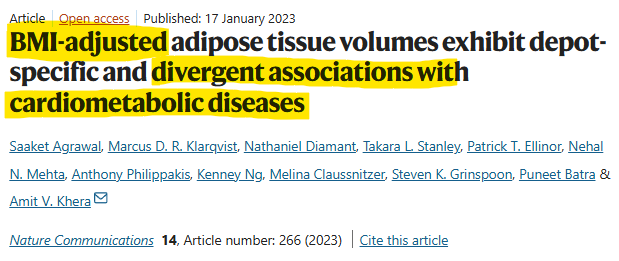
UK Biobank imaged fat depots by MRI in about 40,000 people and followed who got sick thereafter. Per one standard deviation more visceral fat, adjusted for BMI, the risk of new type 2 diabetes rose about 45% and coronary artery disease about 17%. The subcutaneous fat under the skin carried no added risk for either!
This distinction is central to this whole letter, so please pause to consider the implication of that pair of findings.
The visceral fat, specifically, is what I want you to focus your attention on.
Note that those percentage changes in risk are relative bumps on a low base, diabetes and heart disease each affected about 5% of this cohort, so a 45% bump from that ~5% starting point of absolute risk means a few extra cases per hundred. Still a meaningful difference in absolute risk.
Separate evidence has shown that waist size (a proxy for visceral fat) predicts death independently of BMI. In EPIC, a study of 359,000 Europeans, those with the largest waists had about double the mortality of the smallest after adjusting for BMI.
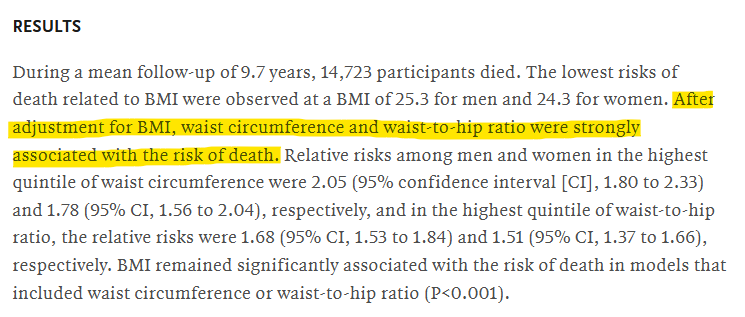
A pooled analysis of 650,000 adults found the same conclusion at every BMI, including normal weight: the men with the largest waists lost an average of about three years of life after 40, women about five.
These are observational data, and waist circumference is only a stand-in for visceral fat, but all the data I have found point in one direction for the health impact of visceral fat.
Down.
This is where visceral fat gets sneaky. In that same MRI data studies from the UK Biobank, a normal-weight man in the top group for visceral fat had a higher predicted absolute risk of type 2 diabetes risk (6.6% risk) than an overweight man in the lowest group of visceral fat (2.7% risk).
In other words, the assumption about future risk for type 2 diabetes that you would (unfairly) make based on looking at those two individuals with your eyeballs would be totally and woefully incorrect. This divergence between what you see and what is going on metabolically is critical to take a moment to reflect upon.
You can not tell how much visceral fat you have around your organs by looking in the mirror. This can be doubly deceiving for people who do not have overweight/obesity. Such a person can still harbor considerable visceral fat risk.
One “see a doctor” flag before we continue. If your belly is expanding fast, or out of proportion to how you’re eating and moving, especially alongside new purple stretch marks, easy bruising, or muscle weakness, see a doctor. Central fat can occasionally be the opening salvo from a thyroid, hormonal (think PCOS, recently renamed PMOS), or a medication problem that no amount of aerobic activity or berries will fix.
In the same MRI study, fat on the hips, thighs, and backside did not track with diabetes risk.
So the target in the crosshairs today is visceral fat.
Not “fat.”
Now the reason for a little molecular celebration. Our biology doesn’t usually make things easy, but this is one case where it kind of does. When people lose a modest amount of weight, they typically lose visceral fat preferentially compared to the fat under their skin. A systematic review of imaging studies found this holds across diets, drugs, and surgery.
By “preferentially” I mean proportionally, not in raw pounds. There is simply more subcutaneous fat to go around, so you’ll probably lose more of that by sheer weight, but visceral fat wins on percentage. The meta-analysis that separates the two is clear on it.
…percent decrease of visceral fat was always greater than percent decrease of subcutaneous fat, with no differences between different strategies…
If you’re in the spirit for an anecdote (who isn’t?), I saw it in my own numbers, too. Whereas my total fat mass went down only about 5%, my visceral fat went down ~70%.
How did I get the visceral fat to go first? By sleeping with a slice of potato in my socks. (kidding)
It’s nothing I (or anyone) did - it’s because visceral fat is metabolically “hot”: it’s more sensitive to hormonal fat-releasing signals. Specifically, this is due to increased function of β3-adrenoceptors, decreased function of α2-adrenoceptors and increased ability of cyclic AMP to stimulate lipolysis in the visceral fat.
What that means is that more of the visceral fat comes off first, while the stubborn (and less risky) stuff on the hips and thighs holds on.
However, that difference in metabolic sensitivity is different from targeted “spot reduction” training. In other words, the visceral fat will preferentially come off at a greater rate than total body fat if you are at a modest total energy deficit or if there is some body recomposition going on, regardless of whether doing stomach-targeted exercises like crunches.
You don’t have to do crunches for this to happen.
In a graded weight-loss trial, a 5% loss cut intra-abdominal fat by about 7%, separately cut liver fat by 40%, and improved insulin sensitivity in liver, muscle, and fat, with participants in that particular study still classified as having obesity throughout.
For scale, five percent loss is 10 pounds on a 200-pound person. I lost about half that, didn’t lose any muscle or strength performance, and still moved my visceral number down measurably.
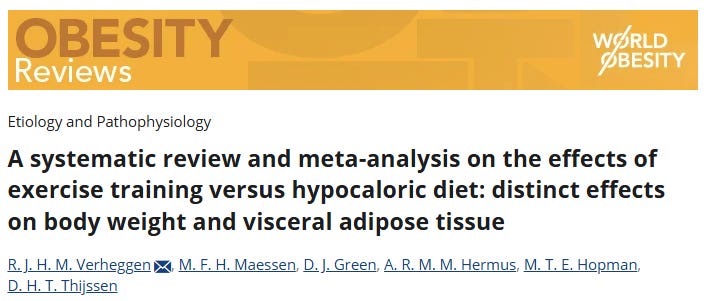
You don’t strictly need the scale to move at all. A meta-analysis of 117 studies found that even in the absence of any weight loss, adding exercise was linked to a 6.1% drop in visceral fat, versus 1.1% for dietary changes alone.
The extended practical section is for the paid subscribers who make this deep research possible. Today:
How to measure your own visceral fat for $5. The one tape-measure number that tracks your trend about as well as a $150 scan, how to take it right, and how often to check.
The playbook. The diet change that beat a standard healthy diet three to one on the same calories, the sleep piece, and the training.
Specific anti-visceral-fat nutrition options to start adding snacks, breakfast, lunch, dinner.
DEXA vs. tape measure vs. the “visceral fat” bathroom scales. How much to trust the numbers, and what to ignore.
The money pits to avoid. The belly-fat products and gadgets that do measurably nothing, with the studies.
The drugs. Where the GLP-1s actually fit.
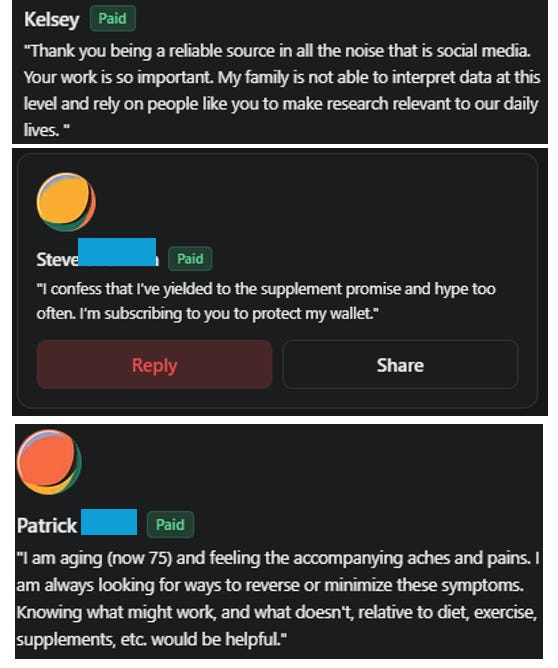
Paid membership also provides access to all prior and future deep dive articles:
And here’s why the extended section is behind a paywall instead of an ad: I take no money from supplement companies, gym-gadget sellers, etc, and this letter is fully reader supported. That means I answer to your best interests alone.
On a subject where almost everyone handing out belly-fat advice is also selling you a hopeful tub of powder or a device, I’d rather you pay me eight dollars a month (that’s the average via the annual plan) for my unfiltered read of the data.
If it’s not useful, you unsubscribe in one click.
So: what moves it, in what order, how to measure it, and what to skip. Here’s the whole playbook.
Comments
Nothing yet. Say the first thing.
Sign in to join the conversation.