
-Morgan McSweeney, PhD (@dr.noc)
If you have browsed health headlines in the last two years, you have seen this headline in one form or another:
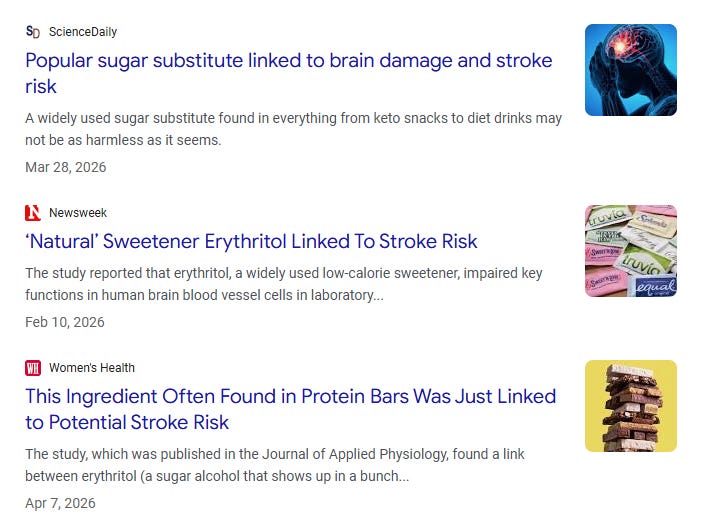
Popular sugar substitute linked to brain damage and stroke risk… ‘Natural’ Sweetener Erythritol Linked To Stroke Risk… This Ingredient Often Found in Protein Bars Was Just Linked to Potential Stroke Risk…
The ingredient in the crosshairs is erythritol, a “sugar alcohol.” It is the most common sweetener in keto ice cream, sugar-free syrups, and “zero sugar” protein bars, with its cousin xylitol close behind.
The stories are alarming and are built on published evidence. However, as usual, the headlines embody a small sliver of truth that has been run through institutional clickbait machinery to generate MaximumFear™.
Today we will take a few minutes to consider what the research actually shows. The current state of the evidence is neither “they’re obviously totally safe” nor “they’re obviously dangerous.”
Here is the big picture before we embark upon our quest for detail.
There is evidence for mechanisms of risk for sugar alcohols. But, it is nowhere near compelling proof that is pans out to actually increase risk in humans. The observational data are confounded by several interesting and important factors. As we will discuss in detail, the FDA has evaluated the research behind the scary claims, and has decided that there is not currently enough justification to act to reduce erythritol in our food supply.
What did they find in the concerning studies?
What was the FDA’s argument against taking regulatory action right now, after reviewing those concerning studies?
(Opinion) How have these data (and the FDA’s argument) changed the way I think about sugar alcohols? Also, we must discuss the substitution effect.
The study in healthy humans that increased my hesitation (for me, this differentiates sugar alcohols from the artificial sweeteners in diet sodas)
What would it take to change my mind one way or the other?
This letter has no ads, no sponsors, and no affiliate links, and is fully reader-supported. In return, my paid subscribers get the extended version of most letters. If you prefer to conduct further reading on this topic yourself first: the FDA’s memo is public. I do not provide special access to secret material. What a paid subscription buys you is my analysis and my commentary as a filter.
A paid subscription also opens the archive. A few recent reader favorites:
It works out to $8 a month on the annual plan ($96/y), which is less than $1 per research letter. If it’s not useful, unsubscribe any time in one click.
Comments
Nothing yet. Say the first thing.
Sign in to join the conversation.