
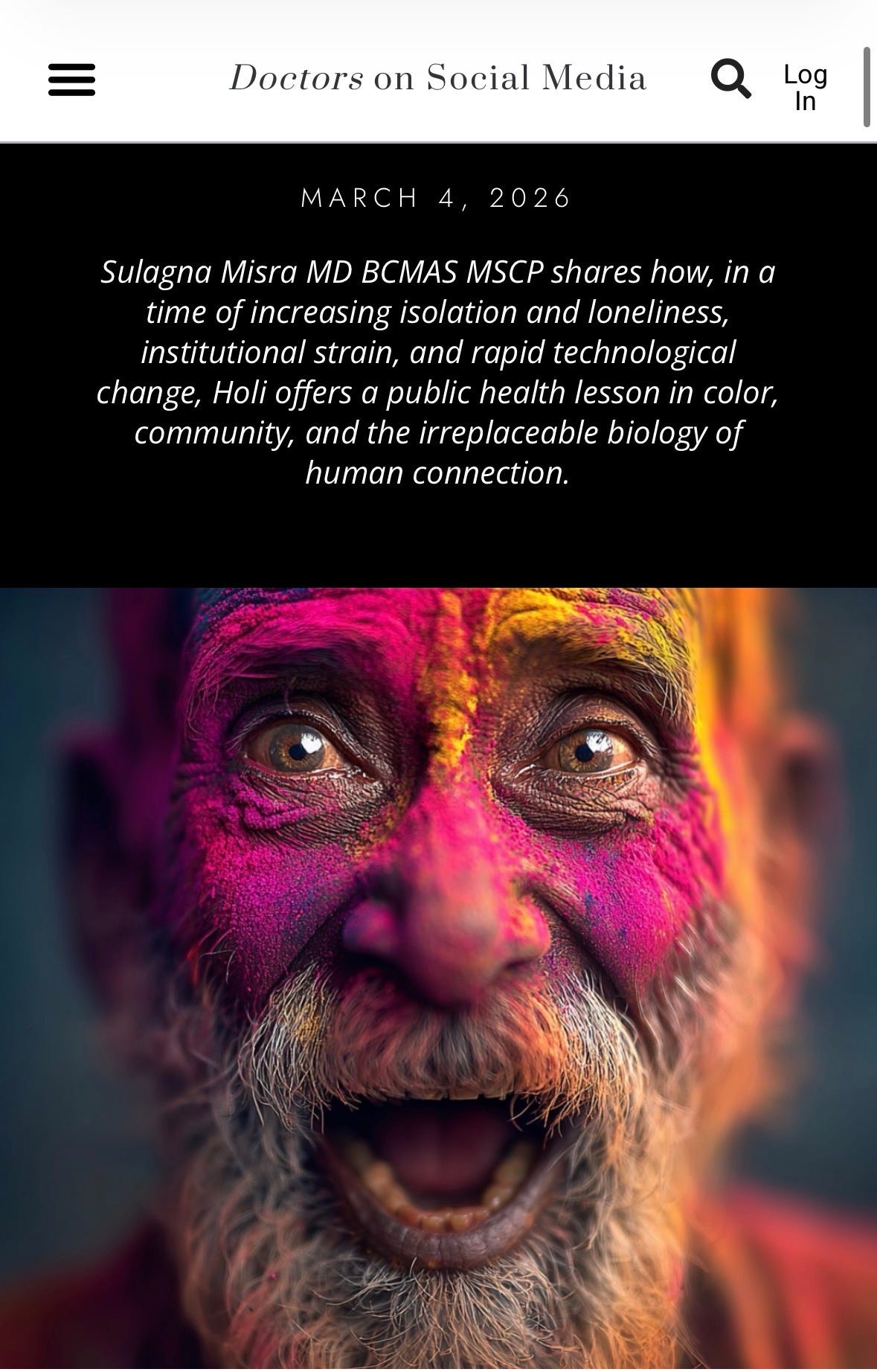
Once a year, children and adults put on white clothing and willingly ruin it. A cloud of yellow rises. Someone laughs. A thumb swipes a cheek and leaves a print. Another hand presses color onto a shoulder. By the end of the afternoon, nobody looks the way they started.
That day is Holi. The Festival of Colors.
Many people have seen the photographs. Fewer know what they are looking at. Holi falls on the full moon of the Hindu month of Phalguna, usually in March. This year, it falls on March 5, 2026. In India it is a national holiday. It is celebrated on every continent. If you have not seen it in your city yet, you might soon.
The timing is not coincidental.
For those of us in North America, Holi arrives at a particular biological moment. Winter forces and concentrates people indoors. Respiratory viruses peak in cold months and begin to decline as temperatures rise, though some pathogens stay active into early spring. Pollen seasons have lengthened significantly over recent decades, and pollen exposure has been shown to suppress the immune defenses that protect airways against respiratory viruses, even in people without allergies. The immune system follows seasonal patterns. The body in March is not the body in December. It is recalibrating, whether we are aware of it or not.
Ayurveda, a system of traditional medicine practiced across South Asia for thousands of years, has a name for this moment. In Ayurvedic medicine, the body is understood through organizing principles called doshas, which describe functional patterns rather than specific organs or molecules. Spring is considered Kapha season: heavy, damp, congested, the accumulation of winter beginning to release. An ancient Ayurvedic text describes spring as the season when that accumulation starts to loosen and disturb the body’s balance. The response it prescribes is movement, cleansing, herbal support, and gathering with others.
That prescription sounds a great deal like Holi.
The colors themselves have history. Traditional Holi pigments were plant-derived, and the choices were purposeful.
Yellow came from turmeric, arguably one of the most studied anti-inflammatory plants on earth. Its active compound, curcumin, has been the subject of thousands of research studies for its effects on inflammation and oxidative stress. Used in kitchens and clinical research alike, turmeric is not new to medicine. It is just new to the people who are now discovering it.
Green came from neem, a tree so medicinally dense that practically every part of it has been studied for antibacterial and anti-fungal properties.
Red came from hibiscus or from roots of plants used for centuries in traditional medicine for skin and circulation.
Blue came from indigo, a dye plant with a long history in Ayurvedic practice, used for far more than color.
These were not arbitrary choices. The people who built this ritual over two thousand years were working from what medicine chest they had available. Ritual and remedy were not separated as cleanly in traditional medicine as we tend to separate them today…and maybe they shouldn’t be.
One clarification, because apparently everything requires a disclaimer: contact with turmeric or curcumin during a festival is not a clinical treatment. A one-day celebration is not a controlled study. There is no evidence that Holi powder prevents viral infection or that participating on Holi directly decreases illness. However, evidence does show these plants are genuinely bioactive. That context is worth mentioning.
Nowadays, most commercial Holi powders are synthetic. Industrial dyes have largely replaced the botanical originals. Studies have found potentially harmful compounds in commercial color samples and in the eyes of people exposed to them. Skin reactions and eye irritation have been reported. If color safety concerns you, speak to your Physician. The original formulation was simple. Medicine sees this substitution pattern often, and it rarely goes in the right direction. (But again, speak directly to your Physician before participating in Holi or similar festivities.)
The colors are only part of the story.
We are living through a loneliness crisis that most people feel but few name out loud. Birth rates are falling. The loneliness epidemic is growing. People report not knowing how to make friends as adults. Screens have replaced, well, everything! In 2025, the World Health Organization released a landmark report finding that loneliness contributes to an estimated 871,000 deaths globally every year. That is roughly 100 deaths every hour, from not having enough people in your life. Not from a virus or a tumor. From disconnection.
Into that landscape enters Holi.
When you participate in Holi, someone has to come close enough to reach out to you. A handprint on your shoulder is not an accident. It is a choice another person made, in your direction. Physical closeness has measurable effects on the nervous system. Moving together, laughing together, being covered in the same colors as the person next to you, these things shift mood, strengthen bonds, and build the felt sense that you belong to something. Studies of large communal gatherings find real, sustained well-being gains in participants that persist for months. This is human biology.
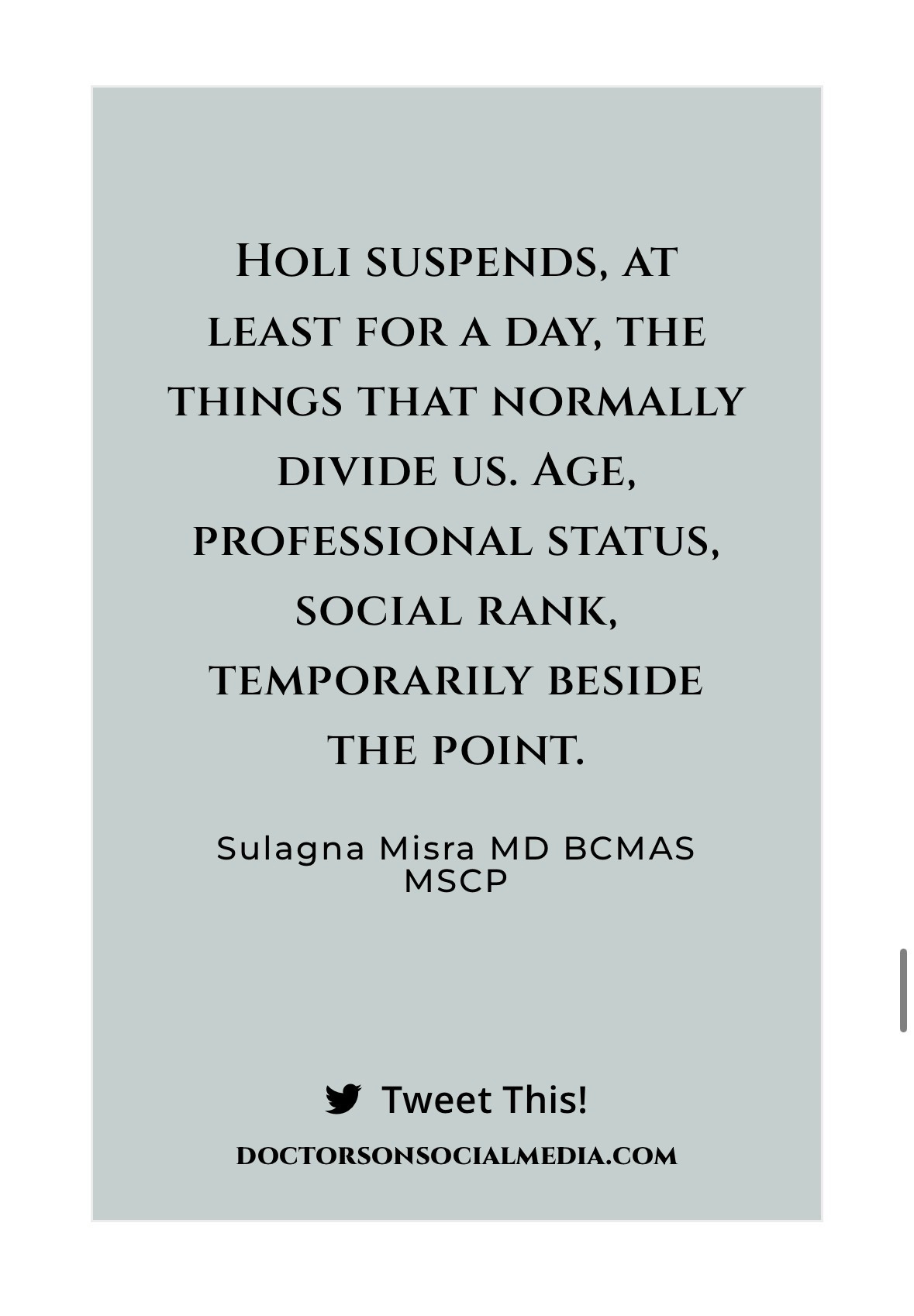
Holi also suspends, at least for a day, the things that normally divide us. Age, professional status, social rank, temporarily beside the point. The barriers that structure ordinary life go soft. Vibrant colors can indeed be an effective equalizer.
We are also living through something else. Public health infrastructure is being cut. Trust in institutions is eroding. Corruption is being documented at scales that should generate outrage and instead generates exhausted scrolling, because people who are isolated and overwhelmed are less able to think clearly, act collectively, or name what they are witnessing. The loneliness is not incidental to the moment. It is useful to the moment, for people who benefit from a distracted and disconnected public.
Into this, some have decided that artificial intelligence should fill the human gap. That a chatbot should practice therapy. That an algorithm should practice medicine. I want to be clear that the distance between human care and human need is not a problem solvable by technology. It is a community problem and apparently also a political one. It requires people. It requires proximity. It requires showing up in a field of color and letting someone reach you.
Holi has been doing that for two thousand years.
It sits at the intersection of seasonal biology, plant medicine, physical contact, and collective joy. It does not replace vaccination or clinical care. It is not a substitute for mental health treatment. It is a reminder that health has always included air, light, plants, movement, and other people. A billion humans gathering every March to cover each other in color and set down what they have been carrying are not doing something quaint.
They are doing something the research supports and the body remembers.
Phalguna is the last full moon of the Hindu year. The name itself means reddish. Endings and beginnings living in the same word. The night before Holi, people light a bonfire to burn what no longer serves. Then morning comes, the colors fly, the divisions soften, and the person standing next to you is suddenly green-handed and laughing.
Two thousand years of community medicine. It predates the clinic, HIPAA, insurance, medical records, and every technology currently being proposed as a replacement for human presence.
A smear of color washes off. What stays with you is having been there.
Happy Holi.
No posts
Comments
Nothing yet. Say the first thing.
Sign in to join the conversation.