
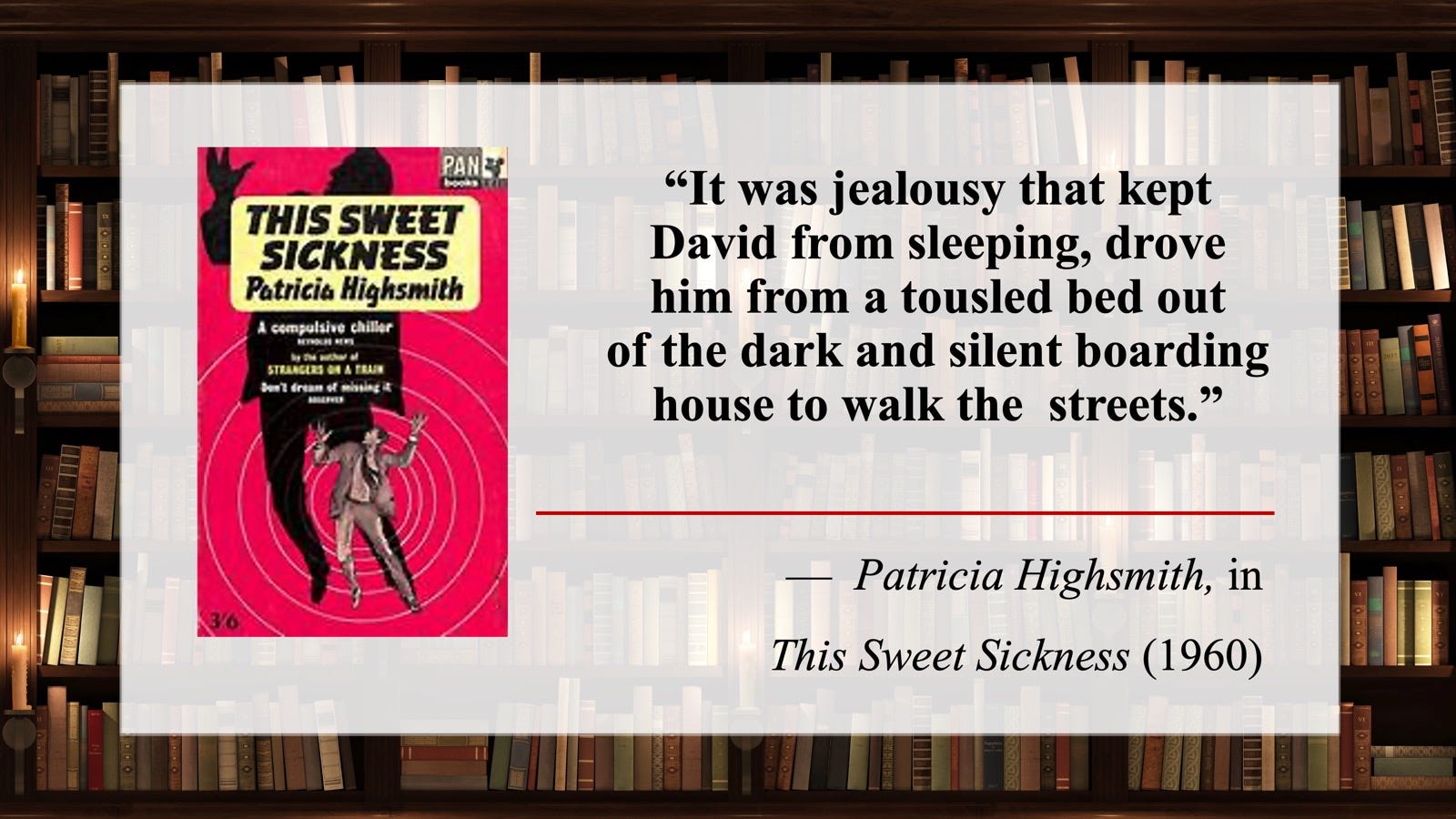
After the first sentence, we don’t know any of the specifics about David’s life, but we already feel certain that no good end can come from a jealousy of this magnitude. The narrator continued in the novel’s second paragraph:
“He had lived so long with his jealousy, however, that the usual images and words, with their direct and obvious impact on the heart, no longer came to the surface of his mind. It was now just the Situation.”
I love it when writers talk about their own opening lines, and in a 2021 New York Review of Books article (“The Hidden Bookkeeper”), Highsmith offered the following thought about how she chose to begin This Sweet Sickness:
“I meant to give a mood of emotional tension, of stubborn plotting also, of a bottling up of a force that will one day explode.“
For more than 2,000 memorable opening lines from every genre of world literature, go to www.GreatOpeningLines.com.
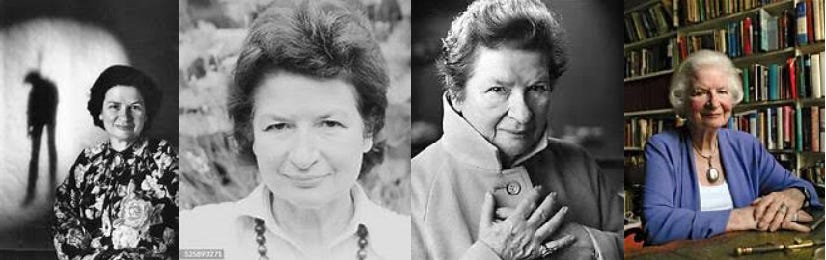
On August 3, 1920, this woman was born in Oxford, Oxfordshire, England. Raised in a family of modest means, she dropped out of school at age sixteen. In 1941, she married a physician and began planning for a future as a homemaker and stay-at-home mom. However, when her husband returned from WWII with a major mental illness, she was forced to return to work.
For many years, she worked as a National Health Service administrator while writing detective fiction during her scant free time. She was forty-two-years old when her first book, the 1962 mystery novel Cover Her Face introduced the Scotland Yard detective Adam Dalgliesh. In 1964, she began working in Britain’s Department of Criminal Affairs while continuing to write best-selling mystery novels, many of which were adapted for television and film. In 1979, she retired from the Criminal Affairs job to work full-time on her writing.
When she died at age 94 in 2014, she was a dame of the British Empire, a legendary figure in the detective fiction genre, and the author of twenty-two books, including fourteen Dalgliesh novels. In an obituary in The Guardian, she was described as “the grande dame” of crime fiction and, after the death of Agatha Christie, “The new Queen of Crime.”
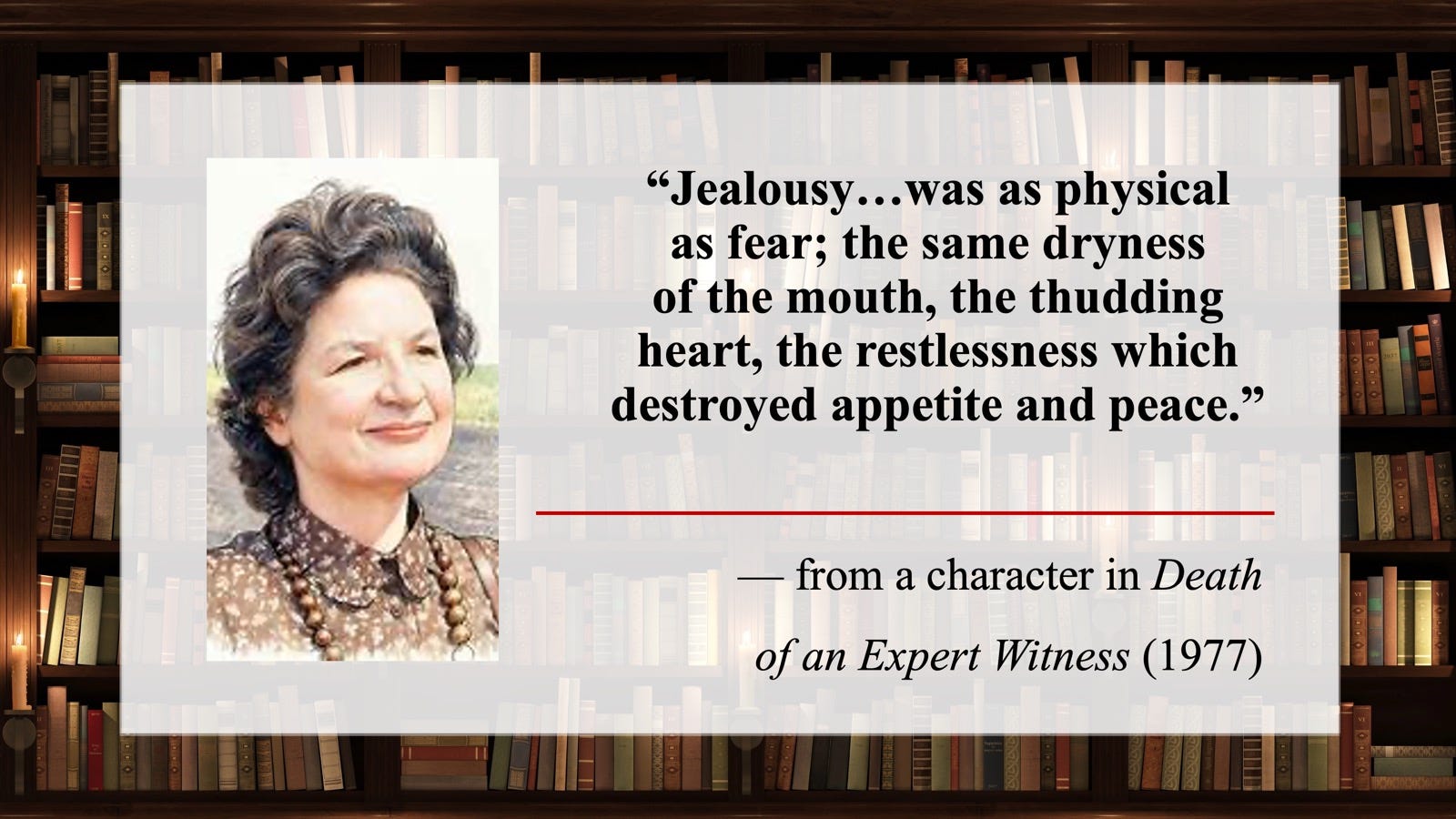
The novels of this week’s Mystery Woman are filled with quotable observations on almost every conceivable topic. For example, in her 1977 novel Death of an Expert Witness, a character offers the following thought:
Who is this woman? (Answer below)
Have you ever been jealous of someone else’s good looks or good fortune?
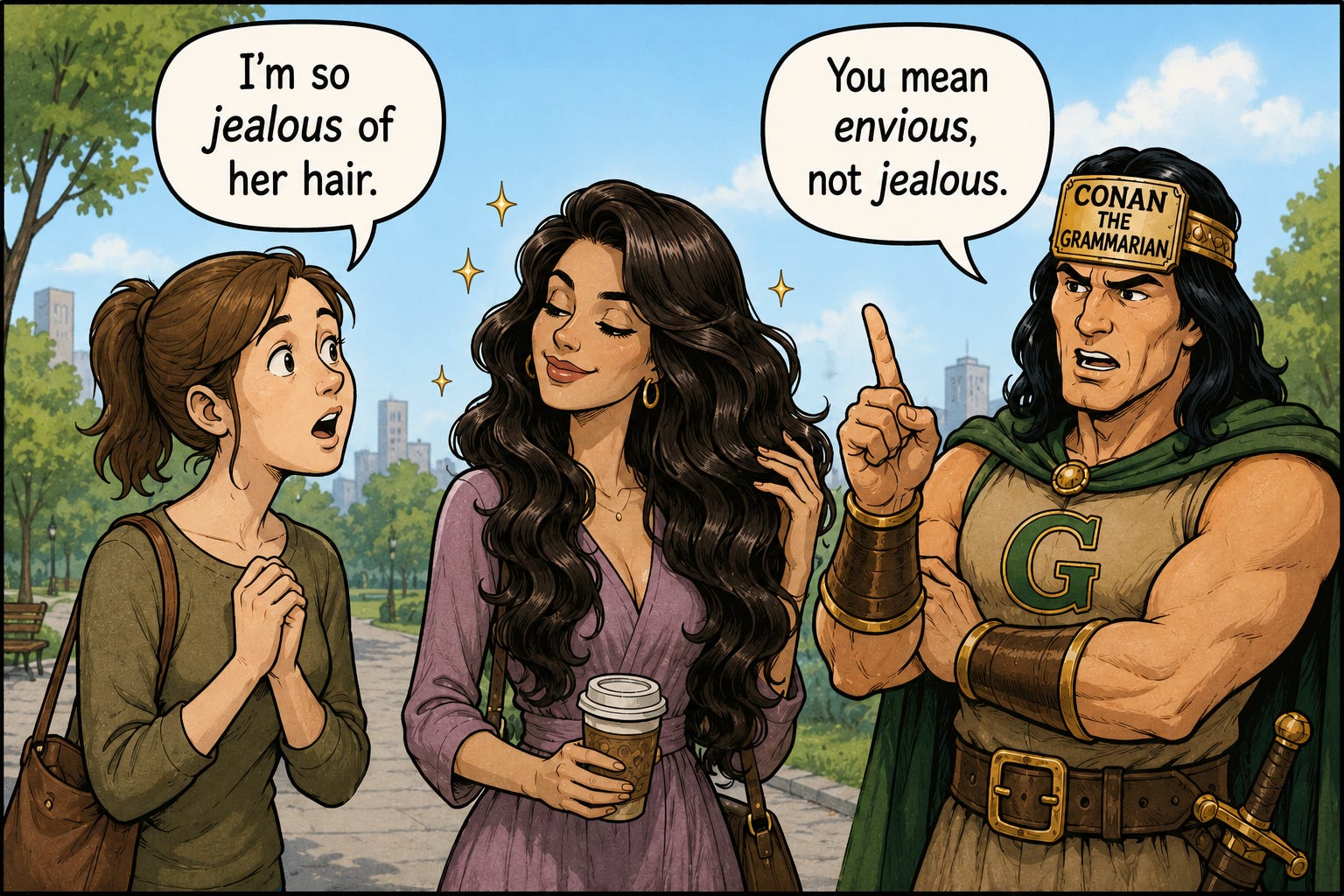
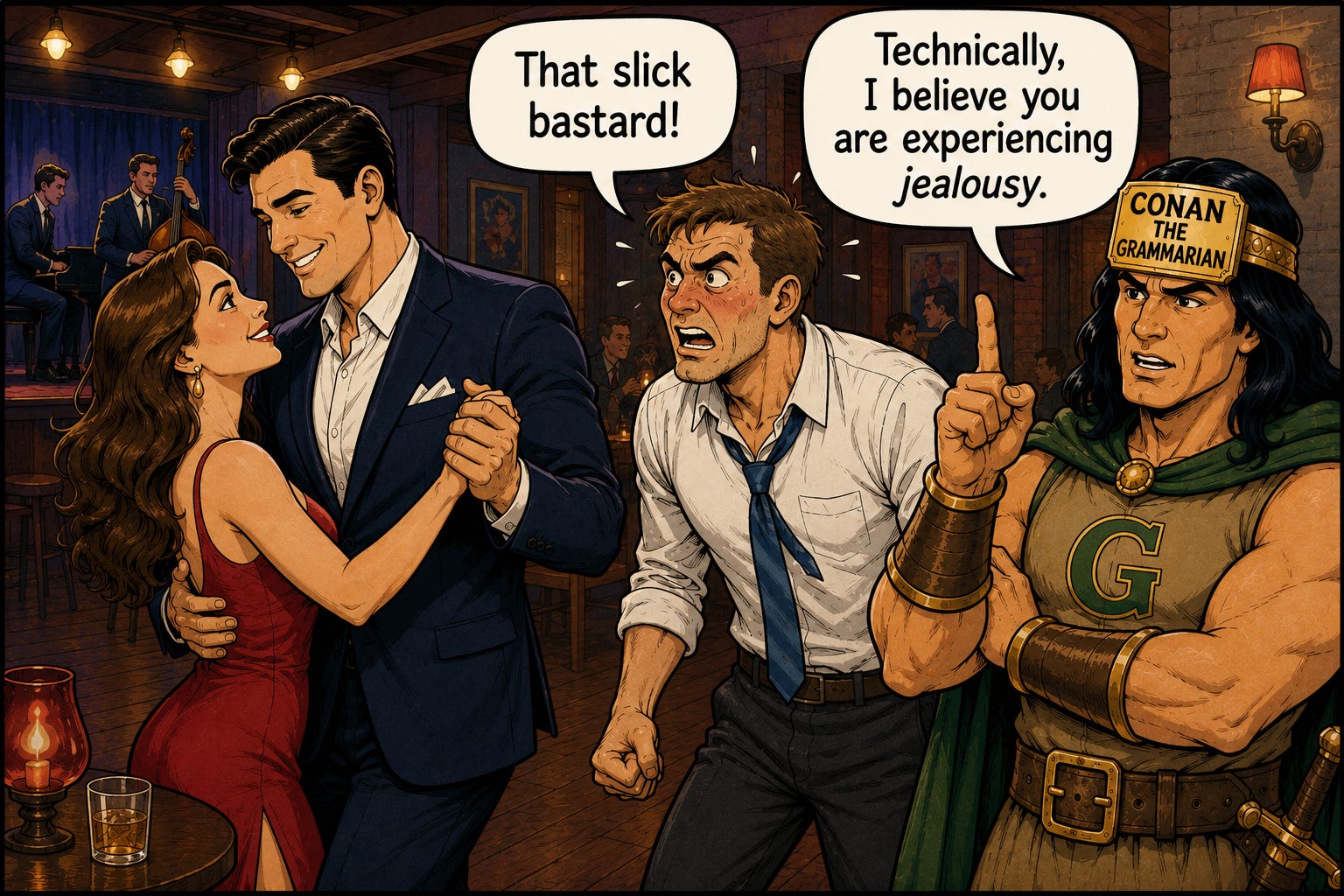
If you answered yes, then you’ve just fallen victim to a trick question. When people say they’re jealous of some quality or trait of another person, what they usually mean is that they wish they possessed it themselves. And that, my friends, is envy, not jealousy. If Conan the Grammarian had been standing nearby, he would have almost certainly stepped in to correct the error.
In precise and proper English, envy is wanting what someone else possesses, while jealousy is the fear that someone will take something of value that we possess. Those two meanings have been recognized for centuries and are still reflected in leading dictionaries, including The American Heritage Dictionary.
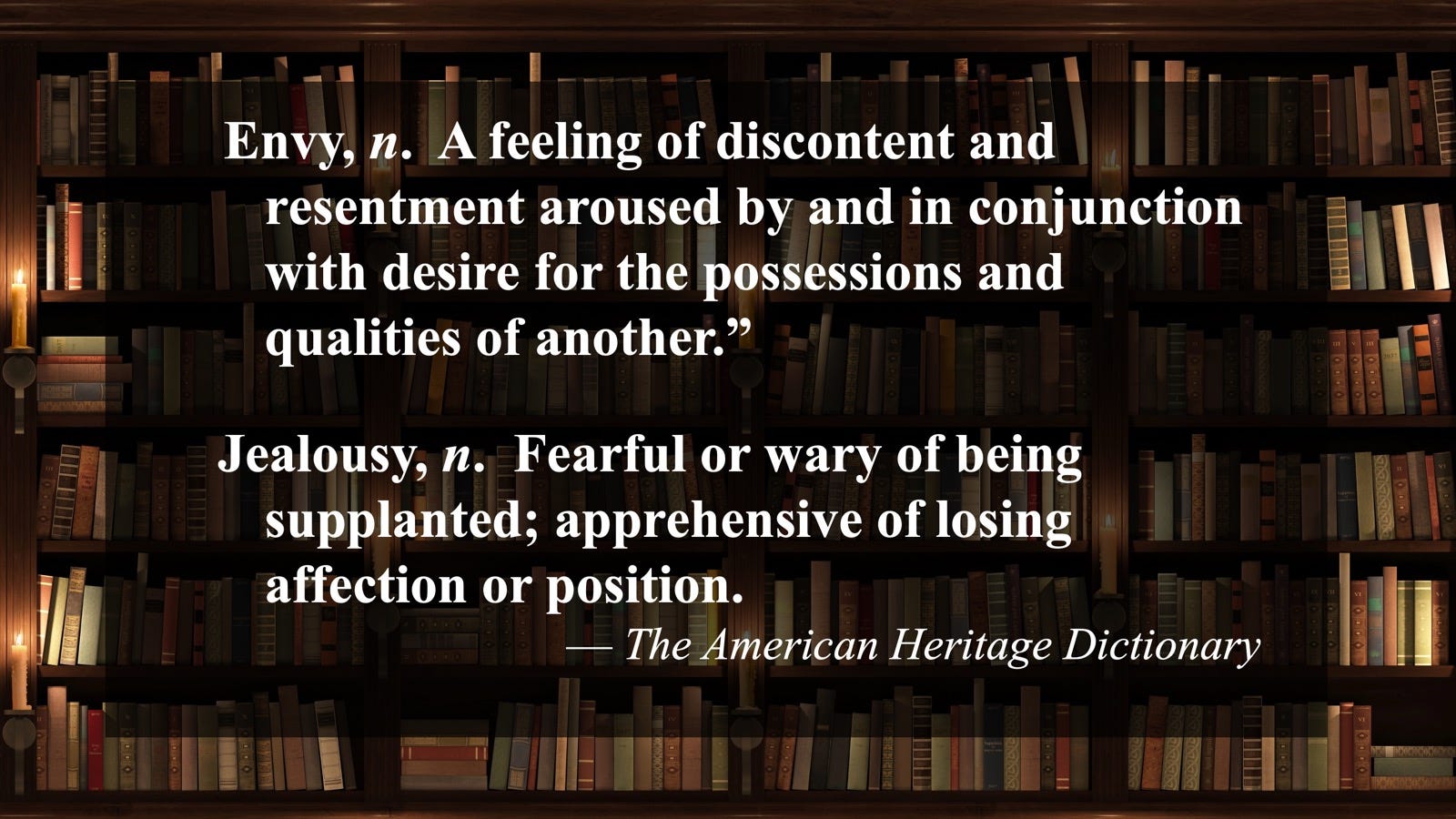
In everyday speech, however, jealous has become so commonly used to mean envious that many people no longer distinguish between the two. One reason for the confusion is that both emotions are generally present in the most common of jealousy scenarios.
Imagine a man who fears losing his wife to another man. He’s clearly experiencing the emotion of jealousy because he fears the loss of someone who’s extremely important to him. At the same time, though, he may also envy his rival’s youth, charm, or physical attractiveness.
As a result, even though envy and jealousy are two different emotions, they so commonly occur together that it’s easy to understand how speakers would gradually begin using the word jealous in situations where the word envious would be technically more correct—as in “I’m jealous of her hair.”
And that brings us to one of the oldest debates in the dictionary world: descriptivism versus prescriptivism.
Descriptivists believe the primary job of a dictionary is to describe how people actually use words. Since millions of English speakers now say “I’m jealous” when they mean “I’m envious,” they regard that usage as perfectly legitimate. Prescriptivists, on the other hand, believe that dictionaries should not merely record usage but also preserve useful distinctions between words that describe different ideas or experiences.
I find myself siding with the prescriptivists in this case.
First of all, English is fortunate to have two excellent words for these two different emotions. If we use jealousy when envy is the more accurate term, we lose the ability to distinguish between wanting what someone else has and fearing the loss of something we possess.
Second, while envy and jealousy commonly occur together, they couldn’t be more different from a psychological point of view. Envy grows out of comparison and the desire to have what we lack. It’s closely related to what the Bible calls coveting. Jealousy, by contrast, grows out of insecurity and the fear of losing something precious—a relationship, a reputation, a position, or a cherished possession.
Finally, preserving the distinction between the two words reminds us of something Confucius said 2,500 years ago: the first duty of a wise person is to call things by their proper names. His point was simple but profound: when words no longer correspond to reality, our thinking becomes muddled and our judgments suffer. Maintaining the distinction between envy and jealousy, according to this view, isn’t merely a matter of grammatical correctness, it’s part of the greater challenge to see the world clearly and describe it accurately.
Etymology
The history of the word itself offers one final insight. Jealous entered English in the thirteenth century from the Old French jalous, meaning “suspicious,” “watchful,” or “fiercely protective.” It ultimately derives from the Greek zēlos, meaning “zeal” or “ardor.”
The root sense of the word, then, is unmistakable. Jealousy is the determination to “fiercely protect” something we value from being taken from us. A jealous lover fears losing a partner. A jealous parent fears losing a child’s affection. Seen in this light, it’s easy to see that envy and jealousy are very difference experiences. Envy says, “I dearly wish I had what you have.” Jealousy says, “I’m deathly afraid I’ll lose what I already have.” One reaches outward in longing; the other clings inward in fear.
Here’s another question.
Why Is Jealousy Associated with the Color Green?
Like most educated people, I’ve long been aware of William Shakespeare’s role in linking the color green with the emotion of jealousy. In Othello (c. 1604), Iago famously warns Othello:
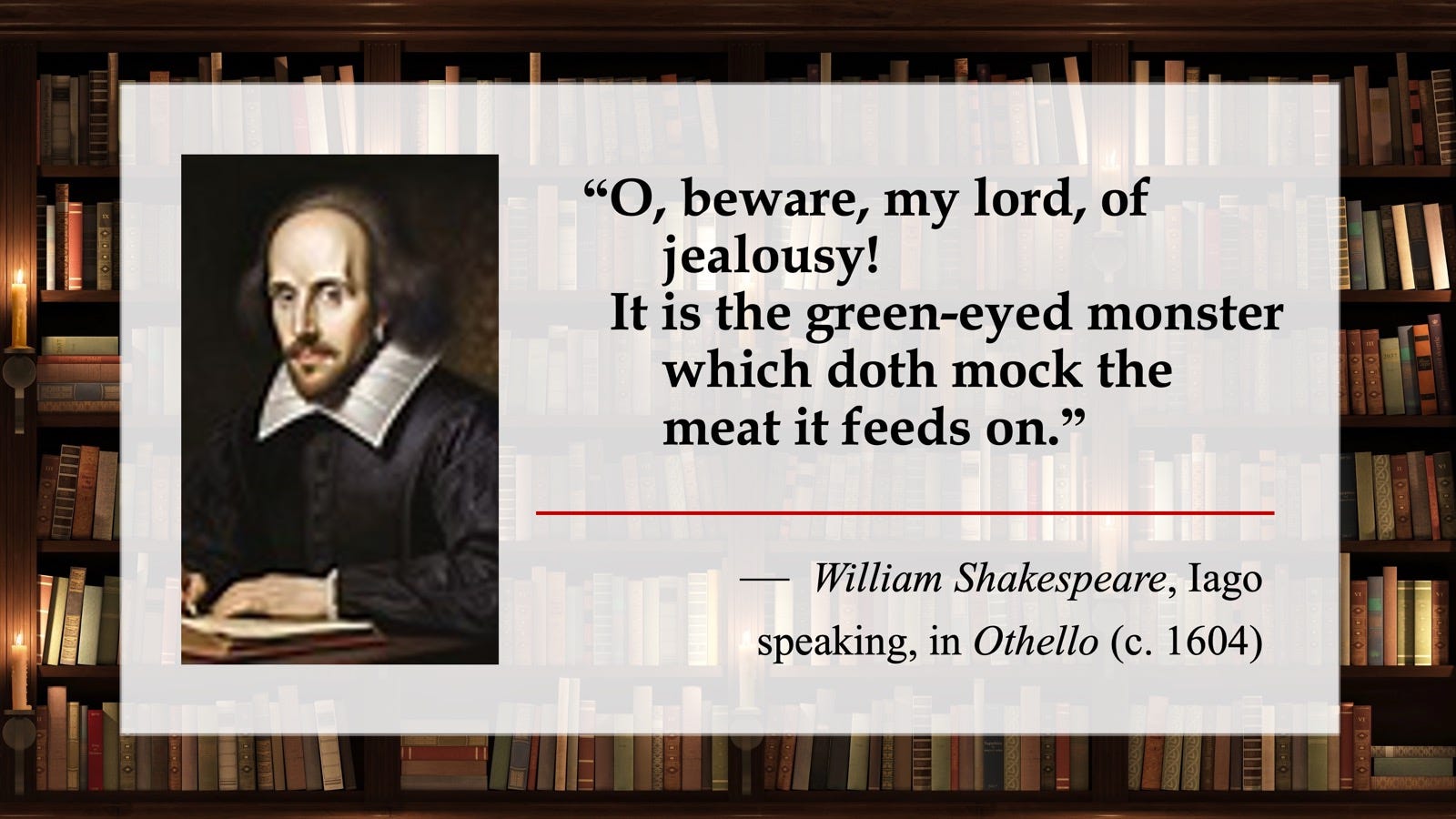
This memorable passage gave the English language one of its most enduring metaphors: the green-eyed monster. Shakespeare had actually introduced the image a few years earlier. In The Merchant of Venice (c. 1596), Portia speaks of “green-eyed jealousy,” showing that Shakespeare had long been associating the color green with the emotion. And ever since, green has remained the color most closely identified with jealousy. But why green?
The answer lies in the history of medicine. In Shakespeare’s day, and for many centuries before, physicians believed that the human body was governed by four bodily fluids, or humors. Strong emotions were thought to disturb the balance among these humors, producing visible changes in a person’s appearance. Jealousy, in particular, was associated with an excess of bile, which supposedly left the sufferer pale, sickly, or even tinged with green. The medical theory is archaic, but the image survived.
As a historical footnote, you should know that Shakespeare never associated the color green with envy, but as the distinction between envy and jealousy gradually blurred, the color green migrated as well. By the mid-1800s, the expression “green with envy” had entered the language, and today the color green serves as a visual symbol for both envy as well as jealousy.
The color green is not the only visual symbol associated with jealousy. In modern cartoons, greeting cards, television commercials, and internet memes, jealousy is also commonly represented by a green frog. Unlike Shakespeare's green-eyed monster, however, the frog has no literary or historical ancestry. It appears to have emerged simply because frogs are green. And also, I suspect, because frogs lend themselves to exaggerated facial expressions that cartoonists can use to depict a full range of human emotions—delight, disgust, and, of course, jealousy.
Shakespeare imagined jealousy as a frightening green-eyed monster, capable of consuming those who got ensnared in the emotion. Modern popular culture has replaced the monster with a frog, softening the image without changing the underlying emotion. But whether portrayed as a monster, a frog, or simply the color green, jealousy continues to represent one of humanity's oldest and most unsettling emotions.
Yet Another Difference Between Envy and Jealousy
Let me bring my remarks to a close this week with one final observation. Most people have little difficulty admitting envy. To say that you’re envious of another person’s good looks, talent, wealth, or success may be a bit embarrassing, but such admissions are generally viewed as harmless acknowledgments of admiration mixed with a bit of personal longing.
Jealousy—especially when it becomes excessive or pathological—is quite a different matter. Because it grows out of insecurity and the fear of losing something precious, it is a far less socially acceptable emotion. As a result, people experiencing jealousy rarely acknowledge it directly, and when they do, they almost never describe it accurately.
When confronted, for example, they’re more likely to insist that their feelings are simply evidence of how deeply they love someone. Or their jealousy may manifest itself indirectly—through anger or hostility toward a perceived rival, criticism that a spouse or partner is “too flirtatious,” constant suspicion or scrutiny, clinging possessiveness, repeated demands for reassurance, intrusive questioning, attempts to monitor another person’s activities, or increasingly controlling behavior.
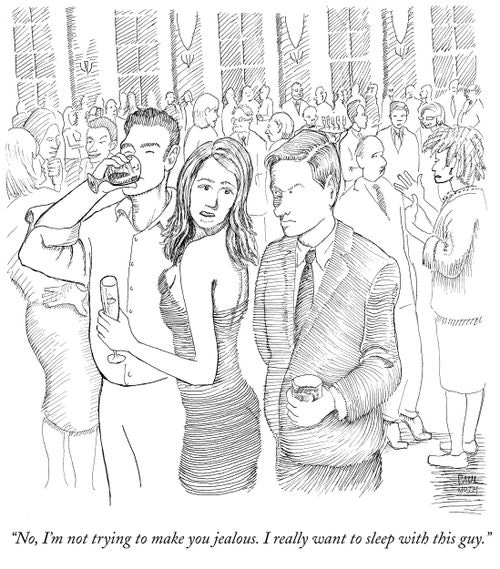
One of jealousy’s most revealing characteristics is that it often remains hidden behind these kinds of outward expressions. We seldom recognize it because people seldom openly confess, “I’m jealous.” More often, we infer it from the way they behave. The words may express anger, criticism, or mistrust, but the underlying reality is always the same: the fear of losing someone—or something—they desperately want to keep.
Imagine a man watching another fellow dancing effortlessly with his girlfriend. Rather than admitting his jealousy, the man directs his anger at his perceived rival. If Conan the Grammarian were standing nearby, we know exactly what he’d say:
Perhaps that’s one more reason why preserving the distinction between envy and jealousy is worthwhile. The two emotions do not merely describe different situations; they reveal different truths about ourselves. Envy invites us to ask, What do I wish I had? Jealousy asks the more unsettling question, What am I afraid of losing? These are profoundly different questions, and understanding which one we’re experiencing is the first step toward better understanding ourselves.
This week, take a few moments to think about how jealousy has shown up in your life. Before you do anything, though, check out this week’s selection of quotations on the subject:
Jealousy in romance is like salt in food. A little can enhance the savor, but too much can spoil the pleasure and, under certain circumstances, can be life-threatening. — Maya Angelou
Jealousy is no more than feeling alone against smiling enemies. — Elizabeth Bowen
To cure jealousy is to see it for what it is, a dissatisfaction with self. — Joan Didion
It is not love that is blind, but jealousy. — Lawrence Durrell
One of the tortures of jealousy is that it can never turn away its eyes from the thing that pains it. — George Eliot
Jealousy: that dragon which slays love under the pretense of keeping it alive. — Havelock Ellis
Jealousy is a disease, love is a healthy condition. The immature mind often mistakes one for the other, or assumes that the greater the love, the greater the jealousy—in fact, they’re almost incompatible. — Robert A. Heinlein
Jealousy is all the fun you think they had. — Erica Jong
Jealousy is the tie that binds—and binds—and binds. — Helen Rowland
To jealousy, nothing is more frightful than laughter. — Françoise Sagan
For source information on these quotations, and many others quotations on the subject of JEALOUSY, go here.
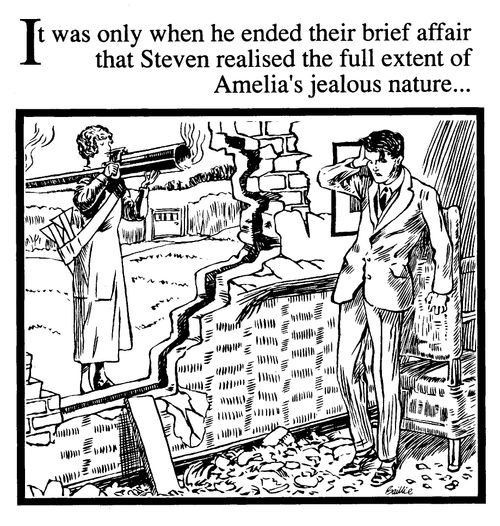
P. D. James (1920-2014)
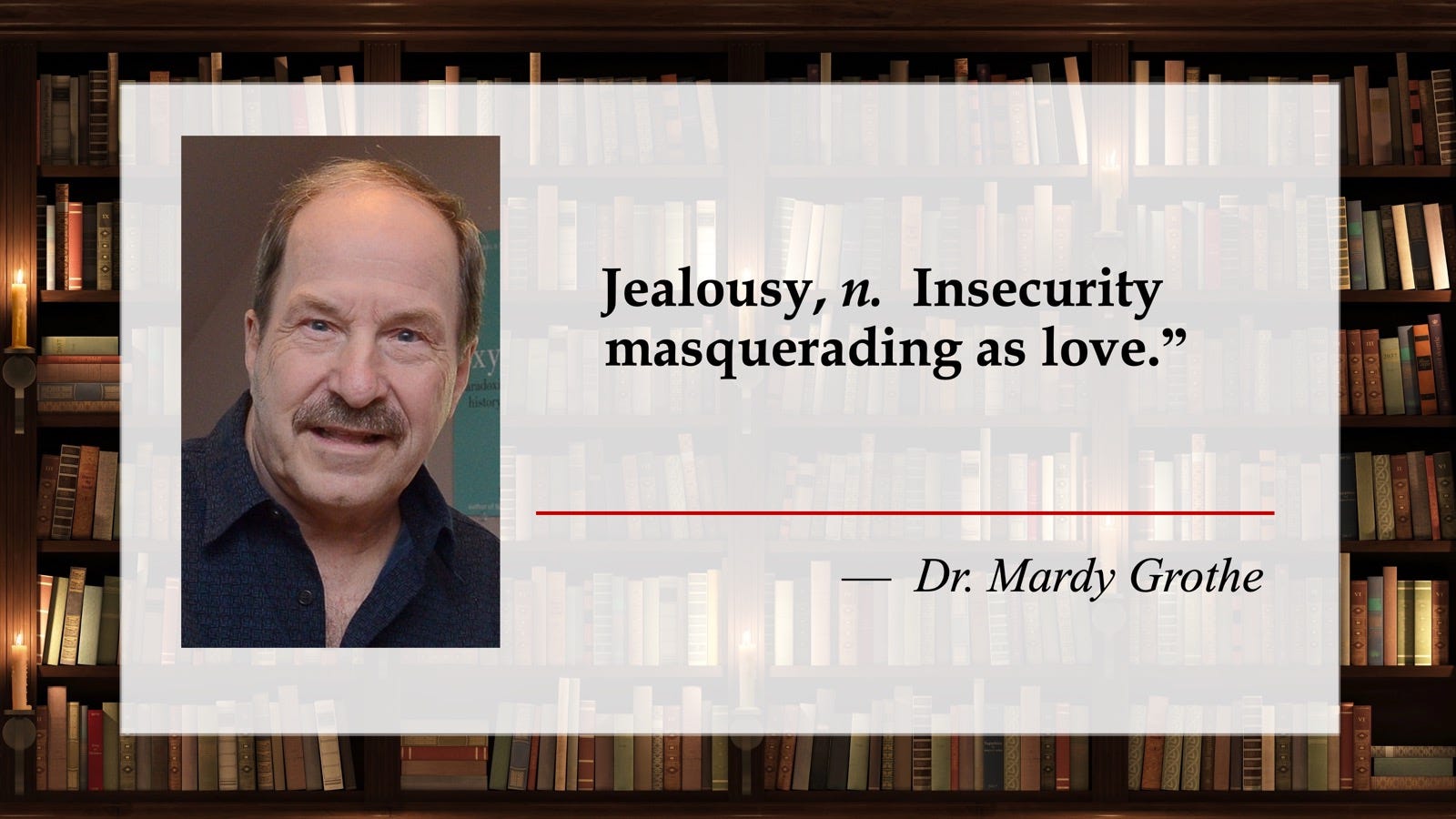
Thanks for joining me again this week. See you next Sunday morning, when the theme will be “Negativity Bias.”
Mardy
My Two Websites: www.drmardy.com and www.GreatOpeningLines.com
Regarding My Lifelong Love of Quotations: A Personal Note
No posts
Comments
Nothing yet. Say the first thing.
Sign in to join the conversation.