
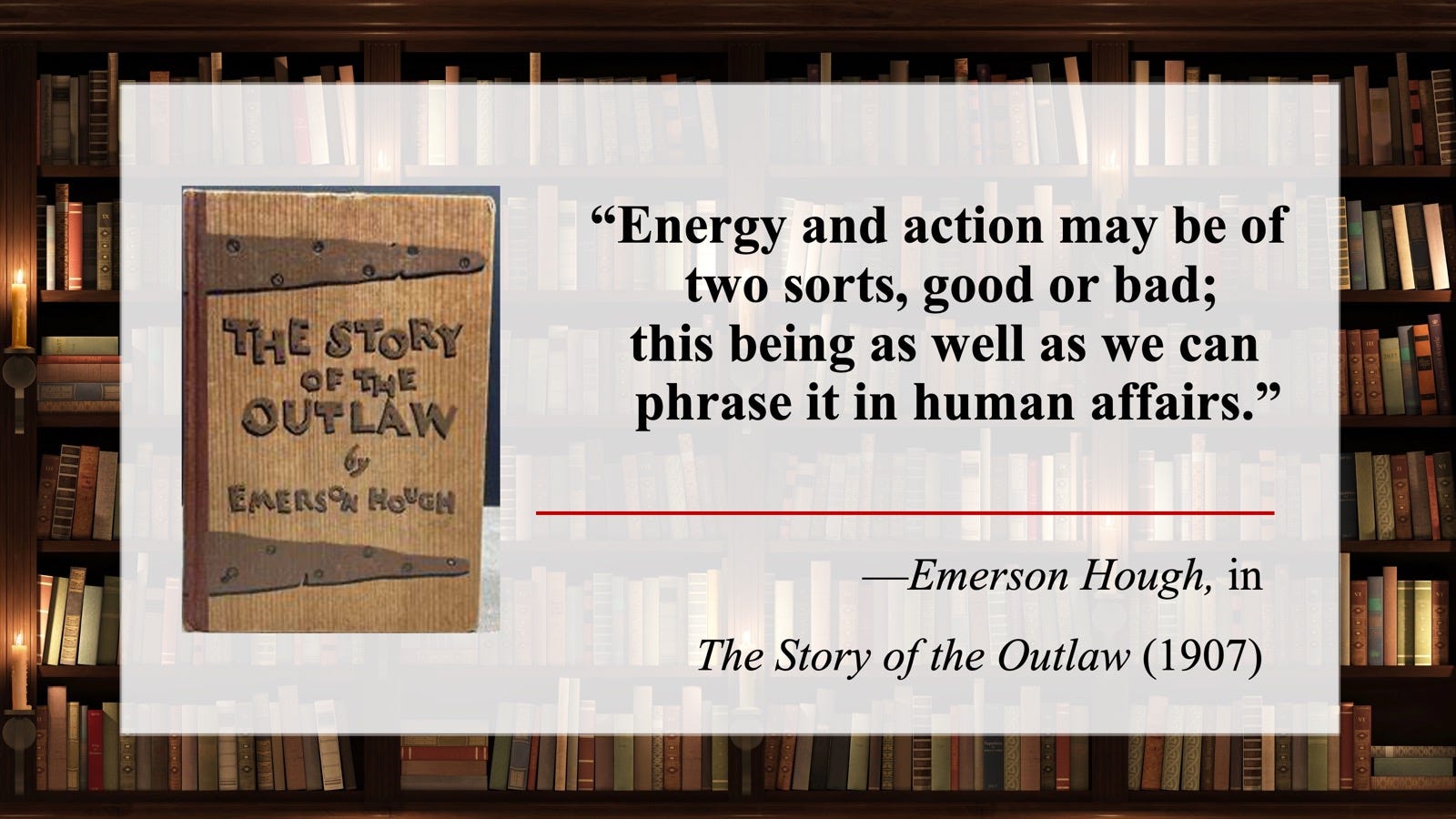
Hough begins with a deceptively simple observation that quietly introduces one of literature’s oldest themes: the energy and actions of human beings can only be effectively judged after we determine whether they’re directed toward good or bad ends.
For well over 2,000 great opening lines from every genre of world literature, go to www.GreatOpeningLines.com.

On August 25, 1949, this man was born in Oxford, England. Even though his father was a famous English writer, he showed little interest in literature—or any other school subjects—as he grew up. Indeed, he performed so poorly in elementary school that one of his early headmasters cleverly described him as “unusually unpromising.”
By age sixteen, he had read nothing but comic books his entire life when his stepmother, the writer Elizabeth Jane Howard, introduced him to the works of Jane Austen. It turned out to be a life-changing experience. Almost overnight, he got turned on to literature—and he went on to deepen that interest considerably as he attended Oxford University’s Exeter College. After graduating in 1971, he worked for several years at The Times Literary Supplement before taking a job at the New Statesman. A few years later, at age 27, he became the publication’s youngest literary editor.
After his first novel—The Rachel Papers in 1973—won the Somerset Maugham award, he went on to become one of his era’s most popular and prolific writers, with novels like Money (1984), London Fields (1989), and The Information (1995). In 2008, The Times of London hailed him as one of the 50 greatest post-WWII English writers.
A prolific short-story writer as well as a novelist, he published seven collections, including Einstein’s Monster (1987) and Heavy Water (1998). He also excelled in the non-fiction arena, with an acclaimed memoir—Experience, in 2000—and five separate collections of essays, including The Moronic Inferno (1986) and Visiting Mrs. Nabokov (1993).
Early in his career, he was a hip, brash, and irreverent figure who was dubbed “the Mick Jagger of English letters.” In a 2003 article, Washington Post editor Carol Burns wrote of him:
“His reputation as the bad boy of British writing shouldn’t overpower the fact that he’s simply a fantastic writer. His brash, intelligent novels are sharp with insight, and his wordplay makes reading [him] feel like playing: swinging high in a swing, hanging from monkey bars, just having fun.”
A life-long smoker, this week’s Mystery Man died at age 73 from esophageal cancer at his home in Florida in 2023.
In a 2006 interview in New York Magazine, he offered this thought:
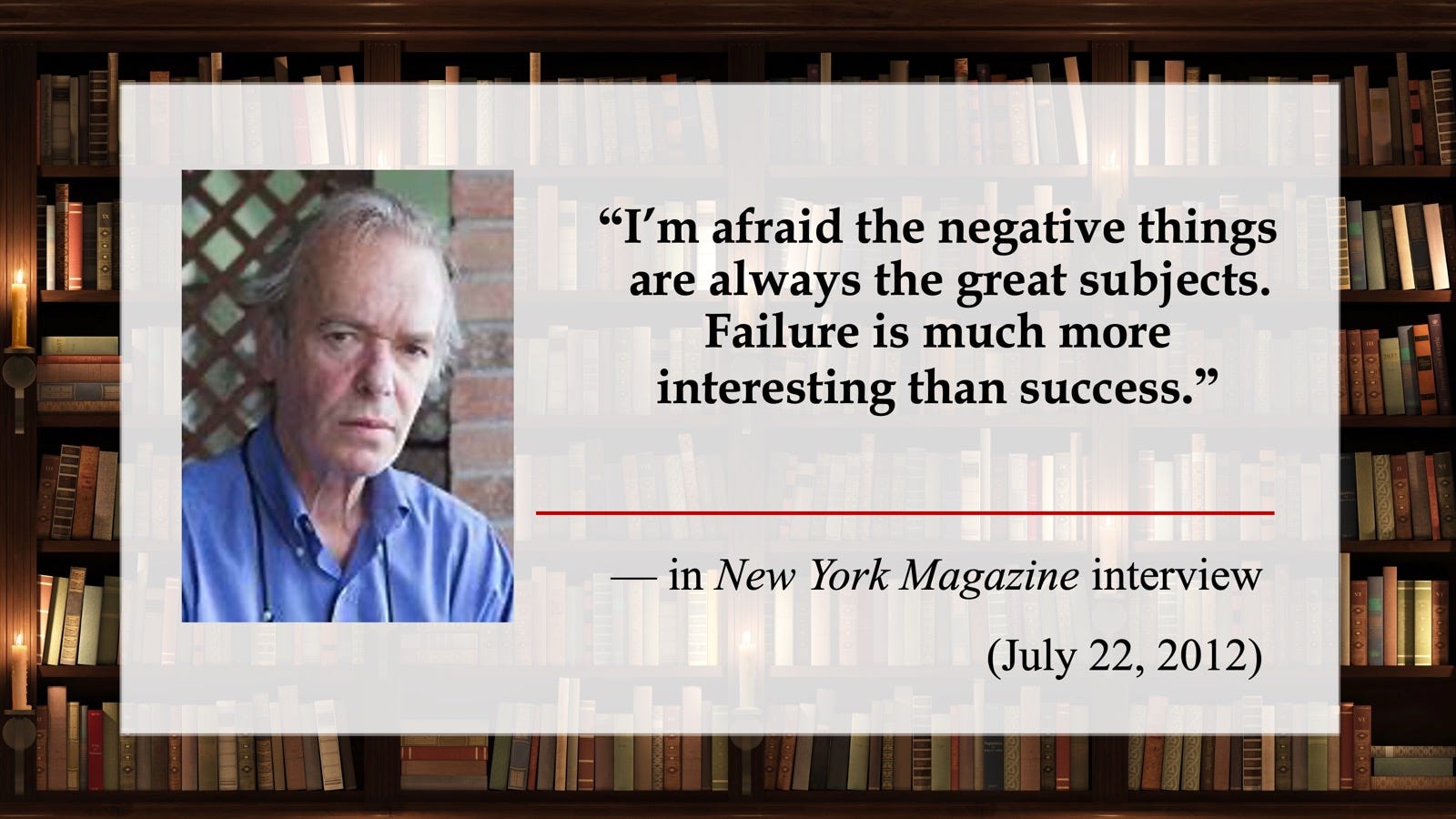
Who is this man? Who was his father? (answers below)
For many years, I’ve believed that failure teaches more than success. While success is far more satisfying, failure generally forces us to think about why we’ve missed the mark or fallen short of our goals. As a result, failure doesn’t merely open the door to corrective feedback, it helps to expose the flawed assumptions and methods that lie behind our unsuccessful efforts.
The quotation in this week’s Puzzler goes a huge step further, though. According to this week’s Mystery Man, the negative side of life is inherently more interesting than the positive side. At first, his audacious assertion had me raising my eyebrows. Then I began to think about it more deeply.
What I discovered surprised me, for I learned that there is a substantial body of evidence suggesting that our minds are naturally far more responsive to the negative things in life. The phenomenon—which is now generally known as negativity bias or the negativity effect—refers to the tendency for negative events to affect us more strongly than positive ones.
The most important publication on the subject appeared in 2001, when Case Western Reserve psychologist Roy F. Baumeister and three colleagues published a landmark review of the literature in the Review of General Psychology.
After reviewing hundreds of studies, the authors concluded that not only does failure teach more than success, but (1) harsh criticism has a greater impact than a generous amount of praise, (2) losses hurt people more than equivalent gains please them, (3) painful memories almost always outlast happy ones, (4) one major betrayal can destroy the trust that developed over a lifetime, and (5) negative impressions form more quickly and last longer than positive ones. An Abstract to the article contained this summary of their findings:
“The greater power of bad events over good ones is found in everyday events, major life events, close relationship outcomes, social network patterns, interpersonal interactions, and learning processes.”
They gave their article a wonderfully simple title:
“Bad Is Stronger Than Good.”
And that, in a nutshell, was their conclusion after a detailed review of the psychological literature. What they found was remarkably consistent: negative experiences generally exert a stronger psychological impact than equally intense positive experiences. In addition to a nifty title, the article contained a number of quotable conclusions:
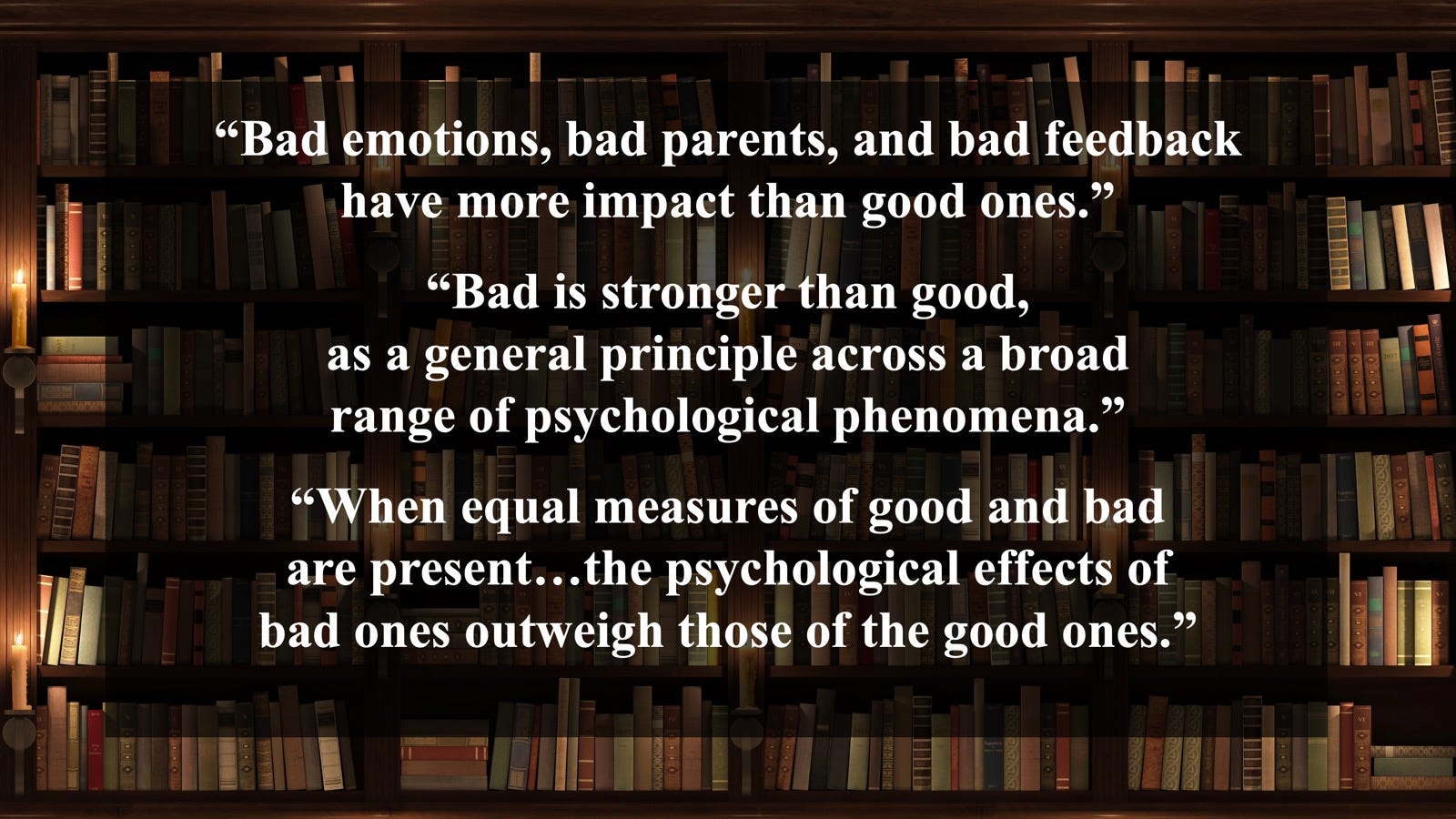
The terms negativity bias and the negativity effect were not coined by Baumeister. Psychologists had been using them for decades. Baumeister’s great contribution was to show that a wide array of separate findings from a wide variety of different investigations were all manifestations of one broad psychological principle.
One of the things I’ve always found fascinating about the field of psychology is how often its key discoveries and insights were anticipated—sometimes centuries earlier—by great philosophers, essayists, and writers.
Writing 2,000 years before the field of psychology became firmly established as a scientific discipline, the Roman historian Titus Livius—better known to the modern world simply as Livy—might have been whispering across the centuries into Baumeister’s ear when he offered this remarkable observation:
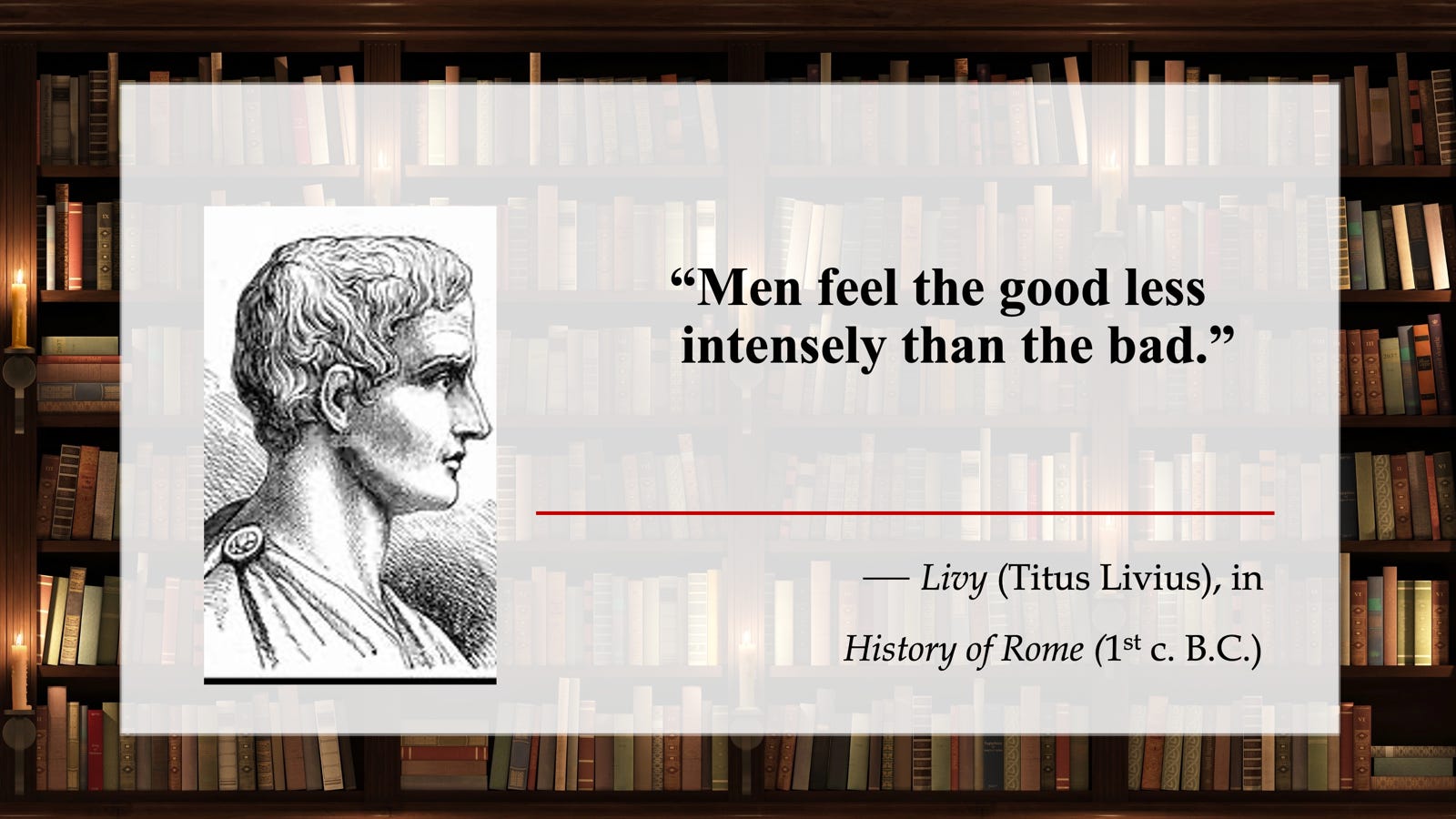
What makes Livy’s observation so striking—almost uncanny, in fact—is that he makes a claim that lies at the very heart of Baumeister's thesis: the bad registers more strongly in the human mind than the good.
Nearly 250 years before Baumeister and his colleagues published their influential review, the great Anglo-Irish statesman and philosopher Edmund Burke arrived at a similar conclusion:
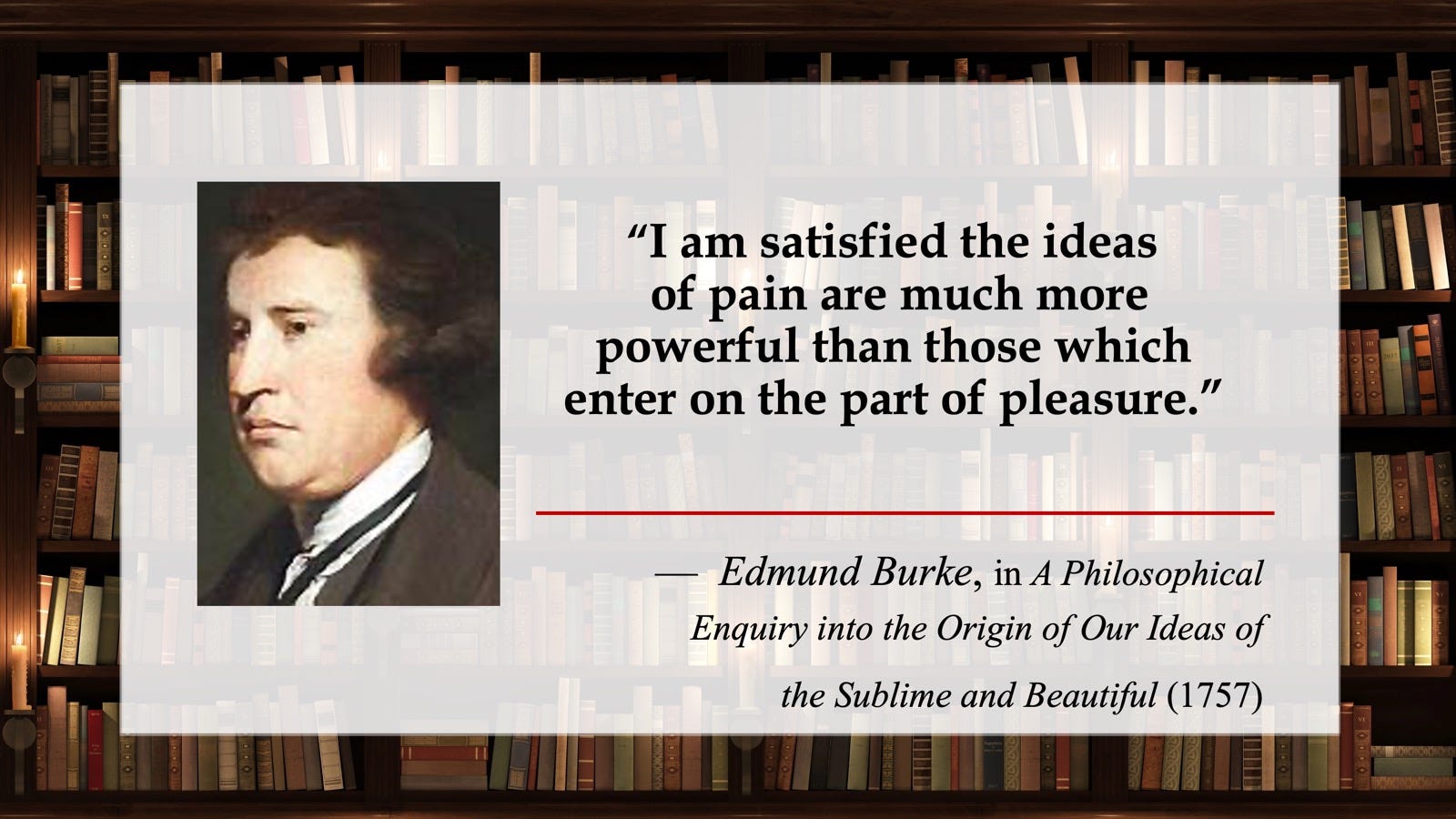
A bit later in his book, Burke expressed the idea even more succinctly:
“Pain is stronger in its operation than pleasure.”
And almost two centuries later, the great British writer and journalist Rebecca West came even closer to Baumeister’s formulation. In an essay in her 1955 nonfiction collection A Train of Powder, she wrote:
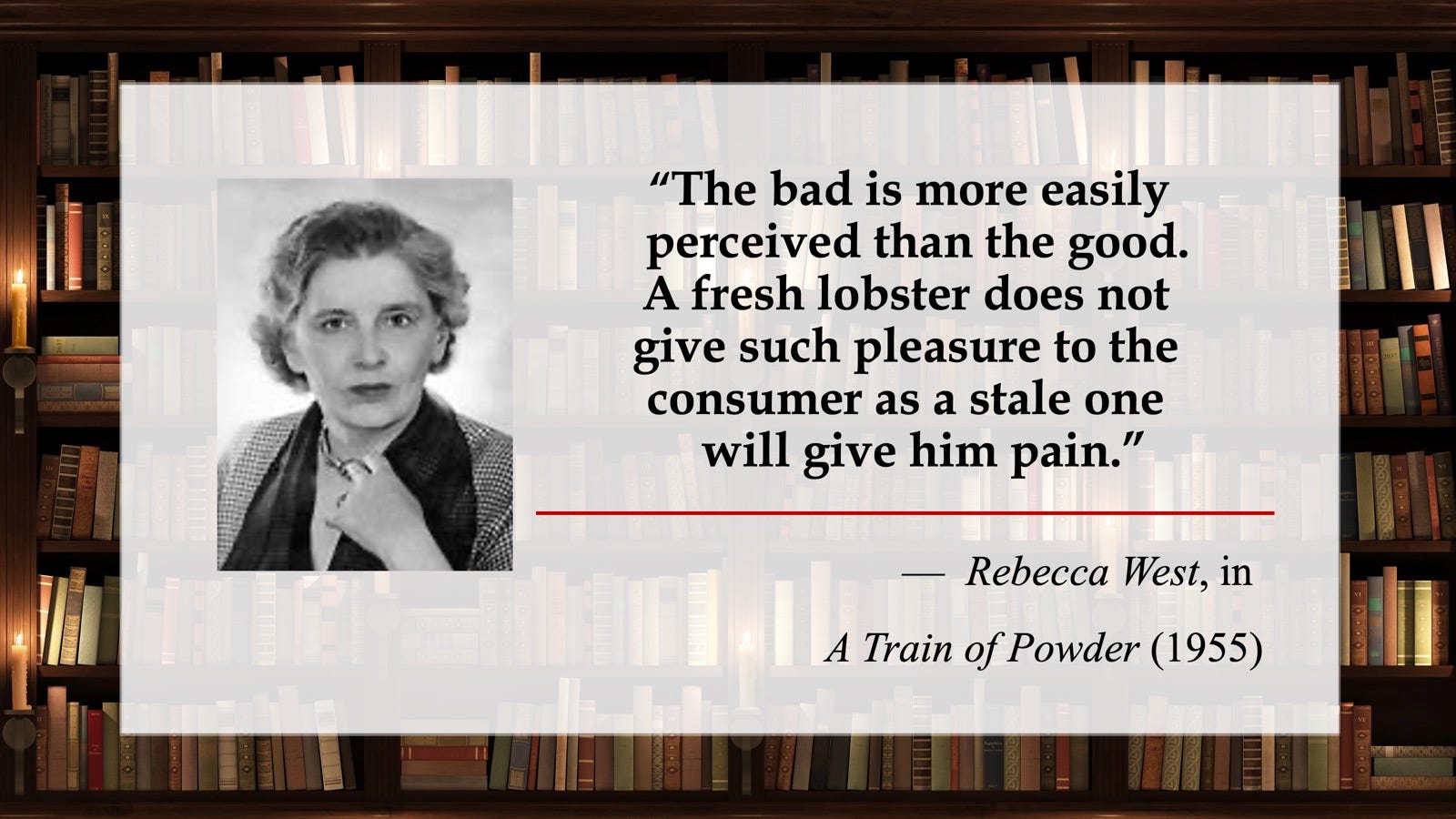
In this remarkable observation, West is suggesting that the good things in life—wonderful sunny days, sumptuously-prepared meals, deeply meaningful conversations, our physical health—can pass almost unnoticed because everything is working as we’d like them to. The bad things, however, almost immediately demand our full attention. A perfectly fresh lobster may be the source of immense pleasure, but nobody sits around a dinner table marveling that the meal hasn’t gone bad. A spoiled lobster, however, is impossible to ignore.
As I reflected on my own life, the idea that bad is stronger than good also seemed to fit like a glove. For as long as I can remember, a stinging criticism has lingered in my mind long after a glowing compliment has faded away. And when I’ve read a bunch of reviews of my books on Amazon or other internet sites, I can easily forget the many favorable ones within a nanosecond of reading one that has panned my work.
I’ve also commonly seen a perfectly wonderful day spoiled by one disagreeable encounter, while a single pleasant encounter rarely has the power to rescue an otherwise miserable day. And I’ve noticed that embarrassing mistakes I made decades ago can still pop into my mind with astonishing clarity, while equally memorable successes have quietly faded into the background
In the world of journalism, the aphorism “If it bleeds, it leads” has long reflected the fact that stories about murder, violence, disaster, and tragedy are far more likely to capture the attention of readers than stories in which everything turns out well. This fascinating phenomenon has even showed up in the field of psychology. One study cited by Baumeister and his colleagues examined more than 17,000 psychology articles and found that negative subjects outnumbered positive ones by 69 percent to 31 percent. Apparently, what journalists have long believed is also true for members of my profession.
By now, I think it’s fair to say that bad is stronger than good has become a psychological axiom. But establishing that something is true is only half the story. The more intriguing question is why is it true?
Why is The Bad Stronger than the Good?
Baumeister and his colleagues believe that the answer lies deep in our evolutionary past. For most of human history, they argued, the failure to notice something good was relatively inconsequential, like missing out on an opportunity. By contrast, the failure to notice something bad could be potentially life-threatening. They expressed the thought memorably:
“Survival requires urgent attention to possible bad outcomes but is less urgent with regard to good outcomes.”
To play this out, simply imagine two of our prehistoric ancestors walking through the woods. To the same stimulus—a rustling in the bushes—one is preoccupied with his delicious meal of ripe blueberries. The other, however, immediately wonders, What was that? If the rustling turns out to be a hungry predator, we know which of the two is more likely to survive.
Baumeister and his colleagues were clearly influenced by Charles Darwin, who had planted the seeds of the idea more than a century earlier. In The Expression of the Emotions in Man and Animals (1872), he described the powerful role that fear and vigilance play in survival. And in an 1876 autobiographical piece, he wrote:
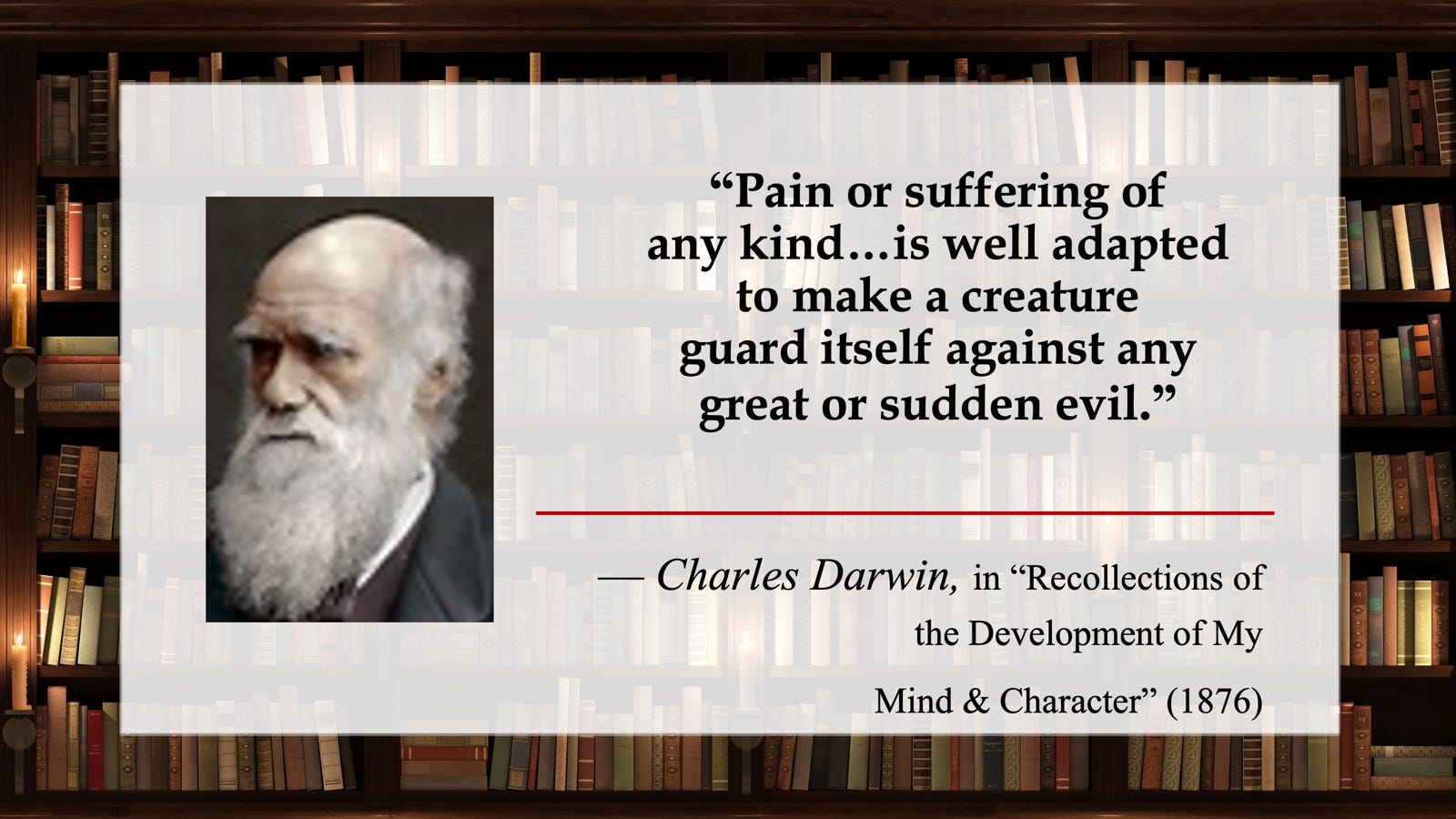
Darwin was not arguing that life contains more bad than good, but he clearly recognized that negative experiences—including pain, hunger, thirst, and fear—contain a special urgency because they warned of threats to survival.
Seen in this light, the phenomenon we now know as negativity bias looks less like an unfortunate flaw in the human mind and more like an ancient survival mechanism. After millions of years of evolution, most of the dangerous predators have disappeared, but the ancient alarm system that once focused our attention on something rustling in the bushes may now latch onto a stinging rebuke, a negative review, or a single criticism buried in a dozen compliments. The threats may have changed, but the ancient bias remains hard-wired in our brains.
To be clear, Baumeister and his colleagues were not saying that bad inevitably triumphs over good. Quite the contrary. On a number of occasions, they explicitly observed that good can prevail—but only when it overwhelms the bad. In The Power of Bad, a 2019 book addressed to a popular audience, Baumeister and his colleague John Tierney expressed it this way:
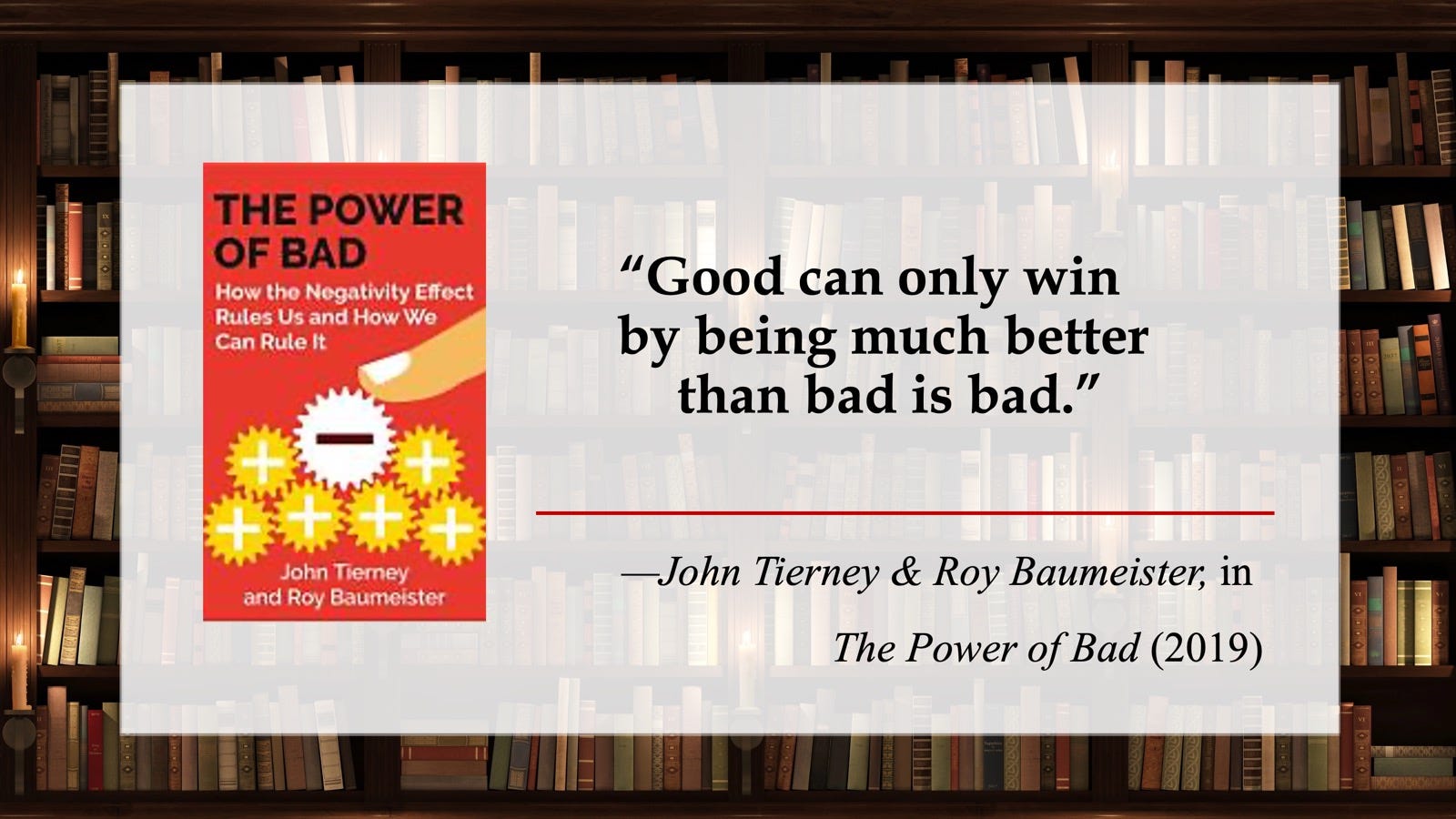
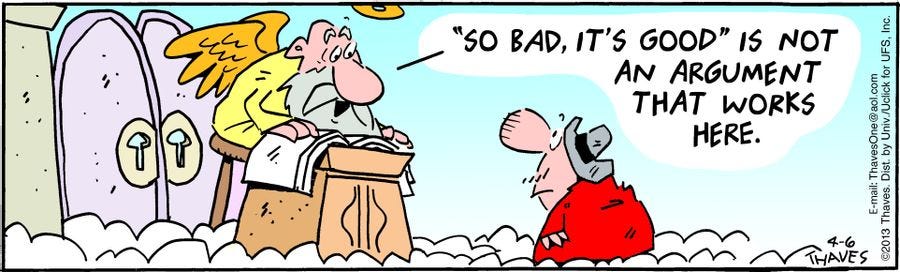
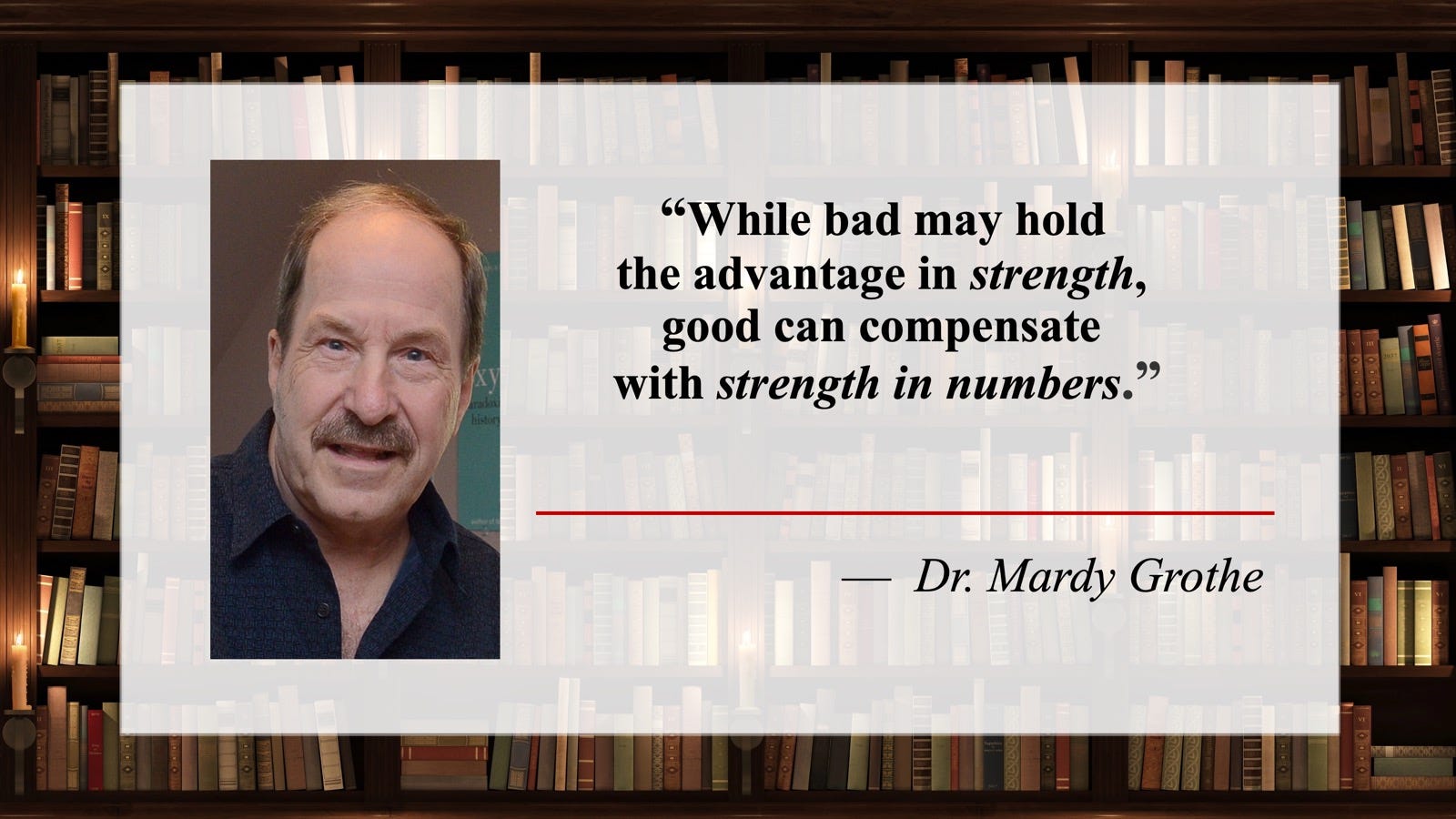
I regard this as a heartening exception to the basic rule that a bad experience is stronger than a comparable good one. A single good experience may not neutralize a bad one—but it can prevail through sheer numbers. For example. a single criticism may outweigh one compliment, but twenty compliments can eventually win the day. Similarly, one unpleasant encounter with a neighbor can sour a developing relationship, but months of positive interactions may gradually repair the impression. And, finally, one quarrel may carry more psychological weight than one affectionate exchange, but hundreds of small acts of loving-kindness can sustain a relationship over time. If bad has the advantage in psychological potency, good can counter with abundance.
And that brings us back to this week’s Mystery Man.
When he says that “the negative things are always the great subjects” and that “failure is much more interesting than success,” he may sound like a pessimist dwelling on the darker side of life. But viewed through the lens of negativity bias, his observation looks remarkably perceptive.
The bad things in life demand our attention in a way that the good things do not. A positive experience may leave us pleased and satisfied, but a failure sets the mind to work: What went wrong? Why did it happen? What did I miss? What can I do differently next time?
This week, take a few moments to think about how this week’s theme has shown up in your life. As usual, I’ve assembled a number of quotations to help stimulate your thinking:
Pain was not given thee merely to be miserable under; learn from it, turn it to account. — Thomas Carlyle
There is only one thing that arouses animals more than pleasure, and that is pain. — Umberto Eco
Your brain preferentially scans for, registers, stores, recalls, and reacts to unpleasant experiences; it's like Velcro for negative experiences and Teflon for positive ones. — Rick Hanson
The power of good is shown not by triumphantly conquering evil, but by continuing to resist evil while facing certain defeat. — Edith Hamilton
Happiness was but the occasional episode in a general drama of pain. — Thomas Hardy
Losses loom larger than gains. — Daniel Kahneman
Badness has such energy/it can drive the goodness from your soul/and leave you bad, even if you’ve practiced/goodness, and have been walking down the road/to grace all your life. — Deborah Keenan
Pain insists upon being attended to. God whispers to us in our pleasures, speaks in our conscience, but shouts in our pains. — C. S. Lewis
The wise man aims at no pleasure, but merely at freedom from pain. — Arthur Schopenhauer
All happy families are alike; each unhappy family is unhappy in its own way. — Leo Tolstoy
Source information on these and nearly 100,000 additional quotations may be found in "Dr. Mardy's Dictionary of Metaphorical Quotations."
Martin Amis (1949-2023). Kingsley Amis (1922-1995)
Thanks for joining me again this week. See you next Sunday morning.
Mardy Grothe
Websites: www.drmardy.com and www.GreatOpeningLines.com
Regarding My Lifelong Love of Quotations: A Personal Note
No posts
Comments
Nothing yet. Say the first thing.
Sign in to join the conversation.