
If it’s not one thing, it’s another.
When I sent out my post last weekend, I thought I was about to resume my regular writing schedule. But Fate had other plans.
On Monday evening, after two days of intermittent, searing pain in my lower left abdomen, I found myself in our local Emergency Room. Following a grueling seven-hour wait, I was finally examined, and several hours later the ER physicians identified the culprit: a kidney stone.
Later in the day on Tuesday, the urologist discovered a very large kidney stone—11 millimeters in diameter—lodged in my ureter. He inserted a ureteral stent, allowing urine to flow freely from my kidney again. Because the stone is too large to pass on its own, it will have to be broken into much smaller pieces in a procedure called lithotripsy . Using either a laser or focused shock waves, the surgeon will fragment the stone so the pieces can pass safely through my urinary tract. That procedure will have to wait another two or three weeks, however, to allow my body to fully heal from this initial ureteroscopic procedure.
I’m home now, feeling a bit weak and out of sorts, but—thank goodness—completely free of pain. I am also, to be honest, feeling a little anxious about that very large kidney stone taking up residence in my ureter. But that, as they say, is just something I’m going to have to deal with.
I’ll be resuming physical therapy for my left shoulder in a few days, and I’m hoping to return to my regular posts next week—unless Fate decides to throw me another curveball.
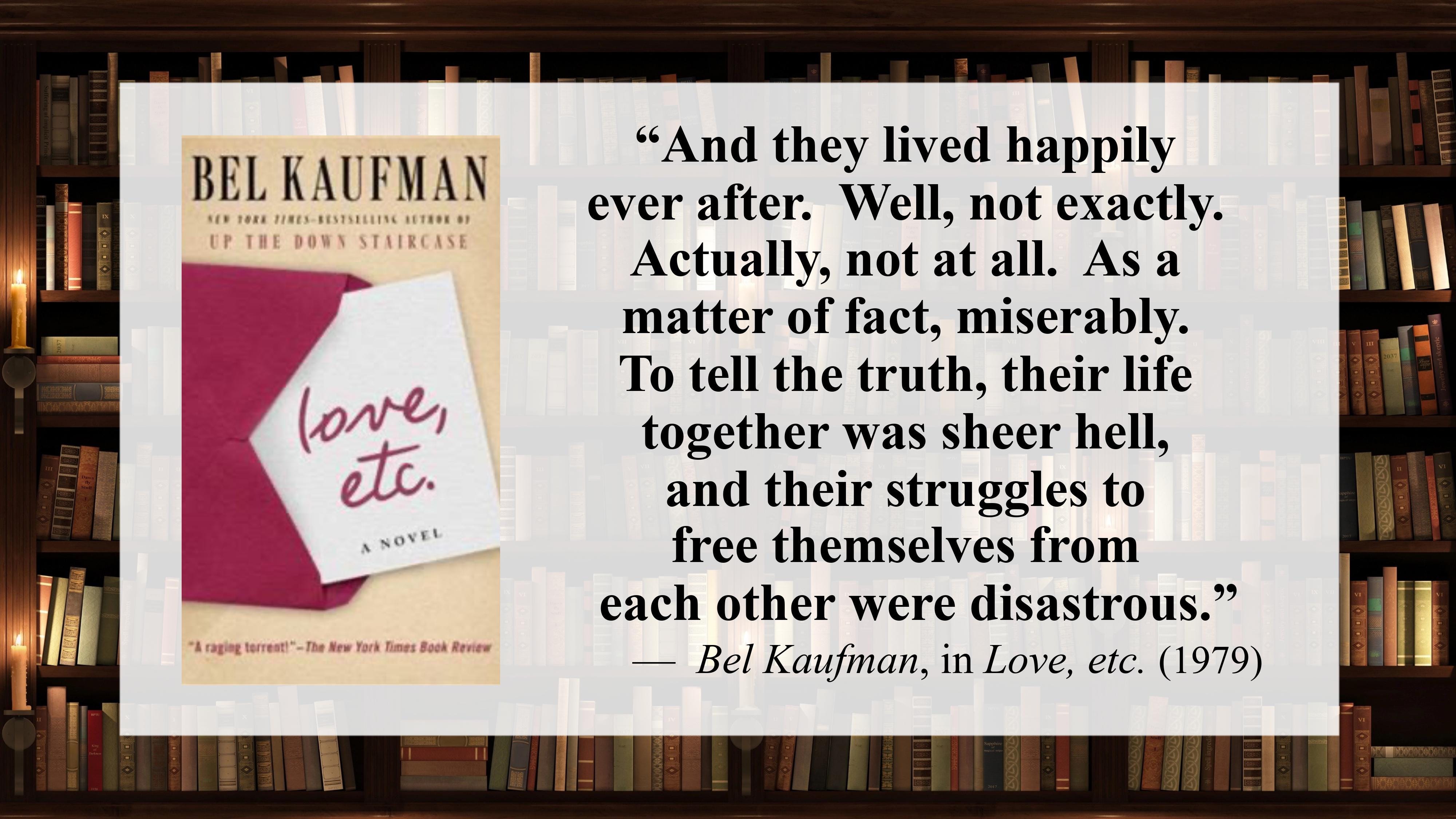
When I came across these opening words many years ago, they immediately drew me in. The marriage seemed similar to a Chinese finger puzzle—the harder the couple tried to free themselves, the more stuck they got.
Kaufman, of course, is better known as the author of Up the Down Staircase (1964). One of the first novels to respectfully capture the vernacular of the era’s urban youth, the novel became a surprise hit (on The New York Times Best-Seller list for 64 weeks). Adapted into a popular 1967 film (starring Sandy Dennis), a stage version of the novel is frequently performed in high school drama productions, and has become an American classic.
For well over 2,000 memorable opening lines from every genre of world literature, go to www.GreatOpeningLines.com.

On July 29, 1905, this man was born into a Russian-Jewish immigrant household in Worcester, Massachusetts. Three weeks before his birth, his father committed suicide after his dressmaking business went bankrupt, and his mother was so upset she had every trace of her husband removed from the family home.
An extremely bright child, he excelled in every school he ever attended, including Harvard College, from which he graduated in 1926 (an M.A. came a year later). His original goal was to become a Harvard English professor, but he abandoned his doctoral studies after a school official told him the college’s Anglo-Saxon students would not like to be taught by a Jew.
He published his first book of verse in 1930, but his poetry didn’t begin to be appreciated until decades later. Most of his early works were out of print when a new collection, Selected Poems, won a Pulitzer Prize in 1959. In 1974, nearing age seventy, he became a consultant in poetry at the Library of Congress (a precursor to the poet laureate program, which began in 1985).
Many believed the appointment would be his “Swan Song,” but he continued to write to great acclaim, winning the 1995 National Book Award—at age ninety—for Passing Through. In 2000, at age ninety-five, he was officially named poet laureate of the United States, the oldest person so honored. He died at age 100 in 2006.
In the poem “Route Six” (1979), he wrote:
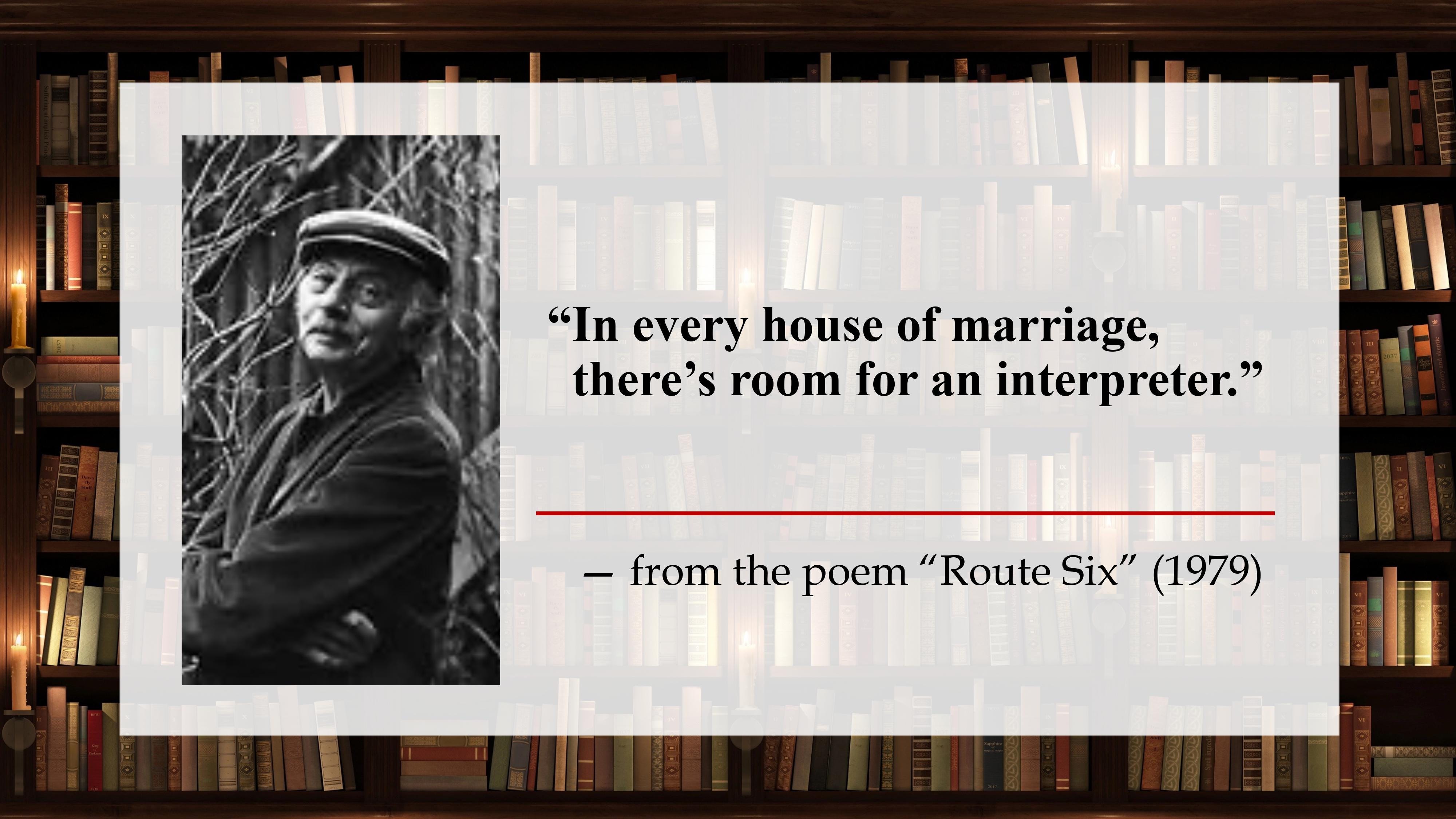
Who is this person? (Answer below)
The poem in this week’s Puzzler captures one of the most intriguing aspects of marriage: when two people decide to “tie the knot,” they’re often so different in the way they communicate their thoughts and feelings that it’s almost as if they’re speaking different languages. This week’s Mystery Man cleverly expanded on this idea to suggest that, in such marriages, an interpreter would be very helpful.
Today, the notion that men and women speak different languages is so popular that it’s become a truism. But you won’t find it expressed by any ancient writers. Back then, you see, nobody believed it was necessary for husbands and wives to understand each other. On the contrary, the prevailing view was that the wife simply needed to understand what her husband wanted—and then comply with his wishes. In Politics (4th c. B.C.), Aristotle explained the rationale:
“The male is by nature superior, and the female inferior; the one rules and the other is ruled; this principle, of necessity, extends to all mankind.”
This belief that men are naturally suited to command and women to obey persisted for many centuries, but significant arguments against it began to emerge during the Renaissance (the 15th and 16th centuries). These arguments accelerated dramatically during The Enlightenment (the 17th and 18th centuries), and they reach a true cultural tipping point in the Women’s Suffrage Movement in the late 1800s and early 1900s.
By the middle of the 20th century, it was widely accepted that the key to a successful marriage was for husbands and wives to mutually understand one other. But desiring mutual understanding and achieving it proved to be so difficult that the ways in which men and women communicate became a subject of keen interest to writers and scholars.
While countless people have investigated the intricacies of gender-related communication, three individuals have distinguished themselves in their work. Below, you will find a brief description of each person, and a sampling of their most memorable observations on the topic.
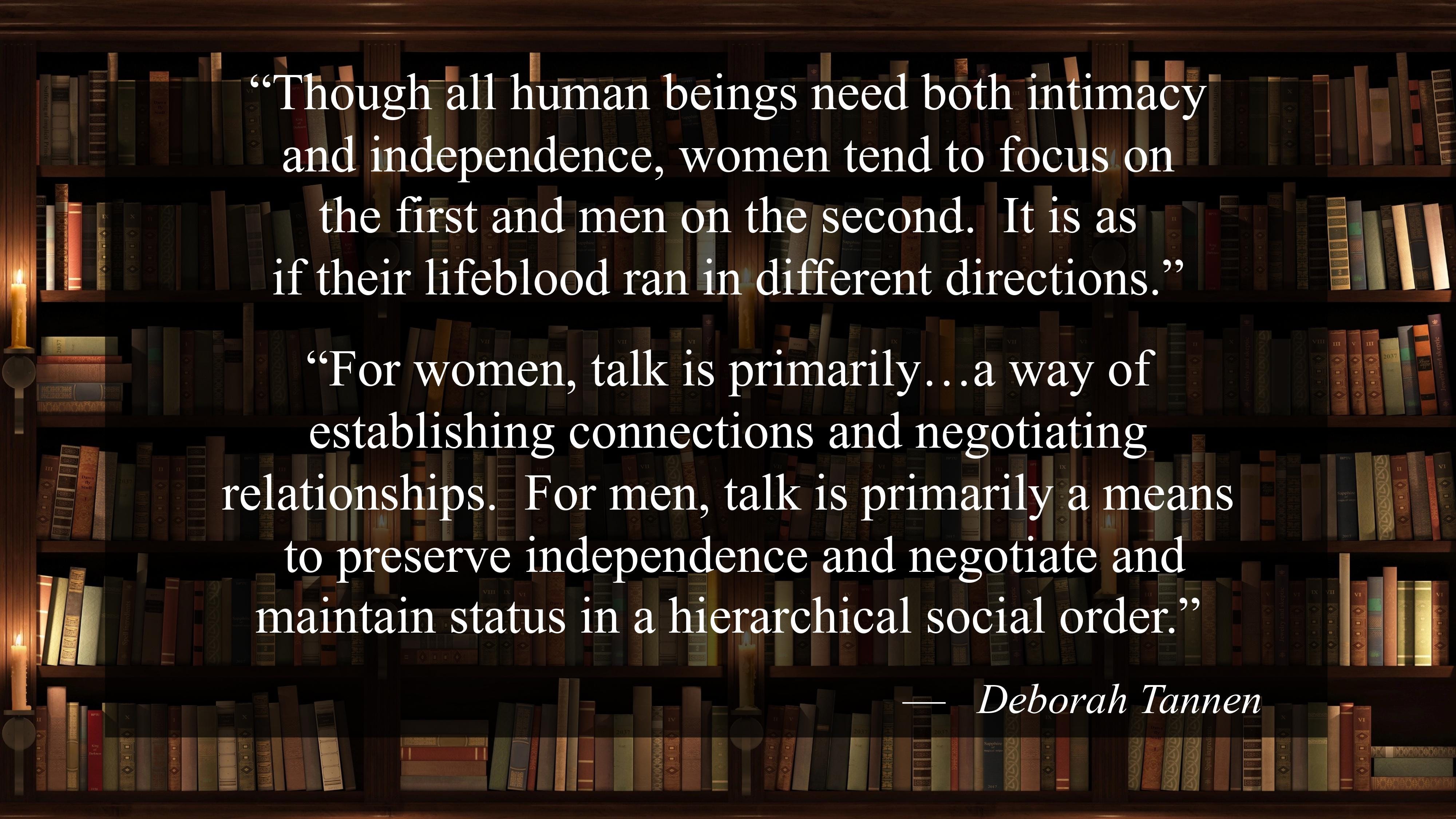
Deborah Tannen is an internationally-respected linguist and professor at Georgetown University. Among her dozen published books, two of them—That’s Not What I Meant! (1986) and You Just Don’t Understand (1990)—explored the nuances of gender-related communication. About her interest in the subject, she once wrote:
“When those closest to us respond to events differently than we do, when they seem to see the same scene as part of a different play, when they say things that we could not imagine saying in the same circumstances, the ground on which we stand seems to tremble and our footing is suddenly unsure.”
She also penned these two additional observations on the theme:
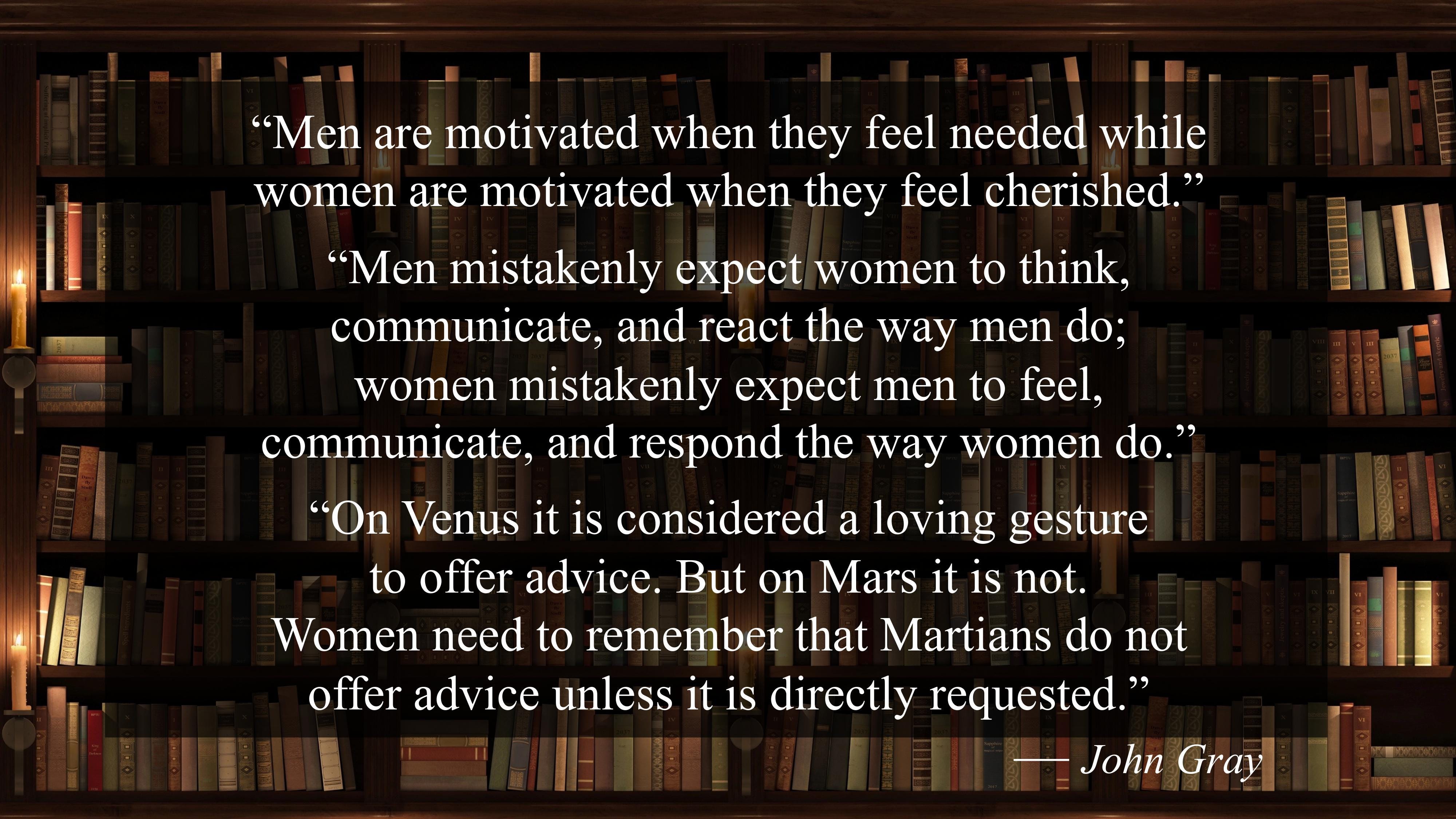
In 1992, John Gray, an American relationship counselor, dramatically expanded the popular idea about men and women speaking different languages in Men Are from Mars, Women Are from Venus. To say the book was a success would be a vast understatement. On the New York Times bestseller list for 121 weeks, it went on to sell more than 15 million copies and was ultimately translated into more than forty languages.

Early on, Gray was accused of heavily borrowing from the work of Deborah Tannen, but he categorically denied those charges and said he’d been teaching the concepts in his seminars long before he’d learned of her work. Gray also added that the core ideas in the Mars-Venus book came to him as he was trying to recover from a painful 1984 divorce from the writer and relationship expert Barbara de Angelis (she had left him for another man). As he attempted to re-evaluate everything he ever knew about relationships, he cited one breakthrough thought that went this way:
“I discovered that what makes women happy is completely different from what makes men happy.”
He also offered these three additional thoughts:
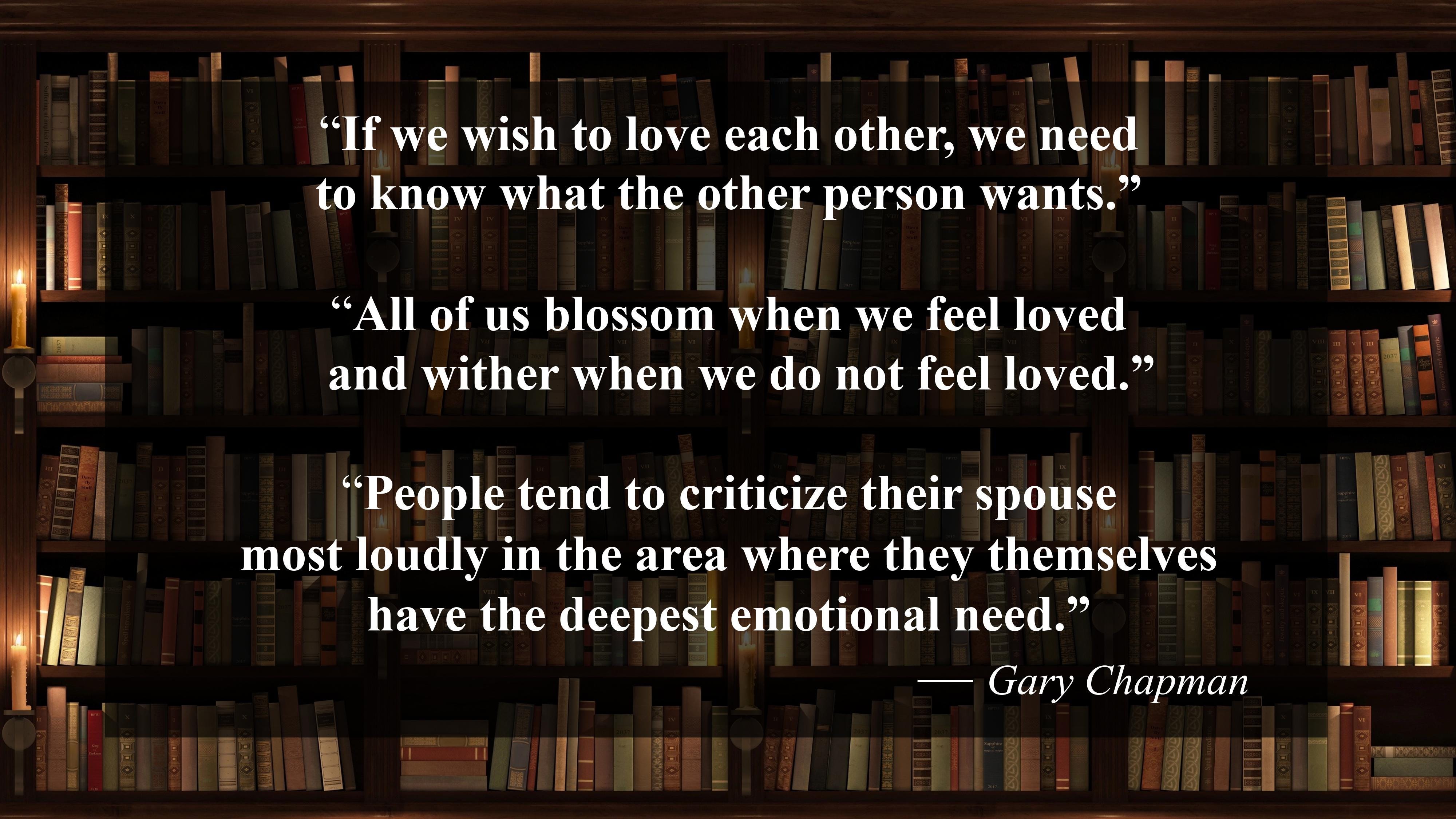
Our third featured relationship expert is Gary Chapman, a marriage counselor who, early in his career, began to notice that the men and women he’d been seeing in his counseling practice had distinctly different ways of both expressing and receiving love. Drawing on his background in anthropology and religion, he eventually put his thoughts together in a 1992 book titled The Five Love Languages: How to Express Heartfelt Commitment to Your Mate.

According to Chapman, the five love languages were: (1) Words of Affirmation; (2) Acts of Service; (3) Receiving Gifts; (4) Quality Time; and (5) Physical Touch. Chapman explained the rationale behind his “approach” simply but compellingly:
“Love can be expressed and received in all five languages. However, if you don’t speak a person’s primary love language, that person will not feel loved, even though you may be speaking the other four.”
Three more of his thoughts have become very popular:
So what about same-sex couples, in which the gender issues are, at least theoretically, cancelled out? Most clinicians would appear to agree that couples in same-sex marriages struggle as much as heterosexual couples. And, further, when we look at the many countries around the world that have legalized gay marriage, the divorce rate for same-sex couples is about the same as their traditional counterparts, and sometimes a bit higher.
According to most psychologists, the vast majority of problems besetting married couples—whether gay or straight—are the result of differences in personality, temperament, values, philosophy, perception, and, quite frankly, personal tastes and preferences. Say, for example, that you and I decide to marry in large part because of our shared love for jazz music, fine dining, classic movies, great literature, and the number of children we want to bring into the world. Even with these things in common, there are still a thousand and one ways in which I am likely to be different from you—and any number of them might be things that annoy you, rub you the wrong way, offend your sensibilities, go against your values, or just seem wrong, weird, or improper in some hard-to-describe way.
The simple truth is that there are so many things to disagree about in the typical marriage. It might be a big clash, like whether or not to have children. Or it might have to do with my lavish spending and your thrifty ways. Or my sloppiness and your neatness, my preference for solitude and yours for social interaction, my love for meat dishes and yours for veganism, my progressive values and your comfort with traditional ways, my love for pets and your aversion to living with animals, my strictness with children and your permissiveness, or my volatility and your even-tempered ways. In any marriage, the list is endless.
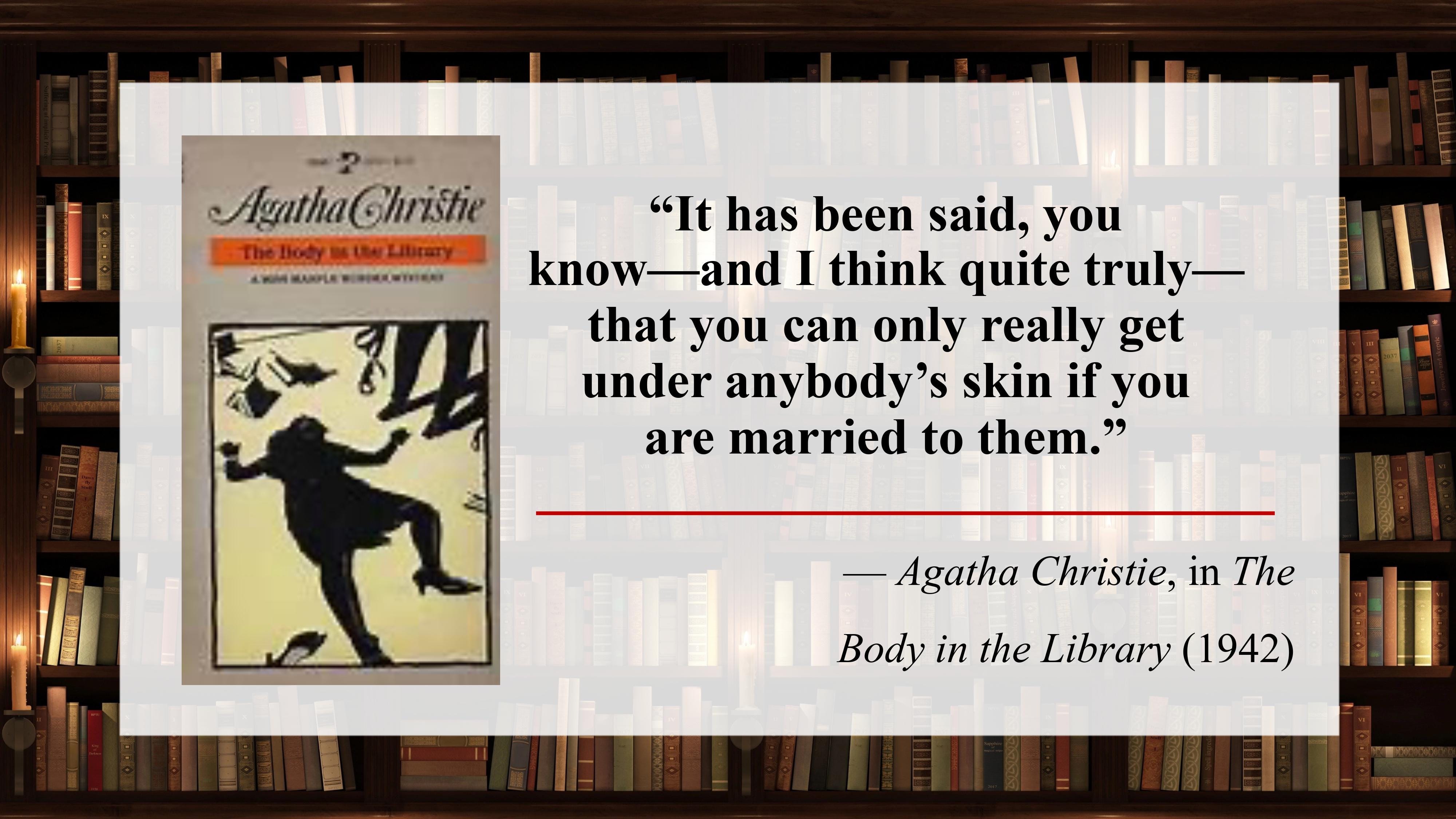
To return to the potentially divisive issues in our relationship, it might be something ostensibly small, but with the potential to be highly annoying or irritating to you—like the way I eat, stack a dishwasher, make a bed, brush my teeth, speak in cliches, attend to personal hygiene, talk back at the television, repeat my favorite sayings, use profane language, make purchases without looking at the receipts, engage with strangers, and so on and so forth. Agatha Christie was clearly thinking of the myriad ways we can annoy our spouses when she had her fictional detective Miss Marple say:
This week, spend some time thinking about the quality of the communication between you and your spouse or life partner. To stimulate your thinking, here's a sampling of quotations on the subject:
The only real argument for marriage is that it remains the best method for getting acquainted. — Heywood Broun
Marriage is not a simple love affair, it’s an ordeal, and the ordeal is the sacrifice of ego to a relationship in which two have become one. — Joseph Campbell
In the sex-war thoughtlessness is the weapon of the male, vindictiveness of the female. — Cyril Connolly
Here’s how men think. Sex, work—and those are reversible, depending on age—sex, work, food, sports, and lastly, begrudgingly, relationships. And here’s how women think. Relationships, relationships, relationships, work, sex, shopping, weight, food. — Carrie Fisher
Marriage is like a war. There are moments of chivalry and gallantry that attend the victorious advances and strategic retreats, the birth or death of children, the momentary conquest of loneliness, the sacrifice that ennobles him who makes it. But mostly there are the long dull sieges, the waiting, the terror and boredom. Women understand this better than men; they are better able to survive attrition. — Helen Hayes
In a successful marriage, there is no such thing as one’s way. There is only the way of both, only the bumpy, dusty, difficult, but always mutual path! — Phyllis McGinley
Marriage involves big compromises all the time. International-level compromises. You’re the U.S.A., he’s the U.S.S.R., and you’re talking nuclear warheads. Bette Midler
Our marriage works because we each carry clubs of equal weight and size. Paul Newman, on his marriage to Joanne Woodward
Women speak in estrogen and men listen in testosterone. — Richard Roeper
How men hate waiting while their wives shop for clothes and trinkets; how women hate waiting, often for much of their lives, while their husbands shop for fame and glory. — Thomas Szasz
Every marriage is a battle between two families struggling to reproduce themselves. — Carl A. Whitaker
For more quotations on the theme of MARRIAGE, go here. For quotations on MEN & WOMEN, go here. And for quotations on COMMUNICATION, go here.
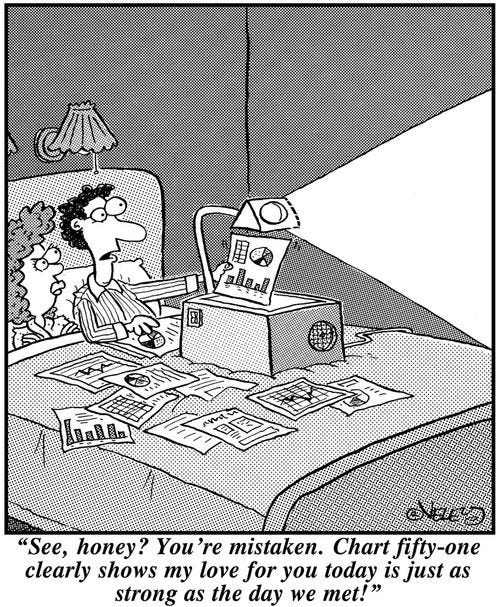
Stanley Kunitz (1905–2006)
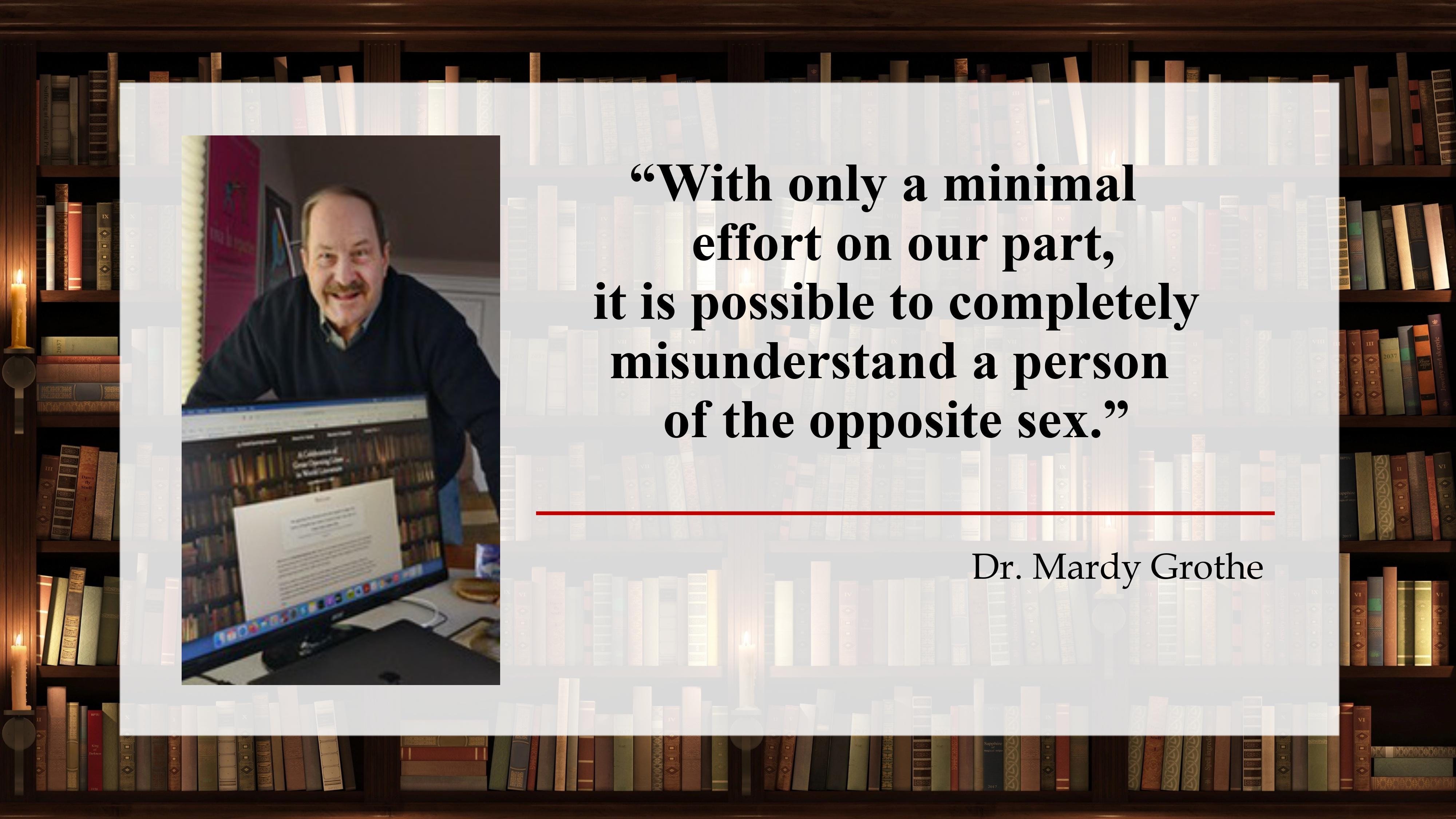
Thanks for joining me again this week. See you again next Sunday morning.
Mardy Grothe
Websites: www.drmardy.com and www.GreatOpeningLines.com
Regarding My Lifelong Love of Quotations: A Personal Note
No posts
Comments
Nothing yet. Say the first thing.
Sign in to join the conversation.