

Think about the last time you were genuinely bored. Not the mild restlessness of a slow afternoon, but real, unstructured, nothing-available boredom — waiting somewhere without your phone, sitting with nothing to do, facing a stretch of time with no task to complete and no stimulation to reach for. Can you even remember it? For most people, the honest answer is no. Not because boredom doesn’t arise — it does, constantly — but because the moment it appears, it is instantly extinguished. The phone comes out. The podcast starts. The email gets checked. The feed gets scrolled.
We have built an entire civilization of boredom avoidance. And in doing so, we have systematically eliminated one of the most cognitively productive states the human brain is capable of generating.
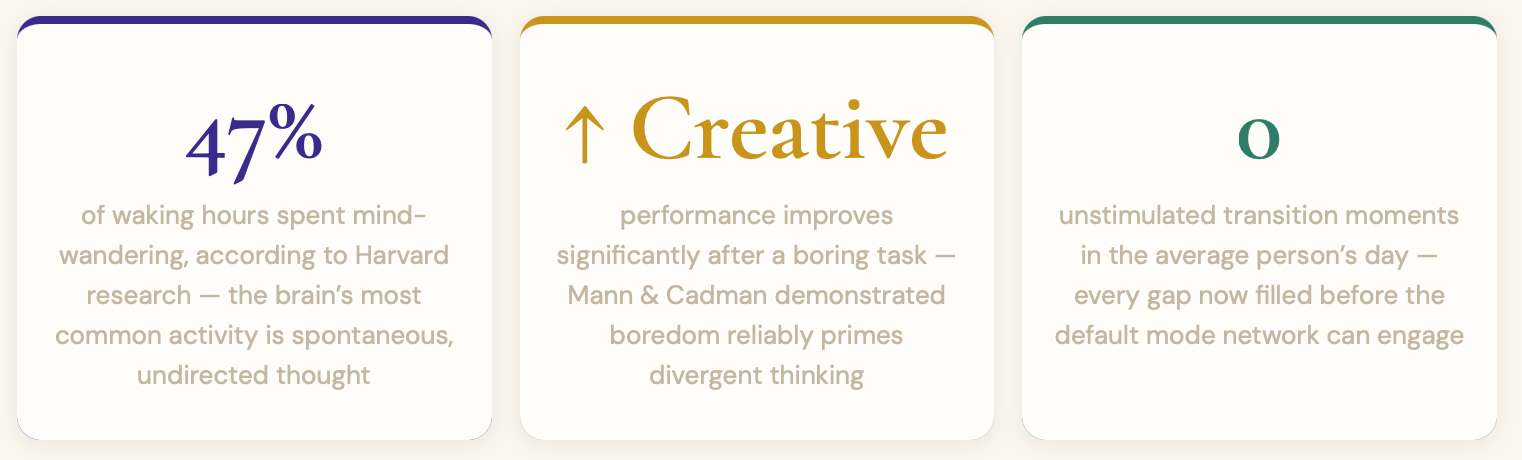
Boredom, neuroscientifically speaking, is not the absence of mental activity. It is a specific state characterized by a particular kind of mental activity: unguided, internally-directed cognition that is not anchored to any external task. When the brain is bored — when it has no immediate external demand to respond to — it does not go blank. It shifts into a mode of processing that researchers call the default mode network, or DMN: the same resting-state system we encountered in the discussion of nighttime rumination.
But in the context of boredom, during waking hours, the DMN does something remarkable. Freed from the demands of task-focused cognition, it begins to range freely across the landscape of memory, imagination, and possibility. It connects disparate ideas. It revisits unresolved problems from unexpected angles. It generates the spontaneous, associative, non-linear thinking that is the neurological substrate of insight, creativity, and self-knowledge.
In other words: boredom is the condition under which your brain does some of its most important work. And we have eliminated it almost entirely from daily life.
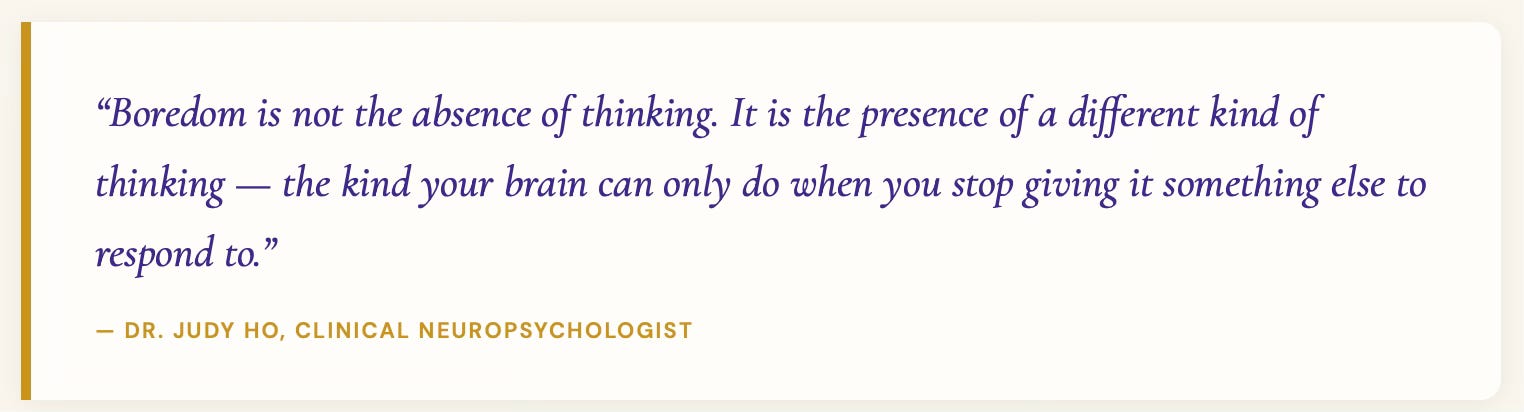

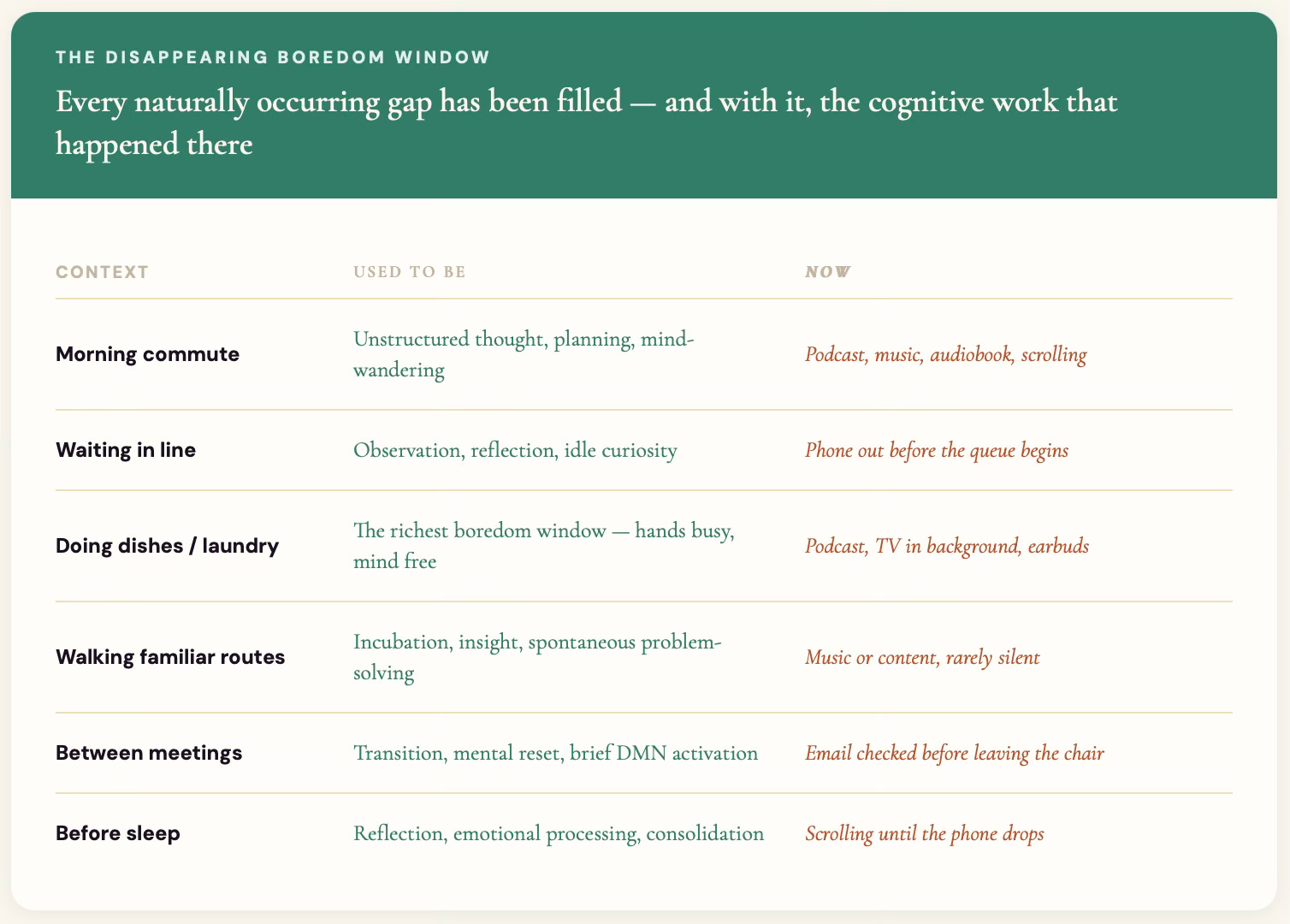
There is a reason that insights reliably come in the shower, on walks, during the drive home, in the moments just before sleep. These are among the last remaining contexts in modern life where the brain is not being asked to respond to anything external. The conditions are not mystical. They are neurological: the default mode network activates, unguided cognition begins, and the brain — freed from the demands of directed attention — makes connections it cannot make when it is busy.
Researchers Sandi Mann and Rebekah Cadman at the University of Central Lancashire demonstrated this experimentally in 2014. Participants who were assigned a boring task — copying numbers from a phone book — before a creative task performed significantly better on the creative task than participants who went straight to it. The boring task had primed their DMN. It had, essentially, given their brains permission to wander — and wandering, it turns out, is where much of our most valuable thinking happens.
The implications of this for how we structure our lives, our work, and our relationship with technology are significant and almost entirely ignored. We optimize relentlessly for productivity, stimulation, and engagement — and in doing so, we systematically prevent the cognitive state that produces our most original thinking, our deepest self-understanding, and our most creative problem-solving.
Research: Mann, S., & Cadman, R. (2014). Does being bored make us more creative? Creativity Research Journal, 26(2). This experimental study demonstrated that participants who performed a boring task before a creative task generated significantly more creative responses than control participants, establishing boredom as a reliable primer for divergent thinking.
The costs of chronic stimulation — of a life in which every moment of potential boredom is immediately filled — are now reasonably well-documented, even if they are rarely framed in terms of boredom specifically.
The most direct cost is creative capacity. The research on mind-wandering is consistent: spontaneous, undirected thought — the kind that happens during boredom — is strongly associated with creative insight, novel problem-solving, and the kind of associative thinking that connects ideas across domains. A mind that is never allowed to wander is a mind that can only work with what it is directly given. It cannot make the unexpected connections that constitute genuine originality.
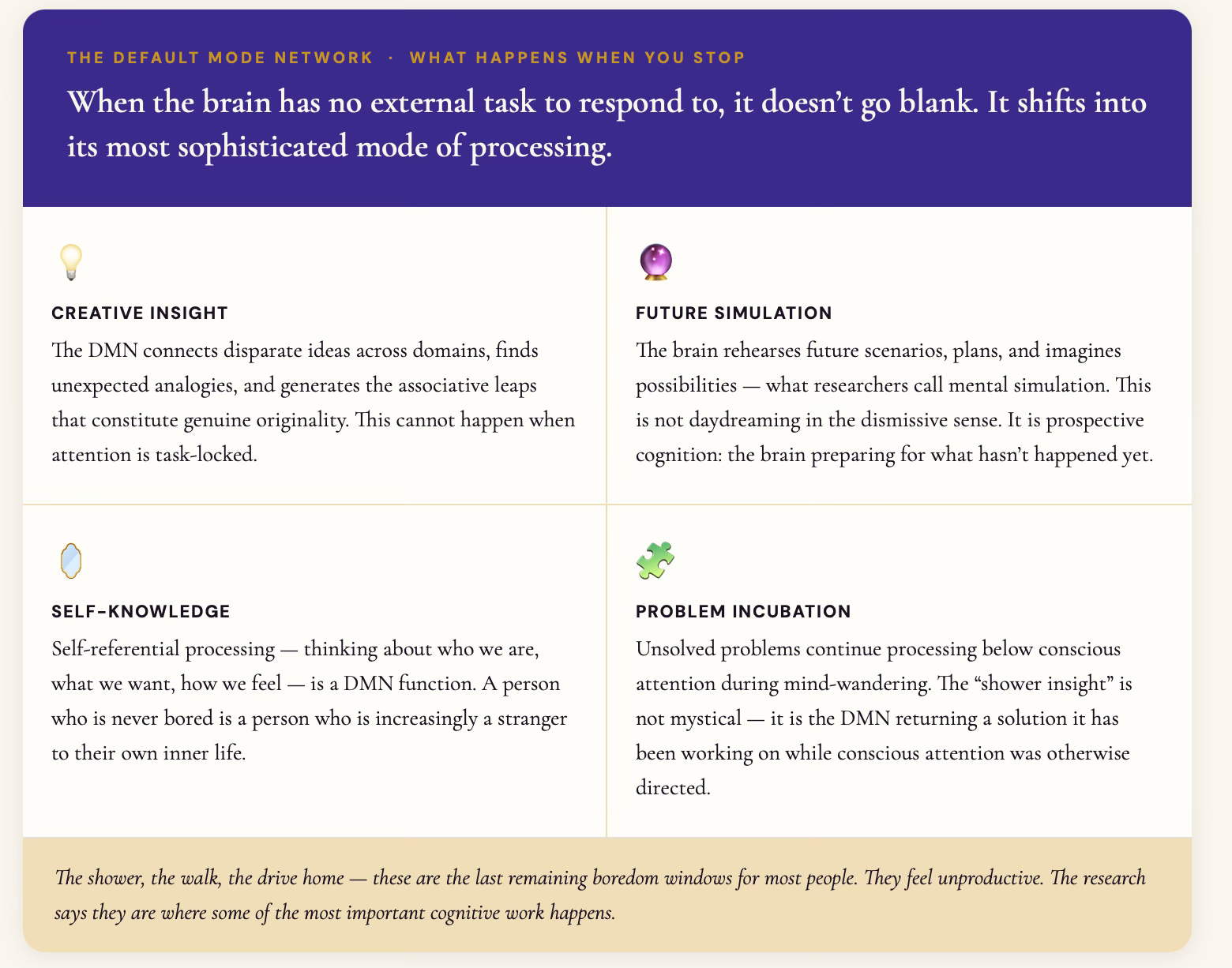
Jonathan Smallwood at Queen’s University has spent over a decade studying mind-wandering and its cognitive consequences. His research establishes that the default mode network, when allowed to operate freely, is not merely idle: it is actively engaged in what he calls “mental simulation” — running scenarios, exploring possibilities, processing unresolved emotional material, and integrating information across time and experience. This is not distraction. This is some of the most cognitively sophisticated processing the brain performs.
The second cost is self-knowledge. The DMN is also the system responsible for self-referential processing — the thinking we do about ourselves: who we are, what we want, what matters to us, how we feel. When we never give this system space to operate — when every quiet moment is immediately filled with content that pulls attention outward — we lose access to our own inner landscape. We become genuinely less acquainted with ourselves. We find it harder to know what we actually think, feel, or want, as opposed to what we are being shown or told.
This may be one of the most underappreciated costs of the attention economy. The same systems that capture our attention and prevent boredom also prevent the inward-directed processing through which self-knowledge is built and maintained. A person who has not been bored in years is a person whose relationship with their own inner life has been quietly degraded — not through any dramatic event, but through the simple, continuous redirection of attention outward.
“A mind that is never allowed to wander is a mind that can only work with what it is directly given. The unexpected connections — the ones that constitute genuine originality — require the space that boredom provides.”
There is also a neurological consequence to chronic boredom avoidance that operates at the level of the reward system. The brain’s dopamine system responds to novelty — to new stimulation, unexpected rewards, and the anticipation of them. In a high-stimulation environment, the baseline threshold for what registers as interesting, engaging, or rewarding rises progressively. The ordinary becomes duller. The quiet becomes more uncomfortable. The capacity to sustain attention on anything that doesn’t provide frequent novelty signals erodes.
The result is a progressive intolerance of boredom — not because the person has become lazier or less disciplined, but because their reward system has been calibrated by an environment of continuous high-frequency stimulation. Reintroducing boredom, at that point, feels genuinely unpleasant in a way that has a neurological basis. The discomfort is real. It is also temporary, and it responds to graduated reexposure — exactly like any other tolerance reset.
Research: Smallwood, J., & Schooler, J.W. (2015). The science of mind wandering: Empirically navigating the stream of consciousness. Annual Review of Psychology, 66. This landmark review established mind-wandering as a coherent cognitive phenomenon with distinct neural correlates, demonstrating that spontaneous thought during apparent idleness is associated with creative insight, future planning, and self-referential processing — not cognitive waste.
The goal is not to eliminate stimulation or to romanticize discomfort. It is to restore the conditions under which your most valuable cognitive processes can operate — deliberately, regularly, and without guilt. Here is what the research most consistently supports.
01 PROTECT AT LEAST ONE UNSTIMULATED TRANSITION EACH DAY
The moments of transition — the commute, the walk between meetings, the wait at the coffee shop, the elevator ride — are the naturally occurring boredom windows that used to exist in everyone’s day before the smartphone made them disappear. Reclaim one of them. Not all of them, not dramatically — just one per day, phone in your pocket, nothing in your ears, mind allowed to go where it goes. The research on incubation — the cognitive process by which unsolved problems resolve during apparent inactivity — suggests that these small windows are disproportionately productive. Problems that have resisted direct effort often yield during exactly this kind of unstructured, transitional drift.
02 LET YOURSELF BE BORED DURING ROUTINE PHYSICAL TASKS
Showering, doing dishes, folding laundry, walking a familiar route — these are the activities that have historically been the richest boredom windows, and that are now almost universally filled with podcasts, audiobooks, and music. The case for occasionally doing them in silence is not aesthetic. It is neurological: these tasks occupy just enough of the motor and sensory systems to prevent sleep-onset, while leaving the DMN free to operate. This is the shower insight condition. You cannot manufacture it by trying to have insights. You can create it by removing the stimulation that prevents it.
03 PRACTICE SINGLE-TASKING AS A BOREDOM TOLERANCE EXERCISE
One of the side effects of chronic multitasking and continuous stimulation is a progressively lowered tolerance for tasks that don’t provide frequent feedback or novelty. Reading a long-form article, writing without interruption, working on a single problem for an extended period — these feel increasingly uncomfortable not because they are harder, but because the reward system has been calibrated to expect more frequent stimulation signals. Single-tasking is a tolerance reset. Start with 20 minutes on one task, no switching, no checking. The restlessness you feel in the first few minutes is neurological withdrawal, not evidence that you are doing it wrong. It passes.
04 CARRY A NOTEBOOK INSTEAD OF REACHING FOR YOUR PHONE
When the impulse to reach for your phone arises — in a queue, in a waiting room, in a lull in conversation — try writing instead. Not productively, not with an agenda: just whatever arises. This does two things simultaneously. It interrupts the automatic boredom-avoidance behavior before it becomes ingrained. And it channels the DMN’s output into a form you can later access. Some of the most interesting thinking — the connections, the questions, the observations that only appear in unguided moments — vanishes immediately if nothing catches it. A notebook catches it.
05 DO A REGULAR STIMULATION AUDIT
Most people have no accurate sense of how continuously stimulated they actually are across a typical day. Spend one day simply noting, at each transition, whether you are consuming content or not. Most people discover that the answer is almost always yes — that the gaps between directed content consumption have shrunk to near-zero. This audit is not designed to produce guilt. It is designed to produce awareness — the prerequisite for deliberate change. Once you can see the pattern, you can begin to introduce gaps intentionally, starting with the smallest and least uncomfortable ones and building from there.
Until next week,
Dr. Judy Ho
Clinical & Forensic Neuropsychologist · drjudyho.com
P.S. — If this resonated with you, forward it to someone who might struggle with negative self-talk.
Share The New Rules of Attachment

I’m thrilled to share that I’ve just launched my new podcast, Savvy Psychologist — and the first episode is live now. Each week, I break down a psychological phenomenon in plain language, explain why it’s happening to you, and give you science-backed tools you can actually use.

Listen/watch my Savvy Psychologist podcast!
Take my attachment styles quiz
About me:
Dr. Judy Ho, Ph. D., ABPP, ABPdN is a triple board certified and licensed Clinical and Forensic Neuropsychologist, a tenured Associate Professor at Pepperdine University, television and podcast host, and author of Stop Self-Sabotage. An avid researcher and a two-time recipient of the National Institute of Mental Health Services Research Award, Dr. Judy maintains a private practice where she specializes in comprehensive neuropsychological evaluations and expert witness work. She is often called on by the media as an expert psychologist and is also a sought after public speaker for universities, businesses, and organizations.
Dr. Judy received her bachelor’s degrees in Psychology and Business Administration from UC Berkeley, and her masters and doctorate from SDSU/UCSD Joint Doctoral Program in Clinical Psychology. She completed a National Institute of Mental Health sponsored fellowship at UCLA’s Semel Institute.
No posts
Comments
Nothing yet. Say the first thing.
Sign in to join the conversation.