

Most people have a complicated relationship with anger. Not because they don’t feel it — everyone does — but because somewhere along the way they learned that feeling it was dangerous, expressing it was unacceptable, or being the kind of person who gets angry was something to be ashamed of. So they stopped. Or they tried to. Or they redirected it so reliably and automatically that they genuinely believe they are not an angry person, even as it leaks out in ways they don’t fully recognize.
This newsletter is about what happens when you do that — and why it costs more than you think.
Anger is a primary emotion, as fundamental to the human repertoire as fear, sadness, joy, and disgust. It is not a character flaw. It is not a sign of poor emotional intelligence. It is a neurobiologically ancient signal that evolved for a specific and important purpose: to alert you to a boundary violation, an injustice, a threat to something you value, or a situation in which your needs are not being met.
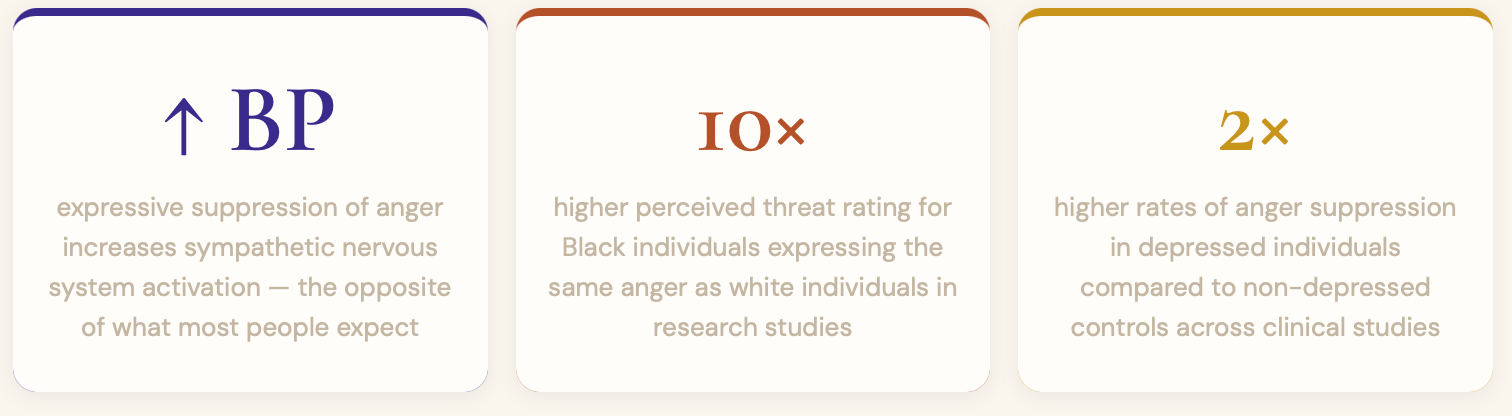
The neuroscience of anger is well-established. When a perceived threat or violation occurs, the amygdala — the brain’s threat-detection center — activates the sympathetic nervous system, producing the physiological signature that everyone recognizes: elevated heart rate, increased blood pressure, muscle tension, heightened alertness, a surge of energy. This is the anger response. And it is, at its core, mobilizing energy for action — the body preparing to address something that needs addressing.
The critical distinction that most conversations about anger miss entirely is the difference between anger and aggression. Anger is the emotion — the internal signal, the physiological state, the information. Aggression is one possible behavioral response to that signal — and not a necessary or inevitable one. Confusing these two things is the source of most of the cultural damage done around anger. When we teach people — particularly women, and children — that anger itself is dangerous or unacceptable, we are not teaching them emotional regulation. We are teaching them to suppress a signal that their nervous system generates for genuinely good reasons.
Anger is not equally permitted across genders, cultures, races, or roles. The research on this is consistent and significant. Women who express anger in professional contexts are judged as less competent and less deserving of status than men who express equivalent anger — while men who express anger in the same contexts are judged as having higher status and greater justification. Black individuals who express anger are significantly more likely to be perceived as threatening than white individuals expressing the same emotion. Children who express anger are frequently taught that the emotion itself — not merely its behavioral expression — is wrong.
The result of these cultural prohibitions is not that people stop feeling anger. It is that they stop being able to work with it productively. The emotion goes underground. It finds other channels. Or it turns inward.
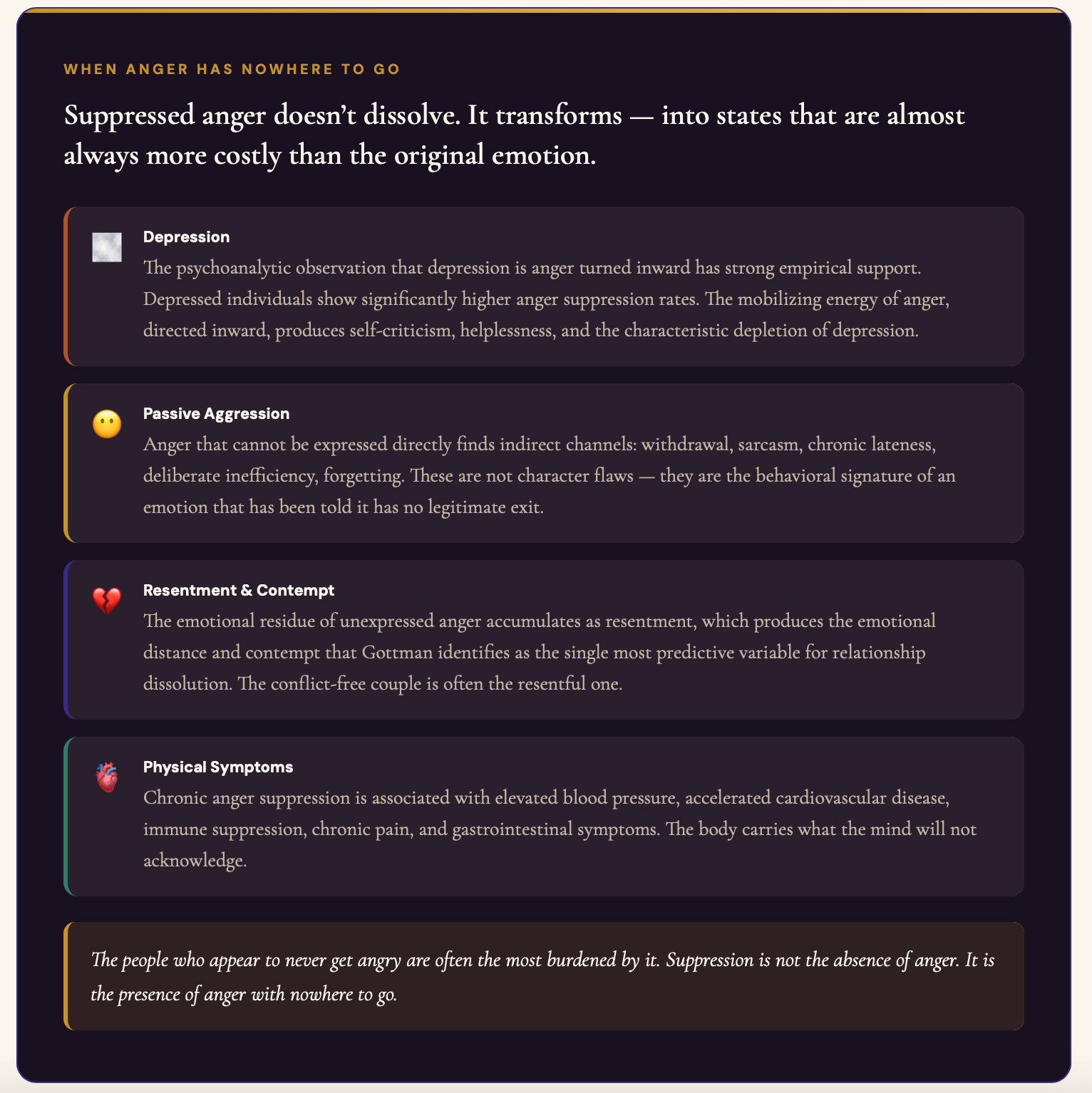
The most important clinical observation about suppressed anger is this: it does not dissolve. It transforms. And the forms it takes when it cannot be expressed directly — depression, chronic physical symptoms, passive aggression, resentment that quietly poisons relationships, self-sabotage, emotional numbness — are almost always more costly than the original anger would have been.
Research: Tiedens, L.Z. (2001). Anger and advancement versus sadness and subjugation: The effect of negative emotion expressions on social status conferral. Journal of Personality and Social Psychology, 80(1). This study demonstrated that anger expression increases perceived status and competence in men while decreasing it in women — establishing the gendered double standard that shapes who feels safe expressing anger and who does not.

The psychological and physiological costs of chronic anger suppression are among the most well-documented findings in emotion research. They are also among the most underappreciated, because the people most affected by them often present as calm, accommodating, and emotionally controlled — the opposite of what we culturally associate with anger problems.
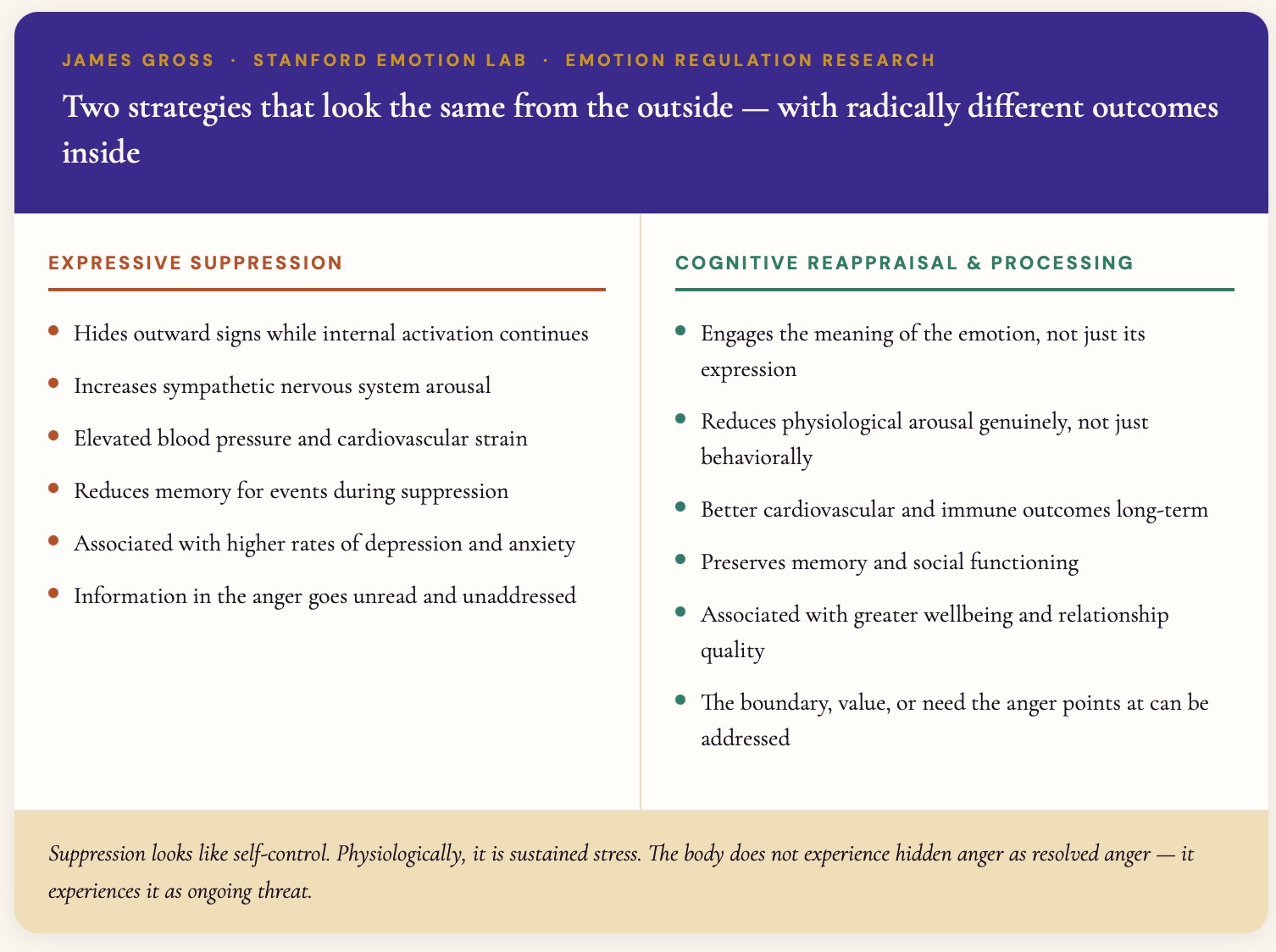
The research distinguishes between two primary suppression strategies: expressive suppression, which involves hiding the outward signs of anger while continuing to feel it internally, and cognitive reappraisal, which involves genuinely changing how you interpret a situation so that less anger is generated in the first place. These look similar from the outside. They produce radically different outcomes on the inside.
Expressive suppression — what most people mean when they say they “don’t get angry” — has been consistently shown to increase sympathetic nervous system activation, not decrease it. The physiological arousal of the anger response does not go away because you hide it. It continues. And sustained physiological arousal of this kind is associated with elevated blood pressure, accelerated cardiovascular disease, impaired immune function, and disrupted sleep — the same downstream effects as any other form of chronic stress.
The relationship between suppressed anger and depression is particularly well-established. The psychoanalytic observation that depression is “anger turned inward” has been supported by decades of empirical research. People who habitually suppress anger are significantly more likely to develop depressive symptoms — and depressed individuals consistently show higher rates of anger suppression than non-depressed controls. The mechanism appears to involve the redirection of anger’s mobilizing energy inward: rather than addressing the violation or injustice that generated the anger, the person turns the aggression toward themselves, producing self-criticism, self-blame, helplessness, and the characteristic energy depletion of depression.
Suppressed anger also profoundly affects relationships, often in ways that are invisible to everyone involved. Resentment — the emotional residue of anger that was never expressed or resolved — accumulates quietly over time. It produces increasing emotional distance, a reduction in genuine intimacy, a growing sense of injustice that colors every interaction, and eventually the kind of contempt that Gottman’s research identifies as the single most predictive variable for relationship dissolution. The couple who appears to have “never fight” is often the couple in which one or both people have learned to suppress anger so effectively that the signal cannot reach the surface — where it might be heard, addressed, and resolved.
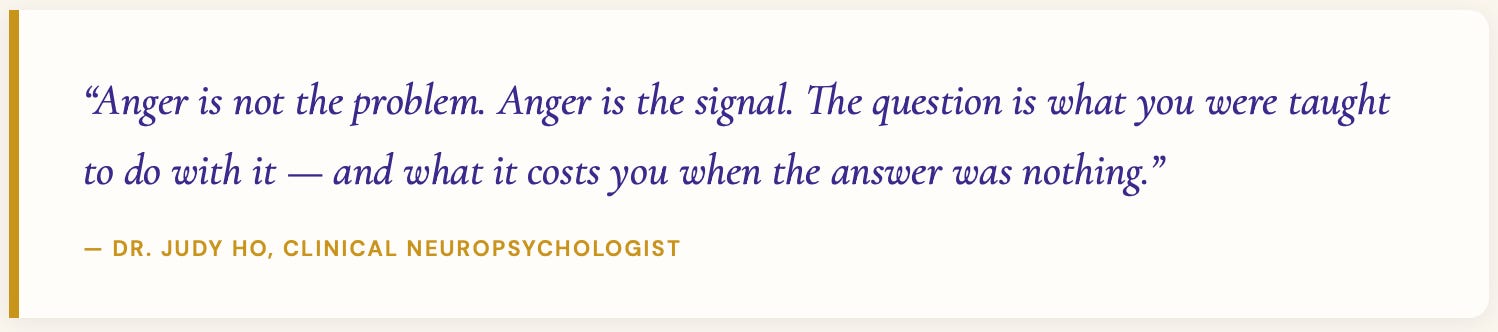
“The people who appear to never get angry are often the most burdened by it. Suppression is not the absence of anger. It is the presence of anger with nowhere to go.”
The most important reframe in working with anger is this: anger is data. Every instance of anger is pointing at something — a value that was violated, a boundary that was crossed, a need that went unmet, an injustice that demands acknowledgment. The anger itself is not the message. It is the signal that a message is trying to get through.
When you can approach anger with curiosity rather than shame or suppression, you gain access to information you cannot get any other way. What specifically was violated? What does this anger reveal about what matters to you? What need is underneath it? What would it mean to actually address what the anger is pointing at, rather than simply managing the emotion?
This is the work that most anger management approaches skip. They focus on regulating the physiological arousal — which is useful and necessary — without ever engaging with the information the anger contains. The result is better-managed anger that still has nowhere to go, still accumulates, and still transforms into whatever it transforms into when it cannot be heard.
Research: Koh, K.B., Kim, C.H., & Park, J.K. (2002). Predominance of anger in depressive disorders compared with anxiety disorders and somatoform disorders. Journal of Clinical Psychiatry, 63(6). This study demonstrated significantly higher rates of anger suppression in depressed individuals compared to non-depressed controls, supporting the clinical model of depression as partially driven by the inward redirection of suppressed anger.
The goal is not to express anger indiscriminately or to treat its expression as inherently therapeutic — the research on catharsis actually shows that venting anger often amplifies rather than reduces it. The goal is to develop a relationship with anger that allows it to function as it was designed to: as information, as motivation, and as a legitimate signal that something needs attention.
01 GET CURIOUS BEFORE YOU GET REGULATED
The standard advice when angry is to regulate first: breathe, pause, wait for the prefrontal cortex to re-engage. This is correct and important. But regulation without inquiry leaves the anger’s message unread. Before the feeling passes completely, get curious about it: what specifically triggered this response? What value or need is underneath it? What is this anger pointing at? A useful practice is to write the anger down — not as a letter to the person who triggered it, but as a private inquiry into what it is telling you. The physiological activation will regulate. The information is what you want to preserve.
02 DISTINGUISH ANGER FROM AGGRESSION IN YOUR OWN MIND
The first step in building a healthier relationship with anger is recognizing that feeling it and acting on it aggressively are entirely separate events with a gap between them — and that gap is where your agency lives. Practice naming the emotion without immediately moving to its behavioral expression or suppression: “I am angry right now” is a complete and adequate statement. You do not have to do anything with it immediately. You do not have to suppress it. The naming itself — what neuroscientists call affect labeling — has been shown to reduce amygdala activation and restore prefrontal cortex access, making it both a regulation tool and an entry point for inquiry.
03 FIND THE BOUNDARY OR NEED THE ANGER IS PROTECTING
Anger almost always has a “because” underneath it — a specific value, boundary, or need that was violated or unmet. The presenting trigger (the thing that happened) is usually not the full story. Ask: if I stay with this anger rather than pushing it away, what does it want me to know? What would need to be different for this anger to be resolved, not just managed? This inquiry often reveals the specific conversation that needs to happen, the boundary that needs to be set, or the situation that needs to change — things that regulation alone will never surface because regulation is designed to manage the signal, not hear it.
04 LEARN THE DIFFERENCE BETWEEN EXPRESSION AND DISCHARGE
Venting — expressing anger in an unstructured way, often to a sympathetic listener — frequently amplifies rather than resolves anger. This is the research on catharsis: it does not work the way people intuitively expect. What does work is structured, purposeful expression: communicating the anger to the person or in the context where it is relevant, in a way that names the impact and the need rather than simply discharging the activation. The gentle startup format from Gottman’s research applies here: “When X happened, I felt Y, because Z matters to me — and what I need is...” This transforms anger from a discharge into a communication.
05 EXAMINE WHAT YOU WERE TAUGHT ABOUT ANGER

Many people’s relationship with anger was shaped before they had language for it. If anger in your family of origin was dangerous, explosive, or consistently punished — or if it was simply never modeled as something safe or resolvable — your nervous system learned to treat the emotion itself as a threat. That learning is implicit and automatic, which means it doesn’t respond to insight alone. It responds to new experience: repeated instances of feeling angry, expressing it in a boundaried way, and discovering that the relationship or the world survived it. Therapy is often the most efficient path to this kind of corrective experience, particularly approaches that work directly with the emotional and somatic dimensions of suppressed anger rather than focusing primarily on cognitive reframing.
Until next week,
Dr. Judy Ho
Clinical & Forensic Neuropsychologist · drjudyho.com
P.S. — If this resonated with you, forward it to someone who might struggle with negative self-talk.
Share The New Rules of Attachment

I’m thrilled to share that I’ve just launched my new podcast, Savvy Psychologist — and the first episode is live now. Each week, I break down a psychological phenomenon in plain language, explain why it’s happening to you, and give you science-backed tools you can actually use.

Listen/watch my Savvy Psychologist podcast!
Take my attachment styles quiz
About me:
Dr. Judy Ho, Ph. D., ABPP, ABPdN is a triple board certified and licensed Clinical and Forensic Neuropsychologist, a tenured Associate Professor at Pepperdine University, television and podcast host, and author of Stop Self-Sabotage. An avid researcher and a two-time recipient of the National Institute of Mental Health Services Research Award, Dr. Judy maintains a private practice where she specializes in comprehensive neuropsychological evaluations and expert witness work. She is often called on by the media as an expert psychologist and is also a sought after public speaker for universities, businesses, and organizations.
Dr. Judy received her bachelor’s degrees in Psychology and Business Administration from UC Berkeley, and her masters and doctorate from SDSU/UCSD Joint Doctoral Program in Clinical Psychology. She completed a National Institute of Mental Health sponsored fellowship at UCLA’s Semel Institute.
No posts
Comments
Nothing yet. Say the first thing.
Sign in to join the conversation.