
Drink Wisely has spent a lot of time in the Cappadocians lately, in Irenaeus, in the wider Christian tradition’s strangest and most beautiful ideas about what God is doing with human beings. This essay goes after the doctrine most of us were familiarized with without ever knowing its real origins.
I recall new member classes met around a table in the fellowship hall, and were conducted not so much as a lecture as a guided discussion. The church elders took turns walking newcomers through the material section by section and whenever it touched on atonement, justification, or what happens when God looks at a sinner, I was usually among the first ones talking. I had an answer ready before anyone finished the question, and it came out sounding “authoritative” because I thoroughly believed every word of it. Christ’s righteousness, I’d explain, gets credited to you the way a coat gets thrown over what’s underneath, imputed, not earned. God looks at a believer and sees Christ, not the sin still tangled up beneath it. Over fourteen years as a ruling elder in the Evangelical Presbyterian Church, formed inside Reformed orthodoxy, fond enough of Francis Turretin’s writing on forensic justification that I’d quote him from memory to people who had never heard his name before. I was so sure this was the most responsible, most biblical account of salvation out there that it never once occurred to me to ask where any of it actually came from.
The picture behind that language, even though nobody in the room ever described it just this way, is a courtroom, complete with a judge. a defendant with no case, and a substitute who steps in, takes the sentence, and lets the guilty walk out acquitted.
This construct didn’t come from where I thought it did.
Even the prayer every one of us memorized as children carries a quiet complication on this point. “Forgive us our debts, as we forgive our debtors” is the line most Presbyterian kids grew up saying, and the Greek word behind it, opheǓlēmata, is exactly what it looks like: debt, the kind owed to a lender, not a legal charge brought by a prosecutor.1 David Bentley Hart’s translation of the New Testament takes the economic reading seriously rather than treating it as a synonym for sin in general.2 Jesus taught his own disciples to pray about actual debt relief in a world of peasant farmers and Roman taxation, not primarily about a courtroom transaction between a wrathful God and a guilty defendant. The tradition assumed the legal metaphor ran all the way down the line but it didn’t even hold at the most repeated text in Christian history. Honestly, though how many of us have always read that passage strictly as debt = sin?
Where the Courtroom Imagery Came From
The doctrine I was teaching in those classes has a much clearer historical starting point than I ever realized: Anselm’s Cur Deus Homo, written around 1098, to be precise. Anselm of Canterbury wrote Cur Deus Homo, “Why God Became Man,” to answer a very specific question. Why the incarnation, why the cross, why this and not some other arrangement? His answer borrowed the logic that was all around him. Anselm lived inside a feudal world of lords, vassals, honor, and debt, where an offense against a superior required satisfaction proportional to that superior’s rank. A crime against a serf was relatively cheap. A crime against a king was catastrophic. Sin, Anselm reasoned, is an offense against a King of infinite rank, which makes the debt itself infinite as well, and no finite creature can pay an infinite debt. Only God can do that; only a human being should have to do that, and Christ, being both of these, resolves the math perfectly.3
That’s satisfaction theory, technically, not the eventual penal substitution we all know, and the distinction is actually quite important. Anselm’s version has Christ paying a debt to restore honor, obeying where humanity failed to obey. John Calvin, four whole centuries later, moves the doctrine somewhere else almost entirely. Christ absorbing the actual punishment owed to sinners, submitting as a criminal to suffer what we would have suffered, appeasing God’s wrath rather than simply restoring God’s honor.4 That’s the version I posited as the definitive one. Most Presbyterians assume this is simply what orthodox Christianity has always taught about the cross. However, it’s really a specific, traceable, sixteenth-century sharpening of a specific, traceable, eleventh-century innovation, and both of them are younger than half of church history.
That is to say, if the assumption holds, the church spent its first thousand years or so getting the central doctrine of the faith wrong and nobody caught the error until an English monk eventually sorted it out. Nobody in that fellowship hall of ours ever put it that bluntly. I certainly never did.
Before the Court
For the thousand years before Anselm picked up his pen, Christians were more likely to imagine the cross in terms of a type of conquest rather than an acquittal. It was more like a battlefield. Christ confronts and defeats the powers that hold humanity captive, like sin, death, the devil, and the resurrection story is the victory announcement. Gustaf Aulén, a Swedish Lutheran bishop, went looking for this older reading in 1931 and gave it a name that stuck: Christus Victor. He found its themes running through the New Testament, through the church fathers, through Luther himself, largely buried under eight centuries of Latin satisfaction theology that had come to feel like the only orthodox option.5
Irenaeus of Lyon, writing in the second century, offers his own version through what he calls recapitulation. Christ retraces the path Adam walked and gets it right where Adam got it wrong, healing human nature from the inside by inhabiting it fully. Athanasius takes the logic further still in On the Incarnation, landing on the line that still stops people cold: God became human so that humans might become divine.6 Not humans replacing God, but humans participating in God’s own life, taken up into a real relationship rather than simply issued a legal pardon from outside it. That’s known as theosis, and it ran through the Eastern church for centuries as comfortably as forensic justification would later run through Geneva. One picture can make salvation feel finalized in a single moment. The other treats salvation as something God keeps working in us throughout our entire lives.
Paul’s Own Vocabulary
Penal substitution depends heavily on Paul, so Paul is where the argument has to be tested rather than with later systematizers reading Paul through Augustine, Anselm and Calvin’s categories.
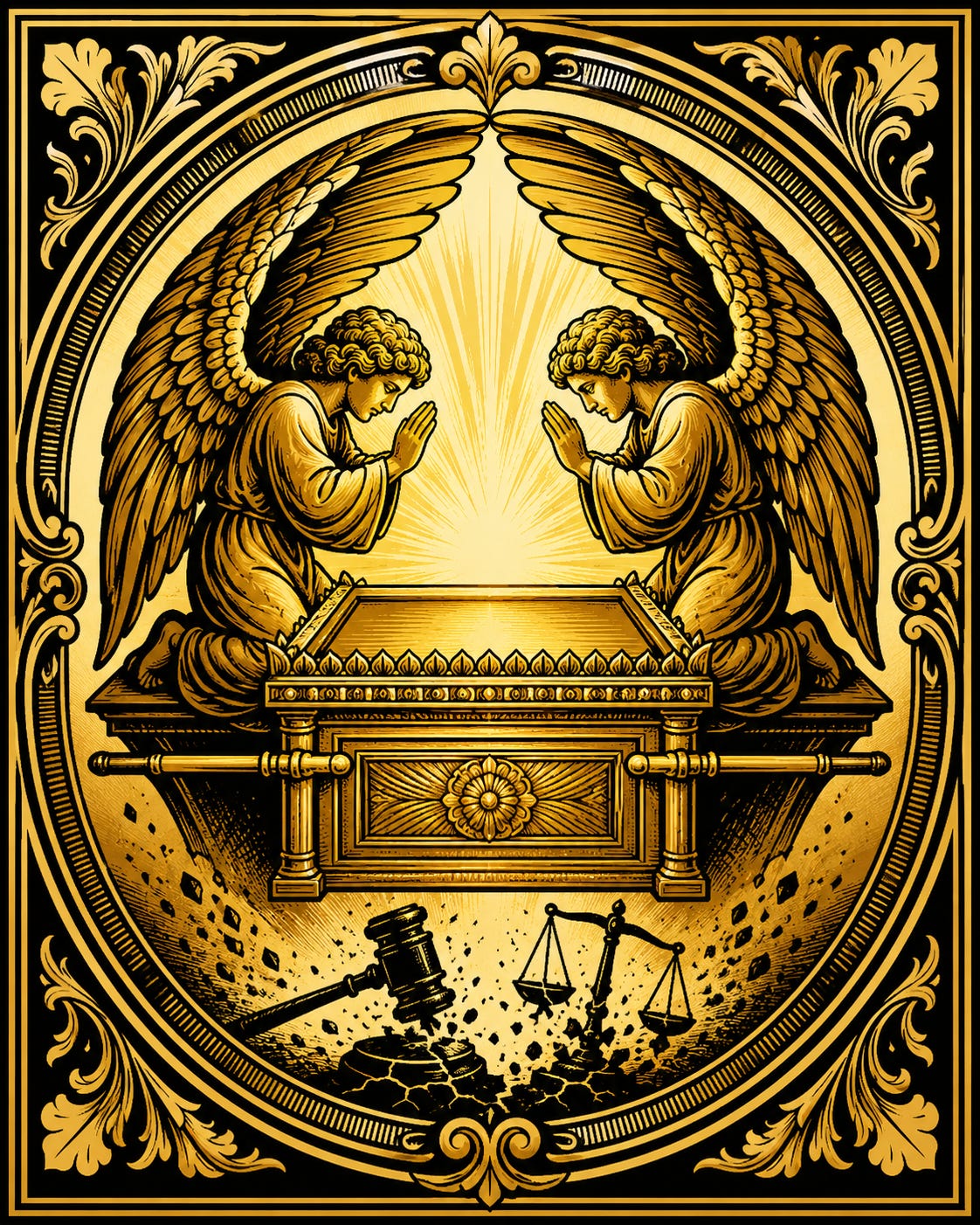
Start with the passage substitution advocates lean on the hardest. Romans 3:25 calls Christ a hilastērion, and the King James, along with most translations shaped by it, renders that word “propitiation;” the appeasing of an angry judge. But hilastērion has a specific place in the Greek Old Testament Paul had memorized long before he wrote a word of his own. It’s the standard Septuagint term for the kapporet, the golden cover of the ark of the covenant, the mercy seat, the place between the cherubim where God’s presence met Israel and where the high priest sprinkled blood once a year on the Day of Atonement (Exodus 25:22; Leviticus 16:2). English tradition still half-remembers this. When Martin Luther translated the passage into German in 1522, he reached for Gnadenstuhl, “seat of grace,” not language of appeasement, and William Tyndale followed him into English with “mercy seat.” The propitiation reading crept in later, through the Latin propitiator, and eventually hardened into the word most preachers grew up repeating without giving it a second thought.
Cambridge scholar Daniel Bailey’s dissertation on the passage makes the fuller case fort us. Paul is naming Jesus as the place where God meets humanity and atonement happens, closer to Leviticus 16 than to any kind of Roman courtroom scenario.7 That doesn’t resolve every question the verse raises, however, and the scholarly debate continues to our own day. But it means the appeasement reading generations of preachers regarded as self-evident was never as sure as it sounded from the pulpit, and even the Reformers’ own translation instincts pointed somewhere else early on.
What Paul reaches for far more often, and far more insistently, is participation. “I have been crucified with Christ,” he writes to the Galatians, “and it is no longer I who live, but it is Christ who lives in me” (Galatians 2:20, NRSVue). That’s not the language of a verdict handed down from a bench. It’s union, a shared identity, dying and rising folded into one continuous life. Romans 6 makes the same gesture at greater length: baptism as being buried with Christ so that believers might walk in newness of life, no longer enslaved to sin because they’ve died with him and been raised with him (Romans 6:3–11, NRSVue). And to the Corinthians, Paul writes plainly that anyone in Christ is a new creation, the old life gone, everything become new (2 Corinthians 5:17, NRSVue). That language describes transformation, actual and ongoing, embodied, and certainly something to keep living into rather than a legal verdict.
The verse most responsible for alien righteousness sits two chapters later in the same letter. “For our sake he made him to be sin who knew no sin, so that in him we might become the righteousness of God” (2 Corinthians 5:21, NRSVue). Read through Anselm and Calvin’s novel categories, that sounds like a straight accounting transfer, our sin moved onto Christ’s ledger, his righteousness moved onto ours. N.T. Wright reads the Greek differently. The word for “sin,” hamartia, carries a Hebraism running through the Old Testament, where the same word can also mean “sin offering,” the animal sacrificed on someone else’s behalf rather than a stand-in punished for someone else’s crime.8 And “the righteousness of God” is language Paul uses elsewhere in his letters for God’s own covenant faithfulness, not a transferable moral quality assigned to individual sinners. On that reading, Paul describes Christ functioning as the offering that deals with sin, so that those united with him come to embody that same covenant reality themselves, becoming, in Paul’s own phrase two verses earlier, ambassadors of God’s reconciling work (2 Corinthians 5:20, NRSVue).
Wright, of course, does not and will not persuade everyone. John Piper wrote a direct, book-length response defending the traditional protestant reading, and I would not attempt to hang the whole case on that one idiom anyway. But it’s enough to show the verse most responsible for the notion of imputed righteousness supports more than one careful reading of the text, and the alternative doesn’t require a courtroom scene at all.
We often called it alien righteousness back then, a phrase meant to protect the doctrine, since the righteousness credited to you was never your own; never intrinsic; it always belonged to someone else. I used that phrase constantly, confident it captured something essential. I’m no longer sure it’s as self-evidently accurate as it sounded at the time, since Paul’s own vocabulary, including the verse the doctrine leans on hardest, keeps pointing toward actual union and covenant identity instead of an entry on someone else’s legally-binding ledger.
Two Paradigms
Marcus Borg gave this contrast its clearest modern shape, in my view. In The Heart of Christianity, a book everyone ought to read, he lays out what he calls the earlier paradigm against the emerging one. The earlier paradigm treats Christian life as a matter of meeting requirements for a future reward, believing correctly, and securing an afterlife. The emerging paradigm treats Christian life as relationship and transformation, a way of being with God that changes how a person lives now rather than a transaction that determines where they go later.9 Borg wasn’t the first to notice this split, but he was one of the clearest at explaining why so many people raised inside the earlier paradigm eventually find it stops working under weight it was never built to carry. Myself included.
N.T. Wright makes a related case from a different angle in The Day the Revolution Began, arguing the Reformation, for everything it genuinely recovered, didn’t go far enough in rethinking what the cross accomplished, and that a courtroom drained of the New Exodus imagery running through the Gospels leaves the story smaller than Paul intended.10 Wright wants substitution folded back into the larger story of Israel and covenant, not extracted into an abstract transaction between God and an individual sinner. This touches on The New Perspective on Paul, which I won’t elaborate on here directly.
Peter Enns offers something different but related in its own way. He’s proof that a scholar can be formed entirely inside inerrantist, requirements-and-rewards evangelicalism, take the Bible and its historical context with total seriousness, and land somewhere the tradition that raised him never anticipated or endorsed. I recognize the shape of that path because it’s largely mine too, minus the doctorate. That trajectory is important for readers standing where I used to stand. I quoted Turretin, believed every word I said in that fellowship hall, and was certain the ground under the doctrine was as solid as the doctrine itself.
It wasn’t inherited directly from the apostles, it was inherited from an eleventh-century monk answering an eleventh-century question with eleventh-century categories, and further modified by a sixteenth-century lawyer into something harder still. The church survived a thousand years, and produced most of its theological depth, before either of these thinkers wrote a word. Hard to call something the one unchanging truth of the Christian faith when the faith ran its first millennium or so without it.
Awkward.
The Table, Not the Ledger
I don’t think the people teaching new member classes alongside me were wrong to care about grace. Reformed theology’s insistence that salvation isn’t earned, that human effort can’t purchase what only God can give, is absolutely worth holding onto. What I’ve come to think the tradition got wrong is more about where it located its center of gravity. It located the action in a ledger, a debt calculated and paid, and equated the closing of that book the gospel. Paul, and the church for a thousand years before Anselm gave it a courtroom, located the action somewhere else entirely: at a table, inside a shared life, in a transformation that keeps asking something of you for as long as you’re alive to give it.
That’s a life, not a moment or an event closed the day you believed the right thing or said the right words. Ongoing, unfinished by design. That’s a much harder gospel to fit on a brochure, granted. But I’m no longer sure that’s necessarily a mark against it.
. . .
Notes
1. Matthew 6:12, Greek text. See also discussion of opheǓlēmata versus paraptomata in the Lord’s Prayer tradition.
2. David Bentley Hart, The New Testament: A Translation (New Haven: Yale University Press, 2017), notes on Matthew 6.
3. Anselm of Canterbury, Cur Deus Homo (1098).
4. John Calvin, Institutes of the Christian Religion, 2.16.10.
5. Gustaf Aulén, Christus Victor: An Historical Study of the Three Main Types of the Idea of the Atonement, trans. A. G. Hebert (London: SPCK, 1931).
6. Athanasius, De Incarnatione 54.3.
7. Daniel P. Bailey, “Jesus as the Mercy Seat: The Semantics and Theology of Paul’s Use of Hilasterion in Romans 3:25” (PhD diss., University of Cambridge, 1999). See also Exodus 25:22 and Leviticus 16:2 in the Septuagint.
8. N.T. Wright, Justification: God’s Plan and Paul’s Vision (Downers Grove, IL: IVP Academic, 2009), 163–65. Compare John Piper, The Future of Justification: A Response to N.T. Wright (Wheaton, IL: Crossway, 2007), ch. 11, for the direct counter-argument.
9. Marcus Borg, The Heart of Christianity: Rediscovering a Life of Faith (San Francisco: HarperSanFrancisco, 2003).
10. N.T. Wright, The Day the Revolution Began: Reconsidering the Meaning of Jesus’s Crucifixion (New York: HarperOne, 2016).
Comments
Nothing yet. Say the first thing.
Sign in to join the conversation.