
In Magnifica Humanitas, dated 15 May 2026, the pope spends several paragraphs on the hidden labor behind artificial intelligence, the data labelers and content moderators, and the children crushing ore for rare earth elements, and then promptly turns the argument on his own institution. Footnote 174 lists four fifteenth-century papal documents by title, Sicut Dudum and Etsi Suscepti of Eugenius IV, Dum Diversas and Romanus Pontifex of Nicholas V, and states that the Apostolic See intervened more than once to regulate and legitimize forms of subjugation, in certain cases the enslavement of “infidels.”1 Footnote 175 adds that as late as April 1866 the Holy Office was still distinguishing moral from immoral aspects of slavery in reply to questions from a vicar apostolic, and still declining to condemn the practice outright.2 The body of the text concedes that unambiguous condemnation waited a full eighteen centuries, describes the delay as a wound in Christian memory from which the Church cannot consider itself detached, and asks pardon.3
There is, of course, a cheap way to read this statement. Nobody in Rome in 2026 pays a price for repudiating Nicholas V, and an apology issued five and a half centuries after the fact costs the issuer nothing but ink. The encyclical anticipates that objection about forty paragraphs earlier, in a passage on transparency where Leo thanks journalists for keeping clerical abuse from being swept under the rug and states that the Church should not need to be compelled by outsiders to face uncomfortable truths about itself.4 That admission is the expensive one, because the abuse crisis is the case where the institution failed at precisely the practice it is now recommending to Silicon Valley.
Still, the apology happened. The interesting question is procedural, however. Rome has a way to say we understood this incompletely and now understand it better while keeping its authority intact, and most of the Protestant world does not.
The machinery Newman built
John Henry Newman sent An Essay on the Development of Christian Doctrine to the press in late September 1845 and stopped writing it mid-argument, because he had decided to become a Catholic and the book had already answered the question that prompted it.5 Protestant polemicists kept pointing out that the Church of the fourth century looked nothing like the Church of the sixteenth. Newman rightly granted the observation and reframed the implication. Living ideas grow. A doctrine held in seed form by the apostles could take centuries to reach articulation, and the growth would count as continuity rather than corruption provided it preserved type, maintained its principles, assimilated new material without losing its essence, and showed the other marks he laid out. He called these tests in 1845 and notes in the 1878 revision.6
The apparatus does something quite specific for an institution. It creates a category for having been incompletely right, which is different from having been wrong and also different from having been correct all along. An authority with that category available to it can revise itself without conceding that it was never an authority.
Consider the case it had to handle. In 1888 Leo XIII wrote that liberty of worship, understood as the freedom of every man to profess any religion or none, gives a man the power to pervert or abandon the most sacred of duties, and that such liberty is “no liberty, but its degradation, and the abject submission of the soul to sin.”7 He closed the same encyclical by declaring it unlawful to demand, defend, or grant unconditional freedom of worship as though these were rights given by nature.8 Seventy-seven years later, Dignitatis Humanae affirmed religious liberty as a right grounded in human dignity and requiring protection in law.9 Somebody had to explain how both belonged to one teaching office, and development is what did that explaining.
The same apparatus works beautifully as a device for pretending nothing ever changed, and it has absolutely been used that way. Rome makes monopoly claims of its own, and the 1870 definition of papal infallibility is the most glaring of them. The Church that apologized for slavery in 2026 is the same Church that spent the last four decades demonstrating that having a mechanism for institutional self-examination guarantees nothing whatsoever about actually using it. Rome can perform this operation. The question is what happens in traditions that cannot.
The East, where the machinery jams
Orthodoxy has a mechanism too, and it predates Newman by a whopping fourteen centuries. Truth gets settled in council, and councils have periodically reversed their predecessors.
The clearest modern case sits in Moscow. The Great Moscow Council of 1667 anathematized the Old Believers over Patriarch Nikon’s liturgical reforms, and the persecution that followed lasted for two and a half centuries, complete with exile, imprisonment, and mass self-immolation. More than 300 years later, in 1971, the Local Council of the Russian Orthodox Church lifted those anathemas, declared the old rites pious and salvific, judged the Nikonian reforms to lack canonical and historical warrant, and treated the curses as though they had never been pronounced. Metropolitan Nikodim’s report to the council said outright that 1667 had anathematized the Old Believers based on an incorrect view of the old Russian rites.10 Six years earlier, Paul VI and Athenagoras had jointly agreed to remove the mutual excommunications of 1054 from the memory and the midst of the Church and commit them to oblivion.11
The 1971 action is a church saying that a council of the church got it wrong and did real damage to real people. A rarity indeed. It also accomplished less than it appears, however. Most Old Believer communities never returned to communion, and the Russian Orthodox Old-Rite Church’s own published assessment is blunt about why that was the case. The council said nothing about recognizing the validity of Old Rite clergy, so the gesture effectively reanimated a corpse and changed no facts on the ground. Fifty years on, the Old Rite metropolitan Korniliy turned the council’s own formula back on it, remarking that its decisions are themselves, in effect, “as if they had not been.”12 An apology that leaves the underlying exclusion in place is received as public relations, which is a lesson freely available to anyone.
The larger problem is that the mechanism for Orthodox self-correction operates at the level of the individual autocephalous church and stalls above it. The Holy and Great Council convened in Crete in June 2016, the first such gathering attempted in roughly a millennium, and four of the fourteen autocephalous churches withdrew in the final weeks. Antioch, Moscow, Bulgaria, and Georgia stayed home over the prepared documents and a jurisdictional quarrel between Antioch and Jerusalem. Moscow’s synod afterward praised the meeting as an important event in the conciliar process while denying that it could be called pan-Orthodox, and Antioch’s synod declared it preparatory and not a council at all.13 Ten years on, Bartholomew is still publicly urging the absent churches to accept its decrees.14
So the East holds a mechanism in working order for a national church and effectively dormant for the communion. Rome’s problem is an authority that can revise but rarely wants to. Orthodoxy’s problem is a communion that would have to agree before it could revise anything, and it cannot seem to ever agree.
The Protestant paradox
This is the part of my research where I, frankly, expected to find nothing much and ended up finding quite the opposite.
The Westminster Confession says, in the chapter on synods and councils, that all synods and councils since the apostles may err and many have erred, and that they are therefore not to be made the rule of faith or practice but used as a help in both.15 Fair. The framers wrote institutional fallibility into the standards. Ecclesia reformata semper reformanda has been on the letterhead of Reformed bodies for four hundred years. On paper, no tradition is better equipped to admit error.
What the tradition lacks, though, is anywhere for corporate error to land. The doctrine of Sola Scriptura holds that Scripture is sufficient and that its necessary teaching is clear enough for the ordinary reader. Grant that, and a church cannot have been corporately and inheritedly wrong for three centuries about a plain teaching, because such a thing would mean the text failed at the one job the doctrine assigns it. Error has to be somebody’s misreading. The remedy for a misreading is a better reading, which needs a body willing to hold it, which is how the Reformation’s characteristic answer to being wrong became one of departure.
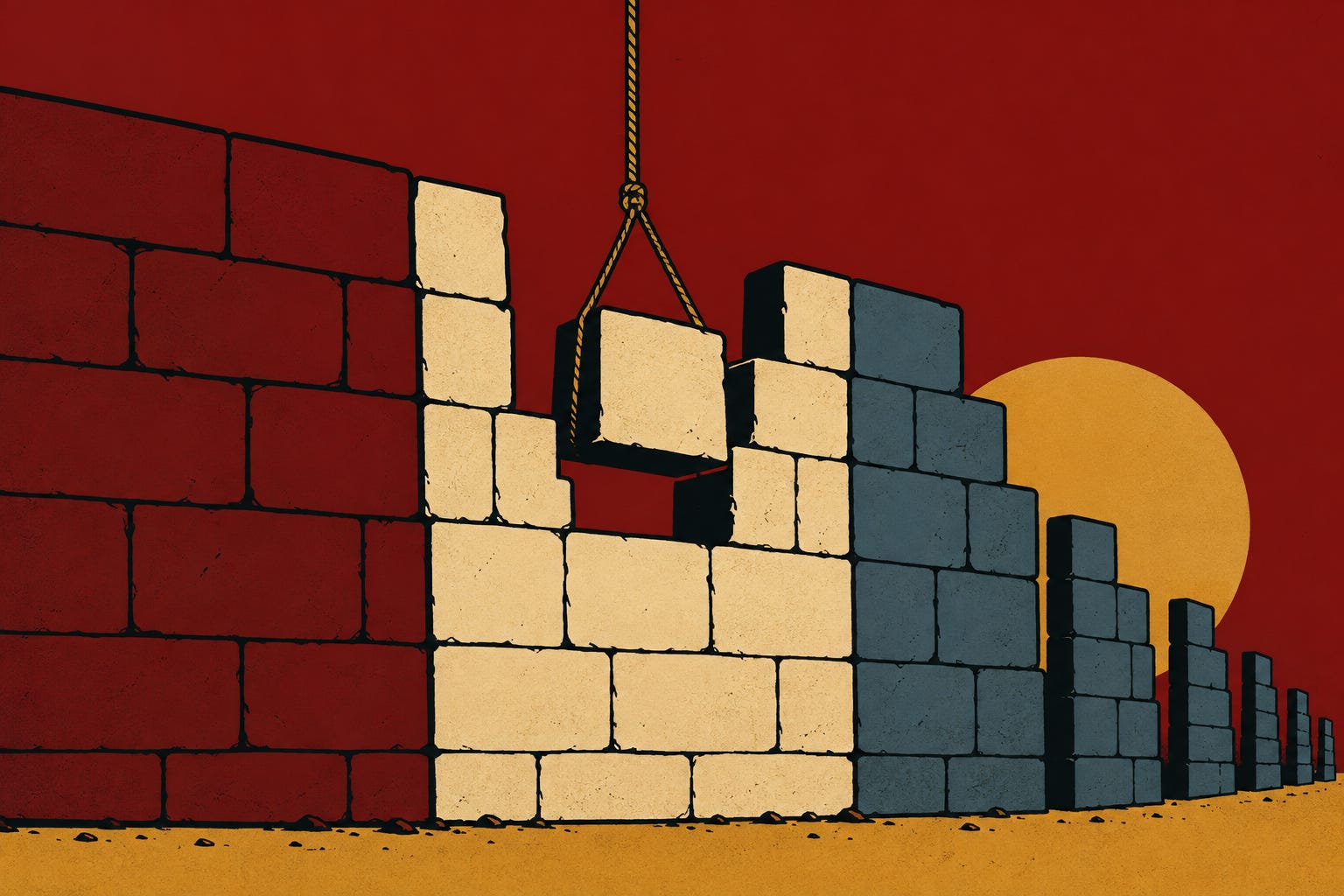
American Presbyterians ran the experiment in public.
In 1837 the Old School majority at the General Assembly abrogated the Plan of Union with the Congregationalists and ejected four New School synods, ostensibly over New England theology and revivalism, with slavery running as a current underneath the whole dispute. In 1845 the Old School Assembly declared that slaveholding was no bar to communion and that slaveholders would face no discipline, reasoning from Westminster’s own statement that God alone is Lord of the conscience. Charles Hodge had supplied the argument nine years earlier in a review essay for the Biblical Repertory, observing that the apostles received slaveholders into their congregations and demanded no manumission, and concluding that any man who calls all slavery sinful has placed himself “above the Bible.”16 In 1857 the New School’s southern synods withdrew, formally organizing the United Synod at Knoxville the following April. In May 1861, a month after Fort Sumter, the Old School Assembly adopted the Gardiner Spring Resolutions pledging loyalty to the federal government, the southern commissioners left over what they called a political test for church membership, and the Presbyterian Church in the Confederate States of America held its first General Assembly that December in Augusta, merging with the United Synod in 1864 to become the Presbyterian Church in the United States.17 Four denominations stood where one had stood in 1837, a span of less than 30 years. The northern Old and New Schools reunited in 1869. The PCUS and the PCUSA waited all the way until 1983.
Look at what never happened across that entire sequence. No assembly said the church had taught wrongly. The doctrine of the spirituality of the church, which holds that the church has no competence over questions Scripture does not settle, did more than provide ample cover. It followed straight from the premises. If Scripture is clear and sufficient, and if Scripture does not plainly forbid slaveholding, then the matter has left the church’s jurisdiction and corporate guilt has nowhere to attach. Sola scriptura did not fail to produce an answer here. It produced one, and the answer rendered the question of institutional sin unaskable.
The arithmetic is available to anyone who wants it. NAPARC, the council where theologically conservative Presbyterian and Reformed denominations in North America keep company, started in 1975 with five member bodies and now lists somewhere around a dozen, depending on which year’s roll you consult.18 That count leaves out the PCUSA, the EPC, ECO, the Cumberland Presbyterians, and a long tail of smaller bodies that would fill another page. In 1997 NAPARC suspended the Christian Reformed Church, one of its own five founders, over the decision to ordain women. Even the council built to demonstrate that these churches belong together runs the mechanism on its own membership.
Two resolutions and the argument underneath them
Two American cases show the machinery straining toward something else.
In June 1995, at its sesquicentennial meeting in Atlanta, the Southern Baptist Convention adopted a resolution on racial reconciliation that repudiated slavery, acknowledged the role slavery played in the denomination’s founding in 1845, and apologized to African Americans for condoning and perpetuating racism. It passed overwhelmingly, by Richard Land’s later recollection, with something near ninety-eight percent, and made the front page of the New York Times.19 Gary Frost, the convention’s second vice president, accepted the apology on behalf of Black Christians from the floor.20
Twenty-one years later the Presbyterian Church in America did basically the same work with more difficulty. A personal resolution from Sean Michael Lucas and Ligon Duncan came to the 43rd General Assembly in 2015 and was referred rather than adopted. Over the following year, some forty presbyteries submitted overtures in response. At the 44th General Assembly on 23 June 2016, Overture 43 from Potomac Presbytery passed 861 to 123 with 23 abstentions, recognizing, confessing, condemning, and repenting of corporate and historical sins including segregated worship, racial exclusion from membership and presbytery, the teaching that the Bible sanctions segregation and discourages interracial marriage, and participation in white supremacist organizations.21
Both resolutions are real, and I have no interest in diminishing them. What holds my attention, though, is the argument that had to be won first. Land’s account of the 1995 process describes people telling him we are not Mormons; we cannot repent for our ancestors.22 The 2015 PCA debate produced the same objection in Presbyterian vestments, asking whether commissioners were culpable for the sins of their forefathers and how a denomination founded in 1973 could confess sins committed before it even existed.
Overture 43 answers that objection, and the answer is the most telling document in this entire essay. Its rationale reaches back to the 1973 “Message to All the Churches,” in which the PCA’s founding generation declared their denomination the continuing church of the PCUS, and uses that self-description as the warrant for corporate repentance.23 A denomination had to quote its own founding press release to establish that it was continuous with its past.
Rome has an instrument for this. The PCA, apparently, had a paragraph from 1973 and a floor vote.
In essentials, unity
I spent fourteen years as a ruling elder in the Evangelical Presbyterian Church, whose motto reads in essentials, unity; in non-essentials, liberty; in all things, charity. The line is usually traced to Rupertus Meldenius in the seventeenth century, and it sounds like prudent modesty. In practice it is a boundary, however, because someone has to sort each question into a column and whoever holds that pen holds the denomination.
Nothing overly dramatic happened during my tenure. The arguments I sat through were the ordinary ones: whether an elder or deacon had to affirm Reformed theology to serve, and the complementarian and egalitarian question that ran hot through the denomination during those years. What I notice looking back is where I was standing. I argued the complementarian side back then, so this is not the story of a man who saw the trap because he was on the losing end of it. The sorting looked correct to me from inside the boundary, which is how it looks to everyone inside the boundary. That’s how it’s supposed to work. That is what the doctrine produces. A body whose authority rests on a text it believes plainly teaches what the body already holds has no available position from which to be the party in error.
Convenient to say the least.
Leo XIV writes in the same encyclical that the Church claims no monopoly on truth, quoting himself from an address in May 2025, and adds that truth is a good to be shared rather than territory to be defended.24 The sentence sounds good, but also invites a raised eyebrow, given the institution issuing it and the 1870 definition sitting in the background. Set that aside and consider what allows the sentence to be written at all. It requires a tradition able to imagine its own past errors as actual errors. Development gives Rome that imagination whether or not Rome uses it. Conciliarity gives the East a version that works within a nation and freezes up between them. Sola scriptura gives the Protestant world an explicit statement of fallibility (at least at the level of interpretation and rule) and no place to file the resulting confession, so the confession becomes a schism, and the schism becomes a new body certain it has finally gotten the reading right.
The pattern will hold. Traditions that cannot say they were wrong for three hundred years keep finding out that they were, and keep handling it the only way they know. Somewhere right now a presbytery is drafting the overture that will become the next denomination, and the men writing it are certain they are the ones who were faithful and stayed. It’s those other guys.
Endnotes
1. Leo XIV, Magnifica Humanitas (15 May 2026), n. 176, footnote 174. The footnote groups the four documents under “regulate and legitimize,” which covers a range. Sicut Dudum (1435) forbade the enslavement of baptized Canary Islanders, while Dum Diversas (1452) and Romanus Pontifex (1455) authorized Portuguese enslavement of Saracens and pagans. The encyclical’s own footnote does not distinguish among them.
2. Ibid., footnote 175, citing an Instruction of the Holy Office of April 1866 responding to questions submitted by Monsignor Massaia, vicar apostolic in the country of the Galla.
3. Ibid., n. 176.
4. Ibid., n. 138.
5. John Henry Newman, An Essay on the Development of Christian Doctrine (London, 1845). Newman sent the manuscript to press in late September 1845; the Advertisement is dated 6 October, three days before he was received into the Catholic Church.
6. Newman called the seven criteria “tests” in the 1845 edition and “notes” in the 1878 revision. They are preservation of type, continuity of principles, power of assimilation, logical sequence, anticipation of its future, conservative action upon its past, and chronic vigor.
7. Leo XIII, Libertas Praestantissimum (20 June 1888), 20.
8. Ibid., 42.
9. Second Vatican Council, Dignitatis Humanae (7 December 1965), 2.
10. Local Council of the Russian Orthodox Church, Trinity Lavra of St. Sergius, 30 May to 2 June 1971, abolishing the anathemas on the old rites issued by the Great Moscow Council of 1667. The council’s acts appear in Zhurnal Moskovskoi Patriarkhii (Journal of the Moscow Patriarchate), 1971, no. 6, with Metropolitan Nikodim (Rotov)’s report in no. 7.
11. Joint Catholic-Orthodox Declaration of Pope Paul VI and Ecumenical Patriarch Athenagoras I, 7 December 1965, 4(B), read simultaneously in St. Peter’s and at the Phanar on the day before the close of Vatican II.
12. Metropolitan Korniliy of Moscow and All Russia, Russian Orthodox Old-Rite Church, interview marking the fiftieth anniversary of the 1971 council, en.rpsc.ru.
13. Tom Heneghan, Religion News Service, reporting the Moscow Patriarchate’s July 2016 synodal response to the Crete council; and the Antiochian synod’s statement characterizing the meeting as preparatory.
14. Ecumenical Patriarch Bartholomew, address at the Church of the Holy Trinity, Stavrodromi, Constantinople, 1 June 2026.
15. Westminster Confession of Faith, ch. 31. Numbered 31.4 in the original and 31.3 in the American revision.
16. Charles Hodge, “Slavery,” Biblical Repertory and Theological Review 8, no. 2 (1836), reviewing William Ellery Channing’s Slavery; reprinted in Hodge, Essays and Reviews (New York, 1857). Hodge maintained this position through 1865, writing that he held precisely what he had held in 1836.
17. On the 1837 ejection of the New School synods, the 1857 withdrawal of the New School’s six southern synods, the organization of the United Synod at Knoxville on 1 April 1858, the Gardiner Spring Resolutions of May 1861, the first General Assembly of the PCCSA at Augusta on 4 December 1861, and the 1864 merger forming the PCUS, see the PCA Historical Center’s document collection at pcahistory.org, which holds the text of the Spring Resolutions. See also Harold M. Parker Jr., The United Synod of the South: The Southern New School Presbyterian Church.
18. The North American Presbyterian and Reformed Council was formed at Beaver Falls, Pennsylvania, in 1975 with five founding members: the Christian Reformed Church in North America, the Orthodox Presbyterian Church, the Presbyterian Church in America, the Reformed Presbyterian Church Evangelical Synod, and the Reformed Presbyterian Church of North America. The RPCES merged into the PCA in 1982, and the CRCNA’s membership was suspended in 1997 following its 1995 decision to open the offices of elder and minister to women.
19. Richard Land, “Richard Land on the 1995 Racial Reconciliation Resolution,” ERLC, 2 June 2025.
20. “A Review of the Southern Baptist Convention’s Progress on Racial Reconciliation, 1995–2015,” SBC Voices, June 2015.
21. Overture 43, “Pursuing Racial Reconciliation and the Advancement of the Gospel,” 44th General Assembly of the Presbyterian Church in America, 23 June 2016.
22. Land, ERLC.
23. Overture 43, rationale, citing the PCA’s 1973 “Message to All the Churches” and its description of the denomination as the “continuing church” of the PCUS.
24. Magnifica Humanitas, n. 25, quoting Leo XIV, Address to the Members of the “Centesimus Annus Pro Pontifice” Foundation (17 May 2025).
Comments
Nothing yet. Say the first thing.
Sign in to join the conversation.