
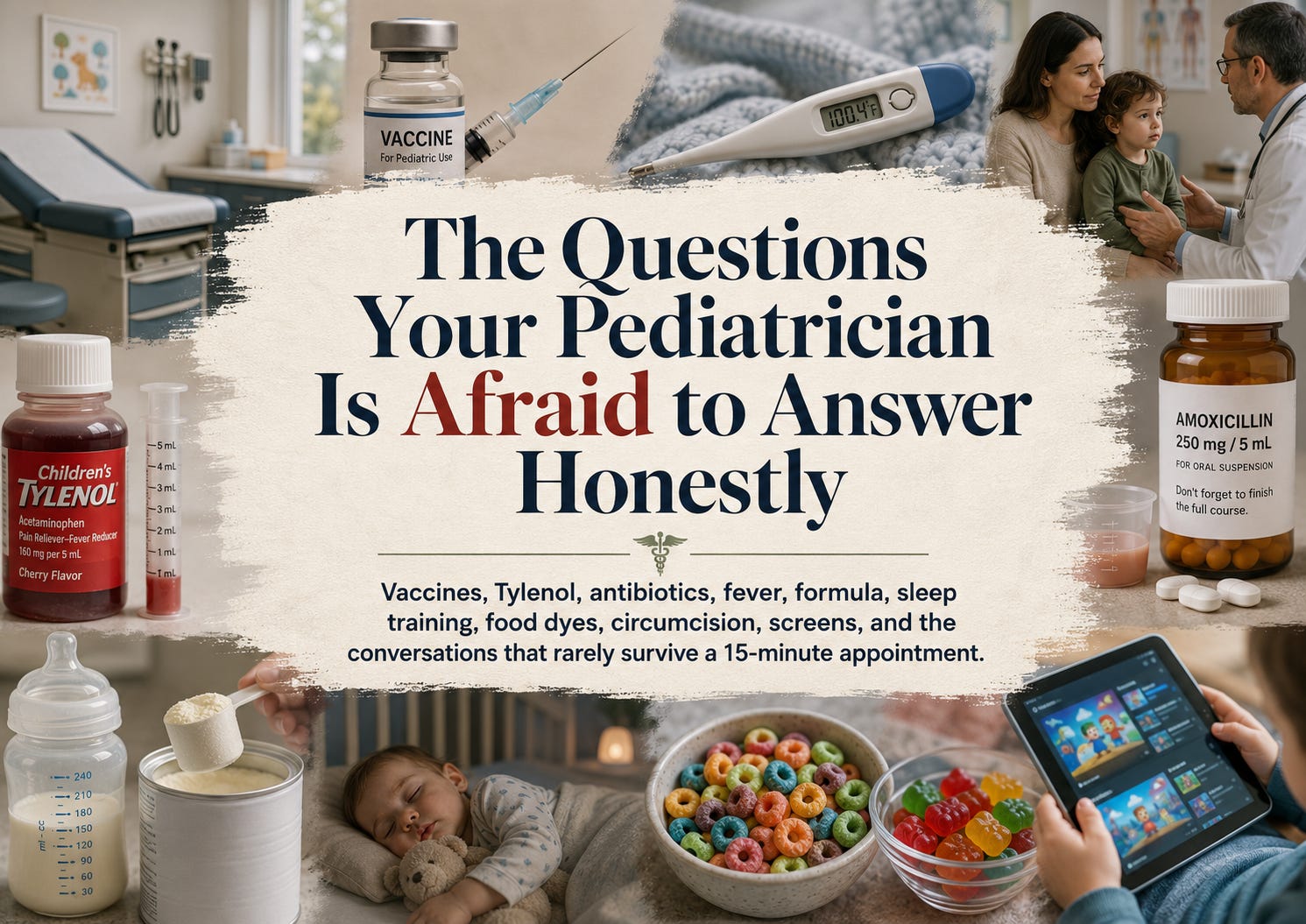
Let me start with something that may surprise parents:
Most pediatricians are not secretly sitting on a collection of forbidden answers.
There is no hidden pediatric vault where we store the uncensored truth about vaccines, fever, formula, sleep training, food dyes, circumcision, Tylenol, antibiotics, and whether your child truly needs to wear sunscreen during the seven-minute walk from the house to the car.
The bigger problem is often time and curiosity.
A well-child visit is supposed to cover growth, development, nutrition, sleep, physical activity, dental health, vision, hearing, school, behavior, mental health, family stress, safety, medications, screening questionnaires, the physical examination, recommended laboratory testing, vaccines, and whatever problem the child has developed since entering the parking lot.
Then, as the doctor’s hand touches the doorknob, a parent says:
“One more quick question. Do vaccines cause autoimmune disease?”
Quick question.
Of course.
Let me just cancel the next six appointments and bring in a whiteboard.
The American Academy of Pediatrics’ preventive-care schedule includes an extensive collection of screenings, assessments, procedures, counseling topics, and immunizations across childhood. Research has found that about one-third of parents reported spending no more than 10 minutes with the clinician at their child’s most recent well visit, while nearly half reported 11 to 20 minutes. Longer visits were associated with more developmental screening, psychosocial assessment, anticipatory guidance, and family-centered care.
The average visit in that study was approximately 18 minutes.
Eighteen minutes is enough time to confirm that your child has a heart, two lungs, and an impressive ability to remove every piece of paper from the examination-table dispenser.
It is not enough time for a thoughtful discussion about the strengths and weaknesses of vaccine-safety monitoring, whether your child’s behavioral symptoms could be related to sleep, or why the pediatrician is recommending an antibiotic while simultaneously telling you that most childhood infections are viral.
So the conversation gets compressed.
“Vaccines are safe.”
“Fever is not dangerous.”
“Breast is best.”
“Formula is fine.”
“Do not co-sleep.”
“Limit screens.”
“Give Tylenol.”
“Do not give Tylenol.”
“Eat a balanced diet.”
“Come back in a year.”
None of those statements is entirely useless. Most contain some truth. But they are rarely the complete truth. And parents can sense that. They know when a complicated question has been answered with a slogan. They know when a concern has been dismissed rather than explored. They know when they are being managed instead of heard.
Sometimes their concern is based on poor information. Sometimes the pediatrician is right. Sometimes the parent is right. And sometimes everyone is arguing loudly while the child quietly eats a crayon in the corner.
In the complete article, I answer the questions that can make a pediatric appointment suddenly feel like a presidential debate:
Are pediatricians truly informed about every vaccine they recommend?
Is it reasonable to ask about delaying, spacing, or declining a vaccine?
Does “safe and effective” mean there are no meaningful risks?
Are we too quick to give babies and children acetaminophen?
Should every fever be treated—or are we treating the thermometer?
Are antibiotics overprescribed, and when are they genuinely necessary?
Is breastfeeding always better, and why does the conversation create so much guilt?
What is actually in infant formula, and should parents worry about seed oils, corn syrup, or heavy metals?
Is sleep training harmful, helpful, or simply another parenting issue turned into a moral identity?
Is bed-sharing always reckless—or are we refusing to discuss what families are already doing?
Is circumcision medically necessary, beneficial, harmful, or primarily a cultural choice?
Are food dyes affecting children’s behavior?
Do children with ADHD need medication, or are we medicating normal childhood?
Are screens damaging children’s brains—or are parents being given unrealistic advice by people who have apparently never needed to make dinner?
Should children wear sunscreen every time they step outside?
Are pediatricians too dismissive of supplements, nutrition, toxins, and lifestyle?
What questions should parents ask without being immediately labeled “anti-science”?
The goal is not to tell every family to make the same decisions.
It is to explain why reasonable parents—and reasonable physicians—sometimes look at the same evidence and come to different conclusions.
Because informed consent does not mean the doctor talks and the parent obeys.
It also does not mean every viral claim deserves equal weight.
It means we are allowed to have an adult conversation.
Comments
Nothing yet. Say the first thing.
Sign in to join the conversation.