
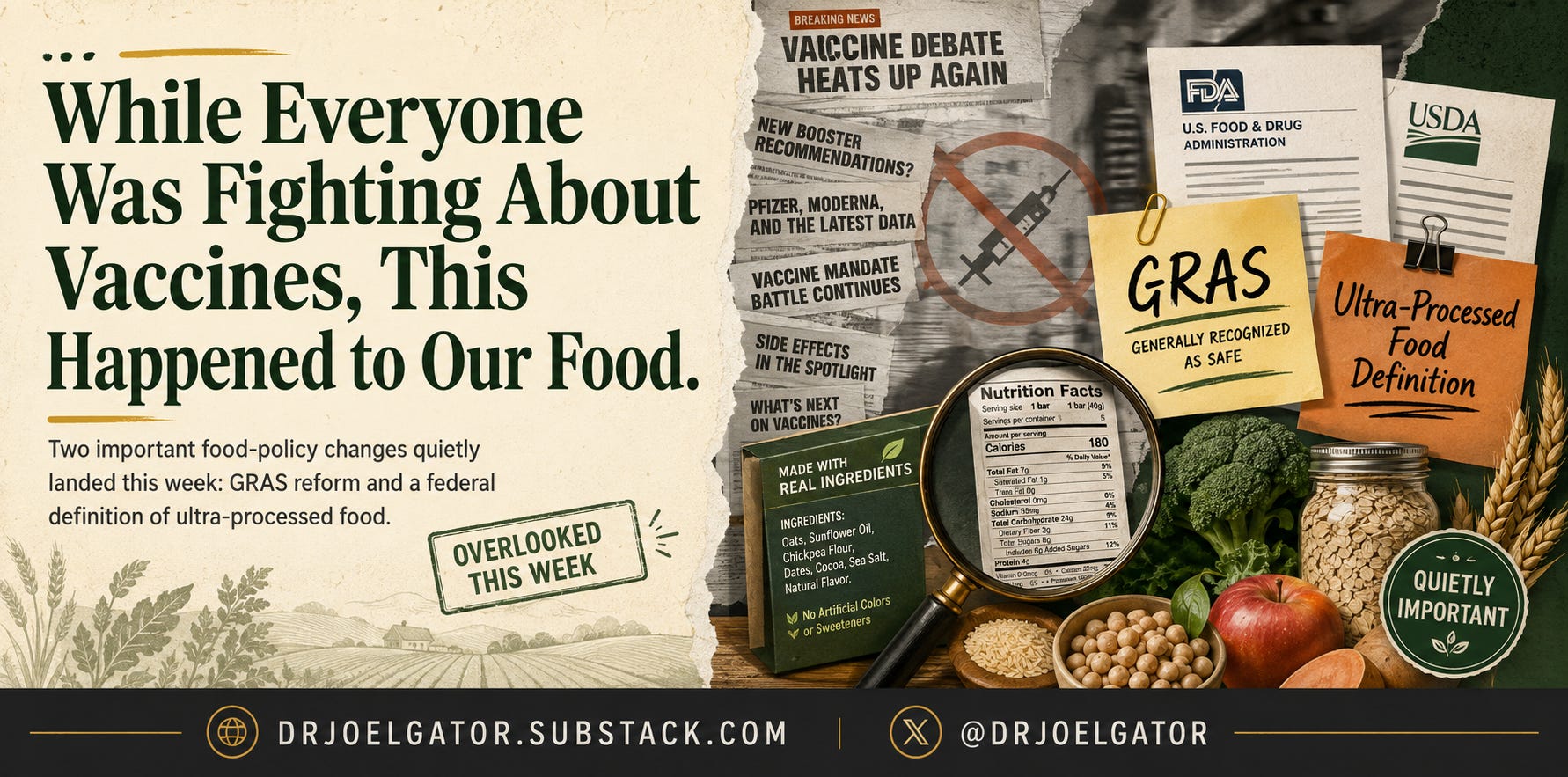
If you spent Monday online, you could be forgiven for believing that absolutely nothing happened in American health policy other than vaccines. President Trump dropped his executive order, the internet immediately divided into approximately 47 different camps, physicians started arguing with one another, medical-freedom accounts started celebrating, public-health accounts started panicking, and somewhere a perfectly innocent family group chat was probably destroyed forever. Vaccines have a remarkable ability to consume every molecule of oxygen in the room. You could announce that scientists had discovered broccoli cures baldness and nobody would notice if somebody mentioned MMR five minutes earlier.
The strange part is that on the exact same day, the administration announced two food-policy developments that I think deserve considerably more attention than they received. HHS announced that the FDA is proposing a major change to the way the federal government oversees substances that companies classify as “Generally Recognized as Safe,” or GRAS, and HHS and USDA also said they have submitted the federal government’s first proposed definition of “ultra-processed food” for final review. Neither development is finished policy yet, and we should be very clear about that, but these are exactly the kinds of boring-sounding structural changes that can ultimately matter much more than a viral headline.
Let’s start with GRAS, because nothing says “exciting parenting content” quite like a four-letter FDA regulatory acronym. GRAS stands for Generally Recognized as Safe, and the concept itself makes sense. Congress created the exemption in 1958 so that substances already broadly understood by qualified experts to be safe under their intended conditions of use would not necessarily have to go through the same premarket approval process as a brand-new food additive. FDA explains that ingredients added to food ordinarily require premarket review unless they qualify for an exemption such as GRAS. Salt probably does not need a 900-page dossier every time somebody wants to put it on a cracker. Baking soda is unlikely to suddenly reveal its secret plan for world domination.
The problem is what happened to the system over time. Under the current framework, companies have been able to make their own GRAS determinations without being required to notify FDA. FDA has operated a voluntary notification program, but notification itself has not been mandatory. HHS now openly acknowledges that information gap: companies could conclude on their own that a substance was GRAS and introduce it into food without necessarily telling the agency. For parents who have ever looked at an ingredient list and wondered, “Who exactly decided this thing with 14 syllables was okay to put in my kid’s cereal?” the answer has sometimes essentially been: the manufacturer and the experts it relied upon.
That does not automatically mean every self-affirmed GRAS ingredient is dangerous. It does not mean companies are sprinkling mystery poison into Goldfish crackers under cover of darkness. GRAS determinations are still supposed to meet a scientific safety standard, and FDA states that general recognition of safety through scientific procedures requires the same quantity and quality of scientific evidence needed for food-additive approval. The problem has been transparency and oversight. If the regulator does not even necessarily know which substances are entering the food supply under self-determined GRAS status, it becomes considerably harder to monitor the system, reassess emerging concerns, or even maintain a complete inventory of what is out there.
The proposed rule announced Monday would change that. Manufacturers would have to notify FDA whenever they conclude that a substance added to human or animal food is GRAS, and the public-facing inventory of notices would expand. Importantly, the proposal would not apply only to new ingredients going forward. For substances already being used under industry self-GRAS conclusions, FDA is proposing a time-limited streamlined process for manufacturers to submit information about those existing uses as well. In plain English, the government is essentially saying: if you are putting something into the food supply because you concluded it is generally recognized as safe, we would now like you to tell us that you did that. This seems like the sort of revolutionary regulatory concept that might have occurred to someone before 2026, but better late than never.
I like this direction. I have talked for years about the bizarre double standard in American health culture where parents are sometimes treated as irrational for worrying about ingredients while our actual regulatory system has contained enormous blind spots around how some of those ingredients enter the marketplace. We should not fear every chemical because it has a difficult-to-pronounce name, and “natural” does not automatically mean safe any more than “synthetic” automatically means dangerous. But transparency should be the floor. If something is being added to the food supply and consumed repeatedly by millions of people, including children, FDA should at least know that it exists and why the manufacturer believes the use is safe.
There is also an important reality check here: the administration has proposed this rule. It has not magically become permanent law because HHS held a press conference. FDA opened the proposal for public comment, and HHS itself is encouraging Congress to go further through legislation. That distinction matters, particularly after a week in which we have all apparently decided that every executive announcement instantly rewrites America before lunch. Policy generally moves slower than Instagram. Sometimes much slower. Often at approximately the speed of a toddler putting on shoes.
This has been needed for a long time because everybody now uses the phrase “ultra-processed,” yet there is still no single authoritative U.S. government definition. FDA, USDA, and HHS began formally gathering information last year specifically because inconsistent definitions make research and policy harder to compare.
This sounds like semantics until you think about what happens once the government actually defines something. Labels can reference it. Researchers can measure it consistently. Schools can build procurement rules around it. Government food programs can potentially distinguish between categories of foods. Dietary guidance becomes easier to translate into actual policy. You cannot meaningfully regulate “ultra-processed food” if six agencies, twelve universities, three nutrition researchers, and your neighbor Karen all mean something different when they say it.
And to be clear, again, the definition has not yet been released publicly. HHS said Monday that the proposed definition was submitted for final review after input from thousands of stakeholders. So anyone online currently explaining exactly which foods the new federal definition includes is showing impressive confidence in a document they have not seen. We should probably wait for the actual words before starting the national war over whether Greek yogurt is technically an ultra-processed weapon of metabolic destruction.
The complexity here is real. Not every processed food is unhealthy. Frozen vegetables are processed. Yogurt is processed. Olive oil is processed. Canned beans are processed. Pasteurization is processing. The meaningful question is not whether humans touched the food between the farm and your kitchen. The debate around ultra-processing is generally trying to identify industrial formulations that are substantially removed from intact foods and often contain combinations of refined ingredients and additives designed for convenience, shelf life, texture, flavor, and palatability. The government’s reason for wanting a single definition is specifically to create consistency in future nutrition research and policy.
That matters because the American diet has moved dramatically toward these foods. HHS says nearly 60% of the American diet now comes from ultra-processed foods, while the earlier FDA announcement noted estimates that roughly 70% of packaged products in the U.S. food supply are foods often considered ultra-processed and that children receive more than 60% of their calories from them. Whatever final definition the government eventually adopts, that is not a fringe nutritional issue. That is basically the supermarket.
The administration had already moved federal dietary guidance toward what is, in my opinion, a refreshingly simple message earlier this year: eat more real food. The 2025–2030 Dietary Guidelines released in January emphasized whole foods, vegetables, fruits, protein, whole grains and healthy fats while recommending reductions in highly processed foods, added sugars, refined carbohydrates and artificial additives.
What I especially appreciate about this week’s announcements is that they target systems rather than simply lecturing parents. It is easy to tell a mother to “make healthier choices” while giving her a supermarket where the majority of shelf space is filled with intensely marketed packaged foods, ingredient oversight is incomplete, labels require detective work, and companies have entire departments dedicated to making products irresistible to children. Then when the child wants neon cereal instead of broccoli, we congratulate ourselves for having educated the parent.
Parents have responsibility, of course, but the environment matters. If we want families to eat better, it helps to make the food environment better too. Better ingredient transparency helps. Better definitions help. Better research helps. Reexamining chemicals already in the food supply helps. Giving people clearer information helps. None of this requires banning birthday cake or forcing children to celebrate Halloween with celery. We can have a functioning society and occasionally eat a cookie.
I also think these developments are worth highlighting because they represent the part of the MAHA agenda where there should be an enormous amount of common ground. You do not have to like Kennedy. You do not have to like Trump. You do not have to own a red hat, a blue hat, or any hat other than the one you panic-bought because your child suddenly needed something for “Hat Day” at school at 7:42 in the morning. Greater transparency around food ingredients should not be particularly partisan. Establishing a consistent scientific definition for a category of foods that researchers are already studying should not be partisan either.
We can argue about the eventual details. We should. Perhaps the GRAS proposal will not go far enough. Perhaps FDA will need additional authority from Congress to meaningfully review every ingredient rather than merely receive notifications. Perhaps industry will challenge parts of the rule. Perhaps the eventual ultra-processed food definition will be too broad, too narrow, or accidentally classify Grandma’s homemade sourdough as a Schedule I controlled substance. Those debates will come once we see the final language.
But right now I think it is worth recognizing progress when it occurs.
Vaccines consumed the news cycle this week because vaccines always consume the news cycle. They are political gasoline. Somebody drops a match and suddenly nobody remembers we were having another conversation.
Meanwhile, quietly in the background, the administration took a step toward ending a system in which manufacturers could make GRAS determinations without mandatory FDA notification, and moved the government closer to having a standardized definition for ultra-processed foods for the first time.
Those may not generate as many screaming news panels.
Personally, I am okay with that.
Sometimes the least exciting policy announcement is the one that actually has a chance to improve what ends up on our children’s plates.
And after the week we have had, I would happily spend a little less time talking about syringes and a little more time talking about lunch.
Thanks for reading Dr. Gator - Between a Shot and Hard Place! This post is public so feel free to share it.
This article is commentary and is for general educational purposes only. It is not medical advice.
No posts
Comments
Nothing yet. Say the first thing.
Sign in to join the conversation.