
I was recently on a plane and clicked on a movie that looked light and fun—basically an adventure about two kids traveling across the country to see their grandfather after running away from home, getting into all sorts of hijinks along the way. Perfect airplane movie. Easy. Harmless. Or so I thought. I was blissfully unaware until near the end that one of the children was not actually alive at all. He was a figment of the other child’s mind, and the child had been carrying his brother’s ashes the entire time. So yes, that was the moment the movie went from “cute little road-trip adventure” to me sitting in seat 14A trying not to openly sob next to a complete stranger while pretending I had something in my eye. Once the realization hit that this whole journey was really about grief, loss, and a child trying to hold onto his brother, I absolutely lost it. Parenthood has apparently made me incapable of emotionally surviving surprise dead-child plot twists at 30,000 feet.
Not every movie, obviously. I am not sitting there sobbing because someone totaled a Lamborghini in Fast & Furious 19. But give me a dying dog, a parent saying goodbye, a kid in a hospital bed, or some soft piano music under a scene where everybody suddenly realizes what really matters, and I am probably done.
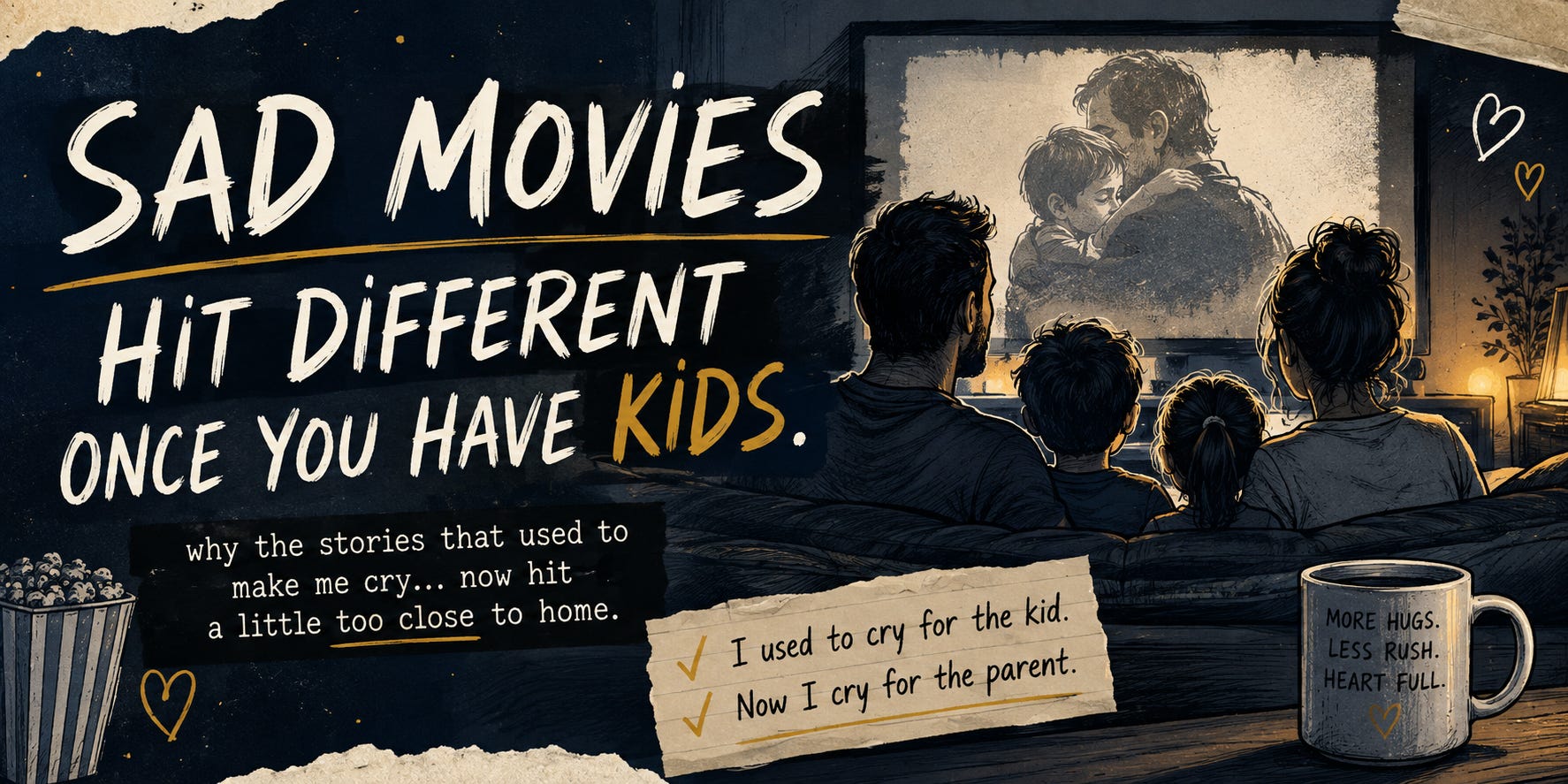
I used to think that was just me being emotional, but what has been interesting is how the feelings have changed over the years, and especially how it has changed since becoming a parent. The movie itself can be exactly the same, but I am no longer watching it from the same place. Somewhere along the way, I stopped identifying mostly with the child in the story and started identifying with the parent standing next to them.
When you are younger, you naturally see the story through the kid. The teenager who feels misunderstood. The child who is scared. The young person who loses a parent. You know that role because you have lived it. Then one day you watch the same kind of scene and realize your brain has switched sides without asking permission. Suddenly you are not thinking, “That poor kid.” You are thinking, “What would I do if that were my child?” And that is a much more dangerous question to ask if your goal was simply to relax for two hours with popcorn.
A child gets sick in a movie and I no longer just see the child. I see the parent sitting beside the bed pretending not to be terrified. I imagine the conversations in the hallway. The fake reassurance. The desperate bargaining that probably happens in your own head when something truly awful is unfolding. Please let this be okay. I will never complain about bedtime again. I will happily listen to the same story 400 more times. I will stop being annoyed about the crackers permanently embedded in the back seat. Just let them be okay. Then the movie keeps going as if it has not just emotionally mugged you in your own living room.
Cancer stories especially hit differently now because you start putting yourself into every role. When I was younger, I mostly thought about the person who was sick. Now I also think about the spouse sitting beside them, the parent hearing a diagnosis they never imagined would apply to their child, or the kids trying to understand why mom or dad suddenly looks different and everyone keeps whispering in the kitchen. And because the human brain is apparently not satisfied with simply watching fiction, it immediately starts inserting your own family into the story. What if that were me? What if that were my wife? What if that were one of my kids? Fantastic. I purchased a movie and received an unsolicited existential crisis at no additional charge.
The same thing happens with stories about death in general. You think about your parents getting older. You think about your own mortality. You think about all the boring little pieces of life that would suddenly become enormous if they disappeared. The morning routine. The school pickup. The ridiculous bedtime negotiation. The shoes left in the middle of the hallway even though apparently we have discussed shoes approximately 9,000 times. The things that can annoy you on Tuesday suddenly seem incredibly precious when a movie reminds you they are temporary.
This is probably the biggest difference for me. A child dying in a movie was always sad, obviously. But after having kids, it almost becomes physically difficult to watch. You cannot help seeing your own child in that story. The age can be different. The child can look nothing like yours. The circumstances can be completely unrelated. It does not matter. Your brain makes the connection anyway. Suddenly the empty bedroom in the movie looks like your child’s bedroom. The stuffed animal on the bed means something. The tiny shoes by the door mean something. A parent walking into a room that still looks exactly the way their child left it can destroy you in about four seconds.
At that point I am no longer appreciating the acting or cinematography. I am just thinking, Who wrote this and why do they hate parents? I would genuinely support a streaming setting that says, “No dead kids, no dead dogs, no terminally ill parents. I have work tomorrow.” We have parental controls for children. I would like emotional controls for parents.
I think that is ultimately why sad movies hit harder as we get older. It is not necessarily that we become more emotional. It is that we have more places for the emotion to land. Your life expands. You build a family. You create routines. You develop these tiny traditions that would mean absolutely nothing to anyone else but somehow mean everything to you. The Saturday morning pancakes. The weird song your kid always asks for in the car. The way they mispronounce a word that you know they will eventually pronounce correctly and, strangely, you will miss it. The sleepy child you carry from the car who somehow weighs 400 pounds only when unconscious.
When you are younger, loss is often something you understand intellectually. As a parent, you know exactly what it would interrupt. You know what would be missing. That changes the way you watch a story because now the story has coordinates. You can picture the house. The bedroom. The dinner table. The silence where noise used to be. That is what makes it hit so differently.
There is another funny thing that happens as you get older: the adults in movies suddenly seem far less unreasonable. When I was a kid, parents in movies mostly existed to ruin everything. “No, you cannot go to that party.” “Be home by ten.” “You have school tomorrow.” Terrible people. Absolutely oppressive.
Now I watch those same scenes and think, That seems pretty reasonable. The teenager wants to disappear at midnight with someone they met three days ago and the parent says no, and suddenly I am on the couch nodding like a judge. Correct. Absolutely not. Go to bed.
You start understanding why the dad is worried, why the mom is hovering, why the parent sometimes makes the wrong call even though they are trying desperately to make the right one. You understand that a lot of what looks like control to a child feels like responsibility to a parent. You remember wanting freedom, but you now also understand the terror of being responsible for another human being whose frontal lobe is still apparently under construction.
That perspective shift is probably one of the strangest parts of growing up. You start realizing that both sides of the story can be true. The teenager can feel suffocated and the parent can be terrified. The child can want independence and the parent can know how fragile life can be. The kid can think the rule is ridiculous and the adult can be making the best decision they know how to make. Parenting makes movies sadder, but it also makes them more complicated.
I sometimes wonder if that is part of what aging really does. We accumulate roles. First you understand the story as the child. Then you understand it as the adult. Then as the parent. Eventually maybe as the grandparent. The same scene keeps changing because you keep changing.
That is probably why a movie you watched at 18 can feel completely different at 40. The script has not changed. You have. You have loved more people. Lost more people. Worried about more people. You have had more moments where you suddenly realize how little control you actually have over the things you care about most.
And that is uncomfortable, but I also think it is beautiful in a strange way. You become more capable of understanding other people’s fear because you now have your own version of it. You understand why someone might panic. Why they might overreact. Why they might cling too tightly. Why they might struggle to let go. You know what it feels like to love something enough that losing it feels unimaginable.
I still cry at movies. Probably more than I used to. But now I often realize I am crying for different reasons. I used to cry because something sad happened to a character. Now I cry because the story reminds me of my own life.
That may be the cruelest part. You spend years wishing your child would sleep through the night, tie their own shoes, stop waking you at 5:42 a.m., and then one day they do all of those things and some part of you misses the version of them who needed you that much. Parenthood seems to involve spending half your time trying to get to the next stage and the other half wishing you could briefly go backward.
So when a movie shows a parent losing a child, or a family facing cancer, or someone saying goodbye, I think part of what hurts is that it strips away all the nonsense. The emails. The dishes. The schedule. The things you were irritated about thirty minutes earlier. It reminds you how much of life is made up of ordinary moments that only look ordinary because you assume there will be more of them tomorrow.
I do not enjoy sad movies more now. If anything, I am more suspicious of them. The second a grandpa starts coughing in act one, I am already looking at the runtime and thinking, I know what you are doing here. But I do think those stories occasionally do something useful. They reset your perspective.
You finish the movie and look at your kids a little differently. Maybe you tolerate the noise for ten more minutes. Maybe the wet towel on the floor feels slightly less important. Maybe you hug them tighter before bed. Not because the movie taught you something profound you did not already know, but because it reminded you of something that normal life is very good at making us forget.
This is all temporary.
The mess is temporary. The tantrums are temporary. The bedtime battles are temporary. The little voice yelling “Dad!” from the other room 37 times in ten minutes is temporary too, even though it does not currently feel that way.
And maybe that is why sad movies hit differently once you have kids. You are not just watching somebody else lose something anymore. You are watching through the lens of everything you love.
And everything you are terrified to lose.
Thanks for reading Dr. Gator - Between a Shot and Hard Place! This post is public so feel free to share it.
No posts
Comments
Nothing yet. Say the first thing.
Sign in to join the conversation.