
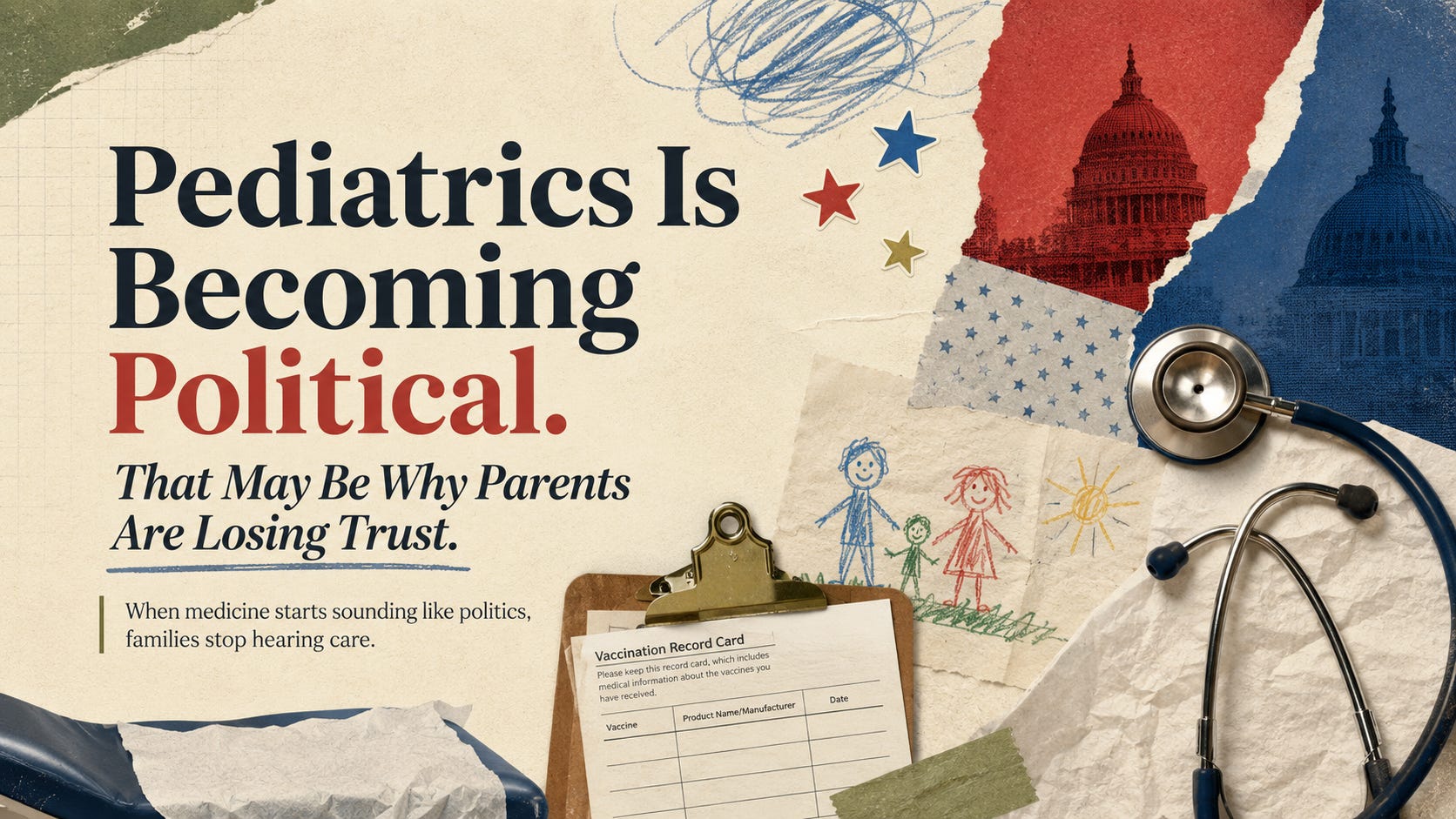
I am genuinely not sure when every pediatric health issue was assigned a political party, but apparently there was a meeting and I missed it. Vaccines became political. Food dyes became political. School lunches became political. COVID obviously became political. Gender medicine became political. Obesity became political. Environmental toxins became political. Somehow raw milk can start an argument about the federal government within approximately four comments on Instagram. I am waiting for vitamin D to formally endorse somebody for Congress. It would probably have a very strong position on outdoor recess. What bothers me about all of this is that children themselves are magnificently apolitical. A two-year-old with an ear infection does not care how you voted. A six-year-old with asthma has never watched cable news. A baby with RSV does not know what a swing state is, although after three nights without sleep the parents may be willing to swing at almost anybody. Pediatrics should be one of the places where politics matters least, and yet I increasingly think political culture has quietly worked its way into pediatric medicine, our professional organizations, our hospital systems, our social-media conversations and ultimately the exam room. I also think it is one of several reasons parents are losing trust in us.
To be clear from the beginning, I do not care how pediatricians vote. Doctors are citizens. They can be Democrats, Republicans, independents, libertarians, socialists, politically homeless or the increasingly appealing category of “please stop texting me about the election.” I am pretty apolitical myself. I do not strongly identify with either party, and I have never been particularly interested in wearing a team jersey. I grew up in Canada if you weren’t aware. I certainly had some excitement when MAHA first gained momentum because suddenly there was national discussion about childhood chronic disease, food quality, environmental exposures and nutrition, topics I have been talking about for years. My excitement was about health becoming a priority, not about which party happened to pick it up. Some of that excitement has certainly faded over time, as politics tends to take every interesting idea, put it through a wood chipper, and return it as a cable-news argument. But my politics really do not matter here. What matters is whether families believe that when they walk into a pediatric office, they are receiving medicine first and ideology second. I am increasingly worried that many do not.
The numbers are interesting because they are more complicated than the easy social-media claim that all doctors are liberal. A national survey of practicing U.S. physicians published in 2024 found that about 32% described themselves as liberal, 43% as moderate and 22% as conservative, so it would be inaccurate to say that most American physicians simply identify as liberal. Pediatrics, however, appears to lean much more heavily Democratic in at least some published samples. One study of 157 pediatric providers, mostly working in urban primary-care practices, found that 75% identified as Democrats, compared with 4% as Republicans and 8% as independents. That was a relatively small and geographically limited study, so I would never claim it means exactly three quarters of every pediatrician in America is a Democrat, but it certainly suggests a cultural tilt that anyone who has spent substantial time in academic pediatrics probably will not find shocking. Additionally, nearly all major academic centers and hospital are in major cities, and nearly every major city leans Liberal.
Now compare that with the country we actually serve. Pew’s 2026 data finds 47% of American adults identify as Democrats or lean Democratic, while 43% identify as Republicans or lean Republican, with another 10% refusing to lean toward either side. In other words, the country is basically divided almost down the middle. That matters to me, not because a liberal pediatrician cannot care beautifully for a conservative family or vice versa, but because any profession dominated culturally by one worldview needs to be especially aware of its blind spots. If almost everybody in your department, academic center, group chat, conference and social-media feed sees an issue similarly, eventually that position stops feeling like a political or ethical preference. It simply feels obvious. That is human nature. The problem comes when the family sitting across from you lives inside an entirely different social and political ecosystem and what seems obvious to you seems deeply ideological to them.
Social media has made this exponentially worse because there is no longer one shared information environment. There are thousands of personalized realities being delivered directly into our pockets all day. One pediatrician opens Instagram and sees posts about vaccine uptake, firearm injury prevention, access to reproductive health care, gender-affirming medicine and health inequities. A parent opens X and sees vaccine injuries, pharmaceutical conflicts of interest, detransition stories, school mandates, food additives and government overreach. Both of them may be intelligent, thoughtful people. Both may be reading actual scientific papers mixed in with plenty of garbage. Both spend months or years having their worldview reinforced by algorithms that very quickly learn what makes them angry enough to stay online. Then they meet for a fifteen-minute appointment or watch a post from a doctor or parent and are somehow surprised that the other person appears to be living on another planet.
I see this constantly because my own social-media world overlaps multiple communities. I can post one medical topic and receive comments from physicians saying, “How is this even controversial? The science is clear.” The exact same post can then get picked up in another community where hundreds of people respond, “How can doctors possibly still believe this?” Everybody feels like they are surrounded by people who agree with them, which makes anyone who disagrees seem not merely incorrect but completely irrational. One echo chamber sees science. The other sees corruption. One sees a public-health measure. The other sees coercion. One sees misinformation. The other sees censorship. One sees a courageous whistleblower. The other sees a grifter. Sometimes one side is clearly more correct than the other, of course, but a lot of the most difficult medical and parenting questions contain more uncertainty and value judgments than social media allows. Unfortunately, nuance has never performed particularly well next to a video of somebody pointing angrily at a headline.
I think one of the biggest mistakes physicians make is believing that extensive scientific training somehow removes our political biases. It does not. We learn anatomy. We learn pharmacology. We spend thousands of hours training to recognize disease. Nobody performs a small ceremony at medical-school graduation where our unconscious biases are removed through the hooding process. Doctors remain human beings, and there is research suggesting that political affiliation can influence how physicians approach politically charged medical issues. A study linking more than 20,000 U.S. primary-care physicians to voter-registration records found that Democratic and Republican doctors responded differently to patient scenarios involving politically sensitive topics, while those differences were not seen in scenarios that were politically neutral. The authors specifically suggested that physicians should be aware of how their political views might influence patient care.
That should not be offensive. I actually find it reassuring because the first step in limiting bias is admitting that you have some. I certainly do. We all do. The problem is that people are extraordinarily good at identifying everyone else’s biases and remarkably bad at noticing their own.
They think…The other side is ideological. I am evidence-based. The other side is political. I am following ethics. The other side is emotional. I am just interpreting the data. It is an incredibly convenient system. If the majority of people around you share roughly the same worldview, that convenience becomes even stronger because nobody is regularly pushing back. Consensus inside a culturally homogeneous room can start to feel exactly like universal truth, even when some portion of that consensus involves values layered on top of science.
Vaccines are probably the cleanest example of this distinction. Whether a vaccine produces antibodies, prevents disease, reduces hospitalization or carries a particular adverse-event risk is primarily a scientific question. Whether the government should require that vaccine for school attendance is not purely a scientific question. It is a scientific question combined with ethics, law, public health and judgments about how much individual autonomy society should trade for collective protection. Reasonable people can sometimes look at the same efficacy and safety data and reach different conclusions about a mandate because they assign different values to personal liberty and population-level benefit. Yet medicine has often spoken as though proving that a vaccine has benefit automatically proves that a particular mandate is the correct policy. Those are not identical questions.
This distinction is especially important in pediatrics because parents are making decisions for their children and there are few things people guard more fiercely than parental authority. If a pediatrician believes strongly that a vaccine should be required, they are perfectly entitled to that belief. But if the physician lives in a professional culture where nearly everybody shares that belief, it may become difficult to recognize that part of the conclusion is not simply virology or immunology. There is also a value judgment about the appropriate power of schools, states and medical institutions. A conservative parent may assign more weight to individual liberty. A progressive physician may assign more weight to collective responsibility. Neither position magically appears under a microscope. Those are philosophical differences interacting with medical evidence, and pretending that the philosophical component does not exist creates enormous mistrust.
I have talked about this before, but COVID probably did more than anything in recent memory to expose this divide. Suddenly pediatricians, hospitals, teachers, politicians, public-health departments and parents were debating school closures, masking, testing, quarantine, vaccination and mandates in real time. The scientific evidence was evolving while policy was being created at tremendous speed, which was always going to be messy. I do not think the great mistake was that guidance changed. Guidance should change when information changes. The mistake was that so much of it was delivered with extraordinary moral certainty. A medical recommendation became a sign of virtue. Questioning a policy sometimes became a sign of selfishness. People stopped merely disagreeing about evidence and began judging each other’s character, which is generally the point where a productive conversation goes to die.
I remember watching this in Los Angeles and thinking how quickly pediatrics had become inseparable from politics. You could often predict somebody’s opinion about masking a four-year-old by knowing how they voted, which should probably have made all of us slightly uncomfortable. The virus did not check your voter registration before infecting you. Yet somehow the entire conversation sorted itself politically. I had families who had never questioned medicine before suddenly questioning everything, and I do not think all of them got there because a Tik Tok algorithm hypnotized them. Some felt that their concerns were dismissed. Some felt policies affecting their children were being made without sufficient acknowledgment of tradeoffs. Some disagreed with school closures or mandates and suddenly found themselves spoken about as though disagreeing with a policy meant rejecting medicine itself. Once that happens, trust does not simply bounce back when the emergency ends.
One of the more interesting features of American medicine is that the culture of large academic hospitals often does not mirror the politics of the surrounding state. You can be in Texas, surrounded by communities that vote overwhelmingly Republican, and enter a major academic medical center where the language, policies and professional culture may feel much closer to institutions in Los Angeles, Boston or New York. That is not evidence of some secret takeover of Texas by pediatricians wearing NPR tote bags. Academic medicine simply attracts a particular population and develops its own culture. But from the perspective of families, the mismatch can be jarring.
Imagine being a parent whose values are fairly conservative and walking into the largest children’s hospital in your area, where institutional positions on vaccines, gender, reproductive issues, gun policy or public-health mandates may align much more strongly with progressive political beliefs than with the community in which you live. The hospital may see those positions as evidence-based medicine and professional ethics. The family may experience them as political ideology wearing a white coat. You can insist all day that the family is misunderstanding you, but from a trust standpoint their perception still matters. If the institutions responsible for caring for children appear culturally aligned with one half of America, we should at least be curious about what that does to the other half.
I also think medicine has become way too comfortable categorizing people. Anti-vaxxer. Misinformed. Quack. Grifter. Conspiracy theorist. There certainly are anti-vaccine activists, there absolutely is misinformation, and God knows the Internet has enough quacks and grifters to populate a small country. I am not suggesting we stop calling objectively false information false. But the labels have become so broad that a parent asking a difficult question can get thrown into the same bucket as somebody claiming vaccines contain microscopic government tracking devices. That is not helpful.
I see this especially with vaccine conversations. A mother asks about an autism study she saw online. Maybe she misunderstood it. Maybe the person sharing it wildly exaggerated the findings. Fine. Explain that. I do this all the time. I have told people publicly that claims being circulated by vaccine skeptics are simply false because sometimes they are. But I have also watched physicians immediately label legitimate questions “misinformation” because the question challenges something they strongly support. Those are two very different things. If you call everything misinformation, eventually the word means nothing. Worse, the parent learns that “misinformation” may simply mean “the thing my doctor does not want to discuss or agree with,” and then when genuine nonsense appears later, they ignore the warning.
There are phrases that sound completely normal inside medicine but very different outside it. “Noncompliant” is a good example. Pediatricians use it routinely to describe a family who does not follow a recommendation, but think about what the word actually implies. Compliance means obedience. That is an odd framework for a relationship that is supposedly built on informed consent and shared decision-making. If a parent hears my recommendation, understands the risks and benefits and makes a different reasonable choice, they are not necessarily noncompliant. They simply disagreed with me. I may believe they made the wrong decision, but disagreement is not insubordination because I am their pediatrician, not their commanding officer.
The same issue appears when we talk about mandates as though opposition to a mandate necessarily means opposition to the medical intervention. Those are not the same thing. Someone can believe a vaccine is beneficial and still oppose requiring it. Someone can support vaccination while believing parents should have greater flexibility. Someone can support mandates in one circumstance and oppose them in another. Once medicine refuses to acknowledge these distinctions, families begin to believe the outcome was decided before the conversation started.
I want to be really clear about what I am not proposing. I am not arguing that pediatricians should become conservative. I am not arguing that liberal doctors provide worse care. I am not asking physicians to hide every personal belief or pretend societal issues never affect child health. Pediatrics has always involved advocacy because things like poverty, pollution, violence, nutrition and access to care obviously affect children. There are times pediatricians absolutely should engage in public policy.
What I am asking for is greater self-awareness. If our profession leans culturally in one direction, we should recognize that. If our colleagues overwhelmingly share our beliefs, we should intentionally expose ourselves to thoughtful people who do not. If a medical policy happens to align nearly perfectly with one political party’s philosophy, we should at least ask ourselves where the science ends and the values begin. That does not mean abandoning the policy. It means being honest about what it is.
I would actually make the same argument if pediatrics suddenly became overwhelmingly conservative. If 75% of pediatricians were Republican and every professional organization began issuing statements that consistently aligned with conservative cultural positions, liberal parents would understandably become suspicious too. I would not blame them. People want to believe their doctor is evaluating their child, not evaluating whether their family belongs to the correct tribe.
As I said, I have never felt strongly attached to either party. I have agreed with Republicans on certain health issues and Democrats on others. I was excited by some early MAHA priorities because childhood chronic disease, nutrition and environmental health were suddenly part of the national conversation in a way I had wanted for years. I have also disagreed with plenty of things associated with that movement, and over time some of my initial excitement has softened. That is fine. I am not looking for a political home. I already have a job.
What matters far more to me is whether parents trust pediatricians. I want conservative parents to trust their pediatricians. I want liberal parents to trust their pediatricians. I want the parent who has a Robert Kennedy Jr. book on the nightstand and the parent who gets every CDC notification sent to their Apple Watch to both feel comfortable sitting in my office and asking the same question. If the pediatrician cannot talk respectfully to both of them, that is a problem.
Medicine often talks about declining trust as though it is something that mysteriously happened to us. Social media did it. Politicians did it. Influencers did it. RFK and Trump did it. Misinformation did it. All of those things played a role, but I think we also need to consider the possibility that, WE, DOCTORS, MEDICINE have contributed to its own trust problem far more than anything in that list. It’s easy to blame RFK for vaccine hesitancy. It does nothing to address the hesitancy that has constantly building for 20+ years, well before he was head of HHS.
A parent asks a question, feels dismissed and goes online. They find a community where everyone tells them their concern is legitimate. Some of the information in that community may be good and some may be terrible, but emotionally they have finally found people who listen. Then medicine looks at that community and complains that parents are getting information from the wrong people.
Maybe.
But why did they leave us?
The beautiful thing about pediatrics is that we already have an enormous piece of common ground sitting on the exam table tearing the paper into seventeen pieces. Everyone loves the kid.
The conservative parent loves the kid. The liberal pediatrician loves helping kids. The progressive parent loves the kid. The conservative pediatrician wants the kid to thrive. Most of us entered this field because we care deeply about children, not because we were looking for an exciting opportunity to debate federal administrative law while checking tympanic membranes. That should be enough common ground to start.
If the family and I disagree politically, who cares? We can still talk about sleep. We can talk about food. We can discuss a fever. We can talk honestly about vaccines. We can disagree about a mandate without treating each other like enemies. We can discuss mental health without first checking party registration. We can look at the actual child in front of us. I think pediatrics becomes much healthier when we remember that our team is not red or blue. Our team is the kid.
Politics has increasingly become professional sports. People pick a team, wear the colors, cheer when their side scores, make excuses when their side behaves badly, and become furious when the other side does the exact same thing. That may be unavoidable in politics. It cannot become the model for pediatrics.
When I walk into an exam room, I should take off the jersey. A parent should not have to figure out which political party I support from the way I answer a question about their child. They should know that I am willing to listen, explain the evidence, acknowledge uncertainty, recognize my own biases as best I can and treat their family respectfully even if we disagree. That seems like an extremely low bar, but lately we are consistently not clearing it.
Pediatricians absolutely have the right to believe whatever they want politically. But with that right comes a responsibility to remember that we care for a country that does not all believe the same things we do. In 2026, America remains almost evenly divided between the two major political coalitions. If the culture of pediatrics becomes strongly associated with one side, we should not act surprised when families on the other side begin to view us suspiciously. The solution is not to swing pediatric medicine toward the opposite political pole. That simply creates a different trust problem. The solution is to get politics back into its proper place.
If we can do that, perhaps parents will begin to see pediatricians less as representatives of a medical-political establishment and more as the people we should have been all along: trusted doctors who know their children, listen to their concerns, tell them the truth and occasionally hand a toddler a sticker that will be stuck to the inside of their minivan for the next seven years.
Thanks for reading Dr. Gator - Between a Shot and Hard Place! This post is public so feel free to share it.
No posts
Comments
Nothing yet. Say the first thing.
Sign in to join the conversation.