
Apparently all it takes to heal several years of pharmaceutical distrust is to put the word cancer in front of the word vaccine.
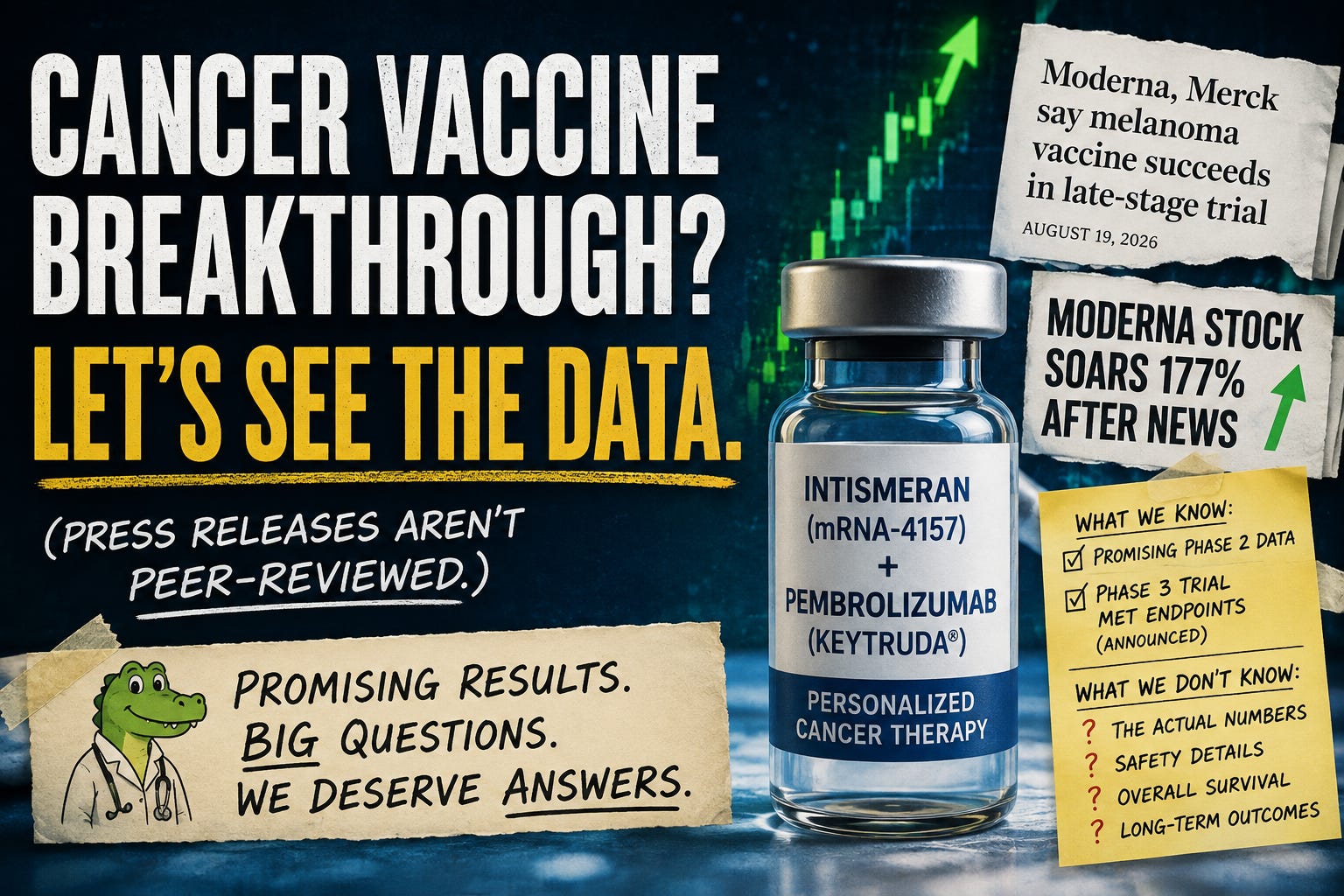
This week Moderna and Merck announced that their personalized mRNA cancer treatment, intismeran autogene, combined with Merck’s immunotherapy drug pembrolizumab, better known as Keytruda, succeeded in a large Phase 3 trial involving patients with high-risk melanoma who had already undergone surgery. The companies said the combination significantly improved recurrence-free survival and distant-metastasis-free survival compared with Keytruda alone. The news was everywhere. Headlines called it historic. Investors apparently did not require a second cup of coffee before reaching for the BUY button. Moderna shares finished the day up roughly 177%, while Merck rose about 12.6%. Moderna’s stock went from “remember us?” to “WE CURED CANCER!” before most people had finished breakfast.
And before anyone sends me an angry email written entirely in capital letters, I want to say something very clearly: I hope this treatment works.
Really.
I would love to see a world where we have therapies that can prevent cancer and/or prevent cancers from coming back or cure them. I would love for melanoma patients to have another powerful option. I would love for mRNA technology to become an important tool in oncology. If this ultimately saves lives, that is incredible. I will happily celebrate it, buy the party hat, and even eat the gluten-filled cupcake.
But I would also like to see the data. Apparently this has become controversial.
When people hear “melanoma vaccine,” they naturally picture something like the measles vaccine: healthy person walks into CVS, gets a shot, and hopefully never gets melanoma. That is not what is being studied here.
Intismeran is a personalized cancer therapy created from mutations identified in an individual patient’s tumor. Researchers sequence the tumor, identify mutations that may create neoantigens the immune system can recognize, and manufacture an individualized mRNA therapy encoding as many as 34 of those targets. The idea is essentially to hand the immune system a personalized wanted poster saying: “These are the bad guys. Please go find anything that looks like this.” It is then given together with pembrolizumab, which blocks PD-1 and essentially releases one of the immune system’s brakes.
And that distinction matters enormously when we start talking about risk.
These patients have had high-risk melanoma surgically removed and remain at substantial risk of recurrence. In that setting, patients and doctors reasonably tolerate adverse effects that would be completely unacceptable for a preventive intervention given to a healthy child or healthy adult. Chemotherapy can make your hair fall out, destroy your appetite and leave you hugging a toilet like it is an emotional-support animal. We still use chemotherapy because when the alternative may be metastatic cancer, the risk-benefit equation changes dramatically.
That is medicine. Risk is not a fixed number. Risk only makes sense in relation to benefit.
We actually do have meaningful published data for this treatment, and pretending otherwise would be just as silly as pretending we already know everything.
The earlier Phase 2b KEYNOTE-942 trial enrolled 157 patients with completely resected stage IIIB–IV melanoma. They were randomized 2:1 to receive intismeran plus Keytruda or Keytruda alone. At five-year follow-up, the combination produced a hazard ratio of 0.51 for recurrence or death, corresponding to about a 49% relative reduction compared with Keytruda alone. Five-year recurrence-free survival was reported as 68.8% with the combination versus 49.1% with Keytruda alone. Distant-metastasis-free survival also favored the combination, with a hazard ratio of 0.41, or roughly a 59% relative reduction.
That is not nothing. If those findings are real and reproducible, they are clinically meaningful.
There was also an encouraging overall-survival signal. Five-year overall survival was reported as 92.2% in the combination arm compared with 71.3% in the Keytruda-only arm. But—and this is a rather large but—only 14 total deaths had occurred, seven in each arm. The hazard ratio for overall survival was 0.47, but the 95% confidence interval ranged from 0.17 to 1.35, meaning the study absolutely did not establish a statistically reliable overall-survival benefit.
This is one of those moments when the headline and the statistics go to different restaurants.
“92% versus 71% survival!” sounds enormous.
“Seven deaths versus seven deaths in a small randomized study with a confidence interval crossing one” sounds considerably less ready for a Times Square billboard.
Both statements describe the same study.
Science is annoying like that.
The Phase 2 trial also had limitations. It was small. Only 50 patients were in the Keytruda-alone group. It was open-label. The original recurrence-free-survival analysis had a two-sided P value of .053, just outside the traditional statistical threshold, although longer follow-up strengthened the signal. The five-year analysis was explicitly described as descriptive, with no alpha assigned.
Again, none of this means it does not work.
It means exactly what it means: promising evidence that needed confirmation in a much larger randomized Phase 3 trials.
Which brings us to this week.
On August 19, Moderna and Merck announced that the Phase 3 INTerpath-001 trial had met its primary endpoint of recurrence-free survival and its key secondary endpoint of distant-metastasis-free survival. The trial enrolled roughly 1,100 patients with resected stage IIB–IV melanoma and compared personalized intismeran plus Keytruda with placebo plus Keytruda in a randomized, double-blind design. That is exactly the kind of trial we wanted to see. This is legitimately important news.
But here is the part that seems to have disappeared beneath the confetti: They have not released the actual Phase 3 efficacy numbers yet.
As of this writing, we do not know the hazard ratio for recurrence-free survival. We do not know the absolute difference between groups. We do not know how many recurrences occurred. We do not know the distant-metastasis-free-survival curves. We do not know whether overall survival differs. We do not have detailed subgroup analyses. We do not have the full Phase 3 safety tables. We do not have a peer-reviewed Phase 3 publication.
The companies have said they plan to present the complete results at an upcoming international medical meeting and pursue discussions with regulators. Independent cancer experts quoted this week have appropriately called the development exciting while also pointing out that the detailed results have not yet been publicly released or peer reviewed.
Yet Moderna gained tens of billions of dollars in market value in a single trading session. Apparently Wall Street has developed a new statistical endpoint called Vibes-Free Survival.
This is the part I find fascinating. For years, people have been told that questioning pharmaceutical companies means you are anti-science. But scientific skepticism is quite literally part of science. The appropriate response to a company saying its experimental drug worked is not: “LIARS!”
It is also not: “SHUT UP AND APPROVE IT!”
It is: “Great. Show us.” That should be completely uncontroversial.
Especially when the announcement comes from companies with enormous financial incentives attached to the outcome. Moderna’s stock rose 177% after this announcement. Merck’s Keytruda is already one of the most commercially important drugs in the world. A successful personalized cancer platform could potentially be worth billions or trillions more. That does not make the results fraudulent. It makes independent scrutiny essential.
I sometimes feel like we learned the exact opposite lesson from COVID. Instead of concluding that transparency builds trust, we decided trust means never asking uncomfortable questions. During the pandemic, enormously consequential decisions were made under extraordinary uncertainty. Vaccine effectiveness against symptomatic infection changed as immunity waned and new variants appeared. Myocarditis after mRNA vaccination, particularly among adolescent and young-adult males, became a recognized safety issue after rollout. CDC analyses in 2021 estimated substantially higher reported myocarditis rates after a second mRNA dose among younger males than among older adults, and recommendations evolved as more data emerged.
Meanwhile, the commercial stakes were breathtaking. Pfizer reported nearly $38 billion in Comirnaty revenue in 2022 alone. It does mean the public was not irrational for wanting transparency, acknowledgment of uncertainty and honest discussion of changing evidence. And pharmaceutical companies are not monasteries populated by monks who have taken vows of poverty.
Pfizer paid $2.3 billion in 2009 to resolve criminal and civil liability involving illegal pharmaceutical marketing, at the time the largest health-care fraud settlement in Department of Justice history. That occurred long before COVID, but history does not magically disappear when a company releases a product we desperately want to succeed. I am not saying “Merck and Moderna announced positive cancer results, therefore the results are false.” That would be ridiculous.
I am saying corporations should never be granted trust as a substitute for evidence. That should be Pediatrics 101. Actually, Human Beings 101.
There is another nuance getting lost in the arguments about mRNA. An mRNA cancer therapy for someone at substantial risk of dying from melanoma is not remotely equivalent to an mRNA preventive vaccine administered to millions of healthy individuals.
If a cancer treatment causes serious adverse events in 2%, 5% or even more patients but meaningfully reduces recurrence and extends life, patients may very reasonably choose it. If you propose giving the same platform prophylactically to healthy people with a tiny baseline risk of disease, the acceptable safety threshold becomes dramatically lower.
This is why I become nervous when people jump from: “Personalized mRNA cancer therapy may work”
to: “See? mRNA technology is safe and everyone who questioned COVID vaccines was an idiot.”
Those are not scientifically connected conclusions. A chainsaw is an excellent tool for cutting down a tree. That does not mean I recommend one for trimming my toddler’s fingernails.
Different job.
Different risk.
Different benefit.
Different standard.
If this Phase 3 data eventually looks as strong as Moderna and Merck suggest, I will be thrilled. But what happens next matters.
Does FDA review the complete data rigorously?
Do regulators demand mature survival information where appropriate?
Do we clearly separate recurrence-free survival from actual overall survival?
Do we get transparent adverse-event data?
Do independent investigators have meaningful access to the evidence?
Do we carefully define which patients benefit enough to justify treatment?
Or does “cancer vaccine” become such an emotionally powerful phrase that asking ordinary scientific questions becomes socially unacceptable? That latter scenario worries me.
Because once something becomes a cultural symbol instead of a medical product, evidence starts playing defense. We watched some version of that movie during COVID. I do not particularly want the sequel.
This is where people sometimes struggle with my position because apparently we are no longer allowed to hold two thoughts simultaneously without requesting special permission from the internet. I can believe this technology is extraordinarily exciting and want full transparency. I can hope Moderna succeeds and distrust pharmaceutical marketing or trials where they have clear incentive to fudge or nudge the data in a direction that benefits their pockets.
I can recognize encouraging Phase 2 data and say Phase 2 was too small to answer everything. I can celebrate a positive Phase 3 announcement and refuse to pretend I have seen Phase 3 numbers that have not yet been released. I can support cancer vaccines and believe preventive vaccination in healthy populations requires a different safety threshold. These positions are not contradictory. They are what medicine is supposed to look like. So yes, I am very cautiously excited.
And after everything the public experienced over the last six years, asking a multibillion-dollar pharmaceutical company to show us the complete evidence before we collectively tattoo MRNA FOREVER across our foreheads does not seem particularly radical.
It seems like common sense.
Maybe even science.
Dr. Gator
Thanks for reading Dr. Gator - Between a Shot and Hard Place! This post is public so feel free to share it.
Not medical advice. This article is for educational purposes and reflects my interpretation of currently available evidence. The Phase 3 INTerpath-001 results discussed above have been announced by the manufacturers but, as of August 20, 2026, the full numerical results have not yet been publicly presented or published.
No posts
Comments
Nothing yet. Say the first thing.
Sign in to join the conversation.