
This is the practical article.
The previous two have established what clomiphene is and how it works. This one addresses the question I receive most often from patients and from the occasional physician who has read the earlier pieces: what does treatment actually look like? How is the medication dosed? What is monitored, and how often? What are the common side effects, and how are they managed? What does an appropriate course of treatment look like from beginning to end?
I want to be clear about what this article is and is not. It is informational. It is not a treatment protocol that should be followed without the involvement of a physician familiar with male hormonal medicine. The clinical management of secondary hypogonadism with clomiphene requires individualization, careful monitoring, and judgment about adjunctive therapies that depends on the specific patient and the response to treatment. What I am describing here is the framework that informs my own clinical practice and that aligns with the published clinical literature. Your physician’s protocol may differ. The point of this article is to give you enough understanding of what good care looks like that you can recognize it — and recognize when something is being done in a way that does not match the standard.
With that orientation, let me walk through what clomiphene treatment actually involves.
The Initial Evaluation
Before clomiphene is initiated, the patient should have a complete evaluation that establishes the diagnosis and the appropriateness of treatment.
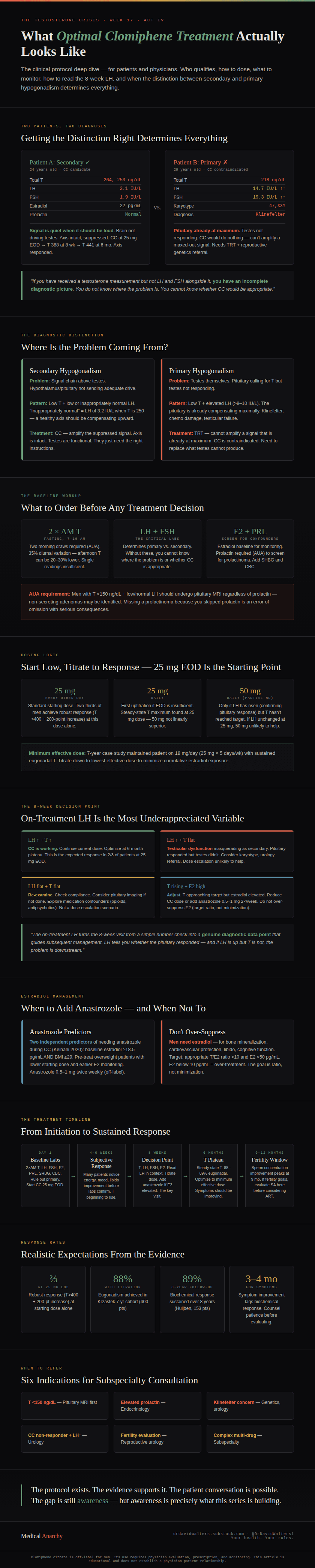
The hormonal panel includes total testosterone, free testosterone direct (or calculated free testosterone from total testosterone, SHBG, and albumin), LH, FSH, estradiol (specifically the sensitive estradiol assay used for men, which differs from the assay used for women), prolactin, TSH, free T3 and free T4. The total testosterone should be drawn between 7 and 10 AM, when testosterone is at its diurnal peak. A second confirmatory testosterone level on a separate day is appropriate before treatment initiation.
The pattern that supports clomiphene treatment is low total testosterone (typically below the age-appropriate cutoff — for men under 30, this means below approximately 400 to 450 ng/dL using the Zhu 2022 normative data) with low or low-normal LH and FSH. This is the secondary hypogonadism pattern characteristic of upstream HPG axis suppression, the population this series has been documenting.
The pattern that does not support clomiphene treatment is low total testosterone with elevated LH and FSH — primary testicular failure, which requires different evaluation and different treatment. Genetic testing may be appropriate in selected cases. Specific genetic conditions affecting the HPG axis may not respond to clomiphene predictably.
Other evaluations before treatment include a complete blood count (to establish baseline hematocrit), comprehensive metabolic panel, and PSA in older men. A baseline semen analysis is appropriate in fertility-relevant patients. Bone density testing should be considered in young men with substantial duration of suppressed testosterone, as their accumulated bone density deficit may inform long-term management.
The exposure history is also relevant. EDC exposure assessment — through urinary biomarker testing where available, through occupational and dietary history-taking — can inform discussions about exposure reduction as part of the treatment plan. The chemical inventory documented in earlier articles in this series provides the framework for these discussions.
The clinical evaluation includes assessment of the symptom complex I have described throughout this series, with attention to what the patient is hoping to address: energy, mood, cognition, libido, body composition, fertility, or some combination. The treatment goals are individualized to the patient’s specific concerns and circumstances.
The Initial Dose
Clomiphene treatment in men is typically initiated at 25 mg every other day, taken orally. Some clinicians begin at 25 mg daily; some begin at lower doses (12.5 mg or alternate-day dosing) in patients particularly sensitive to estrogenic effects.
The 25 mg every-other-day starting dose is reasonable for most patients. It produces a measurable testosterone response in the majority of appropriate patients within 4 to 6 weeks, with relatively low risk of significant side effects. Dose adjustment, if needed, can be made at the first follow-up visit.
The medication is taken at approximately the same time each day. Food does not significantly affect absorption. Patients should be informed that the medication has a half-life of approximately 5 to 7 days, which means that steady-state concentrations are achieved over 2 to 3 weeks. Symptomatic improvement may begin earlier than this but typically does not reach its full extent until the medication has been taken consistently for several weeks.
Patients should also be informed that the goal of treatment is restoration of normal testosterone levels and resolution of symptoms — not maximum possible elevation. Higher doses do not necessarily produce better results, and they may increase side effect risk without improving therapeutic response. The lowest dose that produces the desired clinical response is the appropriate dose.
The First Follow-Up
The first follow-up visit is typically 4 to 6 weeks after treatment initiation. The hormonal panel is repeated, with attention to total testosterone, free testosterone, LH, FSH, and estradiol. The patient is asked about symptomatic response — which symptoms have improved, which have not, what side effects have been experienced.
The expected biochemical response at 4 to 6 weeks is total testosterone elevation to the normal range, with LH and FSH increases reflecting restored hypothalamic-pituitary signaling. If testosterone has elevated appropriately and the patient is improving symptomatically without significant side effects, the dose is generally maintained.
If testosterone has elevated but only into the lower portion of the normal range, and the patient is not yet symptomatically improved, dose increase is reasonable — typically to 25 mg daily, then to 50 mg daily if needed. Some patients require the higher doses for adequate clinical response. The dose should be titrated to clinical effect, with continued monitoring.
If testosterone has not elevated, or has elevated minimally, several possibilities should be considered. The diagnosis may need to be revisited — primary testicular failure that was missed on initial evaluation, genetic factors, or other conditions that limit clomiphene response. Adherence to the medication should be confirmed. Some patients metabolize clomiphene differently and require higher doses. A trial of higher dosing is reasonable before concluding that clomiphene is not effective for this patient.
If estradiol has elevated significantly — generally above 40 to 50 pg/mL on the sensitive assay — adjunctive aromatase inhibition with anastrozole may be appropriate. The aromatase inhibitor reduces conversion of testosterone to estrogen, maintaining the testosterone-to-estrogen ratio in the favorable range. Anastrozole at 0.5 mg twice weekly to 1 mg daily is the typical dosing range, titrated to estradiol response.
The Stable Treatment Phase
Once the appropriate dose is established and clinical response is achieved, the patient enters the stable treatment phase. Follow-up is typically at 3 months, then 6 months, then annually if stable. The hormonal panel and symptom assessment guide ongoing management.
For most patients, the dose that achieves initial response continues to produce sustained response. Some patients require minor dose adjustments over time. Some patients tolerate dose reduction after initial restoration without losing therapeutic effect. The treatment is individualized.
Periodic monitoring of hematocrit and hemoglobin and other parameters is appropriate, particularly in patients on higher doses or in older patients. The cardiovascular and metabolic effects of restored testosterone are generally favorable but require monitoring like any other long-term medication.
The duration of treatment is patient-specific. Some patients continue treatment indefinitely, particularly when the underlying EDC exposures are ongoing and exposure reduction has been incomplete. Some patients may be able to discontinue treatment after substantial exposure reduction and lifestyle modification, with sustained improvement. Some patients cycle on and off treatment based on individual circumstances. The decisions are made collaboratively between patient and physician based on ongoing clinical assessment.
For fertility-relevant patients, the treatment course is often shorter and more intensive — focused on restoring spermatogenesis through 3 to 6 months of treatment, with the goal of conception during the period of restored function. Continuation beyond conception depends on the patient’s broader hormonal status and symptoms.
The Common Side Effects
Clomiphene is generally well-tolerated in men, but several side effects deserve attention.
Mood changes are reported by some patients — typically mild irritability or emotional lability in the first few weeks of treatment, often resolving as the body adapts. More significant mood symptoms, including depression or anxiety, are uncommon but should be assessed and managed if they occur. Dose reduction or alternate-day dosing may help. In rare cases, treatment discontinuation may be needed.
Visual symptoms — typically described as light sensitivity, blurriness, or visual flickering — are reported by approximately 1 to 2% of patients. They are dose-dependent and generally resolve with treatment discontinuation. In most cases, they are mild and do not require intervention. In any case where visual symptoms are significant or progressive, the medication should be discontinued and ophthalmologic evaluation considered. Permanent visual effects are very rare but have been reported, which is the reason for the precaution.
Gynecomastia — the development of breast tissue in men — can occur if estradiol elevation is not appropriately managed. The prevention strategy is monitoring of estradiol and use of aromatase inhibition when needed. Once gynecomastia has developed, it is more difficult to reverse than to prevent, so attention to estradiol management throughout treatment is preferable to retrospective intervention.
Mild headache occurs in some patients, typically in the first few weeks of treatment and resolving without intervention.
Less common but more significant adverse effects include thromboembolic events (rare, but worth considering in patients with elevated baseline risk), liver function abnormalities (rare, monitoring of liver function periodically is reasonable), and the visual symptoms discussed above.
The overall side effect profile of clomiphene in men is favorable. Most patients tolerate the medication well. The side effects, when they occur, are generally manageable and do not require treatment discontinuation in most cases.
The Adjunctive Therapies
Clomiphene is sometimes used in combination with other medications to optimize the treatment response.
The most common adjunct is anastrozole, the aromatase inhibitor. As discussed above, anastrozole is added when estradiol elevation produces symptoms or threatens to produce them. The combination of clomiphene and anastrozole maintains the testosterone elevation while keeping estradiol within the favorable range.
Human chorionic gonadotropin (hCG) is sometimes used as a primary treatment or adjunct. hCG mimics the action of LH at the testicular level, directly stimulating Leydig cell testosterone production. It is administered by injection, typically twice weekly. hCG can be used alone in some patients, in combination with clomiphene in others, or as a fertility-focused adjunct in patients seeking to optimize spermatogenesis.
Vitamin D, zinc, and other nutritional supports are sometimes addressed alongside hormonal therapy, particularly when baseline laboratory testing reveals deficiencies. Vitamin D in particular is associated with testosterone status, and correction of deficiency can contribute to overall treatment response.
For patients with significant EDC exposure burden, exposure reduction strategies — the practical guidance from earlier articles in this series — are integrated with the medical treatment. The combination of pharmacological restoration and exposure reduction produces more sustained outcomes than medication alone.
The Treatment Course in Practice
Let me describe what a typical treatment course looks like for the patient population I have been describing.
A 28-year-old man with the symptom complex documented in earlier articles begins treatment with 25 mg of clomiphene every day. His baseline total testosterone is 247 ng/dL.
At 4 weeks: His testosterone has elevated to 587 ng/dL. His LH has risen from 2.8 to 6.9 mIU/mL. His FSH has risen from 3.1 to 8.2. His estradiol is 32 pg/mL. He reports modest energy improvement, somewhat better sleep, and a sense that his head is clearer than it has been in years. He has not noticed any side effects of concern.
At 12 weeks: His testosterone is stable at 612 ng/dL. His symptoms have continued to improve — his libido has returned, his exercise response is better, he has lost weight despite no major dietary changes. He describes himself as feeling like a person again.
At 6 months: He is in stable response. His testosterone is in the upper-normal range. His symptoms have largely resolved. He has begun strength training and is making gains he had not achieved in years. He has begun making the EDC exposure reduction changes documented in earlier articles. He has tapered off the SSRI he had been taking with appropriate medical supervision.
At 12 months: Continuing stable response. No side effects have emerged. He is considering whether to continue clomiphene indefinitely or to attempt discontinuation alongside continued exposure reduction. The decision will be made based on ongoing assessment.
This is not an unusual course. This is the typical course for the appropriately selected patient. The treatment works because it addresses the actual mechanism of his hormonal suppression. The clinical response is durable because the patient has both the medical treatment and the lifestyle modifications working in the same direction.
When Clomiphene Is Not Appropriate
I want to address briefly the patients for whom clomiphene is not the appropriate treatment, because the framework I have been describing is not universal.
Men with primary testicular failure — where the testes are not capable of producing normal testosterone regardless of stimulation — do not respond to clomiphene. These patients are identified by the laboratory pattern of low testosterone with elevated LH and FSH, indicating that the upstream system is already maximally stimulating non-functional gonads. Treatment for these patients typically involves exogenous testosterone replacement, with appropriate counseling about fertility implications.
Men with specific genetic conditions affecting reproductive endocrine function — Klinefelter syndrome, certain androgen receptor abnormalities, congenital hypogonadotropic hypogonadism in some forms — may require specialized evaluation and individualized treatment that may or may not include clomiphene depending on the specific condition.
Older men with established testosterone replacement therapy are a more complex population. Long-term exogenous testosterone produces HPG axis suppression that may be partially reversible. Some men can transition from exogenous testosterone to clomiphene with restoration of native function. Some cannot. The transition requires careful management, including the period during which the man’s own production restarts, with appropriate monitoring throughout.
Men with conditions that contraindicate clomiphene — significant thrombotic history, certain liver diseases, others — are candidates for alternative approaches.
The selection of appropriate patients is part of the clinical art of male hormonal medicine. The framework I have described in this series — EDC-driven secondary hypogonadism in young men presenting with the integrated symptom complex — represents the patient population for whom clomiphene is most reliably effective. The clinical work involves recognizing this population, distinguishing it from other forms of hypogonadism, and providing appropriate treatment.
Finding the Right Clinician
The most common practical question I receive from patients reading this series is: how do I find a physician willing to engage this framework?
The honest answer is that the patient population I have been describing is best served by a physician with specific interest and experience in male hormonal medicine — typically a urologist or andrologist with focus on this area, or in some cases a primary care physician or endocrinologist who has developed expertise in this specific clinical territory. The clinician should be familiar with clomiphene treatment in men, comfortable with off-label prescribing, and oriented toward addressing the upstream mechanism rather than simply replacing testosterone with exogenous supplementation.
Practical guidance for finding this clinician:
The American Urological Association membership directory includes urologists who indicate special interest in male reproductive medicine. The Society for the Study of Male Reproduction (SSMR) maintains a member directory for physicians focused on male reproductive endocrinology. These are reasonable starting points.
When evaluating a potential clinician, the questions worth asking are: Do you treat male hypogonadism in young men? Do you use clomiphene citrate? Do you order the complete hormonal workup including LH, FSH, free testosterone, and estradiol? Do you use age-appropriate testosterone reference ranges? How do you think about EDC exposure as a contributor to male hypogonadism?
The answers will tell you whether the clinician is operating within the framework I have been describing or within the conventional testosterone-replacement framework. Both can be appropriate for some patients. For the patient population this series has been documenting, the framework I have described is more likely to produce appropriate care.
If the clinician’s answers do not match the framework, the patient has options. Travel to a specialist with the appropriate expertise is sometimes necessary. Telehealth options have expanded access to clinicians with specific expertise in male hormonal medicine. Patient advocacy and persistence are sometimes required to find the right clinical relationship.
Treatment of the kind I have been describing — restoring the patient’s own hormonal function through pharmacologically targeted intervention at the upstream mechanism — does exist. The patients who find clinicians willing to engage the framework typically receive appropriate care and respond well. The patients who do not find such clinicians often continue to receive treatments that do not address their underlying problem.
The work of this series, in part, has been to make the framework articulate enough that more clinicians will be able to engage it, and more patients will know what to look for. Whether the institutional system catches up to the individual clinical realities is a longer-term question. The patient in front of the right clinician today does not need to wait for that institutional change.
Closing Note
This article has been more clinical and protocol-oriented than the rest of the series, by necessity. The practical questions of treatment require practical answers, and patients who have followed this series deserve to have those answers in adequately specific form.
The treatment of EDC-driven secondary hypogonadism with clomiphene is not exotic. It is not experimental. It is not fringe medicine. It is the application of a medication that has been on the market for nearly sixty years, whose mechanism is well-characterized, whose clinical effect in appropriate patients is documented in hundreds of peer-reviewed studies. It is, in other words, mainstream medicine that has not been mainstreamed.
The patient population is large and growing. The treatment is inexpensive. The response is substantial. What is needed is the recognition — by clinicians, by patients, and by the broader medical system — that this picture is real and that the response to it is straightforward.
Next week, the final substantive article before the closing pieces of this series: how the medical treatment integrates with the broader strategy of reducing chemical exposure. The question of whether clomiphene alone is the answer, or whether clomiphene is one piece of a larger response that also includes lifestyle, environment, and the systemic changes that this generation of young men, and the next, deserve.
Key Sources for This Article
• Hayden RP, et al. (2020). “Clomiphene citrate in the management of male infertility.” Current Opinion in Urology, 30(3), 396–401. https://pubmed.ncbi.nlm.nih.gov/32132356/
• Krzastek SC, et al. (2019). “Long-term safety and efficacy of clomiphene citrate for the treatment of hypogonadism.” Journal of Urology, 202(5), 1029–1035. https://pubmed.ncbi.nlm.nih.gov/31144610/
• Wheeler KM, et al. (2019). “A review of the efficacy and safety of clomiphene citrate for the treatment of male infertility.” Translational Andrology and Urology. https://pubmed.ncbi.nlm.nih.gov/30050802/
• Earl JA & Kim ED. (2019). “Enclomiphene citrate: a treatment that maintains fertility in men with secondary hypogonadism.” Expert Review of Endocrinology and Metabolism. https://pubmed.ncbi.nlm.nih.gov/30966827/
• Kaminetsky J, et al. (2019). “Oral enclomiphene citrate raises testosterone and preserves sperm counts in obese hypogonadal men, unlike topical testosterone.” Andrology, 7(2). https://pubmed.ncbi.nlm.nih.gov/30471198/
• Helo S, et al. (2015). “A randomized prospective double-blind comparison trial of clomiphene citrate and anastrozole in raising testosterone in hypogonadal infertile men.” Journal of Sexual Medicine, 12(8), 1761–1769. https://pubmed.ncbi.nlm.nih.gov/26176715/
• Burnett-Bowie SA, et al. (2009). “Effects of aromatase inhibition in hypogonadal older men: a randomized, double-blind, placebo-controlled trial.” Clinical Endocrinology, 70(1), 116–123.
• Bendre SV, et al. (2015). “Clomiphene citrate effectively increases testosterone in obese, young, hypogonadal men.” Reproductive System & Sexual Disorders, 4(4). https://pubmed.ncbi.nlm.nih.gov/27500035/
• Mbi Feh MK & Wadhwa R. (2023). “Clomiphene.” StatPearls / NCBI. https://www.ncbi.nlm.nih.gov/books/NBK559292/
• Society for the Study of Male Reproduction (SSMR).
https://www.ssmr.org/
Dr. David Walters is a physician with clinical and research training in men’s hormonal health. Nothing here constitutes medical advice or establishes a physician-patient relationship. Specific treatment decisions should be made in consultation with a qualified physician.
Next week: integration. The medical treatment combined with broader strategy. Lifestyle, exposure reduction, and the question of what comprehensive restoration actually requires.
Week 17 of The Testosterone Crisis. The treatment is real. The protocol is established. The clinicians exist. The patients deserve the framework that allows them to find each other.
Paid subscribers get the full clinical decision tree below — the exact diagnostic algorithm, dosing escalation protocol, estradiol monitoring thresholds, and the on-treatment LH decision guide I use in my own practice. This is the protocol, not the summary.
Comments
Nothing yet. Say the first thing.
Sign in to join the conversation.