
The medical treatment I described over the last three weeks — clomiphene citrate, used appropriately in patients with EDC-driven secondary hypogonadism — is necessary for many of the patients I see. It is not, by itself, sufficient.
The medication restores hormonal function in the patient who is taking it. It does not address the chemical exposures that produced the suppression in the first place. It does not modify the lifestyle factors that contribute to the body burden of endocrine-disrupting chemicals or that compound the metabolic and physiological consequences of low testosterone. It does not change the regulatory environment that allows the chemicals to remain in commerce. It treats the consequence at the patient’s hypothalamus while the upstream cause continues to act on him every day.
This article is about the integrated response. The combination of medical treatment, exposure reduction, lifestyle modification, and broader advocacy that constitutes a complete approach to the testosterone crisis. Not as four separate strategies, but as components of a single response that addresses the problem at multiple levels simultaneously.
I want to be direct about why this integration matters. A patient on clomiphene who continues to consume the chemical inventory documented in Acts II and III of this series is in a perpetual state of treating an ongoing exposure. His medication is restoring what the chemicals are continuing to suppress. The treatment works, but the underlying condition is unaddressed. He depends on continued medication to maintain function. He may never be able to discontinue treatment without symptom recurrence.
A patient who substantially reduces his exposures, modifies his lifestyle to support hormonal health, and takes clomiphene as a bridge to restored function — has a different long-term trajectory. The medication is restoring function while the patient simultaneously reduces the upstream pressure. Some such patients can eventually discontinue clomiphene with sustained improvement. Others continue treatment, but at lower doses with better tolerability. The integrated approach produces a different relationship to the medication over time.
This is the framework I work toward with every patient I treat. The medication is a tool, not the whole answer. The whole answer requires acting at multiple levels.
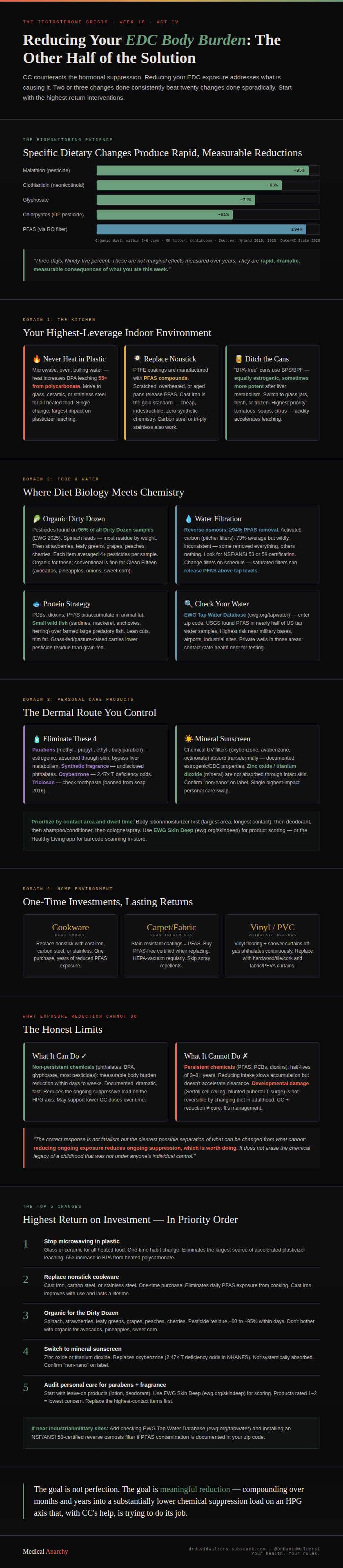
Reducing the Personal Burden
The previous articles in this series documented the four major categories of EDC exposure: plasticizers (BPA, phthalates), agricultural pesticides (organochlorines, organophosphates, glyphosate), persistent industrial pollutants (PCBs, dioxins, PFAS), and personal care products (parabens, triclosan, chemical sunscreens, synthetic fragrance). Each article included practical guidance for reducing exposure in that specific category.
The integration of these reductions into a coherent personal strategy requires some prioritization. Not all exposures are equally consequential, not all reduction strategies are equally effective, and not all patients have the same starting point or the same resources for change.
The highest-impact changes, in approximate order of return on effort:
Eliminating microwave heating of plastic and replacing plastic food storage with glass eliminates the largest single source of phthalate and BPA exposure for most people. The change is simple, the cost is modest, and the exposure reduction is substantial.
Switching to organic produce for the EWG Dirty Dozen items (strawberries, spinach, kale, peaches, apples, grapes, peppers, cherries, blueberries, beans, tomatoes, and similar high-residue items) reduces dietary pesticide intake by 60 to 90% within days. The cost premium is real but the exposure reduction is well-documented.
Filtering drinking water with reverse osmosis or activated carbon block removes the major water-borne contaminants — atrazine, glyphosate, PFAS, and others. Standard refrigerator and pitcher filters do not.
Eliminating fragranced personal care products and household products eliminates a substantial source of phthalate exposure, including the undisclosed phthalates that are common in synthetic fragrance formulations. The change requires reading labels and choosing fragrance-free alternatives, but the products are widely available.
Replacing PFAS-coated cookware with stainless steel, cast iron, or ceramic eliminates the cooking-related route of PFAS exposure. Replacing PFAS-treated outdoor gear and stain-resistant fabrics is a longer process but reduces the household burden over time.
Choosing mineral-based sunscreens (zinc oxide or titanium dioxide) over chemical sunscreens (oxybenzone, octinoxate, octocrylene) eliminates one of the most direct routes of EDC absorption through the skin.
These changes do not require lifestyle perfectionism. They require deliberate attention to the highest-yield substitutions. A patient who makes these changes consistently — even imperfectly — typically achieves substantial reduction in measurable urinary EDC metabolites within weeks.
The integration with medical treatment matters here. The patient on clomiphene who is also reducing his exposures is creating the conditions under which the underlying problem can be addressed at the source rather than continuously compensated. The combination produces more sustainable outcomes than either approach alone.
The Lifestyle Dimensions That Support Hormonal Health
Beyond exposure reduction, several lifestyle factors directly support testosterone production and overall hormonal function. These are not exotic interventions. They are the basic supports that healthy human biology requires, and they have particular relevance for a patient whose hormonal axis is compromised.
Sleep is the single most important non-medical intervention for testosterone. The diurnal testosterone peak depends on slow-wave sleep during the preceding night. Patients who consistently sleep 7 to 9 hours per night, with attention to sleep hygiene and identification of any contributing sleep disorders, support their hormonal recovery substantially. Patients who chronically sleep less than 6 hours undermine their treatment.
Resistance training is the second-most-important. Testosterone-mediated muscle protein synthesis requires the mechanical stimulus of progressive overload to manifest in muscle development. Patients who incorporate consistent resistance training — 2 to 4 sessions per week, focused on compound movements — see substantially better body composition responses to clomiphene treatment than patients who do not. The training is not optional for full clinical restoration. It is part of the treatment.
Aerobic exercise, while less directly anabolic, supports the metabolic and cardiovascular dimensions of restored health. Some aerobic activity — walking, cycling, swimming, or other sustained movement — most days of the week complements the resistance training and supports the broader physiological recovery.
Nutritional adequacy matters in specific dimensions. Adequate protein intake (typically 0.7 to 1.0 g per pound of body weight for active patients) supports the anabolic processes that restored testosterone enables. Adequate dietary fat, including saturated and monounsaturated fats, provides the cholesterol substrate that steroidogenesis requires. Vitamin D status, often deficient in modern populations, correlates with testosterone, and correction of deficiency contributes to overall response. Zinc deficiency, when present, limits testosterone production.
The nutritional dimension is sometimes complicated by the body composition changes that low testosterone has produced. Patients with substantial weight gain may benefit from caloric reduction during the treatment period, which improves both insulin sensitivity and testosterone-to-estrogen ratios as visceral fat decreases. The combination of caloric awareness, adequate protein, and the resistance training described above produces measurable body recomposition over months in most appropriately-treated patients.
Alcohol moderation matters. Heavy alcohol consumption suppresses testosterone production through multiple mechanisms — direct testicular toxicity, hepatic metabolism of sex hormones, and disruption of sleep architecture. Most patients can tolerate moderate alcohol intake without significant hormonal impact, but excessive use undermines treatment in ways that no medication can fully compensate for.
Cannabis use deserves attention. Heavy chronic cannabis use is associated with reduced testosterone in multiple studies. The mechanism involves cannabinoid receptor effects on hypothalamic GnRH pulsatility — interestingly, the same pathway clomiphene addresses. Patients with hormonally driven symptoms who are heavy cannabis users typically benefit from at least a trial of substantial reduction or cessation, in addition to whatever other treatment is being pursued.
Stress management is real but harder to operationalize. Chronic stress elevates cortisol, which suppresses GnRH and antagonizes testosterone effects at multiple levels. Patients with substantial chronic stress benefit from interventions to address it — therapy where appropriate, mindfulness practices, exercise (which contributes here as well), and structural changes to the contributing stressors. The stress dimension is patient-specific and requires individualized attention.
These lifestyle dimensions are not the medication. They are the conditions under which the medication achieves its full effect, and under which sustained improvement becomes possible.
The Broader Advocacy
I want to address briefly the dimension of this work that extends beyond individual treatment.
The chemical exposures that drive the testosterone crisis exist because of regulatory choices that were made decades ago and that continue to be made today. The chemicals are in commerce because regulatory frameworks have allowed them to be. The exposure pattern affecting young men today is the result of decisions made when those young men were children, and earlier — decisions made by their parents’ and grandparents’ generation about what chemicals would be permitted in food packaging, agriculture, consumer products, and industrial production.
The continued exposure of the next generation depends on whether those decisions continue or change. The young men who are currently affected can reduce their personal exposures through the strategies described above. The next generation’s exposures will be determined by regulatory and policy choices being made now and in the coming years.
Individual patient advocacy contributes to this. The conversation that a thoughtful patient has with his physician about the hormonal evaluation that should be done. The choices he makes as a consumer that signal demand for cleaner products. The conversations he has with friends, family, and community about what he has learned. The support, where appropriate, for regulatory changes that would address the underlying problem at the policy level — clearer labeling, restricted use of the most consequential chemicals, support for the agricultural and industrial transitions that would reduce population-level exposures over time.
The European Union’s REACH regulation has produced measurably different exposure patterns for European populations compared to American populations. The regulatory choices that produce this difference were not inevitable. They were policy decisions, made over years, with citizen advocacy as one of the contributing factors. The same kind of advocacy in American policy contexts can produce comparable changes over comparable time scales.
I am not a policy advocate by profession. My work is clinical. But the clinical reality is that I am treating individual patients whose conditions are produced by population-level exposures that no individual patient can fully escape. The policy dimension is not separate from the clinical reality. It is the upstream cause of the clinical pattern.
For readers who feel called to advocacy in this area, the organizations doing serious work include the Endocrine Society, the Environmental Working Group, the Pesticide Action Network, the Center for International Environmental Law, and many others. Engagement with these organizations — through donation, volunteer effort, or simply attention to their work — contributes to the longer-term project of changing the regulatory and policy environment that produced the current situation.
The Generation That Could Be Different
I want to close this article with a thought about timing.
The young men who are currently affected by the testosterone crisis cannot fully undo what has already happened. The bone density that should have been built during their adolescence is partially unrecoverable. The brain architecture that should have been organized under conditions of normal hormonal exposure is partially unrecoverable. Some of the cellular and developmental damage of EDC exposure during developmental windows is not fully reversible by adult treatment, however appropriate.
This is not a counsel of despair. The medical treatment can substantially restore function in adulthood. The exposure reduction can dramatically reduce ongoing burden. The lifestyle modifications can support the integrated recovery. The young men I treat with this comprehensive approach typically experience substantial improvement and live lives that are meaningfully better than they would have been without intervention.
But the next generation has a different opportunity. The children of these young men, and their children’s children, can grow up under different conditions if the policy and regulatory environment changes in the coming years. The chemical exposures that have shaped the current generation are not biological inevitabilities. They are the consequences of choices that can be made differently.
If the children growing up today are exposed to substantially fewer EDCs during their developmental windows, they will reach adulthood with substantially less hormonal compromise than the current generation experienced. The bone density they build, the brain architecture they organize, the reproductive endocrine function they establish — all of this can be more intact than the current cohort’s, if the upstream environment improves.
The work of making this happen extends beyond clinical practice. It involves the policy advocacy, the regulatory engagement, the consumer education, the cultural conversation about the chemical environment we have created and accept. It involves sustained attention to a problem that has been allowed to build invisibly for two generations.
The current generation of young men has been substantially affected. The next generation does not have to be. The difference between those two outcomes will be the work done in the next 10 to 20 years to address the underlying problem at all levels — clinical, behavioral, regulatory, and cultural.
This is the work I have tried to articulate across this series. The chemical era has produced a generational hormonal crisis. The crisis is documented, mechanistic, and treatable. The treatment exists at the individual level. The prevention requires action at the systemic level. The combination, sustained over time, can produce different outcomes for the children of today than the young men of today have experienced.
That is the response. That is what comprehensive strategy actually looks like. That is what the next generation deserves.
Where We Go From Here
Eighteen weeks of evidence and argument. The crisis. The cause. The cost. The structural reasons for medicine’s failure to recognize it. The medication that addresses the upstream mechanism. The protocol for using it. The integration of treatment with the broader strategy.
The remaining articles in this series are not additional documentation. They are conclusions.
Next week, Week 19, is a letter to my colleagues — practicing physicians who have stayed with this series, or who encounter it later. The honest conversation I want to have with the medical profession about what the evidence shows, what the institutional barriers are, and what individual clinicians can do regardless of whether the broader system updates.
The week after, Week 20, is the series manifesto. Where we are. Where we need to go. What I have learned in twenty-five years of clinical practice in this area, and what I want readers to carry with them after this series ends.
I am asking you to stay for these final two pieces. They contain what the previous eighteen articles have been building toward.
Key Sources for This Article
• Lu C, et al. (2006). “Organic diets significantly lower children’s dietary exposure to organophosphorus pesticides.” Environmental Health Perspectives, 114(2). https://pubmed.ncbi.nlm.nih.gov/16451864/
• Hagobian T, et al. (2017). “Randomized Intervention Trial to Decrease Bisphenol A Urine Concentrations in Women: Pilot Study.” Journal of Women’s Health. https://pubmed.ncbi.nlm.nih.gov/28394740/
• Wittert G. (2014). “The relationship between sleep disorders and testosterone in men.” Asian Journal of Andrology. https://pmc.ncbi.nlm.nih.gov/articles/PMC4023367/
• Vingren JL, et al. (2010). “Testosterone physiology in resistance exercise and training: the up-stream regulatory elements.” Sports Medicine, 40(12), 1037–1053. https://pubmed.ncbi.nlm.nih.gov/21058750/
• Pilz S, et al. (2011). “Effect of vitamin D supplementation on testosterone levels in men.” Hormone and Metabolic Research, 43(3), 223–225. https://pubmed.ncbi.nlm.nih.gov/21154195/
• Prasad AS, et al. (1996). “Zinc status and serum testosterone levels of healthy adults.” Nutrition, 12(5), 344–348. https://pubmed.ncbi.nlm.nih.gov/8875519/
• Gundersen TD, et al. (2015). “Association Between Use of Marijuana and Male Reproductive Hormones and Semen Quality.” American Journal of Epidemiology, 182(6), 473–481. https://pubmed.ncbi.nlm.nih.gov/26283092/
• Cumming DC, et al. (1983). “Acute suppression of circulating testosterone levels by cortisol in men.” Journal of Clinical Endocrinology and Metabolism. https://pubmed.ncbi.nlm.nih.gov/6298285/
• EWG Skin Deep Database. https://www.ewg.org/skindeep/
• EWG Dirty Dozen / Clean Fifteen. https://www.ewg.org/foodnews/
• EU REACH Regulation. Regulation (EC) No 1907/2006. https://echa.europa.eu/regulations/reach/understanding-reach
Dr. David Walters is a physician with clinical and research training in men’s hormonal health. Nothing here constitutes medical advice or establishes a physician-patient relationship.
Next week: a letter to my colleagues. The conversation I want to have with practicing physicians about what eighteen weeks of evidence have made clear, and what the medical profession can do — whether or not the institutional system catches up.
Week 18 of The Testosterone Crisis. Act IV is now nearly complete. The framework is articulated. The strategy is integrated. Two articles remain.
Paid subscribers get a downloadable, printable room-by-room EDC exposure reduction checklist below — organized by kitchen, bathroom, laundry, and household products, with prioritized actions ranked by exposure impact so you know exactly where to start.
Comments
Nothing yet. Say the first thing.
Sign in to join the conversation.