
The hypothalamus is, in regulatory terms, a thermostat. It monitors a specific signal — the level of estradiol circulating in the blood — and uses that signal to determine how much GnRH to release. When the signal is high, it releases less GnRH. When the signal is low, it releases more. The downstream effect on testosterone is exactly what one would expect from a properly functioning feedback loop.
The problem this series has been documenting is that the hypothalamus’s thermostat has been receiving false readings for fifty years.
Last week I introduced clomiphene citrate as the medication that has been quietly available for decades to treat the hormonal suppression I have been documenting. This week I want to walk through how it actually works — at the molecular level, at the cellular level, and at the clinical level. Because the mechanism is itself the most compelling argument for why this medication is appropriate for the patient population I have been describing. Clomiphene does not simply elevate testosterone. It corrects the false signal that has been suppressing the hypothalamic thermostat for the patient’s entire life — and in doing so, restores the body’s own capacity to produce testosterone through its own native pathways.
This is not metaphor. It is mechanism. Let me lay it out.
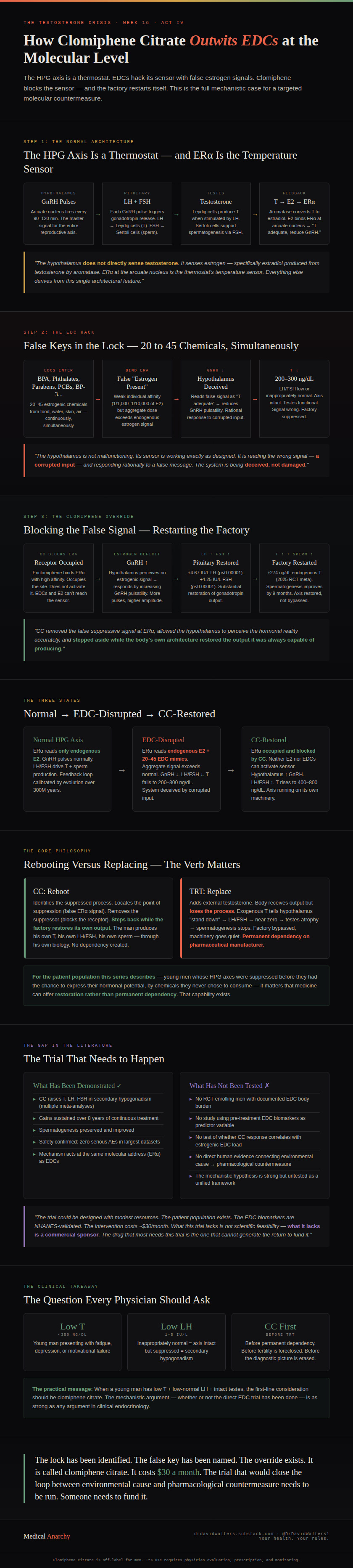
The hypothalamic-pituitary-gonadal axis operates through a cascade of signals, each of which depends on the previous one. The hypothalamus releases GnRH (gonadotropin-releasing hormone) in pulses — discrete bursts every 60 to 90 minutes in healthy adult men — into the portal circulation that connects it to the pituitary gland. The pituitary, receiving these GnRH pulses, releases LH (luteinizing hormone) and FSH (follicle-stimulating hormone) into the systemic circulation. LH stimulates the Leydig cells in the testes to produce testosterone. FSH stimulates the Sertoli cells to support spermatogenesis.
Testosterone, once produced, has multiple downstream effects. It acts on androgen receptors throughout the body to produce its many physiological effects. It is converted in adipose tissue and other peripheral tissues to estradiol via the enzyme aromatase. And critically, both testosterone and estradiol provide negative feedback to the hypothalamus and pituitary, telling the upstream system that production is adequate and that less stimulation is needed.
The estradiol component of this feedback loop is particularly important. The hypothalamic neurons that produce GnRH express estrogen receptor α (ERα). When estradiol binds these receptors, it produces a signal that inhibits GnRH release. The system uses estradiol — much of which is produced from testosterone via aromatase — as the feedback molecule. The hypothalamus is, in effect, monitoring estradiol as a proxy for adequate testosterone production.
This design is elegant and works reliably under normal conditions. But it has a vulnerability. The hypothalamus cannot distinguish between estradiol produced by the body’s own metabolism and chemically similar molecules introduced from external sources. The molecular machinery responds to the signal, regardless of where the signal originated.
The False Signal Problem
This is the vulnerability that endocrine-disrupting chemicals exploit.
A typical EDC with estrogenic activity — BPA, certain phthalate metabolites, parabens, multiple pesticides — has chemical structure similar enough to estradiol that it binds estrogen receptors. The binding affinity is generally weaker than estradiol’s — often by orders of magnitude. But the receptor responds to the binding, regardless of which ligand it bound. The hypothalamic thermostat reads the signal and concludes: estrogen present, testosterone production must be adequate, reduce GnRH.
The body’s actual estrogen production may be entirely normal. The body’s testosterone production may be entirely normal. The difference is that the hypothalamus is being deceived by chemical signals it cannot distinguish from native ones. It responds to the false signal as if it were real, and reduces GnRH accordingly.
The cascade follows. Reduced GnRH → reduced LH and FSH from the pituitary → reduced stimulation of the Leydig cells → reduced testosterone production. The man’s HPG axis has been functionally suppressed by environmental chemicals at the upstream regulatory level, while the downstream machinery (pituitary, testes) remains entirely capable of normal function.
This is the pattern of secondary hypogonadism. The clinical signature is low testosterone with low or low-normal LH and FSH — the pattern that should immediately raise the question of upstream regulatory suppression, and that I find with consistent regularity in young men with the symptom complex this series has documented.
The accumulated literature on EDC effects on the HPG axis is consistent with this picture. Multiple cross-sectional studies have documented inverse associations between EDC body burden and testosterone, with the LH and FSH patterns characteristic of secondary rather than primary suppression. The mechanism has been replicated in animal models and in cell culture studies. The biology is unambiguous.
The question is what to do about it. And this is where clomiphene enters the picture.
The Pharmacology: A Selective Estrogen Receptor Modulator at the Hypothalamus
Clomiphene is a Selective Estrogen Receptor Modulator (SERM). The molecule has structural features that allow it to bind estrogen receptors, but with tissue-specific activity that distinguishes it from pure estrogen agonists.
In some tissues — primarily the endometrium and breast — clomiphene acts as a partial agonist, producing weak estrogenic effects. In other tissues — primarily the hypothalamus — it acts as an antagonist, blocking estrogen receptors and preventing them from being activated by their natural ligand or by chemical impostors.
The hypothalamic antagonism is the therapeutic effect. When clomiphene blocks ERα at the hypothalamus, the receptors cannot transmit the “estrogen present” signal — even if estradiol or estrogenic EDCs are bound to nearby receptors. The hypothalamus interprets the lack of signal as: estrogen low, testosterone production must be inadequate, increase GnRH.
GnRH pulsatility increases. The pituitary, receiving more GnRH stimulation, releases more LH and FSH. The Leydig cells, receiving more LH stimulation, produce more testosterone. The Sertoli cells, receiving more FSH stimulation, support more vigorous spermatogenesis.
The clinical effect is a substantial elevation in testosterone — typically 100% to 300% increases from baseline, into the normal or upper-normal range for young men — within 4 to 6 weeks of beginning treatment. The elevation is achieved through restoration of the body’s own production, not through exogenous supplementation. The patient’s own HPG axis is functioning at a higher level because the suppression has been removed.
This is the essential point. Clomiphene does not replace testosterone. It removes the suppression that was keeping the patient’s own testosterone production below normal. The medication corrects the upstream regulatory dysfunction, and the downstream system — which was capable of normal function all along — produces normal testosterone in response.
Why Restoring the Native Pathway Matters
The distinction between exogenous testosterone replacement and HPG axis restoration is not a technical detail. It has important clinical consequences that deserve direct attention.
Exogenous testosterone replacement — the conventional approach to male hypogonadism — supplies testosterone from outside the body. This produces testosterone elevation, but at the cost of further suppressing the patient’s own production. The body, sensing adequate testosterone, reduces GnRH, LH, and FSH, and the testes essentially shut down their own production. The man becomes dependent on exogenous testosterone for normal hormonal function. Spermatogenesis, which requires high local testosterone concentrations within the testes that exogenous administration cannot reproduce, is suppressed. The man becomes infertile while on testosterone replacement.
For men attempting to conceive, exogenous testosterone is effectively a contraceptive. This is well-documented. Multiple guidelines explicitly contraindicate testosterone replacement in men actively trying to father children. And yet the medication is routinely prescribed to young men with hypogonadism without consideration of fertility implications, because the standard clinical pathway treats hypogonadism as a condition of older men whose fertility is no longer relevant.
Clomiphene operates differently. By restoring the upstream regulatory signal, it stimulates both testosterone production and spermatogenesis. The man’s testes are being stimulated through the same pathway that nature uses, with the same pulsatile pattern, supplying both the systemic testosterone the body needs and the high local testosterone concentrations within the testes that spermatogenesis requires. Sperm parameters typically improve on clomiphene. Fertility, where impaired by secondary hypogonadism, often returns.
The native-pathway dimension also matters for the long-term clinical picture. A man on exogenous testosterone for years will have an increasingly suppressed and atrophied native HPG axis. If he eventually wishes to discontinue treatment — either to attempt fertility, or for any other reason — he faces a recovery period during which his suppressed axis must restart, with variable success. Some men recover fully. Some recover partially. Some require formal restart protocols, including clomiphene or hCG, to re-stimulate the system.
A man on clomiphene maintains an active HPG axis throughout treatment. His native production is being augmented, not replaced. If treatment is discontinued, his system continues functioning at whatever level it was functioning before treatment began. The clinical reversibility is comparatively straightforward.
For a young man whose primary problem is environmentally driven HPG suppression — the patient population this series has been documenting — clomiphene addresses the actual mechanism of his condition while preserving the integrity of his native reproductive endocrine function. This is fundamentally different from replacing what is missing with exogenous supply.
Enclomiphene: The Active Isomer
A technical point that deserves attention is the stereochemistry of clomiphene.
Clomiphene citrate, as marketed, is a mixture of two stereoisomers: enclomiphene (the trans configuration) and zuclomiphene (the cis configuration). The standard formulation is approximately 38% enclomiphene and 62% zuclomiphene, though this varies somewhat across manufacturers and over time.
The two isomers have different pharmacological profiles. Enclomiphene is the predominantly antiestrogenic isomer — it produces the GnRH-stimulating effect that drives the therapeutic response in men. It has a relatively short half-life of about 10 hours and is cleared from the body within a few days of dosing. Zuclomiphene is mildly estrogenic, has a much longer half-life (up to several weeks), and accumulates in tissue with sustained dosing. The estrogenic activity of zuclomiphene partially counteracts the antiestrogenic activity of enclomiphene at the hypothalamus, and may contribute to some of the side effects observed in some patients.
A pure enclomiphene formulation has been studied in male hypogonadism in multiple clinical trials, including the Wiehle 2014 phase II study published in Fertility and Sterility. Pure enclomiphene produces robust testosterone elevation, normalization of LH and FSH, and preservation of spermatogenesis — with potentially fewer side effects than the mixture due to the absence of zuclomiphene accumulation.
Pure enclomiphene has been pursued for FDA approval as a male hypogonadism treatment. The regulatory process has been complex, with applications submitted, partially approved, withdrawn, and resubmitted across multiple cycles. The pure enclomiphene formulation is currently available in the United States but generally at significantly higher cost than generic clomiphene citrate mixture.
For most patients, the mixture clomiphene formulation works well. The antiestrogenic effect of the enclomiphene component dominates the clinical response, and the small zuclomiphene contribution does not generally interfere with therapeutic effect. The decision between mixture and pure enclomiphene is made on a case-by-case basis, weighing efficacy, side effect profile, and cost.
Where the EDCs Meet the Mechanism
The connection between this medication and the testosterone crisis I have been documenting deserves to be made explicit.
The chemical impostors I described in Acts II and III — BPA, phthalates, parabens, certain pesticides, multiple persistent industrial pollutants — work through the same hypothalamic estrogen receptors that clomiphene blocks. The EDCs deceive the system by binding the receptor and activating it. Clomiphene corrects the deception by binding the receptor and refusing to activate it.
In a sense, clomiphene meets the EDCs at the same molecular checkpoint and outflanks them. It does not remove the chemicals from the body — that requires exposure reduction over time. It does not reverse the cellular and developmental effects of long-standing exposure — those effects have their own trajectories. But at the specific point of false hypothalamic signaling that is the upstream cause of the testosterone suppression, clomiphene provides a competing signal that restores normal function.
The picture that emerges is one of a medication that, by happy chemical coincidence, acts at exactly the molecular site where the modern chemical environment has produced its primary endocrine harm. The chemicals have been suppressing the hypothalamus for sixty years. The medication that restores the hypothalamic signaling has been available for nearly the same period, used for unrelated indications, with its application to male hypogonadism slowly emerging in the urology and andrology literature.
The convergence is not accidental in any meaningful sense. Clomiphene was designed to modulate estrogen receptor signaling, and it does so reliably. The EDCs disrupt estrogen receptor signaling, and they do so consistently. The two molecular processes meet at the same receptor, with opposite effects. The restoration follows naturally from the chemistry.
What has been missing is the recognition that these two phenomena are connected — that the population-level testosterone decline driven by EDCs is treatable, in many patients, by a SERM that has been on pharmacy shelves for the entire duration of the chemical era. The molecule that addresses the problem has been available all along. The recognition that it should be used has not yet caught up with the underlying biology.
The Clinical Response
The mechanism I have described produces a predictable clinical response in appropriate patients.
Within days of beginning clomiphene, GnRH pulsatility begins to normalize. LH and FSH levels rise from baseline. Within 1 to 2 weeks, testosterone production from the testes increases, and serum testosterone elevation becomes measurable on standard laboratory testing. By 4 to 6 weeks, the testosterone response has typically reached its therapeutic plateau — usually a 100% to 300% increase from baseline, into the normal or upper-normal range for the patient’s age.
The symptomatic response follows the biochemical response with some lag. Energy improvement is typically among the earliest changes patients notice — often within 2 to 4 weeks, sometimes earlier. Cognitive clarity follows shortly after. Libido restoration takes somewhat longer, usually 6 to 12 weeks, and may continue to improve over the first 3 to 6 months. Mood improvement, when present (which it usually is in patients whose depression had a hormonal substrate), typically becomes evident within 4 to 8 weeks.
Body composition changes — improved muscle development, reduced visceral fat — occur over months and require continued exercise and nutritional support, but the changes are real and reflect the restored anabolic environment that adequate testosterone provides.
For fertility-relevant patients, sperm parameter improvement typically appears within 3 to 6 months — the timeframe required for new spermatogenesis under improved hormonal conditions to manifest in ejaculated semen. The full spermatogenic cycle is approximately 74 days, and the improvement in sperm count and motility reflects sperm produced under the new hormonal conditions reaching the ejaculate.
The treatment is generally continued at the dose that produces the desired clinical response, with periodic monitoring of testosterone, estradiol, and other relevant parameters. For some patients, treatment may be needed indefinitely. For others, particularly those who can substantially reduce their EDC exposure through lifestyle changes, treatment may eventually be discontinued with sustained improvement. The optimal treatment duration is patient-specific and determined by ongoing clinical response.
A Note on Side Effects and Limitations
The detailed treatment protocol — including side effects, monitoring, and adjunctive therapies — is the subject of next week’s article. I want to address briefly here the aspects of clomiphene treatment that affect the mechanism-level discussion.
Clomiphene generally has a favorable side effect profile in men. The most common complaints are mild — mood changes, occasional headache, visual disturbances in a small subset of patients. Visual symptoms, when they occur, generally resolve with dose reduction or treatment discontinuation. The major adverse effect requires careful monitoring: an excessive elevation of estradiol can occur in some patients, particularly those with high baseline aromatase activity (often correlated with adiposity), which may produce gynecomastia, mood symptoms, or other estrogenic effects. This is generally managed with adjunctive aromatase inhibition (anastrozole) and is well-controlled clinically.
The medication is not appropriate for all patients with low testosterone. Primary testicular failure — where the testes themselves are not capable of normal production — does not respond to clomiphene, because no amount of upstream stimulation can produce testosterone from a non-functional gonad. Genetic conditions affecting the HPG axis may not respond predictably. Some patients with apparent secondary hypogonadism do not respond fully to clomiphene for reasons that are not always clear. The medication is most reliably effective in functional secondary hypogonadism — the pattern produced by EDC suppression in men with otherwise intact reproductive endocrinology.
The selection of appropriate patients, the management of those who do not respond as expected, and the integration of clomiphene with other treatment options — all of this is part of next week’s discussion of optimal clinical management.
The Recognition That Has Been Missing
The mechanism I have described in this article is not novel. It has been understood in pharmacology and reproductive endocrinology for decades. The application to male hypogonadism has been in the peer-reviewed literature since the late 1960s. The clinical effectiveness in appropriate patients has been documented in study after study.
What has been missing is the integration. The population-level testosterone crisis. The mechanism by which environmental chemicals produce it. The patient population affected. The medication that addresses it. These four pieces have existed in separate scientific and clinical domains, with limited communication between them.
This series, in part, has been an attempt to bring these pieces together. To articulate the integrated picture in a form that allows clinicians and patients to recognize the connections. To show how a population-level environmental phenomenon, an upstream regulatory mechanism, a clinical syndrome, and an available pharmaceutical treatment fit together into a coherent picture that can inform clinical decisions.
The mechanism is the connecting thread. The chemicals deceive the receptor. The medication blocks the deception. The hormone production restores. The patient improves.
This is what clomiphene does. This is why it works. This is why, for the substantial fraction of young men I have been describing throughout this series, it represents the appropriate clinical response to a problem that has been too often missed and too often mistreated.
Next week, we will move from mechanism to practice. The optimal treatment protocol. How to dose. How to monitor. How to manage side effects. What an appropriate course of treatment looks like for a patient newly initiated on this medication. How to find a clinician willing to engage this framework.
The transition from theoretical understanding to practical clinical care is the work of the next two articles.
Key Sources for This Article
• Wiehle RD, et al. (2014). “Enclomiphene citrate stimulates testosterone production while preventing oligospermia: a randomized phase II clinical trial comparing topical testosterone.” Fertility and Sterility, 102(3), 720–727. https://pubmed.ncbi.nlm.nih.gov/25044085/
• Kaminetsky J, et al. (2013). “Oral enclomiphene citrate stimulates the endogenous production of testosterone and sperm counts in men with low testosterone.” Journal of Sexual Medicine, 10(6), 1628–1635. https://pubmed.ncbi.nlm.nih.gov/23530712/
• Hill S, et al. (2009). “Effect of clomiphene citrate on serum prostate-specific antigen levels in men.” Urology, 73(6), 1300–1303. https://pubmed.ncbi.nlm.nih.gov/19376568/
• Ramasamy R, et al. (2014). “Testosterone replacement and impact on the male reproductive system.” Asian Journal of Andrology, 16(2), 172–177. https://pubmed.ncbi.nlm.nih.gov/24407187/
• Krzastek SC, et al. (2019). “Long-term safety and efficacy of clomiphene citrate for the treatment of hypogonadism.” Journal of Urology, 202(5), 1029–1035. https://pubmed.ncbi.nlm.nih.gov/31144610/
• Earl JA & Kim ED. (2019). “Enclomiphene citrate: a treatment that maintains fertility in men with secondary hypogonadism.” Expert Review of Endocrinology and Metabolism. https://pubmed.ncbi.nlm.nih.gov/30966827/
• Mbi Feh MK & Wadhwa R. (2023). “Clomiphene.” StatPearls / NCBI. https://www.ncbi.nlm.nih.gov/books/NBK559292/
• Roth LW, et al. (2013). “Clomiphene citrate in the management of male hypogonadism.” Translational Andrology and Urology. https://pubmed.ncbi.nlm.nih.gov/26816704/
• Shabsigh A, et al. (2005). “Clomiphene citrate effects on testosterone/estrogen ratio in male hypogonadism.” Journal of Sexual Medicine, 2(5), 716–721. https://pubmed.ncbi.nlm.nih.gov/16422831/
• Shoshany O, et al. (2017). “Outcomes of anastrozole in oligozoospermic hypoandrogenic subfertile men.” Fertility and Sterility. https://pubmed.ncbi.nlm.nih.gov/28336111/
Dr. David Walters is a physician with clinical and research training in men’s hormonal health. Nothing here constitutes medical advice or establishes a physician-patient relationship.
Next week: the practical application. How clomiphene treatment is actually conducted in clinical practice — dosing, monitoring, adjunctive therapies, common side effects, and what an appropriate treatment course looks like.
Week 16 of The Testosterone Crisis. The mechanism is clear. The molecule meets the chemicals at the same receptor. The restoration is real. Next week: how to put this into clinical practice.
No posts
Comments
Nothing yet. Say the first thing.
Sign in to join the conversation.