
0:00
-19:42
I’ll be honest with you: I’m wired for this.
When someone shares an idea they’re wrestling with, or a decision they’re sitting on the fence about, or an opportunity they’re not sure they deserve — something lights up in me. I want to jump in. I want to ask questions, offer perspective, help them see what I can already see from the outside. The instinct is immediate and genuine and sometimes, if I’m being really honest, a little overwhelming for the person on the receiving end.
Because here’s the thing: not everyone who mentions a problem is asking for help with it.
I’ve had to learn that. I’m still learning it.
I didn’t come to this wiring out of nowhere. I’ve been on the receiving end of it, and I know what it felt like when someone took the time to believe in me before I fully believed in myself.
I’ve had mentors who encouraged me to step out and try things I wasn’t sure I was ready for. People who saw something in me and said go when every instinct I had was telling me to wait. That kind of encouragement changes you. It recalibrates what you think is possible. And once someone has done that for you — really done it, not just said the words — the natural response is to want to do it for someone else.
So yes. I get excited. I see potential in people and I want to name it. I want to hand them back the version of themselves that I can see from where I’m standing.
The problem is that nobody asked me to do that.
There’s a real difference between someone who is seeking ideas and someone who simply needs to be heard. And when I misread which one I’m dealing with, I don’t just fail to help — I can actually make things worse.
I overstep. I bring an answer into a space that wasn’t asking for one. And instead of leaving the person feeling built up, I leave them feeling a little crowded, a little managed, maybe a little talked at. That’s the opposite of what I want. And it’s a failure I’ve had to sit with more than once.
My coach put it plainly: a good coach doesn’t tell people how to solve their problems. The counselors and clinicians I’ve worked with at the university understand this instinctively. You don’t deposit the solution. You draw it out. You ask the question that helps the person find what’s already in them.
That reframing changed something for me.
Here’s how I’ve started thinking about it.
There are people who have never encountered an idea before. They genuinely don’t have the raw material to work with yet. If you try to draw the answer out of a person who doesn’t have the answer inside them, you’re going to sit in silence together for a long time and neither of you will feel great about it. These people need a seed planted. They need someone to say here’s a thought — what do you make of it? and then give them room to turn it over.
And then there are people who already know. They’ve heard the idea. They’ve turned it over a hundred times. They’ve essentially already arrived at the answer — they just haven’t given themselves permission to act on it yet. What they need from me is not another perspective. They need someone to reflect their own thinking back to them and ask: You already know what you believe here. What’s actually stopping you?
The smoking analogy makes this concrete. If someone has heard their whole life that smoking is harmful and they’re still smoking, what they don’t need is one more person explaining the risks. That information is already inside them. The work is drawing out why they haven’t acted on what they know. But if someone has been drinking a certain energy drink for years and genuinely has no idea what’s in it, there’s nothing to draw out. They need the information first. You can’t reflect back knowledge that was never there.
Reading which situation you’re in — that’s the skill. And it doesn’t come naturally, at least not to me.
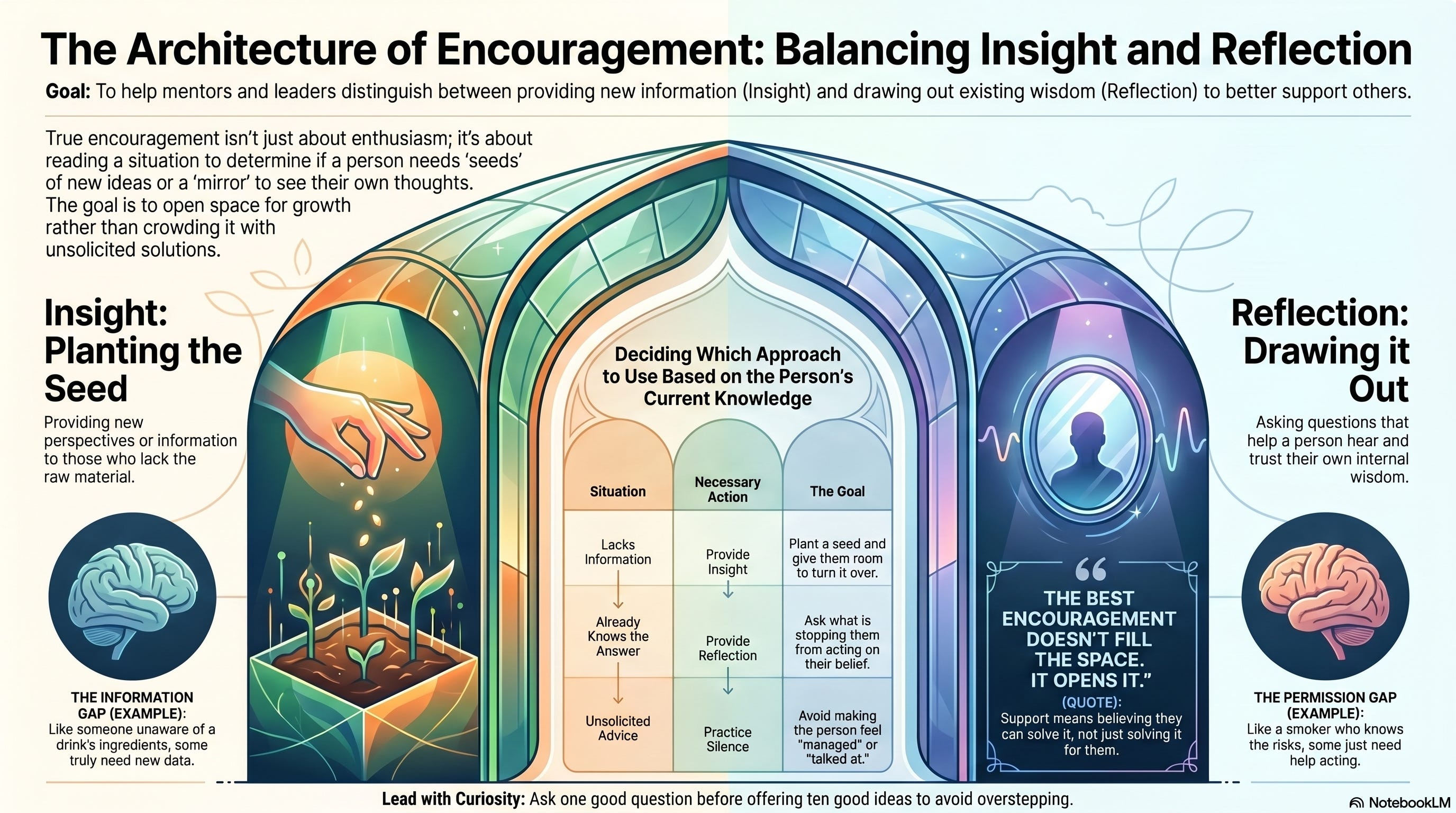
What I’m working toward is the ability to move fluidly between two modes.
The first is insight — bringing something to the table, planting a seed, offering a frame the person hasn’t considered. The second is reflection — asking the question that helps someone hear their own thinking more clearly, that gives their existing wisdom a chance to surface.
The best encouragers I’ve known can do both, and more importantly, they can read the room well enough to know which one the moment is calling for. They’re not locked into one approach. They’re not always the advice-giver or always the question-asker. They’re paying close enough attention to the person in front of them to follow the conversation where it actually needs to go.
That’s what I’m aiming for. Not to be less enthusiastic about helping — I don’t think I could turn that off if I tried, and honestly I wouldn’t want to. But to channel it better. To lead with curiosity before I lead with answers. To ask one good question before I offer ten good ideas.
People don’t always need you to solve it. Sometimes they just need you to believe they can.
The mentors who changed my life weren’t always the ones with the best advice. Sometimes they were simply the ones who stayed in the room long enough to ask the right question at the right moment — and then trusted me to do something with it.
That’s what I want to give people. Not just answers. Not just enthusiasm, as genuine as it is.
Just the sense that someone sees them, believes in them, and thinks they’re worth the conversation.
That’s enough. Sometimes that’s everything.
The best encouragement doesn’t fill the space. It opens it.
Comments
Nothing yet. Say the first thing.
Sign in to join the conversation.