
0:00
-19:24
Every organization has a mission statement. It’s usually polished, framed, and hung in the lobby, featuring words like integrity, collaboration, and excellence.
But the true culture of your organization isn’t defined by the words on the wall. It is defined by the behaviors you walk past.
There is an uncomfortable truth in leadership and team dynamics that separates average organizations from high-performing ones: what you tolerate, you endorse. If you permit a negative behavior to exist within your team, you are effectively giving it your blessing. Silence is not neutral — silence is permission.
To understand how quietly this happens, consider the story of the lobby carpet.
Imagine a newly opened, state-of-the-art facility. The director of the building is fiercely proud of the standard of excellence they’ve set. Everything is pristine.
One Tuesday morning, the director walks through the main lobby and notices a small, spilled coffee stain on the carpet. They are running late for a critical meeting, so they step over it, making a mental note to call maintenance later. But the day gets busy, and they forget.
The reception staff saw the director walk past the stain and ignore it. Subconsciously, a new baseline is set: perfection is no longer the standard. “Good enough” is.
The next week, a lightbulb flickers out in the hallway. A team member notices, but remembering the coffee stain, decides it’s not a big deal and leaves it. A month later, staff start arriving five minutes late to meetings. The director gets frustrated, wondering where the commitment to excellence went.
The truth? The director endorsed the decline the moment they stepped over the coffee stain. By tolerating a small slip in environmental standards, they silently communicated that the core value of excellence was optional.
This erosion of standards doesn’t just happen with physical spaces — it happens with people, and the consequences are far more damaging.
Imagine you have a team member who is incredibly skilled but famously hard to get along with. They roll their eyes in meetings, refuse to collaborate, and hoard information. As a leader or a peer, it’s tempting to look the other way. Confrontation is uncomfortable. You might tell yourself, “That’s just how they are,” or “We need their output, so I’ll just manage around their bad attitude.”
Here is what is actually happening when you make that compromise:
You are resetting the baseline. You are telling the rest of the team that teamwork is optional, provided you are talented enough. You are punishing your top performers — your collaborative, positive employees are now forced to carry the emotional and logistical weight of the toxic individual. And you are officially endorsing the toxicity. By doing nothing, you have integrated that bad attitude into your accepted company culture.
Consider a high-performing academic or clinical department. They have a rainmaker — a brilliant senior specialist who brings in the most prestige, the highest numbers, or the biggest grants.
The rainmaker is also notoriously toxic. They belittle junior staff, refuse to follow standard operating procedures, and create a culture of anxiety. The department head knows this but refuses to intervene. “We can’t afford to lose them,” the leader rationalizes. “Their numbers are too good.”
For a year, the numbers remain strong. But beneath the surface, a rainmaker’s tax is being levied on the organization.
Because the department head tolerates the abuse, the best junior staff members quietly start looking for other jobs. The ones who stay stop sharing innovative ideas, fearing they will be mocked. Collaboration dies. When two of the most promising young talents finally resign, the cost of recruiting, onboarding, and lost institutional knowledge far outweighs whatever surplus the rainmaker brought in.
The department head never explicitly said, “Bullying is an acceptable core value here.” But by tolerating the rainmaker’s behavior for the sake of short-term success, they endorsed it — and destroyed their team’s long-term potential in the process.
Culture is not a set of beliefs — it’s a set of acceptable behaviors. When you tolerate the unacceptable, it becomes the new standard.
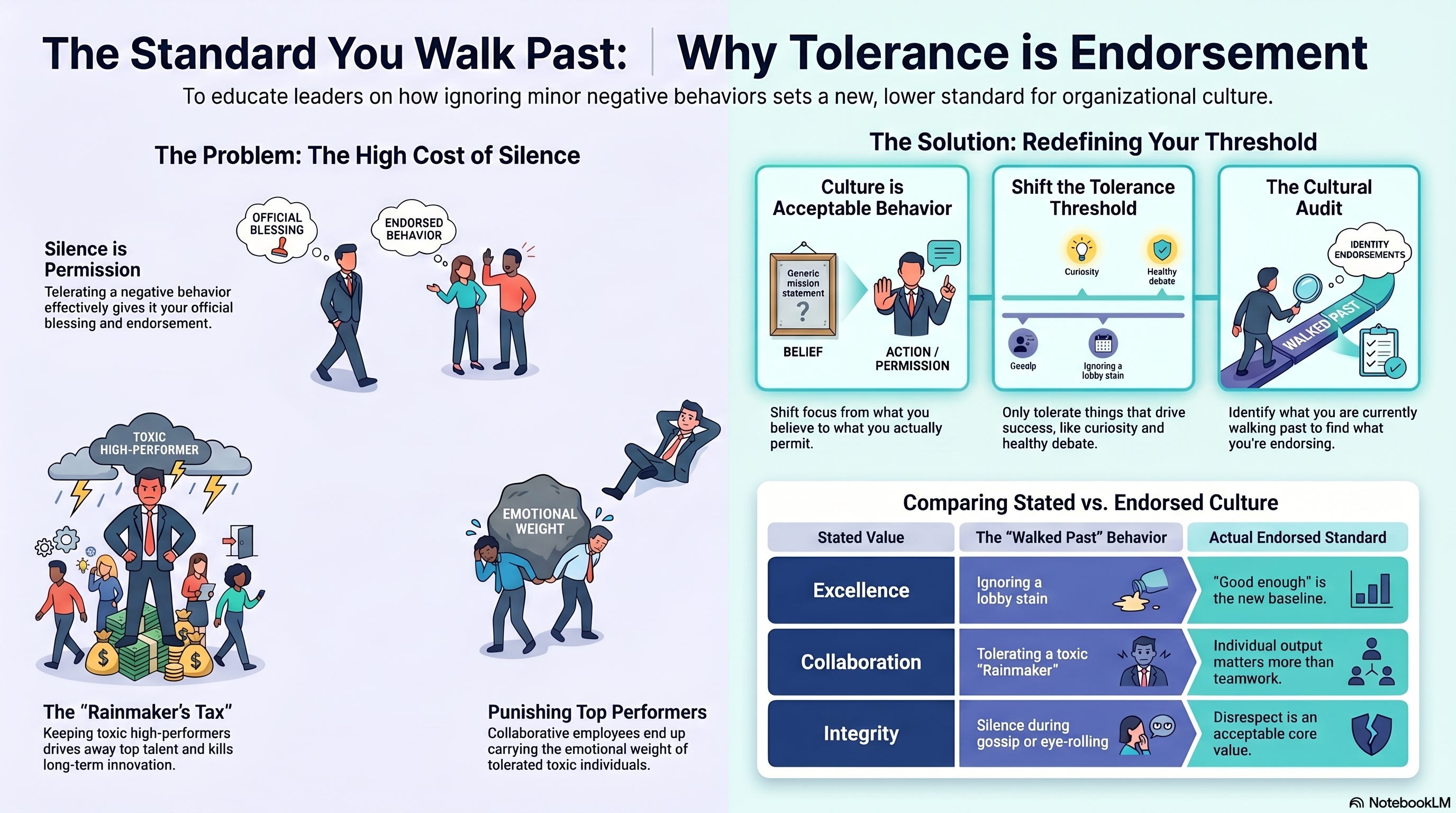
When you are building a high-quality organization — a place designed to be as successful, innovative, and resilient as possible — you have to be ruthlessly protective of your culture.
Every action, attitude, and behavior in your workplace is either pulling you closer to your goals or pushing you further away. There is no neutral gear.
If you are only supposed to endorse actions that help your organization succeed, then your tolerance threshold requires a massive shift. You must align what you tolerate with what you actually want to achieve.
If you tolerate something, it should only be the things that drive success — relentless curiosity and asking why, respectful disagreement and healthy debate, and honest mistakes made in the pursuit of innovation.
If you are willing to tolerate something that is actively harmful to the organization — like a bad attitude, gossip, or an unwillingness to collaborate — you are signing your name to it. You are telling your team, “This is who we are.”
Building a successful organization means having the courage to close the gap between the culture you say you want and the behaviors you actually permit.
Take a hard look at your team, your meetings, and your daily operations. Ask yourself: what am I currently tolerating?
Because whatever your answer is, that is exactly what you are endorsing.
Comments
Nothing yet. Say the first thing.
Sign in to join the conversation.