
0:00
-18:23
There’s a parable that has been told for thousands of years, and like all great stories, it keeps revealing new layers depending on where you are in life when you hear it.
A farmer goes out to scatter seeds. Same farmer. Same seeds. Same day. But the seeds land in different places, and what happens next depends entirely on the ground — not the seed.
Some seeds fall on the path. Hard, packed earth. Before they even have a chance, birds swoop in and take them. Gone. As if they were never there.
Some seeds fall on rocky soil. Shallow ground with no real depth underneath. They actually sprout — sometimes quickly, sometimes enthusiastically — but when conditions get tough, when the sun beats down and the rain stops coming, they wither. There was never enough beneath the surface to sustain them.
Some seeds fall in thorny ground. These ones actually grow. They take root, they reach upward, they show real promise. But the thorns and the weeds are growing too, competing for the same space and resources, and over time they choke out what was trying to flourish.
And some seeds fall on good soil. Prepared, deep, clear of competing things. And those seeds grow into something real.
I’ve been thinking about this parable differently lately. Not as a story about faith, though it certainly is that. But as a framework for understanding what happens when an idea meets a person.
Every time you share an idea with someone — a new approach, an opportunity, a challenge to think differently — you’re scattering a seed. You can’t fully control where it lands. You can scatter it thoughtfully, intentionally, at the right moment. But ultimately, what happens next depends on the ground.
And the ground is the person. Specifically, two things about that person at that particular moment in their life.
The first is readiness — have they done the foundational work? Do they have the skills, the knowledge, the circle around them, the self-awareness to receive this idea and know what to do with it?
The second is bandwidth — do they have the capacity to stay committed? Not just initial excitement, but real, sustained follow-through? Because commitment isn’t just about willingness. It’s about whether your plate has room for one more thing without everything sliding off the edges.
When you put those two things together, you get four kinds of ground. And here’s what matters most: this isn’t a judgment framework. It’s a diagnostic one. No quadrant tells you that someone can’t get there. It just tells you what they need to address first.
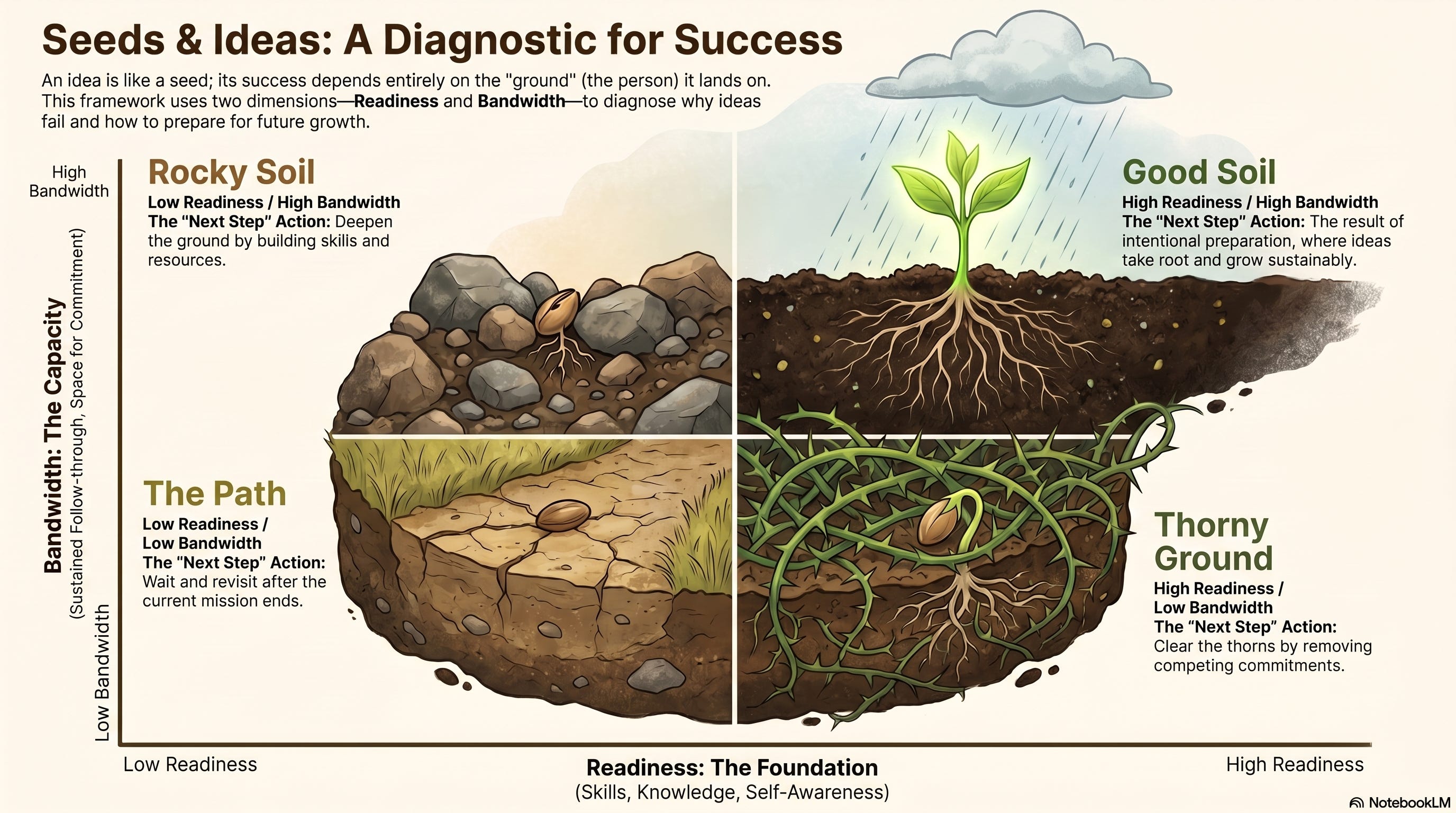
When I picture this kind of ground, I don’t picture someone who is stuck or disengaged. I picture someone who is already moving.
They’re on a path — literally in transit, going from one place to another. Maybe they’re in the middle of a job transition, or carrying a project that is consuming everything they have. Their readiness is tied up in a current mission. Their bandwidth is spoken for. The idea lands at the wrong moment, not on the wrong person.
This is an important distinction. The path doesn’t mean never. It means not here, and not yet. When this person arrives at their destination — when the transition settles, when the current mission completes — the ground may look completely different. The same seed, scattered again at the right moment, might find fertile soil in the very same person.
So if you’re the one carrying the idea, be patient. Make a note. Come back to it. And if you’re the one on the path, recognize that your season is coming. You’re just not there yet.
This person wants it. Genuinely and deeply. The commitment is real, the enthusiasm is there, and the vision is clear in their mind.
But the foundation isn’t built yet.
Consider someone who has a genuinely brilliant idea for an app — something that could solve a real problem, something they can see working perfectly in their mind. The passion is absolutely there. But they don’t have the technical knowledge to build it. They don’t have the relationships to get it resourced. They don’t have the capital to execute it. None of that makes the idea wrong or the person incapable. It just means that before the commitment has anywhere solid to take root, some foundational work needs to happen first.
They need to find the right people. Build or borrow the right skills. Gather the resources. Cultivate the relationships. The seed needs more soil underneath it before it can hold — and the good news is that soil can be built deliberately, one layer at a time.
The next step for rocky soil isn’t to abandon the idea. It’s to deepen the ground.
This one is perhaps the most frustrating quadrant, because this person actually has what it takes. The foundation is there. The skills exist. The preparation has happened.
But their plate is overflowing.
Every new commitment competes with a dozen existing ones, and over time those competing demands quietly choke out the very thing that was trying to grow. This is the person who starts strong, genuinely intends to follow through, but slowly gets swallowed by everything else pulling at their attention and energy. It isn’t a lack of ability. It isn’t a lack of desire. It’s a lack of space.
The next step here isn’t more preparation — they’re already prepared. What they need is to clear some ground. To say no to something else before they say yes to this. To ruthlessly examine what is competing for the same resources and make some intentional decisions about what stays and what goes.
You cannot grow something new in ground that is already fighting itself.
The foundation is there. The preparation has happened. The circle is moving in the right direction, the behaviors are aligned, and there is genuine capacity to stay committed when things get difficult.
When an idea lands here, it has everything it needs. It takes root. It grows into something real and sustainable.
This is not about being a certain kind of person. It’s about being in a certain kind of place — a place that can be worked toward deliberately, intentionally, over time. Good soil isn’t an accident. It’s the result of someone doing the quiet, unglamorous work of preparing themselves before the opportunity arrives.
If you’re someone who shares ideas, who invests in people, who genuinely lights up when you see potential in someone else — this framework is for you too.
Your job is not to force the seed into ground that isn’t ready. Your job is to scatter thoughtfully, to read the ground honestly, and to help people understand what they need to address before the idea can take hold.
To the person on the path, you say: keep moving — your season is coming, and we’ll revisit this when you arrive.
To the person in rocky soil, you say: the commitment is there — now let’s talk about building the foundation underneath it.
To the person in thorny ground, you say: you already have everything you need — now let’s talk about what needs to come off your plate.
And sometimes — more often than we’d like — your role is simply to plant the seed and trust the process. You don’t always get to see what grows. The farmer scatters and moves on, trusting that the seeds worth growing will find their soil eventually.
That’s not failure. That’s faithfulness to the work.
Before you take on something new — a project, an idea, a challenge someone has placed in front of you — it’s worth sitting with two honest questions.
Am I ready? Do I have the skills, the relationships, the foundational preparation to actually sustain this? Or do I need to do some ground work first?
Do I have the bandwidth? Is there genuinely room on my plate for this, or am I setting it up to get choked out by everything else already competing for my time and energy?
If the answer to either question is no, that’s not a reason to walk away from the idea. It’s a roadmap for what needs to happen first.
Prepare the ground. Clear the thorns. Finish the journey you’re already on.
Then plant the seed.
The seed hasn’t changed. It never does. What changes is the ground it lands in.
Comments
Nothing yet. Say the first thing.
Sign in to join the conversation.