
0:00
-21:05
A friend and colleague reached out last night with one of those conversations that starts with I have an idea I want to run by you. She’d been given a lead on a position — an international role, something that aligned with a passion she already had, something that could open doors she hadn’t even fully imagined yet. A friend who knew her well had recommended her as a strong candidate.
And she was hesitating.
Not because she wasn’t interested. Not because she was clearly underqualified. Just that particular combination of nervous and intimidated that shows up whenever something feels bigger than what we’ve been giving ourselves permission to want.
So I asked her two questions.
Is this something you’re at least vaguely interested in?
Yes.
Do you think you could remotely meet the qualifications for this role?
Yes.
Then what’s the problem with applying?
Here’s the analogy I keep coming back to when I have this conversation — and I’ve had it more times than I can count.
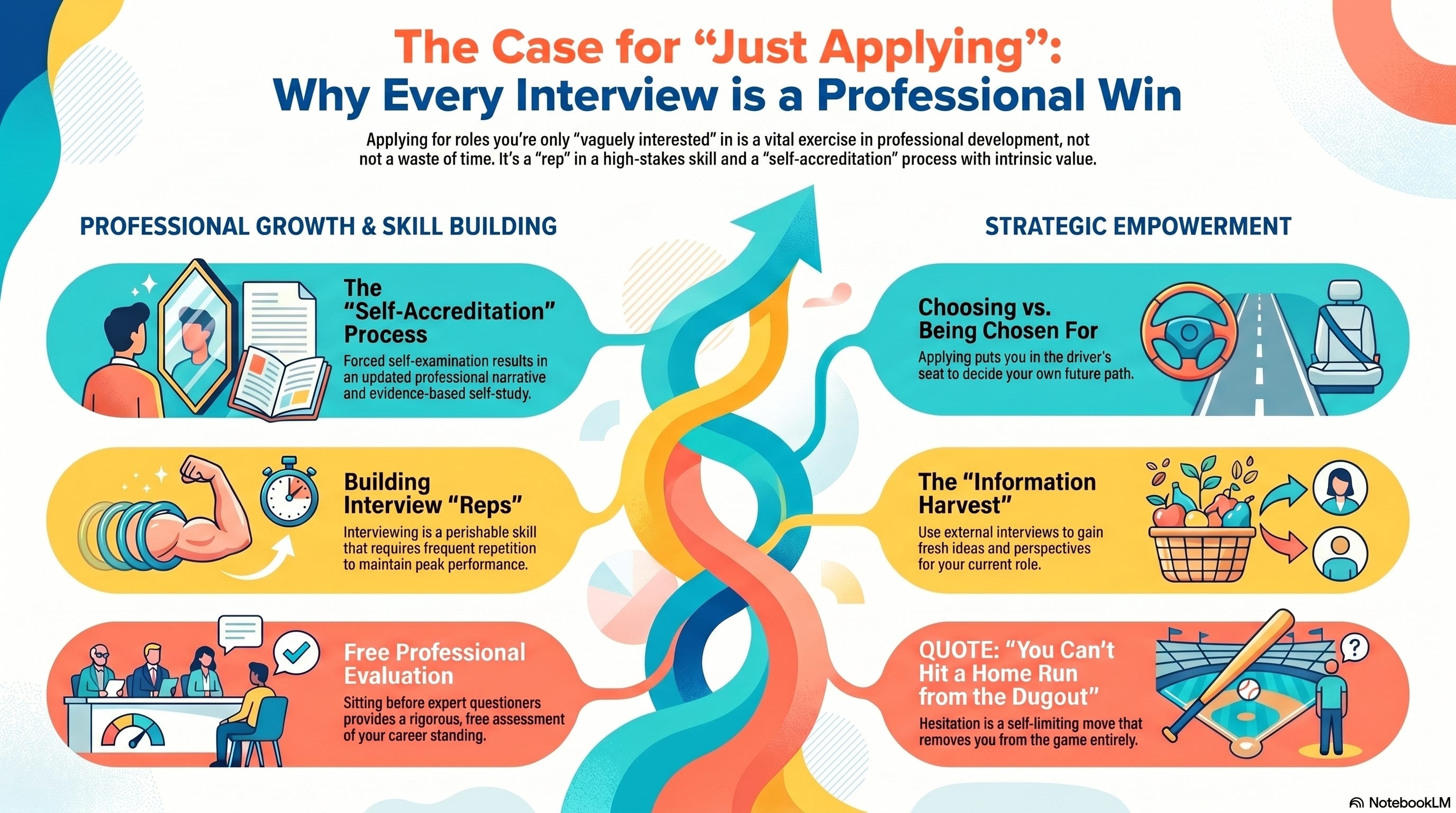
It’s the bottom of the ninth. Score is tied. You have a chance to step up and hit the game-winning home run.
This is not your first time holding a bat.
You don’t walk into a high-stakes interview after eight years away from the process and expect to perform at your best. That’s not how any of this works. The interview is a skill. Applying is a skill. Presenting yourself, articulating your experience, defending your qualifications under thoughtful questioning — all of it requires practice, and practice requires repetition.
Every application you submit, whether you want that particular job or not, is a rep. Every interview you sit through sharpens something. The people who interview well aren’t naturally more impressive — they’ve just done it more recently and more often than everyone else in the room.
I told her something else that I think reframes the whole experience: a serious job interview is essentially an accreditation process for yourself.
Think about what accreditation actually requires. You put together a self-study. You document your work, your outcomes, your evidence of meeting established standards. And then you sit across from people whose job is to ask hard questions and see whether the evidence holds up.
A good interview is exactly that. You’re asked to articulate who you are, what you’ve done, why you made the decisions you made, and what evidence you have that you’re capable of doing what this role requires. It forces a level of self-examination that most of us don’t do voluntarily because it’s uncomfortable and time-consuming.
But the output of that process — the updated CV, the refreshed references, the clear narrative about your own career — that’s yours to keep regardless of what happens with the job. You’ve essentially conducted a free professional self-evaluation. And what you learn about yourself in that process might be more valuable than the position itself.
There’s a principle underneath all of this that I feel strongly about:
It is always better to be in a position where you get to make the decision than to be in a position where someone else makes it for you.
When you don’t apply for a job you’re qualified for and interested in, you haven’t avoided a decision — you’ve made one. You’ve chosen not to be in the room. You’ve removed yourself from consideration before anyone else had the chance to weigh in. And that is a self-limiting move dressed up as caution.
Apply. Go through the process. And if they come back and say they want to move forward — now you’re in the driver’s seat. Now you’re the one deciding whether this opportunity fits your life, your goals, your timing. That’s a completely different position than sitting at home wondering what might have happened.
The worst realistic outcome is that you don’t get the job and you walk away having practiced, reflected, and learned something about yourself. That’s not a bad outcome. That’s actually a pretty good use of an afternoon.
I want to say one more thing about this, because it doesn’t get mentioned enough.
I have gone through interview processes for positions I ultimately didn’t take — or didn’t get — and come back to my current role with ideas I could not have paid a consultant to generate. Sitting across from people at another institution, being asked how I would approach a particular problem, hearing how they frame their challenges — it opens something up. It creates connections that wouldn’t have formed any other way.
I’ve rolled those ideas directly into my existing work. They changed how I thought about problems I was already sitting with. The interview that didn’t result in a job offer still returned value — just not in the form I originally expected.
That’s the thing about putting yourself in new rooms, even temporarily. You don’t always know in advance what you’re going to take with you when you leave.
If you’re sitting on an opportunity right now — something you’re remotely interested in, something you could plausibly qualify for, something that someone who knows you well thought you’d be good at — here’s my advice:
Update the CV. Reach out to the references. Write the cover letter. Submit the application.
Not because you have to take the job. Not because you’re definitely leaving where you are. But because the exercise is worth doing, the practice is worth having, and you deserve to be in a position where you make the call.
Don’t let your hesitation make the decision for you.
Just apply.
You can’t hit a home run from the dugout.
Comments
Nothing yet. Say the first thing.
Sign in to join the conversation.