
0:00
-18:39
There is a particular kind of loss that nobody prepares you for when you leave a job.
Not the loss of the title or the routine or the colleagues — those are real, but they’re expected. The loss I’m talking about is quieter and more personal. It’s the feeling you get when you look at the projects you’ve been nurturing, the ideas you’ve been developing, the things you were right in the middle of building — and you realize they’re no longer yours.
You’re handing them off. And the person receiving them is going to do things differently than you did.
Stay with me on this analogy, because I think it’s more accurate than it might first appear.
You’ve been caring for these projects the way a parent cares for a child. You’ve fed them time and attention. You’ve stayed up late worrying about them. You’ve made decisions about how they should be raised — what they need, what they don’t need, what kind of environment helps them thrive. You have a vision for who they’re going to become.
And now you’re handing them to someone else.
Maybe the new parent believes in structure where you believed in flexibility. Maybe they’re going to set a strict bedtime where you let things run a little later. Maybe they’re going to cut out the ice cream you’d been allowing even when the plate wasn’t finished. Maybe they’re going to let the kids run wild in the mud in ways that make you wince a little.
Or maybe it goes the other way — maybe you were the structured one, and the new approach is looser, more experimental, less controlled than what you built.
Either way, you feel it. And the feeling is worth examining, because it’s telling you something important — not just about the projects, but about yourself.
When I started sitting with this feeling during my own transition, I realized it wasn’t one thing. It was several, and they each had a different texture.
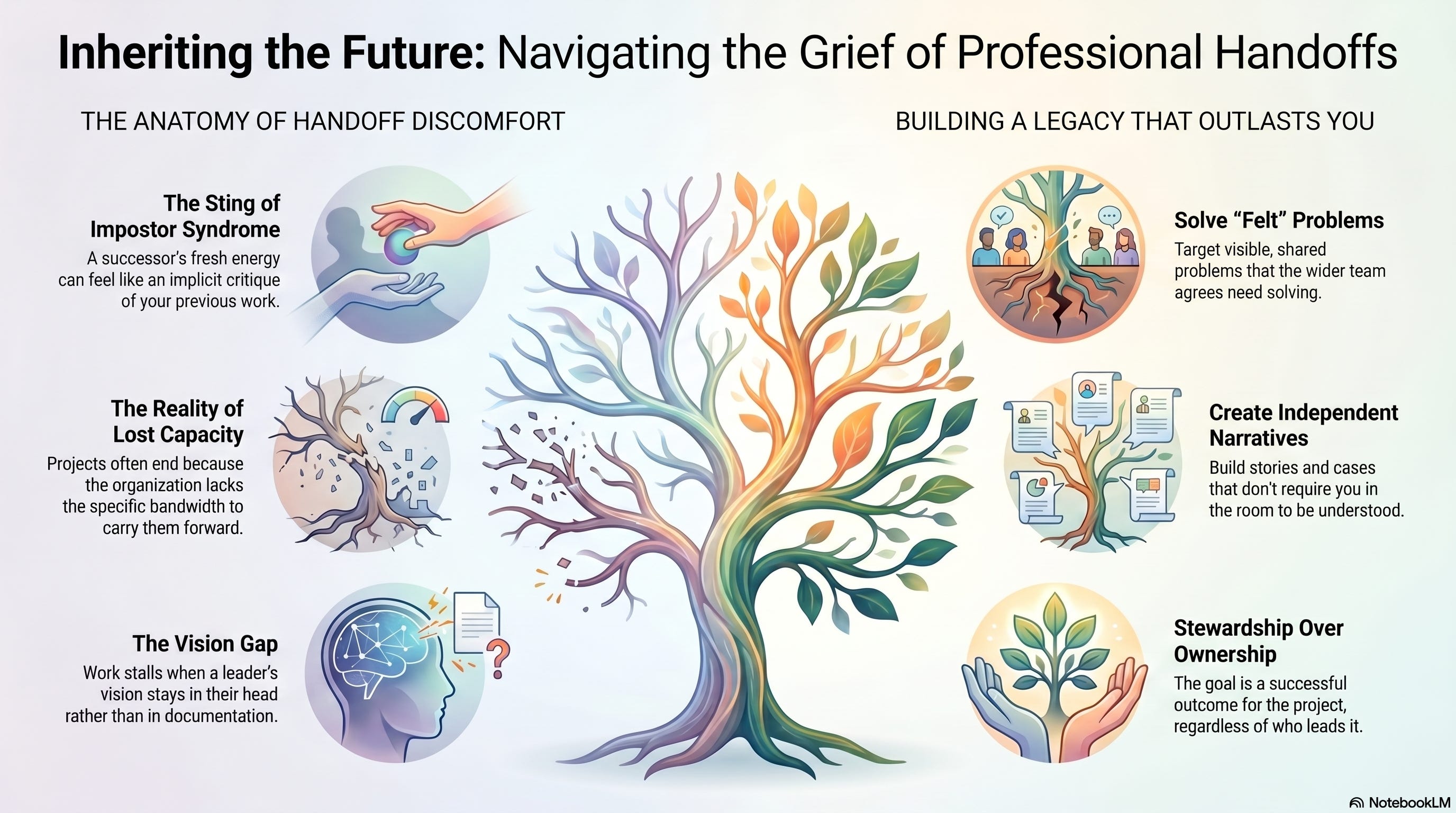
The first is impostor syndrome.
When someone steps into your role and immediately starts identifying solutions to problems you’d been wrestling with — when they walk in with fresh eyes and apparent confidence and a clear sense of what needs to happen — something uncomfortable surfaces. A voice that says: I should have seen that. Why didn’t I fix that before they got here? Was I even qualified to be doing this job?
That’s impostor syndrome talking, and it has a particular bite during transitions because the contrast is so visible. The new person’s energy and perspective can feel like an implicit critique of everything you did and didn’t do. It isn’t, usually. But it feels that way.
This is something I’ll be managing for the rest of my career. Most leaders at this level will. The goal isn’t to eliminate it — it’s to recognize it for what it is and not let it rewrite the story of what you actually built.
The second is lost capacity.
Some projects don’t continue after you leave because the organization simply doesn’t have the bandwidth to carry them without you. It’s not that the idea was wrong. It’s not that the new leadership doesn’t see the value. It’s that the margin required to move it forward no longer exists in the same way.
This can happen even when you’re still in the building. Someone leaves, capacity shifts, and a project gets shelved — not because it failed but because the conditions that made it possible changed. That’s an organizational reality, not a verdict on the work.
The third is the hardest one.
Sometimes a project gets set aside not because of capacity, and not because the new leadership lacks vision in general — but because they specifically can’t see your vision. They can’t find themselves in the story. The problem you were solving doesn’t resonate with them the way it resonated with you. And so it stops.
This is the one I’ve had to do the most work on. Because it raises a question I’d rather not sit with: did I communicate the vision clearly enough? Did I build the case thoroughly enough? Did I engage the right people early enough that the story belonged to more than just me?
Here’s what I think this feeling is actually trying to teach me, and I want to be honest about it because I don’t think I learned it as early as I should have.
When a project dies after you leave because the incoming leadership doesn’t see the vision — that’s worth examining carefully. Not to assign blame, but to ask: was the problem clearly defined? Was the story fully fleshed out? Was the solution developed in a way that made sense to the people who would eventually have to carry it?
Because if the answer to those questions is yes — if the problem was real, visible, and widely understood, if the story was clear and the solution was sound — then the people taking over are far less likely to walk away from it. Even if their approach is different from yours. Even if they’re more of a bulldog where you were more methodical, or more experimental where you were more structured. A well-built foundation tends to survive a change in architects.
But if the answer is no — if the project was built around your intuition more than a shared understanding of the problem, if the vision lived primarily in your head rather than in documents and conversations and buy-in from the people who matter — then its survival was always more dependent on your presence than on its own merit.
That’s not a comfortable thing to realize. But it’s a useful one.
I left a job once early in my career — my first supervisory role in a respiratory department. We had real problems we were trying to solve, real projects in motion, real momentum. When I left, the person who picked up the reins apparently kept a notebook. They would call me from time to time — hey, I just accomplished another one of your ideas. Eventually they stopped calling about my ideas because they’d developed their own. They built a whole career around it.
The ideas didn’t die. They just needed a different person, at a different time, with a different approach to bring them the rest of the way home.
That’s the perspective I’m trying to hold right now. Not every project that changes after I leave was abandoned. Some of them just needed to evolve. Some needed a different hand. Some needed more time than I had. And some — I’ll be honest — probably needed to be better communicated before I ever walked out the door.
So here is what I want to carry into the next chapter:
Before I pick up a new project, I want to ask — clearly and honestly — what problem am I actually trying to solve? Not what innovative idea do I want to explore, not what can I attach a problem to after the fact, but what is the real, visible, felt problem that other people would recognize and agree needs solving?
And then: have I told the story in a way that doesn’t require me to be in the room for it to continue?
Because the goal was never to be indispensable. The goal was to build something that outlasts my presence.
If you’re the one receiving the handoff — the one inheriting someone else’s projects, their approaches, their half-finished ideas — this is worth saying too.
You are the new parent now. The late nights belong to you. The homework battles, the missed soccer practices, the hard decisions about what stays and what goes — that’s yours now. The dynamic has changed and so have the constraints, and you’re going to have to make adjustments that the previous parent never had to make.
Respect what was built, even when you change it. Understand that the person who handed it to you cared about it in ways that might not be immediately visible. And recognize that some of what you’re inheriting is further along than it looks — because someone stayed up late for a long time getting it there.
The goal is still the same. A successful outcome for the child. A good life for the project.
How you get there is now, entirely, up to you.
Just because it’s no longer yours doesn’t mean it didn’t matter. And just because they do it differently doesn’t mean you did it wrong.
Comments
Nothing yet. Say the first thing.
Sign in to join the conversation.