
0:00
-17:29
I’m reading The First 90 Days right now, alongside a couple of other books I picked up in preparation for a new chapter. And I’ll be honest — reading it at this particular moment, while I’m reflecting on what the last few years actually looked like in practice, is equal parts enlightening and humbling.
Because I can see, with the clarity that only hindsight provides, exactly where the map didn’t match the territory.
Michael Watkins writes about entering an organization and taking time to learn it — the culture, the politics, the unwritten rules, the immune system response that every organization has when something new tries to take root inside it. It’s smart, practical advice. The kind that makes you nod along and think yes, obviously, that’s exactly right.
The challenge is that the book assumes a fairly stable host. An existing organization with established patterns that you, the newcomer, need to read carefully before you start pushing.
What it doesn’t fully account for is what happens when the newcomer is the organization.
That’s the situation we were in. We weren’t just a new leader or a new team being introduced into an existing body. We were a new medical school — a new entity, an organ of sorts — being introduced into a university that had its own immune system, its own history, its own way of doing things that predated us by decades.
And from the very beginning, the rejection response was real. Not malicious. Not personal. Just biological, in an organizational sense. The university’s systems weren’t built for what we needed. Processes that worked perfectly well for established departments had to be bent, negotiated, or routed around entirely in order for us to function. Every conversation with the broader institution felt like starting from scratch, as if the organizational memory reset between meetings.
What made it even more complicated was that we weren’t a finished transplant. We were a growing one. We started small, added people, and with every addition the dynamic shifted. Each new faculty member brought deep expertise in their field — exactly what you want when you’re building a curriculum. But each one also brought a new perspective, a new angle, a new set of instincts about how things should be done. And so the curriculum we’d carefully sketched out — the skeleton our Senior Associate Dean had painstakingly assembled — would flex and shift and sprout in a new direction every time someone new came through the door.
It was like trying to get your arms around a blob that kept squirting out in new directions the moment you thought you had a grip on it.
I still don’t know how our Senior Associate Dean kept it all moving forward. But somehow she did.
Here’s the honest reflection: I came in with a framework mentality. Plant the seeds, build the structure, and trust that things would grow in the right direction. What I underestimated was how much active force it takes to manage growth inside a system that is itself still figuring out what it is.
The blob needed someone with arms wide enough to hold it — not just to contain it, but to shape it with intention as it expanded. That required a kind of assertive, directive leadership that doesn’t come naturally in a start-up culture, where the instinct is to stay flexible, stay collaborative, let the best ideas win.
Both instincts were right in their own way. The problem was knowing when to switch between them. And I think I stayed collaborative longer than the situation required, in moments when what was actually needed was someone drawing a firm line and saying this is the direction, and we’re moving in it.
That’s the lesson. Not that collaboration was wrong. Just that in a rapidly growing, undefined, structurally complicated environment — one that is a start-up and also inside a large institution that doesn’t fully understand what you are yet — you have to be willing to be more directive than feels comfortable. The blob won’t hold its shape on its own.
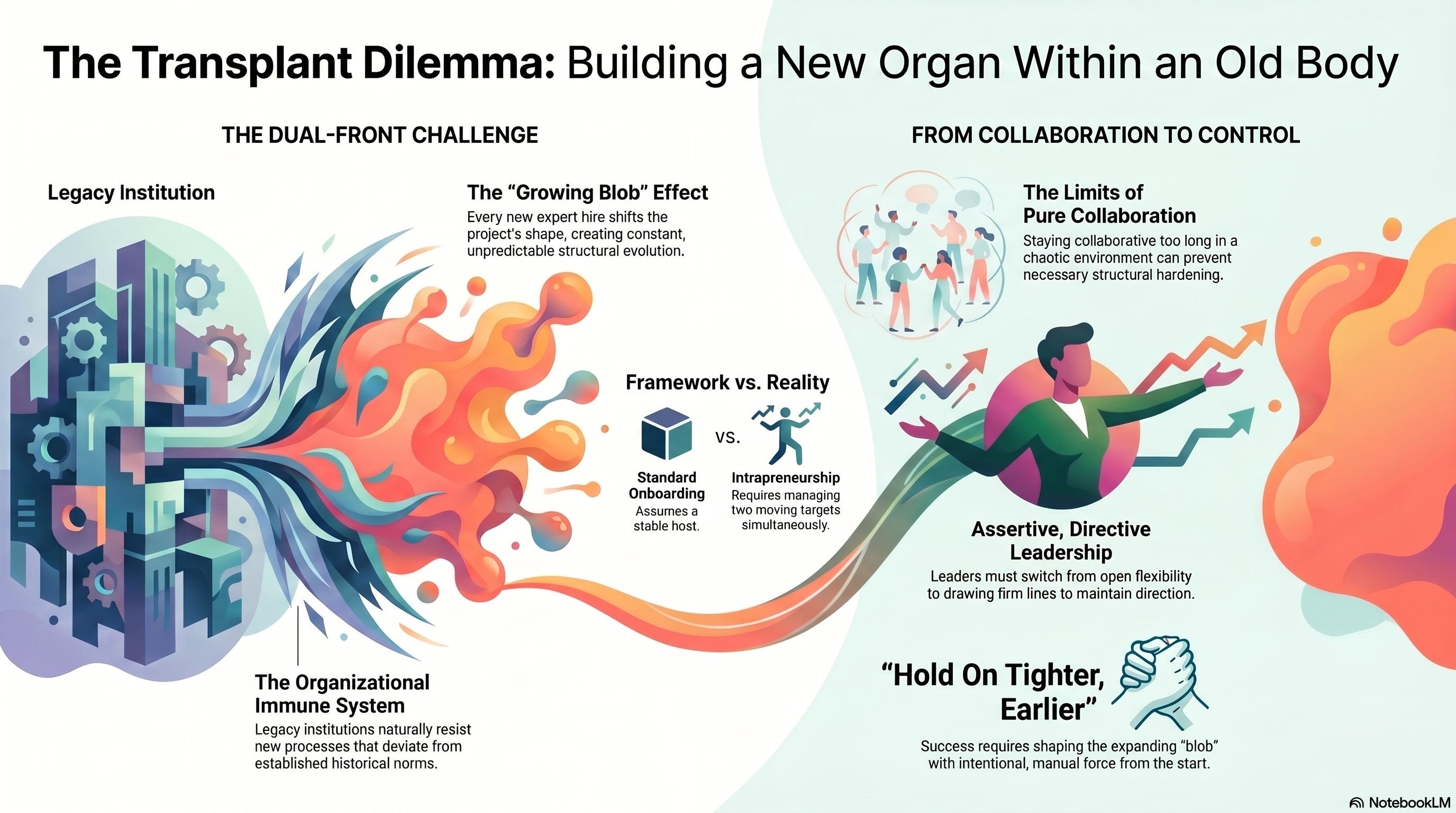
The First 90 Days framework is built around a relatively clean scenario: one person, entering one organization, trying to understand and eventually influence an existing culture.
What we were doing was something else entirely. It was a start-up, but inside a university. It was a new organization, but one that had to operate within the rules of an old one. It was a team that kept growing, which meant the first 90 days never really ended — every new hire brought their own version of it, their own adjustment period, their own immune response.
Trying to apply standard onboarding wisdom to that situation was like trying to catch autumn leaves with a leaf blower. Technically you’re doing something. The leaves are definitely moving. But the results are not exactly what you pictured.
I don’t regret the experience. Not even close. If anything, I’m leaving with something that feels like a post-doctoral fellowship in a discipline I didn’t know existed when I started — higher education institution-building, at the intersection of academic medicine, accreditation, faculty development, and organizational chaos theory.
I’ve learned from the people who came alongside me. I’ve learned from watching what the leadership around me navigated. I’ve learned from observing what the people who will replace me are now inheriting, and what that tells me about what we built and what we left unfinished.
And now, reading The First 90 Days on the other side of it, the frameworks make more sense than they ever could have at the beginning. Because I have the experience to hang them on.
That’s how it usually works, isn’t it? The map makes the most sense after you’ve already walked the territory.
Next time — and I do think there will be a next time — I’ll be ready in a way I simply wasn’t before. Not because I’ll have a better plan. But because I’ll know, from the inside, what it actually feels like when the blob starts moving.
And I’ll know to hold on tighter, earlier, with both hands.
The best preparation for building something new is having survived building something new before.
Comments
Nothing yet. Say the first thing.
Sign in to join the conversation.