
0:00
-18:59
There’s a ritual in clinical medicine that every healthcare provider knows well: the shift handoff. You’ve been with your patients for hours. You know their history, their current status, their problems, the things you’re worried about, the things you didn’t get to. And now you stand across from the person taking over and you give them everything — clearly, honestly, completely — because someone’s wellbeing depends on how well you transfer that knowledge.
I had a version of that conversation today. No patients involved. But the feeling was surprisingly familiar.
The person taking over my responsibilities is someone I’ve known for years. We’ve worked together in different capacities, crossed paths on different projects. But this conversation was unlike any we’d had before. It had the texture of a handoff — the weight of it, the vulnerability of it — without the clean structure that clinical training gives you for those moments.
In a patient handoff, you know the format. You know what to lead with, what to flag, what can wait. The framework exists because the stakes demand it.
This was harder to organize. I was handing off a department, not a patient. The consequences of a gap in communication were less immediate, less measurable — though not necessarily less real. And unlike a clinical shift, I won’t be fully gone when this is over. For the next two months I’m still available, still reachable, still able to fill in the backstory when a question surfaces. It’s less like handing off a patient and more like handing off a patient and then staying available at the nurses’ station for follow-up questions.
That’s an unusual dynamic. And sitting with it today taught me some things.
What struck me most about this conversation wasn’t what I said. It was how he approached the receiving of it.
He didn’t come in reactive or overwhelmed. He came in organized, methodical, with a clear sense of what information he needed and in what sequence. The day before, he’d asked for an executive summary — the players, the reporting structure, the full landscape of what was happening across the department. Give me the map before we talk about the terrain.
Then today, after he’d read it, he came back with a specific question: What are the fires?
Not tell me everything. Not walk me through your whole tenure. Just — where is it burning right now, and how hot?
From there we moved systematically. Human resources. Hiring. Budget. Faculty. Equipment. Purchasing. Curriculum — intake, output, development challenges, specific struggles in specific domains. New stakeholders coming into the space. External activities and partnerships. One domain at a time, fully examined before moving to the next.
It was one of the most well-structured receiving conversations I’ve been part of. And watching someone absorb a complicated, imperfect situation with that kind of calm, organized curiosity was genuinely instructive.
Here’s the part I have to be honest about: I wasn’t satisfied with what I was handing over.
Not in a catastrophic way. Things weren’t on fire in every direction. But there were gaps. Things I wanted to have further along. Problems I’d identified but hadn’t resolved. Areas where I yielded when I should have pushed harder, or pushed when I should have waited, and now the outcome of that is someone else’s inheritance.
He received all of it graciously — the wins and the shortfalls alike — with an openness that made the conversation easier than it had any right to be. But his generosity in receiving it didn’t change how I felt handing it over. The frustration of unfinished business is its own particular thing. You can make peace with it. You can recognize that no transition is ever perfectly clean. But you still feel it.
And I think that feeling is worth paying attention to, because it’s pointing at something actionable.
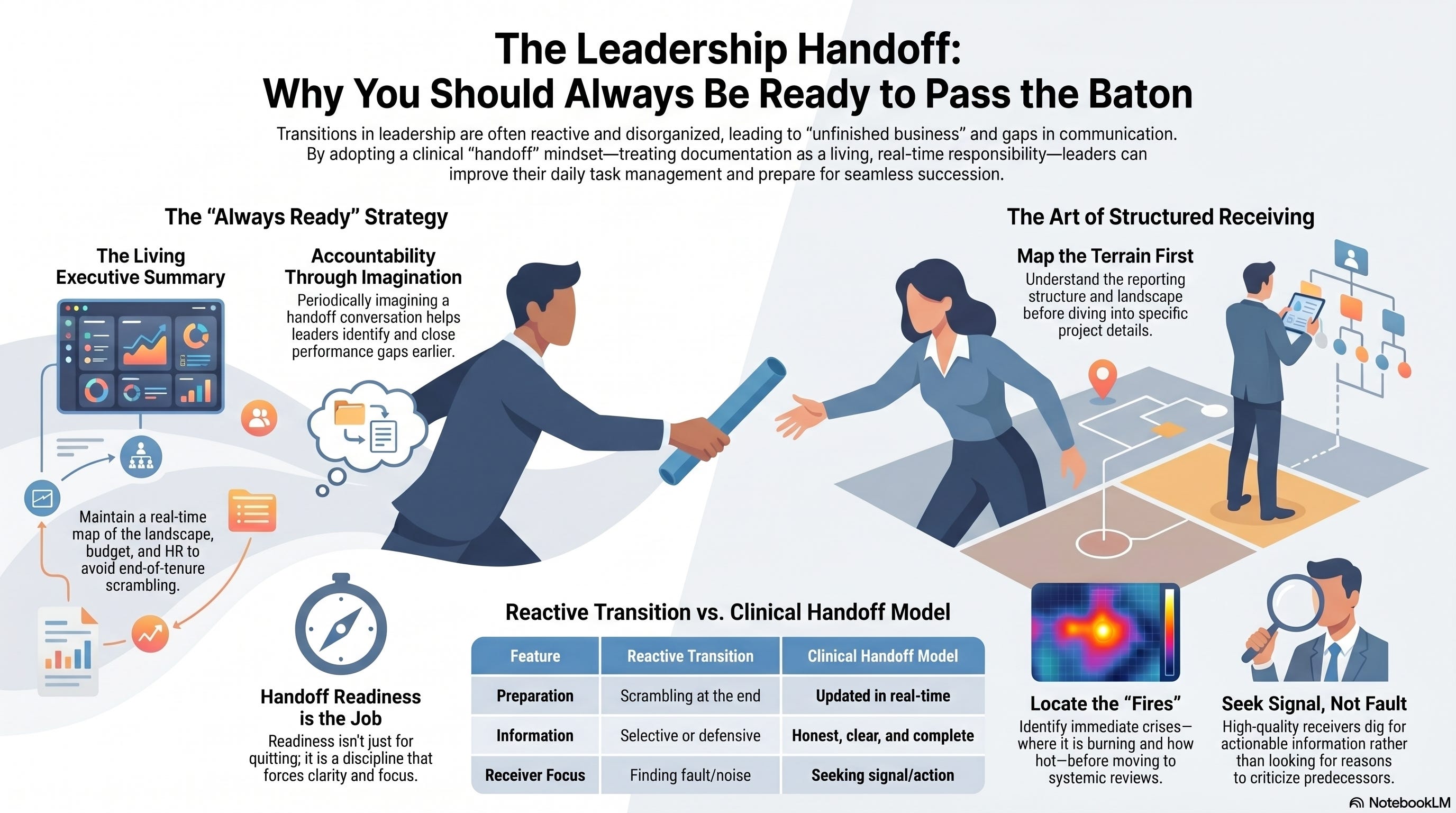
Here’s what I’m taking away from today:
The reason the clinical handoff works as well as it does — when it works — is that good clinicians aren’t scrambling to reconstruct information at the end of the shift. They’ve been tracking it all along. The report is essentially always ready, updated in real time, organized in a way that can be transferred at a moment’s notice.
There’s no reason that principle can’t apply to leadership.
If I maintain a living document — an ongoing executive summary of the landscape, the fires, the HR situations, the budget status, the open problems and where they stand — then I’m not just preparing for a handoff. I’m creating my own task management system. I’m forcing myself to see the full picture regularly, to notice what’s slipping, to stay honest about what’s getting done and what isn’t.
The handoff readiness is the leadership practice. They’re the same thing.
If I had approached this role from day one with the mindset that I should always be ready to give a clean report to whoever comes next, I might have caught some of those gaps earlier. I might have pushed harder on the things I eventually had to admit were unfinished. The accountability of imagining that conversation — having to say it out loud to someone taking over — has a focusing effect that I underestimated.
One more thing worth naming: watching someone receive information well is its own kind of education.
He didn’t dig through the noise to find something to criticize. He dug through it to find what he actually needed. There’s a difference, and it matters. He was looking for signal, not for fault. He asked clarifying questions without making me feel like I was on trial. He acknowledged the complexity of the situation without using it as an excuse to lower expectations for himself going forward.
That’s a skill. And it’s one I want to carry into the next time I’m the one receiving someone else’s report — because eventually I will be, and how I show up in that moment will say a lot about the kind of leader I’m becoming.
Always be ready to give the report. Not because someone is about to take over — but because the discipline of staying ready is the whole job.
Comments
Nothing yet. Say the first thing.
Sign in to join the conversation.