
The last thing the farm did before I left was throw a tornado warning at me. The power went, the rain came at the windows sideways, and I said goodbye in the dark.
I'm writing this from the top floor of a very small apartment in the middle of Paris, windows open, nothing outside louder than a scooter.

I'm here for five weeks. I try to do this every year and I've stopped pretending there's a strategic reason: I'm here for the streets, the buildings, the food, the light, and a pace of life that feels designed by someone who had actually thought about it.
If you see me, wave.

The first few days were spent entirely on one thing. A new teammate took the train over from the UK and we spent three days in a slightly-too-warm coworking space taking a new project apart and rebuilding it from the ground up.
I can't tell you what it is yet. Next week, I think.
I posted a short last week about a bacterium found in the gut of Japanese tree frogs that wiped out 100% of colorectal tumours in mice with a single dose. It's now been watched over 10 million times.
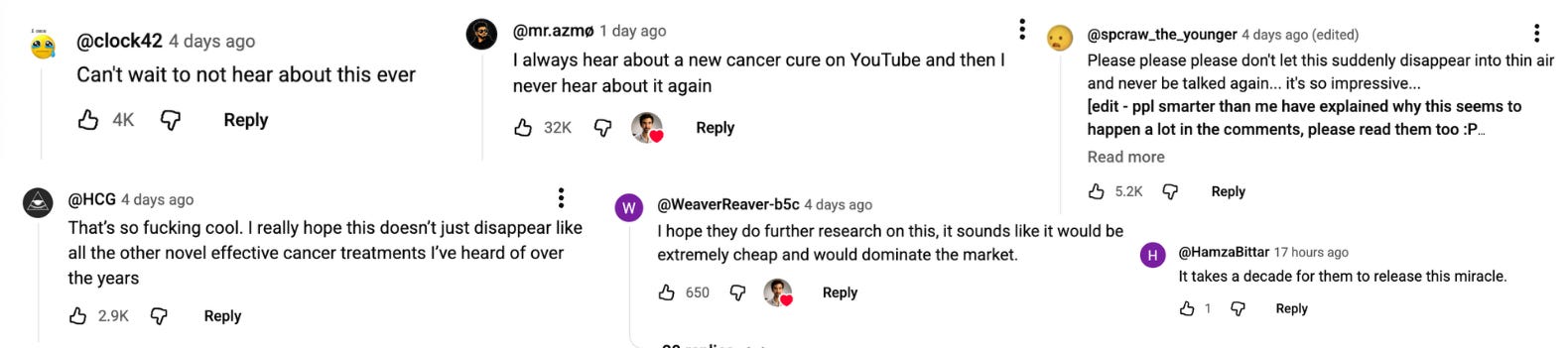
What always strikes me when a video blows up like this is how many of the comment are basically some version of : "can't wait to never hear about this again."
There are usually also an equal number (if not slightly more) of comments asking these scientists not to get on planes together, or attesting to their robust mental health
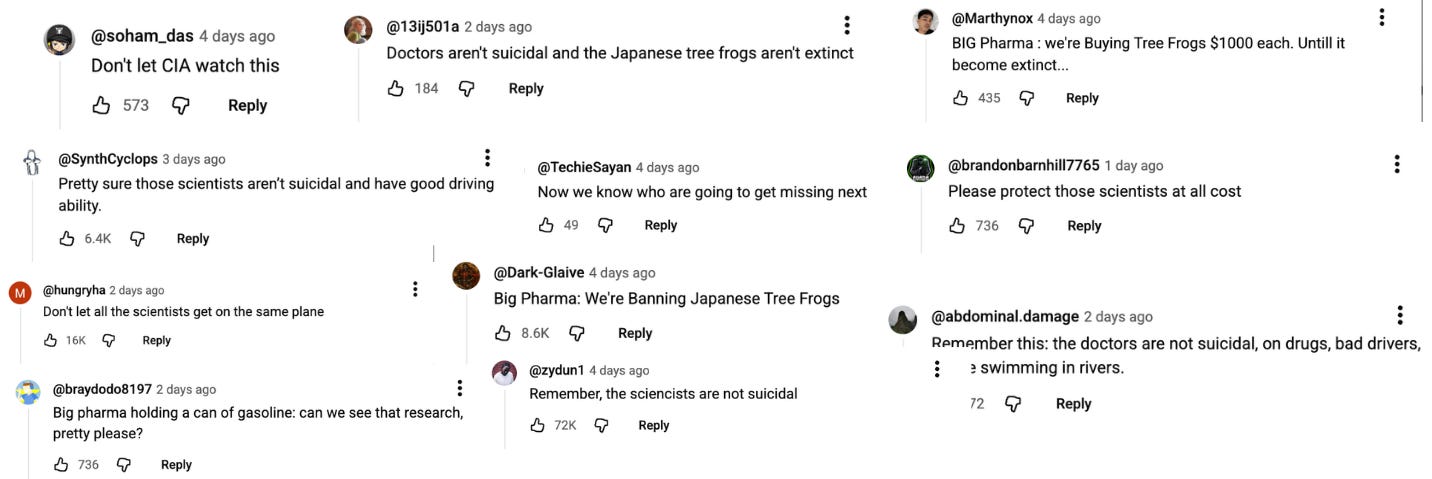
But the truth is that you don't need conspiracy theories about “big pharma” or nefarious government schemes to explain why breakthroughs like this one tend to vanish. You just need to understand how science actually works.
Publish, Patent, or Perish… and then Perish anyway
Science runs on cultures of publish, patent, or perish. Gone are the days of comfortable tenure and open-ended grants - a scientist, especially early in their career, has to produce results fast enough to justify the next 12-18 months of funding. That pressure has turned science into a sprint toward one specific finish line
“a proof of concept”.
Just enough to survive the judging eye of reviewer 2 and sufficiently evidenced that it seems to point to a new truth unlocked about the universe looks. This means the holy grail of all activities can be completed:
a peer-reviewed academic paper.
A daringly entrepreneurial scientist may patent their breakthrough but even these often just spend the rest of time as one of many ideas in a untouched digital library.
But what does that actually mean for something like the frog bacterium? It means the team has, entirely legitimately, put the idea into the world. The problem is that standing between a validated idea and something that can actually change the world is a long queue of experiments and further hard work.
Does it hold at a hundred times the size? Does it survive ten thousand cycles rather than fifty? Does it work with feedstock that isn't 99.999% pure? (because nobody is running a factory on 99.999% anything) Does it work in a building that isn't this building? Does it still work after the PhD student with the magic touch graduates and moves to Zurich?
Every one of those is an experiment with a genuine chance of “no” being the correct answer. That's science.
For scientists in academia: It's just the kind almost nobody funds and no journal wants, because the result is either "yes, incremental result as expected" (not a paper) or "no" (unless it happened for an interesting reason, also not a paper).
And papers secure future grants, so the system forces scientists to sprint to the next “big idea” not refine the ones that look like they are going well but need 6 more years of fine tuning.
But why doesn’t industry solve this? Isn’t that their job?
As a PhD, this was my impression - my duty was to work hard, discover things, and write papers to “throw ideas over the wall” and industry would eagerly pick them up, develop the good ones, and turn them into products.
This unfortunately, simply doesn’t happen.
For industry: science moves so fast we are simply producing too many ideas too quickly - and working up any one idea from proof of concept to useful product is usually a 6-8 year journey costing 10’s-100’s of millions of dollars.
I’ve shared this figure before:
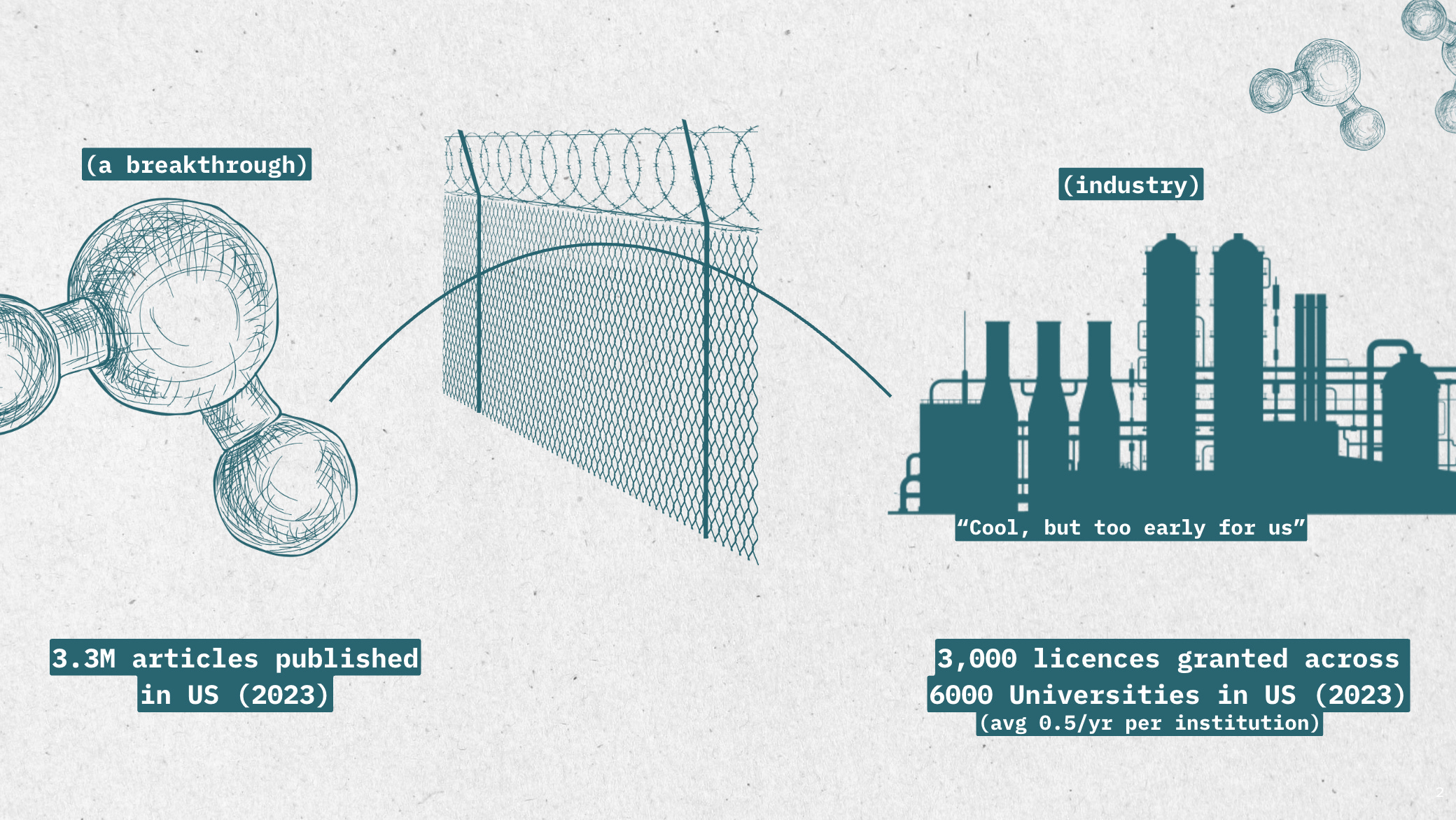
In 2023, US universities published roughly 3.3 million research articles. Those same 6,000-odd institutions granted, in the same year, around 3,000 licences to industry. Half a licence per university per year. Three million ideas in. Three thousand out.
A rounding error.
The research system is optimised to produce new knowledge, and it's spectacular at that job. We simply never built the second machine - the unglamorous one that takes a promising result and spends six years finding out whether “that’s an interesting result” turns into actually changing the world.
For the past six years I've run one of the very few organisations that sits down with teams like the one behind E. q and works out which of those follow-on experiments actually matter — then helps them go and run it. Usually outside of universities, in small scrappy startups.
We’ve had some pretty interesting results recently (more on that next week, some of you have already spotted it). And it's made me want to know whether this could serve far more scientists around the world than it currently does.
That's what the three hot days in a Parisian co-working space are for - starting to say something outlandishly ambitious out loud, accept it's probably impossible to build, then go and build it anyway.
Met
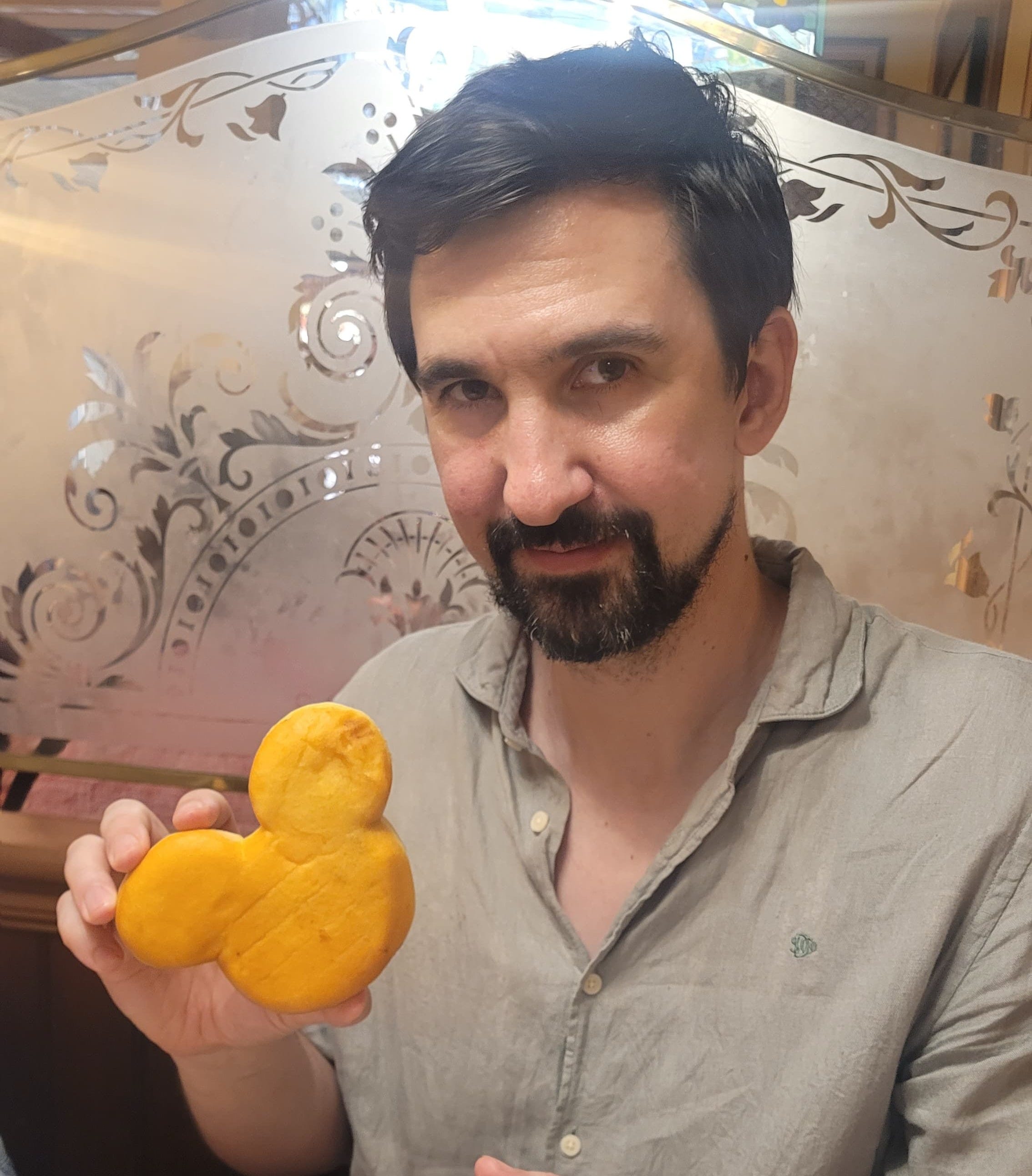
My sister at Disney Paris (not pictured) - we ate donuts (pictured)
Saw

Tasted - Île flottante. Whipped egg white floating in custard, caramel over the top, chopped nuts. A pudding that is essentially a cloud with a sugar problem. I failed entirely to photograph it, which tells you how fast it went. 15/10.

I write this because I spend my life around people turning impossible-sounding ideas into real things, and I wanted somewhere to put down what I learn, who I meet, and what I make of it. Partly to document the thing while it's happening. Partly because someone should be showing you what this world looks like from the inside.
Feedback always welcome.
Hope you’re having a great week,
Dr Ben
No posts
Comments
Nothing yet. Say the first thing.
Sign in to join the conversation.