
We are programmed much earlier in life than we ever thought. Powerful emotional experiences are etched into our brains in fine detail. Sensations are encoded messages. Often, before we have language, these memories become a blueprint for how to “do life” or not “do life”.
My earliest memory dates back to when I was about 9–12 months old. I was sitting in my highchair in our farmhouse kitchen with my family. On the way over for a visit, my relatives broa package for my mother that they picked up at the local general store. I was awash with marvellous sensations as I watched my mother try on her first pair of eyeglasses. She was the centre of attention and was enjoying herself as she received compliments. When my mother was happy, there was a positive ripple effect, which made everyone happy. Life was good when my mother was happy. Looking back, I realized that I took on the mission of making myself and everyone happy at a very early age.
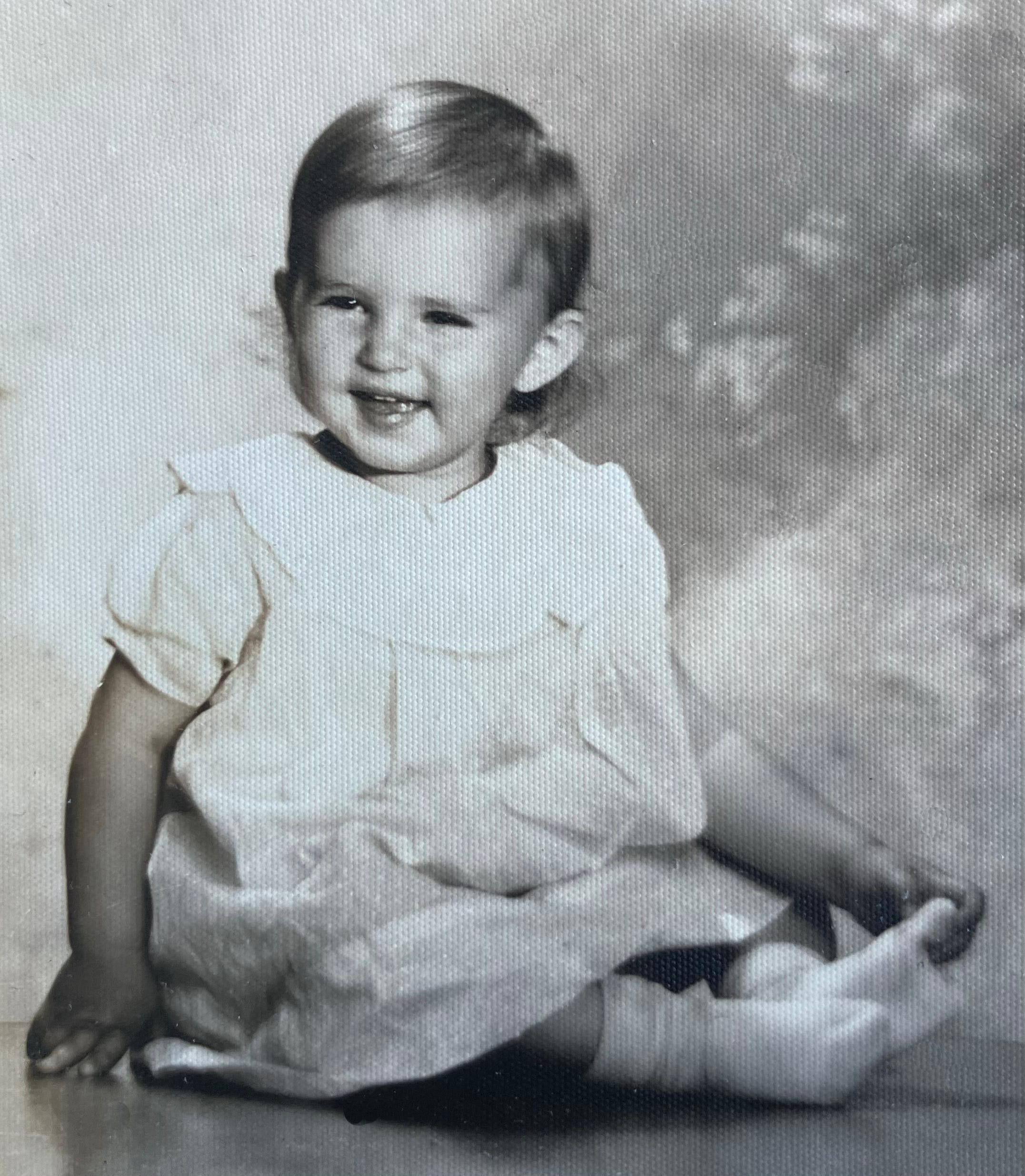
Photo: Dr. Bea at 10 months old
Sensations are encoded messages. Often, before we have language, these memories become a blueprint for how to “do life” or not “do life”.
In life, I try to recreate this experience of happiness within myself and between others. As a mother, I learned to parent in ways that created this experience with my children. I wasn’t always successful, but I tried my best to handle conflict in reasonable ways. Instead of yelling at my kids, I developed strategies to handle ongoing issues. I began leading parenting classes and attended personal therapy. These experiences paved the way for me to become a psychologist. I love facilitating pleasant sensations within individuals, between couples, and within families.
Newborn babies intuitively know how to process sensations. They have no language to make meaning out of them. When they are hurt, they cry. When they are lonely, they seek contact. When they are excited, they move their whole bodies. If allowed to, they breathe through the sensations which tend to come in waves that get smaller, and smaller until they are gone—that is, the sensations are processed. Their brains have created new neural pathways that precipitate new, different (pleasant/neutral) sensations. When they feel different, they behave differently. Thus, they learn how to allow the sensations to run their course without doing anything but breathing.
Newborn babies intuitively know how to process sensations.
In my work experience, I found that people try to avoid experiencing unpleasant sensations by managing them. They block feeling sensations by keeping busy, minimizing, deflecting, getting angry, overworking, drinking, and drugging, etc. When they avoid the sensations, they build up and create a backlog, which requires more energy to manage. Eventually, the pressure of the backlog finds release in explosive or implosive behaviors. The sensations are not processed because they are not allowed to run their course. When you process your emotions/feelings, the unpleasant sensations are totally gone, so there is nothing to manage. You talk about the unpleasant/painfulness, but the sensations are no longer evoked as you talk about them in the present moment. It is like talking about how painful it was when you broke your arm many years ago. You remember the pain, you have scars where the injury was, yet you no longer feel the sensations of pain.
When I work with clients, I help them learn how to shift from managing their sensations to processing them. It frees them up to be themselves. They heal from unhealed traumas in their past and feel different, pleasant, and happy sensations within themselves, which radiate out to others.
As babies learn language, they give meaning to the sensations that make up their feelings/emotions. Yet often the sensations get buried without meaning and operate out of awareness. When a person experiences a traumatic event and they get through it, they emotionally and physically heal from it. They are stronger for having struggled successfully. They develop sensations of agency, which helps them handle whatever life hands them.
Another way to process sensations is to change the meaning of an event. When a person sees and/or understands the same data in a new way, they create new neural pathways, which precipitate different sensations. Vice versa, when a person experiences sensations, they have never experienced before, they create new meaning. “Connecting the dots” is an expression that explains viewing the same material in a new way.
We all have a relationship with ourselves. It is the quality of this relationship with ourselves that matters. Learning about sensations educates us as to how we encode the meaning of our sensations. You learn how to create the sensations you want to experience, and perhaps, more importantly, it helps you know how to change/process the unpleasant ones.
By understanding how sensations in your body are at the core of your own experience, and how the quality of these sensations influences your thoughts and behaviors, you become self-aware, which has a grounding effect. Relearning how to process sensations gives you a sense of agency, a sense of “I can do it! I am capable! I have the tools to operate in life!” That is, you create positive self-talk, which aligns your energy, so it all flows in the same direction, making you available to handle whatever life hands you.
There are no big words to know. There is nothing new to learn, just relearning what you were born knowing how to do. Here I am, a Sage, and I still want to ‘spread the word’ to as many people as I can. I want more people to learn how to live happier and healthier lives. That’s why I am making my manuscript available on Substack now.
Upgrade your free subscription and receive helpful exercises, tools, and access to my upcoming book “Say It Like It Is”, which is a great resource for effective communications. My goal is to help people create the life they want void of pain, sorrow, and regrets.
While in the final year of my B.P.H.E. degree (physical education), we went on many field trips. One of the excursions that our class went on took place on a sailboat. I recall it was a beautiful windy day, and we sailed quickly. The experience for me was exhilarating. The intense sensations felt marvellous. However, at the same time, my classmate and good friend was having a panic attack. I assume she was feeling the same sensations that I was, but for her, they were terrifying. Because of my friend’s experience, we had to head back to shore. While I was disappointed, I was also curious. Why did I experience thrilling sensations, and she experienced terrifying sensations? This mystery inspired me years later to find answers to what makes people tick.
For over 30 years, I’ve worked with individuals and couples. During interactions with clients, I observed how people interact with each other and developed a hypothesis about what makes people tick. That is, what is at the core of a relationship with oneself.
We all have a relationship with ourselves. It is the quality of this relationship with ourselves that matters. Learning about sensations educates us as to how we encode the meaning of our sensations. You learn how to create the sensations you want to experience, and perhaps, more importantly, it helps you know how to change/process the unpleasant ones.
That explains the dynamics in ourselves and between others. However, the answer to what makes people tick is about the quality of the sensations experienced. When we feel pleasant sensations, we relax and enjoy them. When we feel unpleasant sensations, we want to make them stop. We try to avoid doing anything that might recreate those sensations, and THAT IS WHAT MAKES PEOPLE TICK.
When people think and talk about their ’comfort zone’, they are talking about the quality of the sensations they are experiencing. When they feel out of their comfort zone, they experience tension and unpleasant sensations in their body. It is because of this discomfort that they adjust their activity to stop, dissipate, or avoid these sensations.
What people do not realize about avoidance is that their comfort zone gets smaller, and smaller until they become a prisoner of their own comfort zone. Sometimes we need to re-learn what we were born knowing—how to act and breathe through the discomfort of the sensations (that is, breathing through the waves of unpleasantness). Working through uncomfortable sensations allows the brain to create new neural pathways that precipitate different (new) and pleasant or neutral sensations. When people feel different, they behave differently. The unpleasant sensations become a memory that can be talked about, but NOT re-experienced.
Note:
A painful broken arm, once healed, is no longer painful, but we remember that it was painful at the time.
For most women, giving birth is full of many painful and scary sensations. However, when it’s over (with the NATURAL PRODUCTION of oxytocin plus enjoying their infant) they no longer re-experience the painful and unpleasant sensations when they have memories of the birth.
Story 1:
I’m working with a young tennis player who plays at a high level until she’s about to win a match. Then her self-talk changes and she scares herself. She is terrified of conflict and needs people to like her. She knew what she was doing was silly, harmful, and counterproductive, but she couldn’t stop it.
Her coach referred me to her mother who brought her daughter to me.
Using Two-You Work1 In our work together, I helped her experience the sensations of her self-talk (to her experiencing self) so she became aware of what she was doing to herself and why. Then she could OWN that she was creating the unpleasant sensations, owning what she was doing gave her agency. When she owned her inner dynamic, she could do it more, do it less, OR do something completely different.
I coached her on how to interrupt old negative behaviours by putting them into ‘pause’ mode. Then taught her about what she could do instead. By the next session, she reported being able to ’hold her own’.
I continued to work with her inner dynamic. I knew if her critic (CR) was interrupted from recreating the old pattern (given the passion and determination she exuded), the CR would come up with something new and positive. She soaked it up!
The next time we met, she was delighted to give me her update. In a tournament, she had won a match with an opponent she’d never been able to beat before. She was excited about the dramatic change in her inner dynamic.
She said she didn’t have to tell herself not to let her opponent, or anyone else, bother her. She excitedly said, “Those thoughts were just gone, and I could focus on my play!” moving her hands firmly beside of her head, from behind her head, and straight ahead to accentuate her new ability to fully focus on her own play.
This transformation happens when one focuses on staying with the sensations. She is no longer the caterpillar crawling along the branches while eating the leaves. She has evolved into the butterfly she was genetically programmed to become. Now she can come into her own and play her best tennis when she needs it.
Story 2:
A woman came to me because she was dreadfully unhappy in her life (work and marriage). Her home was very important to her, so she invested most of her time and energy in it.
This was her second marriage. Early in her first marriage, when she was pregnant with her son, she discovered that her husband was gay. She was blindsided by this new twist in life. She felt deeply betrayed and had great difficulty trusting anyone anymore. Finding out her husband was gay was traumatic for her, but the bigger trauma was being blindsided—SHE DID NOT SEE THAT COMING.
She was uncomfortable with any change and was shocked by something new. I worked with her to heal her emotionally from her sense of being betrayed. This was achieved, but when I tried to get her to make any changes in her life she resisted, and responded to each of my suggestions, no matter how small, with, “I’m not comfortable with doing that.”
She was terrified of something happening that would shake her to the core again. Even though she was so uncomfortable in her marriage and her job she reluctantly chose the ’Devil she knew’ making herself a prisoner of her own comfort zone. I was unable to help her help herself.
Families and couples who are emotionally connected to each other, in a positive way, have relationships that remain strong through good times and bad times. When relationships are going well, like in most courtships, couples will share what they think and feel with each other. So, why do people stop connecting? Many reasons! The main one is that they do not feel safe to speak or act with each other. Maybe they never did, even in courtship. However, courtship feels so good they ignore the red flags. Then they settle into an ongoing relationship.
Gottman, a marriage therapist and researcher, has statistics for the various stages of relationships.
In courtship, there are 20-50 positive interactions to 1 negative.
In a happy marriage long-term relationship there 5+ to every 1 negative.
In an unhappy marriage/long term relationship there are 1+ to 4 negative.
Unhappy couples often stay together struggling with issues they are unable to resolve. They develop a habit of having, what I call, “merry-go-round” fights when clashes come up. They go around, and around, up and down, but NEVER resolve the issue. Eventually, one or both partners tire of the cycle, and understand they are not going to resolve their differences. They both unhappily let it drop unresolved. These couples feel increasingly disconnected from each other with every merry-go-round fight. Eventually, one or both will not even engage with an issue to avoid wasting their time, energy, and the discouragement they feel when the same result occurs.
Early in my career, when I began counselling couples, I found that in the first session, most partners had one foot in the marriage and the other was ready to go out the door. After about 4 sessions, they were doing so well that they started putting both feet tentatively in the marriage. In the 5th or 6th session, one or both sabotaged the positive changes. I was so puzzled by this pattern because of the previous progress. What did I miss? What did I do wrong? Then I got it! It was because they were doing so well, that fear set in (unpleasant sensations) and they unintentionally sabotaged the progress made.
Once I understood that people sometimes don’t have enough neural pathways to handle things going well over time, I learned to break the tension (unpleasant sensations) building in the relationship. I prescribed a ’fight’. I said, “Things are going so well. I want you to fight before the next session.”
When they came to the next session, either they presented a fight which we worked through, or, if they did not fight, I explored with them how they were able to avoid it. Either way, the tension was broken. I then worked with them on how to process the unpleasant sensations when things go too well for too long.
I told them to breathe through the waves of sensations until all the waves were gone. I also encouraged them to have a conversation about being nervous and things going well in their relationship. When a partner knows that uncomfortable sensations can be the result of things going well (new patterns/behaviours), it is easier to support one another and connect in a deeper satisfying way.
This is about connection. This is what makes people tick. The quality of the sensations determines the quality of the connection.
When people, especially family members, stop sharing what is going on in their lives, connections weaken, go dormant, die, or become twisted and warped. It is difficult to recover when people react with hurt and/or anger. The damage is deep. That is why rifts in families are so difficult to repair. People get hurt because they care about family members and not because they do not care, at least initially. Then, as reprisals, revenge, and stonewalling occur, love wilts, weakens, and dies, or love warps into hatred. To hate someone or something takes a lot of personal energy. I believe that hate is NOT the opposite of love, because there is energy invested. To me, indifference is the opposite of LOVE because there is no energy invested.
Over the years, I coached hundreds of people on what to say and how to say it. It works for everyone in many situations and keeps others connected.
It’s simple. The good news is that you do not have to learn anything new. Why? Because you were born knowing how to do it. When babies enter the world, they have no language, and they intuitively process their emotions without jargon, diagnoses, and neuroscience.
The best part is you will use everyday language. In this book, I help you find easy ways to connect with others by communicating in your unique individual style.
Awareness is the key to change.
Life can be busy. When we are busy, we often tune out the sensations we experience. This is okay in the short term but can be disastrous in the long term. Sensations are a language of their own. They are a code that we can learn to decode. Analysing the code is one way to deal with them, and it may be helpful, but the best way is NOT to decode them at all. What is-is! You are experiencing unpleasant painful sensations in the HERE & NOW. The best way to process sensations is to focus on them and stay with them longer. Breathe through the waves until they are gone.
Words alone cannot decode the sensations. When explaining sensations, we often use metaphors (e.g., caterpillar/butterfly, lightbulb). When we express them negatively, we cry, cringe, moan, groan, shrink, curl up, hide our faces, freeze, go numb, etc. When we express them positively, we laugh, smile, throw up our arms, our heads go back, jump up and down with excitement/glee, or move our bodies, etc. We may get goosebumps (the hairs on our body stand up). They can be a reaction to fear/terror (unpleasant sensations). Juxtaposed, the sensations can be a feeling of love or being touched/moved (pleasant sensations).
When we feel/sense sensations the experience tells us we are alive! The sensations can be positive even when they are unpleasant. For example, people choose to watch horror movies because they get a thrill from being scared/frightened.
Personal Story:
I was the baby of the family and a girl. I felt adored by Dad. However, he could not tolerate my tears or me being upset.
I (age 4-5 years-old) have a memory of my dad shutting down my crying saying in a harsh tone.
“If you are going to cry, I’ll give you something to cry about.”
I reacted by holding my breath and squeezing my eyes, trying to stop the tears. He never hit me or punished me for crying, but he didn’t have to because I shut down my tears, somewhat out of fear but mostly to please him. I knew he loved me.
This carried over into my marriage. My husband, who loved me, felt manipulated by tears, because of his experience with his mother, so he would get angry whenever I cried. Because of this, I continued to shut down my tears for most of the marriage. After 25 years, our marriage ended, and I had to relearn to cry.
Processing emotions is healthy. Often, we need to pick a time when it is appropriate to cry and express grief, so then manage them until there is an opportunity to process them. When we over-manage sensations, it is unhealthy. Throughout life, many people manage, deflect, and minimize their sensations to such an extent that they block all their sensations and become robotic. They stop feeling human and often become suicidal.
Story
A female police officer sought me out for treatment. She told me that she cannot feel anything; that is, she did not have any sensations in her body.
“Sometimes it gets so bad that I take a razor blade and go in the bathtub. When I see the blood running down my leg, I know I’m still alive. I cannot tolerate it any more. If it continues, life is not worth living,”We worked on reconnecting her with her body. This brought into her awareness the horrible memories of the sexual abuse she had been blocking off for years, Using EMDR we began to process them. She took leave from her job as a police officer because she had used it to control her sensations and block them. She did this to survive her childhood and enabled her to function as an adult and police officer.
To do therapy she had to let go and allow herself the experience wherever sensations came to the foreground. I was her container for this process. It took time but eventually she healed from traumae, She reclaimed the part of herself that she had left behind and got frozen in time and place. As she went through this process, reconnecting with her body, she felt new and different sensations. She still felt quite vulnerable. When therapy ended, she had left the police force and was exploring different options for work.
It is essential to process sensations, so we remain emotionally and physically healthy.
The ’light bulb’ moment is a metaphor that describes the sensations we experience in our heads when our brains (left and right) create new neural pathways. During this ‘light bulb’ moment, we feel the creation. New neural pathways are created when the left brain’s data (logical side) synthesizes with the right brain’s data (sensory side).
The body responds in many ways like, eyes widening and smiling spontaneously. As a person has a ’light bulb’ moment, one’s body lifts and they experience a new perspective or understanding of something they have not seen before. In other words, when we turn on a light, we can see things that we could not see before. We learn and know something new, even if it has been there all along.
Personal Story (me learning Geometry at 15):
When I was in grade 9, I started learning Geometry. One day in class, I remembered vividly experiencing the ’light bulb moment’ while finally understanding a theorem. The teacher witnessed me having it—we looked at each other and smiled.
This experience was the result of new neural pathways forming in the brain. ’Connecting the dots’ is another metaphor for creating new neural pathways.
When new neural pathways form and precipitate new sensations, they can range from a ’tiny blip’ to ’humungous’. The quality of the sensations can range from ’slightly nervous’ to ’abject terror’ or a ’light blip’ of ’pleasure to ’exhilaration’.
The quality of the sensations determines how we respond/react to the new information. WHEN WE FEEL DIFFERENT, WE ACT DIFFERENTLY. WE DO NOT HAVE TO THINK ABOUT IT. WE ARE THIS NEW WAY.
Story:
One of my clients, a tennis player, shared an experience with me about her break though.
“You remember that guy who bothers me a lot? I didn’t have to tell myself not to think about him. Those thoughts were just gone, and I was able to focus on my game. Even the people playing on the courts beside me were laughing at me, it didn’t bother me at all. I just thought about my own game.”
Trauma, per se, is not a problem. When you go through something difficult and heal from it (physically and emotionally), you are wiser from going through it. You learned something from going through it and experienced a sense of agency (I did it! I made it!, etc.)
It is the unhealed traumas that are troublesome. Often, we are healed physically from a trauma but not emotionally. The unhealed part gets buried in our psyche and ’festers’ there. Unhealed trauma usually tends to recreate the sensations of original trauma but is not always in our awareness. Without the information from the body (in terms of sensations) the person cannot ’connect the dots’.
Story:
Nathalie, a woman in her mid-30s, came to see me. She was in distress. She had been married for 12 years, and for 10 of those years, she had been having an affair with another man. She said she didn’t know why she was having an affair, and she desperately wanted to stop. She said she wanted children but couldn’t have them until she decided which man she would be with.
We began therapy, and soon, she recalled a memory from the age of three. She had never recalled this memory before. She was at her brother’s funeral, whom her father had accidentally run over with the car. She remembered standing between two big people looking across the gravesite. She saw the pain etched on her father’s face. Unbeknownst to her, she was traumatized by her father’s grief. Somehow, she decided to never have children so that she wouldn’t have to experience the pain of ever losing them. I don’t know how a child does this, it’s certainly not in words/thoughts—but sensations.
Without Nathalie knowing it, the traumatic memory was stored in her Sensory Brain but was not available to her Logical Brain. The trauma was operating out of awareness. She had been managing her emotions in a unique way by having an affair, which prevented her from trying to get pregnant. The information was shared with the Logical Brain during therapy and could come into awareness. We targeted the trauma she experienced at the age of three and helped her access and express the fear and pain she felt at that time. As she breathed through the emotional pain, she processed the psychic pain she experienced at age three. Once she processed the trauma, the fear of pain and loss dissipated. She could live her life the way she wanted. Once she had healed from the trauma, she took action. She left her husband for the other man. However, that relationship didn’t work out. She reconciled with her husband, and the last time I saw her, she was eight months pregnant with a big smile on her face.
You are still wounded when you talk/think about the PAST event and the painful unpleasant sensations are evoked in the current moment—the HERE & NOW.
You are healed, and when you talk/think about the PAST event or the painful unpleasant sensations, THEY ARE no longer evoked in the HERE & NOW. You remember that you felt unpleasant sensations/DEEP HURT but those are a memory of them. You do not experience unpleasant sensations in the moment. It’s similar to what you would talk/think about when evoking a memory about a broken bone or serious illness. It no longer hurts or feels bad because you have physically healed from it. Scars are memories/proof of times when we were hurt. Scars (unless they are extensive) do not usually affect our lives negatively. It’s how one reacts or responds to the scars that determine a negative or positive outcome.
Personal Story:
One day, I visited my son (a teacher) at his school where he worked. One of the students came up to me and told me about how Mr. Mackay helped him. He showed me his deformed hands. He told me that Mr. Mackay said I should stop focusing on what I cannot do with my hands and start to focus on what I can do. That changed my life. In more ways than just my hands. It’s really helped me ever since.
From my experience working with clients, I realized that some people need coaching (guidance) to improve their communication skills. My coaching involves simple everyday language. People do not need to learn anything new, they mostly need to be told what to say and how to say it.
In the following chapters, I explain skills and give examples, so that you can learn simple ways to process and communicate during any situation. These skills and examples are modelled from what I have taught my clients in sessions and workshops. I’m delighted to share them with you! I hope you find them helpful too.
I encourage you to share them with others, especially your kids, by modelling and teaching. THE BEST WAY YOU CAN INFLUENCE YOUR CHILDREN IS TO MODEL EFFECTIVE BEHAVIOR. That way they learn it the same way they learn language by experiencing it.
Let’s get to it!
STAY TUNED FOR CHAPTER ONE
“THE POWER OF MATTER-OF-FACT”!
Two-You Work is a powerful technique that helps people to resolve inner conflict [i.e., their inner battle within between their CRITIC (CR) and their EXPERIENCING SELF (EXP)]. I guide people to demonstrate how they treat themselves as if they have an identical twin. By taking this inner dynamic out of their head and acting it out loud they get to hear and feel what they are doing to themself. NOTE: it is not role-playing because I ask them to be more of who they already are. I’m not asking them to be someone they are not.
No posts
Comments
Nothing yet. Say the first thing.
Sign in to join the conversation.