

Within standard architectural rendering and spatial design, the human form is critically misunderstood. The industry treats people as mere “scale figures” passive, emotional props pasted into digital environments to fabricate a false sense of life. This is a profound failure of spatial integration.
At DPRLAB, we reject the separation between the environment and the occupant. Within our Synthetic Environment Infrastructure (SEI), the human subject is not a decorative addition; it is an active, structural anchor.
Today, we release the Chrome Concept brief. This R&D documentation proves that by weaponizing material intelligence, perspective convergence, and atmospheric synthesis, the human body can be computationally integrated into an environment with the same physical gravity as steel and concrete.
“The architectural rendering industry treats human occupants as passive scale figure, emotional props pasted into CAD spaces to fabricate a false sense of life. Within Synthetic Environment Infrastructure (SEI), the human subject is not a decorative addition. It is an active, structural anchor.” -dprlab
Modern rendering pipelines suffer from a disconnect between the physics of the environment and the physics of the occupant. When designers drop generic 3D human assets into a meticulously calculated CAD space, the cognitive illusion breaks. The lighting parameters do not match; the material interactions fail. The environment feels heavy, while the human feels weightless.
To influence human psychological and behavioral responses, what we call Perception Engineering there can be no visual seams. The Chrome Concept asserts a new operational baseline: the wardrobe and the body must act as active architectural surfaces.
By utilizing highly specular, form-fitting materials (the “Chrome” latex), the occupant physically reflects and distorts the environment. They do not just inhabit the space; they absorb and project its lighting data. This transforms the subject into a dynamic visual keystone, ensuring that if the environment’s lighting changes, the human anchor dynamically recalculates with it. This is the death of the static fashion photograph and the birth of the human architectural node.

To demonstrate this operational mandate, we analyze two benchmark assets from the Chrome Concept repository. These outputs bypass conventional photography, operating strictly as calculated spatial studies.
Referred to in our repository as the “Urban Monolith,” this asset weaponizes perspective to assert structural dominance. The urban corridor is not a background; it is a containment system.
                  [ Zenith / Sky Void ]
                       ^         ^
                      /           \
 [ Left Visual Rail] /             \ [Right Visual Rail]
   (Brick / Shadow) /    FIGURE     \  (Brick / Shadow)
                   /   (Monolith)    \
                  /                   \
Perspective Engineering: The extreme low angle camera position forces a dramatic convergence. The physical guide rails of the surrounding buildings point directly to the figure’s center axis, forcing the viewer’s eye along the high-specular zipper line. The body replaces the skyscraper as the apex of the composition.
Material Intelligence (Specular Mapping): The chrome like latex operates as an active HDRI (High Dynamic Range Image) reflector. It captures the ambient sky data and maps it across the topology of the body, creating liquid-metal highlights. The material physically roots the subject in the exact lighting conditions of the urban trench.
Atmospheric Synthesis: By defaulting to high-contrast monochrome, we eliminate chromatic noise. The friction between the matte, porous brickwork and the frictionless, synthetic skin of the garment becomes the primary narrative.

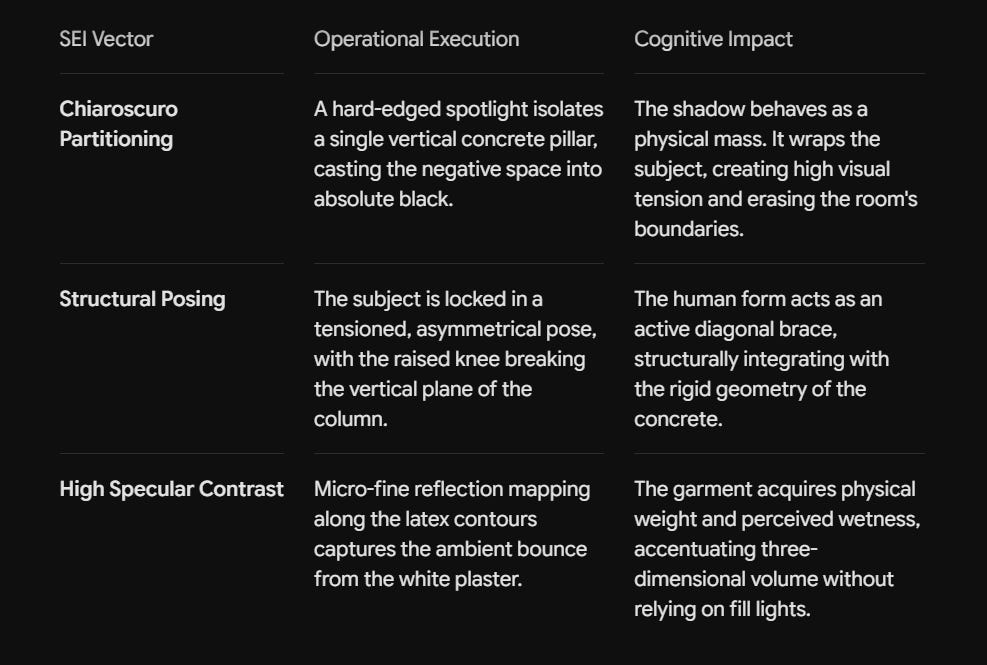
In the second asset, “Light Architecture,” we strip away physical infrastructure entirely. Instead, we use volumetric light as the primary structural partition, carving the figure out of absolute shadow.
As the computational landscape matures, the integration of Hybrid Workflows will permanently separate sovereign operators from legacy dependents. A select group of industries, those willing to discard bloated, centralized ecosystems in favor of localized, hardware-autonomous nodes will leverage Advanced Synthetic Intelligence not to iterate on the past, but to engineer entirely new operational baselines.
Within this paradigm, Synthetic Environment Infrastructure (SEI) will transition from an R&D framework into a mandatory commercial standard. As these hybrid pipelines scale, AI ceases to function as a speculative utility; it solidifies as the definitive operating system for organizations demanding absolute spatial cohesion, operational privacy, and unyielding structural truth. The architects of the future will not be those who adopt the most software, but those who engineer the most resilient nodes.
No posts
Comments
Nothing yet. Say the first thing.
Sign in to join the conversation.