

“When architects talk about AI, the conversation centers on prompt engineering and rendering speed. It should begin with a statistician born in 1919.” -dprlab
Yet, David Harold Blackwell, one of the most influential mathematicians of the 20th century constructed the exact intellectual machinery that now drives modern learning systems: Bayesian updating, decision theory, information dominance, and sequential optimization.
At DPRLAB, where container architecture, hyper-realistic rendering pipelines, and sovereign infrastructure systems converge, Blackwell’s work offers something far more powerful than inspiration: a formal operating system for generative design. By integrating his legacy directly into our Synthetic Environment Infrastructure (SEI), we transform AI from an unpredictable “slot-machine” generator into a disciplined, mathematically grounded engineering asset.
Blackwell’s research focused on a foundational question: How should an intelligent agent act when operating under deep uncertainty? In modern computation, this inquiry forms the basis of Bayesian learning systems that dynamically update probability distributions as new evidence arrives.
Within the SEI architecture, every generative iteration is treated as a calculated experiment. When we generate modular container configurations or edge data center layouts, each output is quantitatively scored across a strict six-axis matrix:
Structural Efficiency: Deflection, load path optimization, and interlocking steel integrity.
Cooling Performance: Thermal dynamics and passive airflow routing.
Luxury Perception: Aesthetic calibration, spatial volume, and material prestige.
Construction Feasibility: Transport logistics, crane weight limits, and site-assembly speed.
Regulatory Alignment: High-probability compliance with strict zoning envelopes.
Investor Response: Capital attraction signals and market narrative viability.
These metrics are not subjective opinions; they are hard feedback signals. Future prompt hierarchies, negative constraints, and latent space reference weights are updated mathematically based on these scores.
The Result: Instead of random ideation, DPRLAB operates a probability driven convergence engine that systematically isolates elite architectural designs.
Blackwell mathematically proved that some information sources are objectively superior to others, meaning higher signal data inherently produces superior decisions. In generative architecture, this translates directly to Reference Dominance.
Not all visual inputs deserve equal weight in an SEI pipeline. To eliminate the “hallucination noise” common in standard AI models, DPRLAB enforces strict dataset tiering prior to executing any workflow:
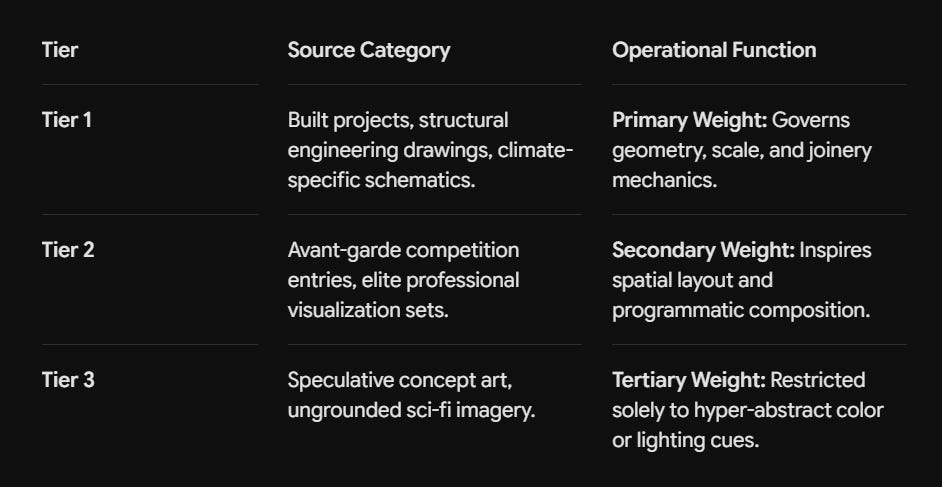
The Result: By filtering out the noise of unbuildable digital art before generation ever begins, Blackwell’s theorem becomes our primary law of input governance—yielding cleaner geometry, realistic MEP (mechanical, electrical, plumbing) allowances, and zero “cinematic impossibilities.”
One of Blackwell’s most practical statistical insights demonstrates that rough estimates improve dramatically when they are conditioned on known, invariant variables. In design terms, this means a simple rule: stop letting AI guess what engineers already know.
Before initiating a generative run, the SEI platform divides the architectural task into absolute invariants and exploratory variables:
+-------------------------------------------------------+
|             INVARIANT SCAFFOLD (Frozen Physics)       |
|  - ISO Container Dimensions (8x20 / 8x40)            |
|  - Structural Span Limits & Cantilever Tolerances     |
|  - Regional Climate Loading & Solar Angles            |
+-------------------------------------------------------+
                           |
                           v
+-------------------------------------------------------+
|             EXPLORATORY VARIABLES (Artistic Zone)     |
|  - Kinetic Façade Perforations                        |
|  - Material Subsurface Scattering & Light Interaction   |
|  - Interior Luxury Volume & Materiality Textures       |
+-------------------------------------------------------+
Engineering serves as the immutable scaffold, generative creativity occurs strictly within its parameters.
The Result: The model is stripped of its ability to break physical laws. We produce build-ready fabrication concepts rather than unbuildable digital renders.
Blackwell deeply influenced the evolution of dynamic programming the mathematical paradigm stating that complex, multi-variable problems are solved most efficiently stage-by-stage, rather than all at once.
DPRLAB completely rejects the “one-shot prompt” approach to architecture. Our SEI workflows break projects down into highly disciplined, sequential AI phases where each layer inherits the mathematical boundaries of the previous step:
1.Massing & Site Fit: Phase 1.
Calculating localized boundaries, solar orientation, and basic programmatic zoning blocks.
2.Structural & Modular Grid: Phase 2.
Locking container boundaries, load-bearing stacking paths, and structural reinforcement zones.
3.Mechanical Systems (MEP): Phase 3.
Integrating dedicated chases for power, localized water networks, and data infrastructure routing.
4.Envelope & Material Luxury: Phase 4.
Applying photorealistic material maps, high-end glazing systems, and localized landscape architecture.
Blackwell was a pioneer in repeated games analyzing how intelligent agents dynamically adapt when facing competitors, moving targets, and shifting regulatory constraints. Physical architecture is a highly contentious, multi-player game involving municipal planners, utility providers, competing developers, and capital networks.
Instead of designing in a vacuum, our generative orchestration engine runs adversarial scenario simulations:
Which configuration minimizes grid-upgrade dependency while maximizing off-grid sovereignty?
What design topology clears municipal zoning velocity records based on local historical data?
Which material expressions maximize premium luxury cues to demonstrably outperform adjacent assets?
Each scenario yields distinct, optimized geometries, allowing us to deliver strategic architectures, not just beautiful ones.
David Blackwell did not design buildings. Instead, he designed something far more durable: a mathematical theory of computational adaptation. At DPRLAB, that theory forms our infrastructure layer:
Prompt hierarchies that enforce engineering constraints
Dataset governance that rejects speculative noise
Feedback scoring matrices that kill unviable iterations
Sequential engines that replace design lotteries with production lines
This is how architecture successfully transitions into the AI civilization stack not through superficial digital spectacle, but through pure decision intelligence.
The next generation of design firms will not simply render faster. They will measure better, filter noise, and encode engineering truths directly into the latent space. David Blackwell gave the world the equations; DPRLAB is building the workflows.
Comments
Nothing yet. Say the first thing.
Sign in to join the conversation.