
This game will always find a way to remind you that you have not fully made it.
There is always someone coming. There is always a younger player. There is always another draft class. There is always some organizational decision that reminds you a business is humming beneath the dream.
The uncertainty never really leaves. You can compete at the highest level, succeed, and still know the game is constantly evaluating whether you belong. The big leagues is one long, constant audition. Every at-bat, every inning, every season. The elite competition you are trying to defeat night after night is relentless, and the expiration date on your career moves closer every day. The game cares less about what you have already accomplished than about what you can do right now and what you will do next. At least until you establish a legacy.
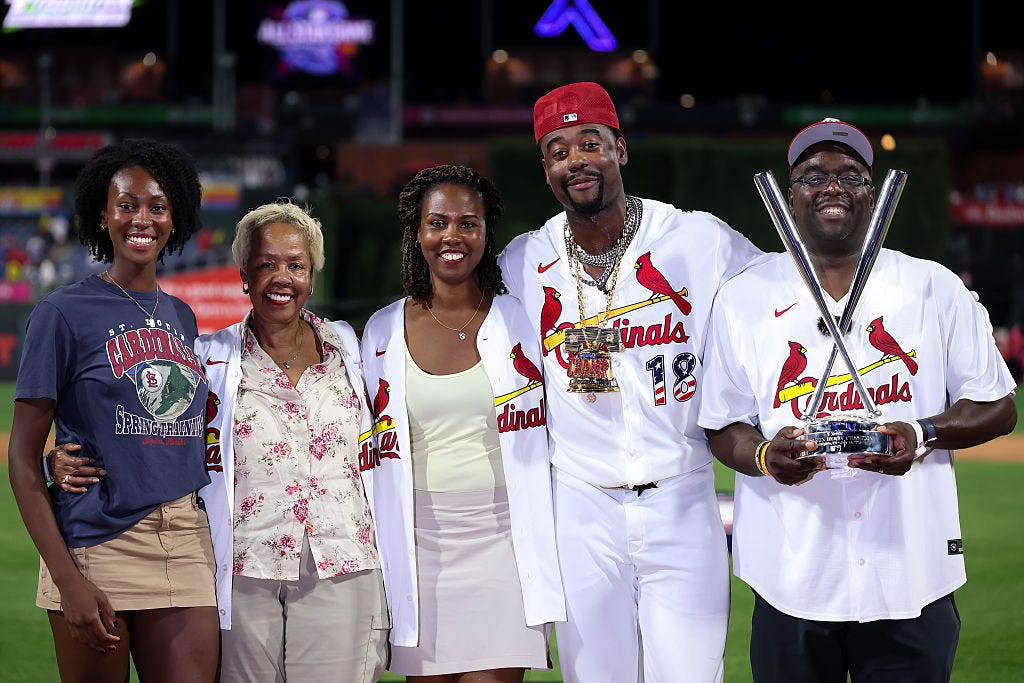
I was on the radio call for the Home Run Derby last week in Philadelphia, and when I watched Jordan Walker of the St. Louis Cardinals win it, I found myself thinking about so much of what made up my own career. Particularly all of the uncertainty that surrounded the idea of making it.
This time, though, I saw Walker through a parental lens. Not just from the perspective of where I was in 1991, the college student with professional aspirations, but from the perspective of someone who now understands what parents must feel when their child chooses a path where the dream is real, but the guarantees are not.
I imagine what Walker’s parents may have considered along the way and how comfortably they handled the ups and downs that come with the life of having a professional baseball-playing son. At some point, did they ever quietly ask themselves the question so many parents do?
Is it time for him to do something else?
Walker was called up to the big leagues at 21 years old, which was remarkable pacing. For the most part, he held his own. The next two years in the majors presented significant challenges as he dealt with a lack of power production, defensive struggles, nagging injuries, and the difficult process of adjusting to the speed and precision of big league pitching.
It is already mind-blowing how quickly these players arrive. At 21 years old, I was newly drafted and beginning a journey that would take almost five years in the minor leagues. I was 25 before I made my major league debut. Walker, meanwhile, is already in his fourth big league season before his 25th birthday. But getting there quickly does not guarantee staying there long enough to build a full career.
That is the part that is so difficult about this game.
My parents understood that before I did.
They were concerned about my aspirations to play pro baseball because, to them, it was a fantasy that could not be planned for. They were surprised when I announced at a scholarship dinner that my goal was to be a professional baseball player.
I did not see it as choosing baseball over education. I still planned to earn my engineering degree. But they worried because there were so many voices telling me that I did not need the degree right away, that I could always go back and get it later.
Of course, money was part of the equation, along with the desire to start my baseball career immediately. So when I was drafted and took weeks to sign, I had to wrestle with how I would finish my degree after taking a semester away to play, and what that decision would cost me in the pursuit of reaching the top level. The baseball world was telling me to move faster, while my parents understood the value of making sure I had something to fall back on. I chose to slow down my baseball timeline to finish my final semester at Penn.
I understand their concerns much more now.
The odds of making it were low. The odds of making a living in the game were even lower, even as a first-round pick in those days. And I was entering a profession that was not exactly designed to encourage me to finish what I started in college.
I was swimming upstream. It was not just reasonable to have a life preserver in case things did not work out. It was wise to have a lifeboat, too.
I am sure my parents were pulling their hair out wondering how much I truly understood the importance of preparing for another future. Long before I ever stepped into a major league ballpark, I would be riding buses through the minor leagues, far away, playing in places where Jim Crow was still within living memory, while an Ivy League degree, and everything it represented, hung in the balance.
They did not think their Black son, in the midst of an engineering degree effort, would always be understood, let alone treated fairly. They kept referring to the “good old boy” network and how I would have to navigate some significant challenges.
They were not wrong.
Every horror story from the minor leagues must have made them bite their tongues. They never told me to quit, but they also wanted me to understand the calculation. How long would I toil away before taking my PE exam and beginning an engineering career?
Thank you for being part of the Welcome to Glanville community. If you’ve enjoyed the free posts and would like to support my work, I’d love for you to consider becoming a paid subscriber.
I remember my teammate in Winston-Salem facing a choice I knew could one day be my own. While grappling with slow advancement in A-Ball, he also had a Stanford University degree waiting for him. After an injury in Double-A forced him to take stock of his future, he chose to pursue the more secure financial future his education afforded rather than continue chasing a baseball career.
I could relate to his decision. I arrived late to Winston-Salem while dealing with a lingering injury that had followed me through spring training forcing me to consider life after baseball sooner than I had expected. I could have leaned on my Penn degree for security and comfort, but I still loved to play and believed I could return to form with a different approach to my preparation. I also did not want to give anyone the satisfaction of thinking Ivy Leaguers were not tough enough, or not willing to go the extra mile.
There were already enough reasons some people thought I did not belong.
Being a first-round draft pick helped. A lot. It gave me some leverage and created more opportunities, even when those opportunities were sometimes given reluctantly.
I also had a lot to learn.
I ate baseball year-round, but I still needed to significantly refine my game. That took coaching, patience, long stretches in the minor leagues, winter ball, and good health.
My parents knew my signing bonus made some of the time worthwhile financially, but for baseball to make sense to them, I needed to turn it into a career. That perspective came from the worlds they knew. An educator and a physician. Two professionals who spent years learning, studying, and earning their places. Two people who were given very little room to make mistakes as Black professionals in America.
Jordan Walker’s parents went to MIT and Harvard, respectively. Walker himself had a full scholarship offer to Duke University. A great student and a great talent.
I can only imagine the conversations in their household.
Unlike me, Walker chose to sign for $2.9 million and pass on a scholarship to Duke, skipping college altogether—even as the pandemic caused the cancellation of what would have been his first season in the minor leagues. That decision makes the pressure even more complicated for his parents. There is no degree waiting in the background.
On their behalf, I felt the stress when he struggled in the majors and was sent back to the minors. I exhaled with them when he found his footing, overcame setbacks, and became an All-Star.
Then he won the Derby.
And maybe, for a moment, it felt different.
Maybe it felt like he was becoming the player everyone believed he could be. Maybe it felt like his career was taking shape. Greatness, winning, financial security, and the ability to pursue education later on his own terms.
In today’s game, productive, young players are signing long-term contracts early in their careers that recognize their contributions and provide a greater measure of security. If the Cardinals one day choose to make a long-term commitment to Walker, it would give him the kind of confidence and support that can quiet some of the uncertainty that comes with a baseball career.
But the game still will not let him fully exhale.
That is the nature of this profession. The path is not linear. It is not like moving from elementary school to middle school to high school, where the next step is expected. In baseball, every step forward is steeper than the previous while carrying another layer of uncertainty.
Walker has done enough, though, to secure something important: a place in the game.
That gives him the chance to play more on his own terms. It lets his parents worry a little less. It allows them to move from protecting against a dream slipping away to enjoying a dream realized.
That may be the greatest gift an athlete can give their parents.
Just before I was able to give my parents that gift, my father nearly succumbed to a series of illnesses. When I made my MLB debut, he turned to my mother and said,
“I almost missed this.”
He would not live to see all of my major league career. But he lived long enough to stop wondering whether I would have one.
In the end, that may be what every parent hopes for. Not certainty, because this game never offers it, but the chance to see a child’s dream become a life. The chance to finally exhale, to stop wondering what tomorrow might bring and simply enjoy watching, fully present, grateful they were there to see it.
Share Your Thoughts…
What is a dream you pursued where the outcome was never guaranteed? How did you handle the uncertainty?
What did your parents understand about risk that you could not see when you were younger?
What does “making it” mean to you? Reaching a goal, sustaining it, or simply having the courage to chase it?
Tune in to Starkville with me and co-host Jayson Stark for more baseball talk every week. New episodes drop on Saturdays as part of the Rates & Barrels feed at The Athletic. You can find us wherever you get your podcasts.
No posts
Comments
Nothing yet. Say the first thing.
Sign in to join the conversation.