

Budgets don’t care about politics.
They don’t care about campaign promises.
They don’t care about good intentions.
They only care whether the math works.
Lately, I’ve been thinking about that more than ever.
My daughter is two years old. Like every parent, I want to know that when she enters the public school system, the resources she needs will still be there.
Parents of children with disabilities don’t get to postpone therapy because a district runs out of money. They don’t get to wait while adults figure out budgets. The services they receive are legal obligations, not optional programs.
That is why LAUSD’s financial condition matters.
Public education is one of the most important promises a community makes to its children. Families pay taxes and voters approve school funding because they believe those dollars will educate students, support children with special needs, strengthen neighborhoods, and preserve confidence in our public institutions.
That promise depends on responsible stewardship.
When I began examining LAUSD’s finances, I expected to find difficult tradeoffs. Instead, I found repeated warnings from the Los Angeles County Office of Education that the district’s long term financial trajectory was becoming increasingly difficult to sustain, followed by Board votes approving major recurring spending commitments anyway.
Four days.
That is how long the Board had to consider one of those warnings before voting to approve labor agreements carrying substantial long term costs.
The Board voted anyway.
Within weeks, county officials concluded that LAUSD met the statutory criteria for a “Lack of Going Concern” designation, assigned a fiscal expert to the district, and ordered district leaders to produce a credible financial stabilization plan.
This is no longer just an accounting story.
It is a question of whether California’s largest school district can continue meeting its promises to every student, especially those who depend on specialized services.
The Warning
The chronology matters.
According to county officials, concerns about LAUSD’s financial trajectory did not arise overnight. They developed over months as declining enrollment, the expiration of one-time federal pandemic funding, growing recurring obligations, and long-term budget projections pointed toward an increasingly challenging fiscal outlook.
Before approving the labor agreements, the Board received formal warnings from the Los Angeles County Office of Education that the district’s financial condition was deteriorating and that additional recurring commitments would increase long-term fiscal pressure.
The agreements were approved.
In the weeks that followed, LACOE escalated its oversight, ultimately determining that LAUSD met the statutory criteria for a “Lack of Going Concern” designation and requiring the district to submit a revised fiscal stabilization plan.
That sequence forms the foundation for the rest of this analysis.
The central question examined in this article is whether long-term financial commitments were approved at a time when the district’s long-term revenue projections could realistically support them.
The Decisions
Financial deterioration did not occur overnight. It resulted from a series of policy decisions made by the Board of Education after repeated warnings from the Los Angeles County Office of Education. The Board has consistently prioritized expanding student services, including special education and other support programs. Those priorities are important. Every child deserves the opportunity to succeed, and students with disabilities are entitled to the services they need under the law.
The question raised by the county’s findings is not whether these programs should exist. It is whether the Board approved significant long-term financial commitments after being warned that LAUSD’s fiscal trajectory was becoming increasingly difficult to sustain.
By the Numbers
• Peak enrollment: 746,831
• Current enrollment: 398,487
• Enrollment decline: 46.6%
• One-year enrollment loss: 16,400 students
• ESSER funding expired: September 30, 2024
• Projected structural deficit: ~$1.6 billion
• Reserve drawdown: ~$2 billion
• SEIU wage increase: 24%
• Estimated annual UTLA cost: ~$650 million
• Projected General Fund balance: –$3.6 billion
• Layoff notices: ~3,200
• July 2026: County places LAUSD under heightened fiscal oversight
School funding in California largely follows student attendance. As enrollment changes, district revenue changes as well.
For nearly two decades, LAUSD’s enrollment has moved downward.
Chart 1. LAUSD Enrollment Has Fallen Nearly 47%
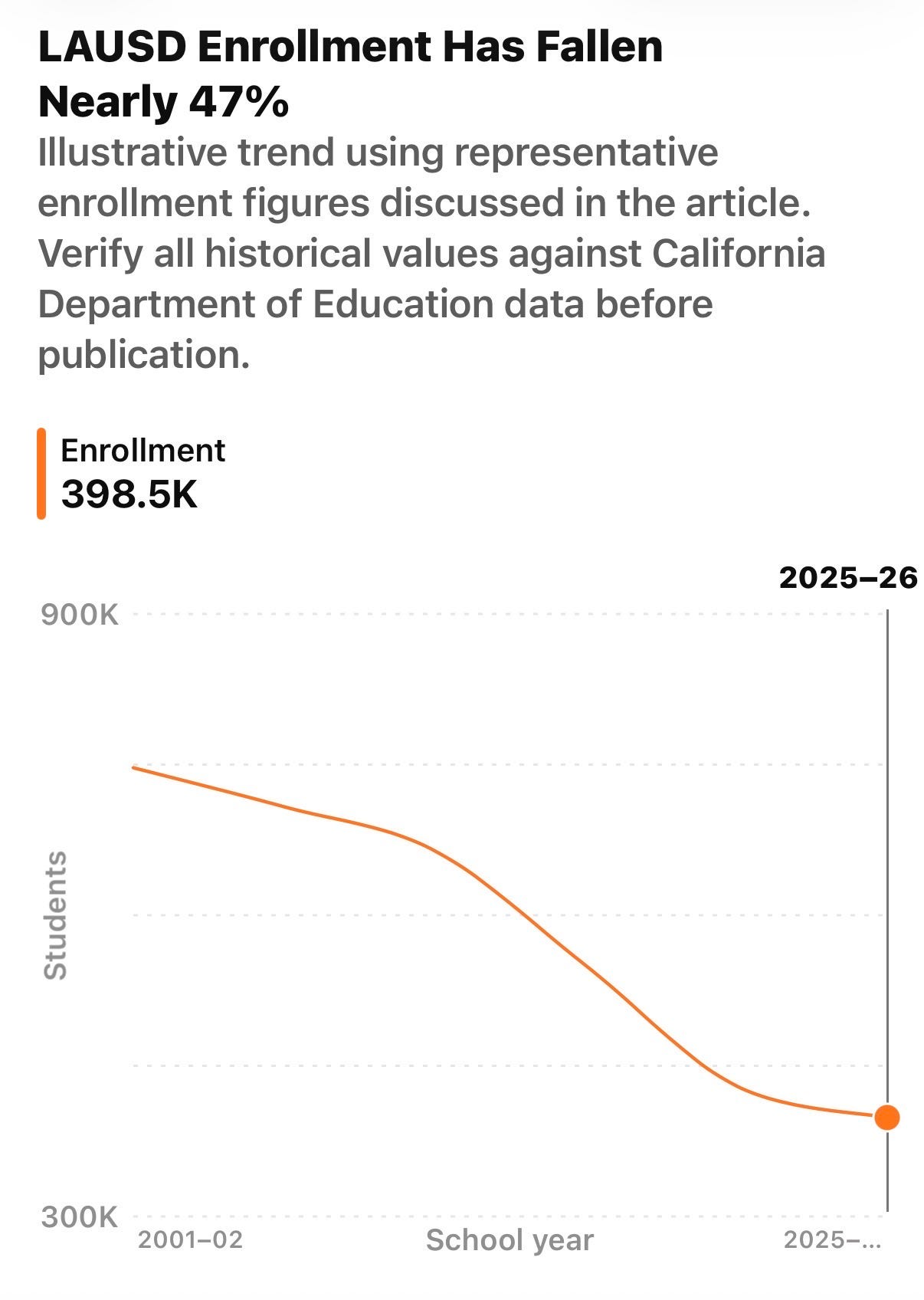
LAUSD’s enrollment has declined from approximately 746,800 students in 2001–02 to about 398,500 students in 2025–26. Because California school funding is tied largely to student attendance, a sustained decline in enrollment reduces recurring revenue and increases pressure on districts with large fixed operating costs.
Chart 2. Recurring Costs vs. Enrollment
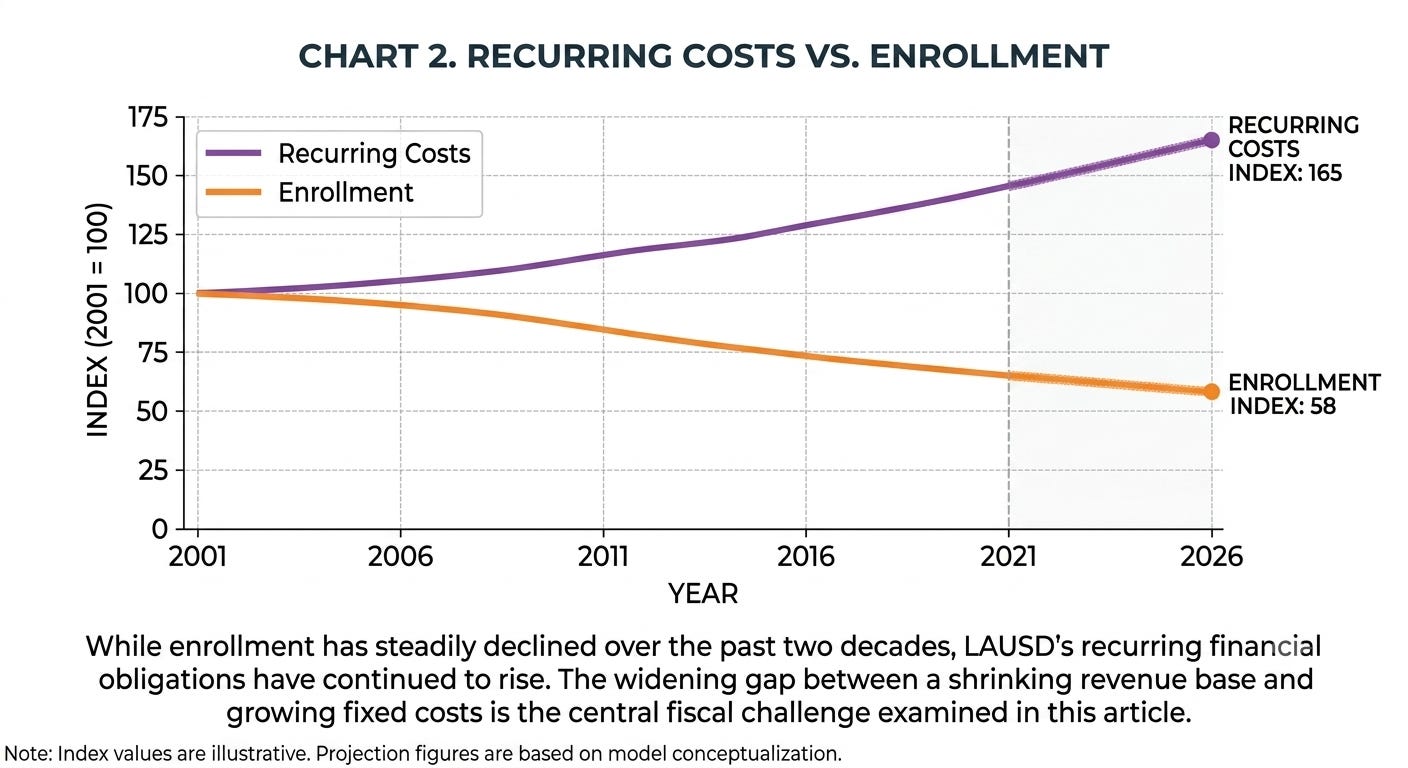
While enrollment has steadily declined over the past two decades, LAUSD’s recurring financial obligations have continued to rise. The widening gap between a shrinking revenue base and growing fixed costs is one of the central fiscal challenges discussed in this article.
The Pattern
The most significant challenge facing LAUSD is not any single labor agreement, budget vote, or enrollment decline. It is the way these factors reinforce one another over time.
Enrollment has been declining for years. Because California largely funds school districts based on student attendance, fewer students generally mean less recurring revenue. At the same time, many of the district’s largest expenditures—including salaries, benefits, and facility costs—are recurring obligations that cannot be reduced quickly or easily.
That creates a widening gap between recurring revenue and recurring costs.
County officials warned that the district’s long-term financial outlook was deteriorating before the Board approved its latest labor agreements. Those agreements added new ongoing financial commitments at a time when the district was already projecting structural deficits and the expiration of one-time federal pandemic funding had removed an important budget cushion.
Viewed individually, many of these commitments can be understood on their own merits. Competitive compensation helps recruit and retain employees, and staffing commitments can support educational goals. The fiscal question is different: whether the district’s long-term revenue projections can sustain those commitments without requiring repeated reserve drawdowns, significant future cuts, or additional outside intervention.
This is what distinguishes a temporary budget imbalance from a structural one. Temporary deficits can often be addressed with one-time resources. Structural deficits persist because recurring expenditures grow faster than recurring revenue.
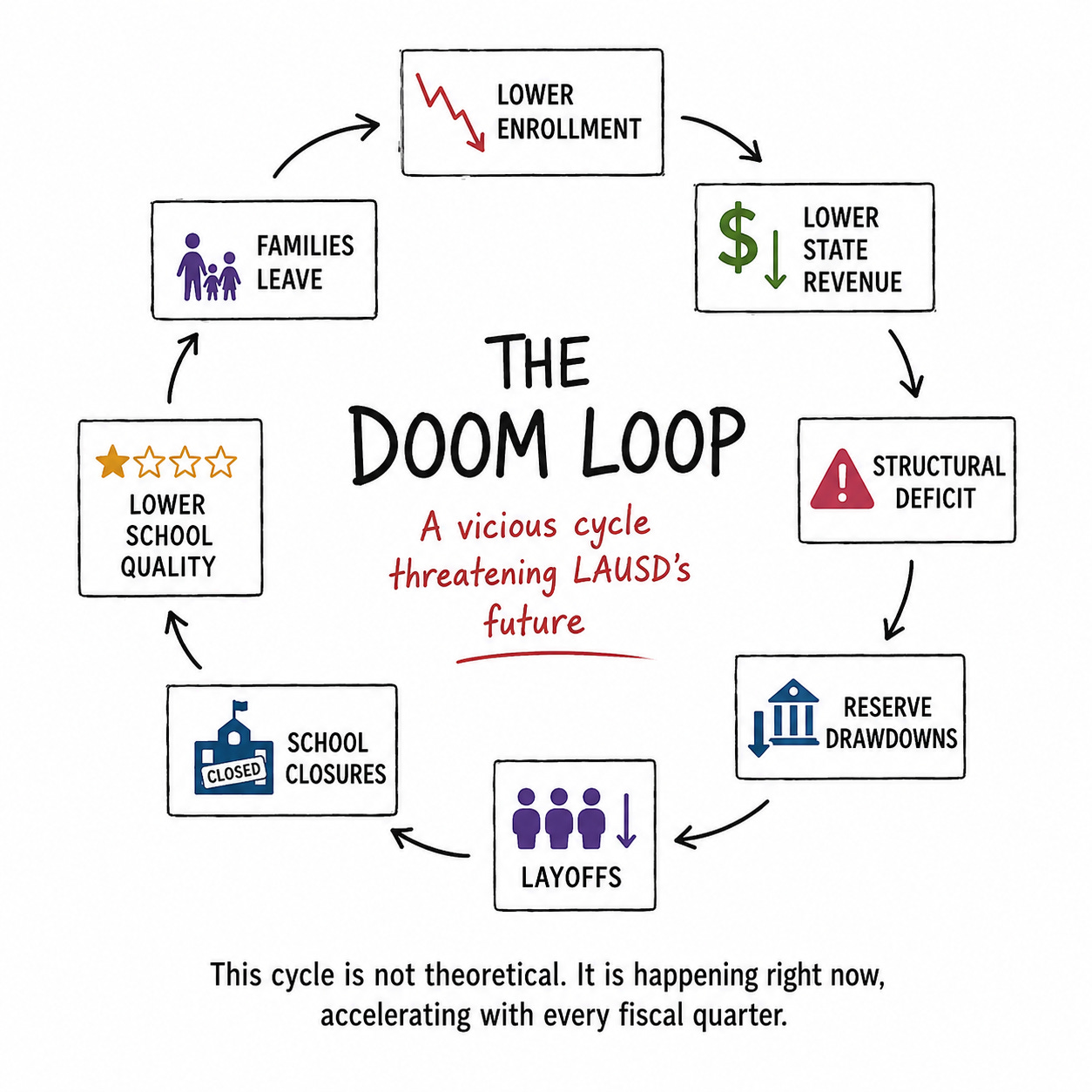
That is the pattern reflected throughout LAUSD’s recent financial projections. Declining enrollment reduces revenue. Fixed obligations remain. Reserves are used to bridge the gap. As those reserves diminish, the range of available options narrows.
Whether the district can reverse that trajectory will depend not only on future enrollment trends, but also on whether recurring expenditures and recurring revenues can be brought back into closer alignment.
The Consequences
If current projections prove accurate and no significant corrective actions are taken, the consequences will extend well beyond budget documents.
When a district faces a persistent structural deficit, the available options become increasingly limited. Administrators typically must consider some combination of spending reductions, staffing changes, school consolidations, use of reserves, renegotiation of obligations, or additional revenue if available. As financial flexibility narrows, each successive budget cycle becomes more difficult.
LAUSD has already discussed substantial reductions over the coming years, including layoffs, school consolidations, and operational changes. Earlier in 2026, the district issued approximately 3,200 layoff notices as it grappled with its financial outlook. County officials have also required the district to produce a credible fiscal stabilization plan as a condition of continued local control.
For students and families, budget decisions ultimately become tangible. They may affect the availability of elective courses, counseling, extracurricular activities, campus maintenance, transportation, and other services that shape the day-to-day educational experience. Which programs are affected depends on future Board decisions and budget priorities.
Enrollment trends can also work in reverse. If reductions in programs or services make a district less attractive to families, enrollment pressures become harder to reverse. Improving educational quality and rebuilding public confidence can help stabilize enrollment over time.
This relationship is one reason county fiscal oversight has focused not only on LAUSD’s current budget, but also on its long-term financial trajectory. The central challenge is not balancing a single year’s budget. It is ensuring that recurring revenues are sufficient to support recurring commitments over the years ahead.
What Leadership Requires
True leadership in public education requires making the difficult, unpopular choices necessary to protect the system’s long-term survival.
It requires looking at a map of Los Angeles and admitting that we cannot afford to operate half-empty school buildings. It requires honest, transparent conversations with labor partners about the absolute limits of district revenues, recognizing that you cannot negotiate money that does not exist.
Most importantly, it requires putting the interests of the next generation ahead of the political pressures of the present. Correcting course will be painful. It will involve consolidating campuses, angering constituencies, and saying “no” to worthy causes. But the alternative—a state takeover, bankruptcy, or the total hollowing out of the classroom experience—is infinitely worse.
Timeline
2001–2002: LAUSD reaches peak enrollment.
2020–2023: Federal ESSER pandemic relief funding.
September 30, 2024: ESSER funding expires.
2025–2026: Fiscal developments and county oversight milestones.
July 2026: Heightened fiscal oversight.
Primary Sources
This analysis relies primarily on official public records, including:
Los Angeles County Office of Education (LACOE) fiscal oversight letters, budget reviews, and statutory findings.
Los Angeles Unified School District Board of Education agendas, meeting minutes, adopted budgets, multi-year financial projections, and collective bargaining agreements.
California Department of Education enrollment, Average Daily Attendance (ADA), and Local Control Funding Formula (LCFF) data.
LAUSD Budget Services and publicly released financial reports.
Secondary Sources
Additional context and analysis were drawn from reporting and research by:
Los Angeles Times
LAist
EdSource
Daily News
The 74
Los Angeles Public Press
Other publicly available reporting, financial analyses, and education policy publications referenced throughout the article.
Methodology
Unless otherwise noted, enrollment figures, financial projections, budget estimates, and other quantitative data are drawn from publicly available government documents, including records from the Los Angeles Unified School District and the Los Angeles County Office of Education, and corroborated where appropriate with contemporaneous reporting. When multiple published figures existed for the same metric, preference was given to official government sources. All calculations, percentage changes, and comparisons were independently derived from the underlying data.
Author’s Note
I wrote this piece as a father, homeowner, and taxpayer. My two year old daughter will one day attend public school. The decisions made today by the LAUSD will shape the education she and hundreds of thousands of other children receive tomorrow.
No posts
Comments
Nothing yet. Say the first thing.
Sign in to join the conversation.