
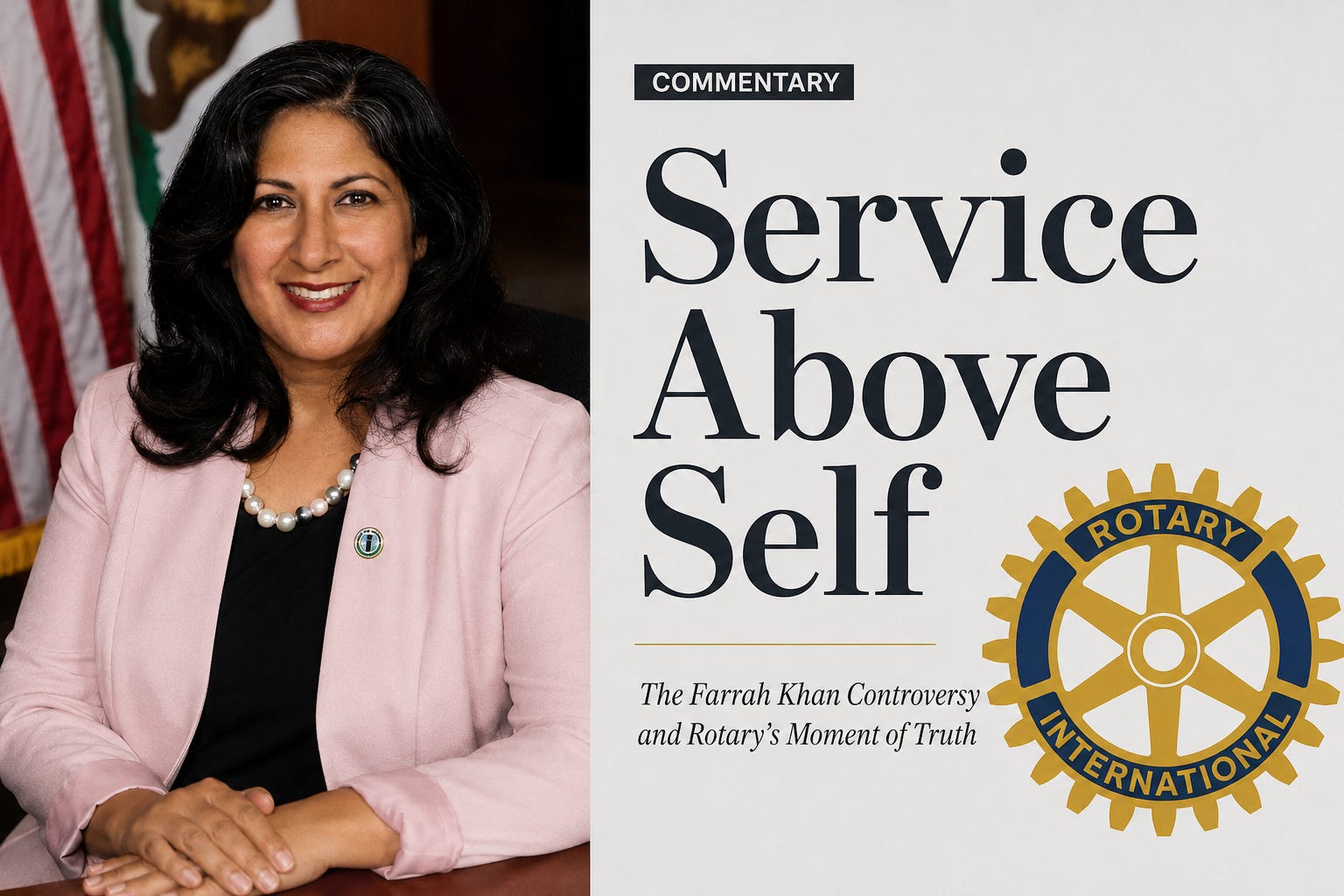
Until recently, I knew little about Farrah Khan beyond the fact that she had been mayor of Irvine. Then her name surfaced in a controversy involving Rotary, antisemitism and a social media record that seemed hard to reconcile with the woman’s remarkably wholesome civic résumé.
So I started reading.
The first thing I learned made me like her.
In 2016, Khan ran for Irvine City Council and lost. I recently ran for Congress and lost too, so this is one part of her biography I understand better than I would like. Campaigns create their own strange reality. Friends tell you everyone they know is voting for you. Strangers shake your hand and promise their support. Then election night arrives and you discover the electorate was apparently not included in the group chat.
Khan came back. In 2018, she won a council seat. Two years later, she became mayor.
I respect the hell out of that.
Her path there is an appealing American story. Born in Lahore, Pakistan, Khan came to the United States as a small child, grew up in Northern California and graduated from UC Davis. She worked in biotech regulatory affairs before settling in Irvine with her husband, where they raised two sons, fostered two other children for a time, and ran a restaurant and catering business.
Her political career began somewhere less glamorous than City Hall: the PTA. Khan served three terms as PTA president and became involved in her children’s schools, community events, interfaith organizations, Irvine’s Global Village Festival and eventually the city’s Community Services Commission.
This is how local power is usually built. Most people ignore school meetings and municipal commissions because they are boring. The people who don’t ignore them eventually wind up making decisions for everyone else.
By 2020, Khan had turned that civic résumé into a winning political one. A little girl who came to America from Pakistan had become mayor of one of Orange County’s largest cities.
There is a lot to admire in that story.
The closer I looked, though, the messier it got.
Politics Gets Messy
One of the people central to Khan’s political rise was Melahat Rafiei, a powerful Democratic consultant who had served as secretary of the California Democratic Party and as a member of the Democratic National Committee. Khan’s campaigns paid Rafiei more than $110,000 between 2018 and 2022, according to Voice of OC.
Rafiei had been arrested by the FBI in 2019 during an attempted bribery investigation and later cooperated with federal authorities. She eventually admitted agreeing to facilitate at least $225,000 in bribes to two Irvine councilmembers in connection with proposed cannabis legislation.
None of that makes Khan corrupt. Rafiei’s conduct belongs to Rafiei.
But Khan’s response when the relationship became politically toxic is worth noting. In May 2022, she publicly described Rafiei as her “friend and advisor” and defended her. Days later, Khan announced that Rafiei was no longer involved with her campaign.
Records later obtained by Voice of OC showed Rafiei continuing to communicate with Irvine City Manager Oliver Chi, sometimes claiming she was acting on Khan’s behalf. Khan denied authorizing her to do so.
That same year, Khan faced criticism from Armenian Americans over her relationship with Ergun Kirlikovali, a prominent Armenian genocide denier who had participated in her mayoral advisory council. Khan initially described the controversy as a political attack and disputed the interpretation of a video circulating online.
As criticism mounted, she changed course. Khan apologized to the Armenian community, explicitly acknowledged that the Armenian genocide happened and pledged to cut ties with genocide deniers.
I give her credit for the apology. People should be allowed to reconsider something and make it right.
October 7
After October 7, I developed a habit I suspect many pro Israel Jews share. When an elected official, activist, journalist or public figure enters my radar, I go to their social media and scroll back to October 7, 2023.
I want to know what they said when it happened.
Not six weeks later, when everyone had talking points and Gaza had become the argument. I mean October 7 itself, when families were hiding in safe rooms, young people were being hunted at a music festival and Israelis were being dragged into Gaza as hostages.
Did they express horror? Did they condemn Hamas? Did they acknowledge the murdered and kidnapped?
Silence alone proves nothing. Nobody owes the internet a statement every time something terrible happens. But when a public official later has a great deal to say about the war, October 7 seems like a reasonable place to start reading.
So that’s where I started with Khan, or at least as far back as the public material available to me would allow. I’m not going to claim something was deleted simply because I couldn’t find it.
What I could find was enough to keep me reading.
By spring 2024, the war had reached UC Irvine. Protesters established an encampment demanding divestment from Israel, and Khan publicly asked law enforcement to “stand down,” saying she would not tolerate violations of students’ rights to peacefully assemble.
The protesters had rights. They had every right to condemn Israel, demand divestment and say things Jewish students might find offensive. Free speech becomes useless if it only protects speech everyone likes.
But Khan wasn’t the protesters’ lawyer. She was the mayor.
Her responsibility extended to the protesters, but also to Jewish students who wanted to cross campus, attend class and feel safe doing it. My daughter is two, but someday she may be one of those students. When the mayor publicly told law enforcement to stand down, I wondered where those students fit into her calculation.
Two weeks later, as protesters barricaded areas around a lecture hall and police responded, Khan wrote that “taking space on campus or in a building is not a threat to anyone.”
Not a threat to whom?
Mine Isn’t Exactly the Dead Sea Scrolls
Before I go rummaging through someone else’s social media history, I should probably disclose that mine isn’t exactly the Dead Sea Scrolls.
I’ve posted angry things, shared things too quickly and gotten into political arguments that accomplished absolutely nothing. When I was single, I also shot my shot in DMs, sometimes with a level of confidence unsupported by the available evidence.
I’m married now. I behave myself.
So I’m wary of taking one ugly post from someone’s past and pretending it explains the person who wrote it.
The problem with Khan is that this isn’t one post.
The Forward reported that after leaving office, Khan began posting what it described as “conspiracy tinged anti Israel messages.” Jewish organizations pointed to claims about handcuffed babies found in a Gaza mass grave and another post in which Khan wrote about “the elite” being caught “eating humans” and engaging in rape and pedophilia.
Then there was this.
Responding to a claim that Israel had attacked an Iranian girls’ school, Khan wrote:
“The sick pedophiles/cannibals are doing what they do best.”
You can despise the Israeli government. You can condemn its military decisions. You can accuse it of recklessness, cruelty or illegality and make your case.
But “pedophiles/cannibals” is something else.
The blood libel was never merely a nasty insult. For centuries, Jews were accused of kidnapping and murdering non Jewish children, often with claims involving their blood and Jewish religious practice. These fantasies turned Jews from neighbors into monsters and helped provide justification for persecution and violence.
That history doesn’t mean every reference to cannibalism or abused children is automatically antisemitic. Context matters. But when a former mayor uses “pedophiles/cannibals” while also circulating claims involving dead or abused babies, Jewish organizations are not pulling the historical association out of thin air.
Khan rejects the accusation that she is antisemitic. She has said her criticism is directed at Israeli government officials and the military, not Jews.
That distinction matters, and she is entitled to make it.
It still leaves me wondering why a former mayor with years of interfaith experience thought “pedophiles/cannibals” was an appropriate way to talk about anyone.
Especially this former mayor.
Khan has condemned antisemitism herself. She spoke out when white supremacists displayed antisemitic messages in Irvine. She spent years doing interfaith work and built much of her civic reputation around inclusion.
I don’t know how she reconciles those things.
I don’t know this lady from Adam.
I can only read what she chose to put into public view.
The Other Farrah Khan
The Farrah Khan you encounter today looks rather different from the feed I had been reading.
There is community service, education, entrepreneurship, nonprofit work and now Rotary. It is a public life that communicates seriousness, generosity and civic trust.
And to be fair, she didn’t invent that résumé after leaving office. The PTA years were real. The interfaith work was real. So was the community service.
That is what makes the contrast so striking.
A woman who spent years building a reputation around inclusion and interfaith understanding was now being challenged by Jewish organizations over posts about cannibals, pedophiles and babies. And while that controversy was building, another civic institution was preparing to put a gavel in her hand.
That institution was Rotary.
Service Above Self
I had been thinking about joining Rotary myself, although I suspect my mental picture of it was similar to that of many people who have never been members: local businesspeople having lunch, raising money for scholarships and posing with oversized checks.
Rotary is considerably more than that.
Founded in Chicago in 1905, it grew into a worldwide network of more than 45,000 clubs. Rotary describes its mission in terms of service, integrity and advancing “world understanding, goodwill, and peace.”
Those words matter.
For more than a century, Rotary and its charitable foundation have supported humanitarian work, education, disease prevention and peacebuilding. Rotary has played a major role in the global campaign against polio. Its Peace Centers train people in conflict resolution, and its own peacebuilding work addresses discrimination and ethnic tension.
This isn’t some neighborhood Facebook group with a logo.
Rotary has spent more than a century building a name associated with service and civic trust. When a Rotary club chooses its president, the title means something because the institution means something. Hand someone the gavel and you hand them some of that reputation too.
That is what makes Khan’s appointment so difficult for me to understand.
Not because the president of one Orange County club controls Rotary International. She doesn’t. And certainly not because Rotarians should have to agree about Israel, Gaza or anything else.
An organization devoted to goodwill should contain people who disagree profoundly.
But there is a difference between disagreement and dehumanization.
Rotary has its own test for conduct. The Four Way Test asks whether what members think, say or do is true, fair to everyone concerned, conducive to goodwill and better friendships, and beneficial to everyone concerned.
Those aren’t standards being imposed on Rotary by its critics.
They’re Rotary’s.
The Gavel
New York Post reporter Jamie Paige is the reason I became involved in this story at all.
Paige documented Khan’s social media posts, the objections from Jewish organizations and Rotary’s decision to install her as president of the Rotary Club of Orange County L.A. She deserves credit for putting the pieces together and asking questions that apparently had not stopped the appointment from going forward.
Irvine Vice Mayor James Mai subsequently resigned from the club and from his leadership position in its charitable foundation.
Paige called me because I had been considering joining Rotary. I told her that organizations with trusted public reputations have a responsibility to carefully vet the people they elevate into leadership.
The more I learned about Khan, the more I wondered why Rotary had chosen her in the first place.
A Rotary presidency means something because Rotary means something. The name carries more than a century of goodwill, public service and trust. Hand someone the gavel and some of that reputation goes with it.
I don’t know whether Farrah Khan is trying to rehabilitate her image. I don’t know what she believes privately, and I’m not interested in pretending that I do.
I know what she posted. I know Jewish organizations objected. I know those objections were raised before her installation.
And I know Rotary handed her the gavel anyway.
This isn’t an argument that Farrah Khan should be banished from civic life. I began this story admiring something about her, and I still do. Losing an election and coming back to become mayor takes resilience. Her years of community service deserve to be part of the story too.
But so does the rest of it.
Rotary’s motto is “Service Above Self.”
Its Four Way Test asks whether something is true, fair, conducive to goodwill and beneficial to everyone concerned.
I didn’t choose those standards for Farrah Khan.
Rotary chose them for itself.
Farrah Khan’s words are hers to explain. The decision to make her president belongs to Rotary.
And that is where this story finally leaves me.
The question isn’t whether Farrah Khan lives up to Rotary’s standards.
It’s whether Rotary does.
Author’s Note
I did not know Farrah Khan before writing this piece. I began looking into her public record after New York Post reporter Jamie Paige contacted me for a story about Khan’s appointment as president of the Rotary Club of Orange County.
This essay draws on public records, Khan’s public statements and social media activity, reporting by Paige and other journalists, and statements from the organizations and individuals involved. Where Khan has disputed an allegation or offered an explanation, I have tried to include it.
I am Jewish, Israeli born, strongly pro Israel, and recently ran for Congress in California. Those experiences inform my perspective. I believe criticism of Israel, including criticism I strongly disagree with, must be distinguished from rhetoric that dehumanizes people or invokes longstanding antisemitic ideas.
I don’t know Farrah Khan’s private beliefs or motives. This essay is about what she has said and done publicly, and about the institutions that choose to lend public figures their credibility.
About the Author
Dory Benami is an Israeli born American small business owner, community advocate and former candidate for Congress in California’s 32nd District. He lives in the San Fernando Valley with his wife and daughter and writes about American politics, Israel, Jewish life and the increasingly uncomfortable places where they intersect.
No posts
Comments
Nothing yet. Say the first thing.
Sign in to join the conversation.