
For a long time, I thought America’s biggest political divide was between Democrats and Republicans.
I don’t think that anymore.
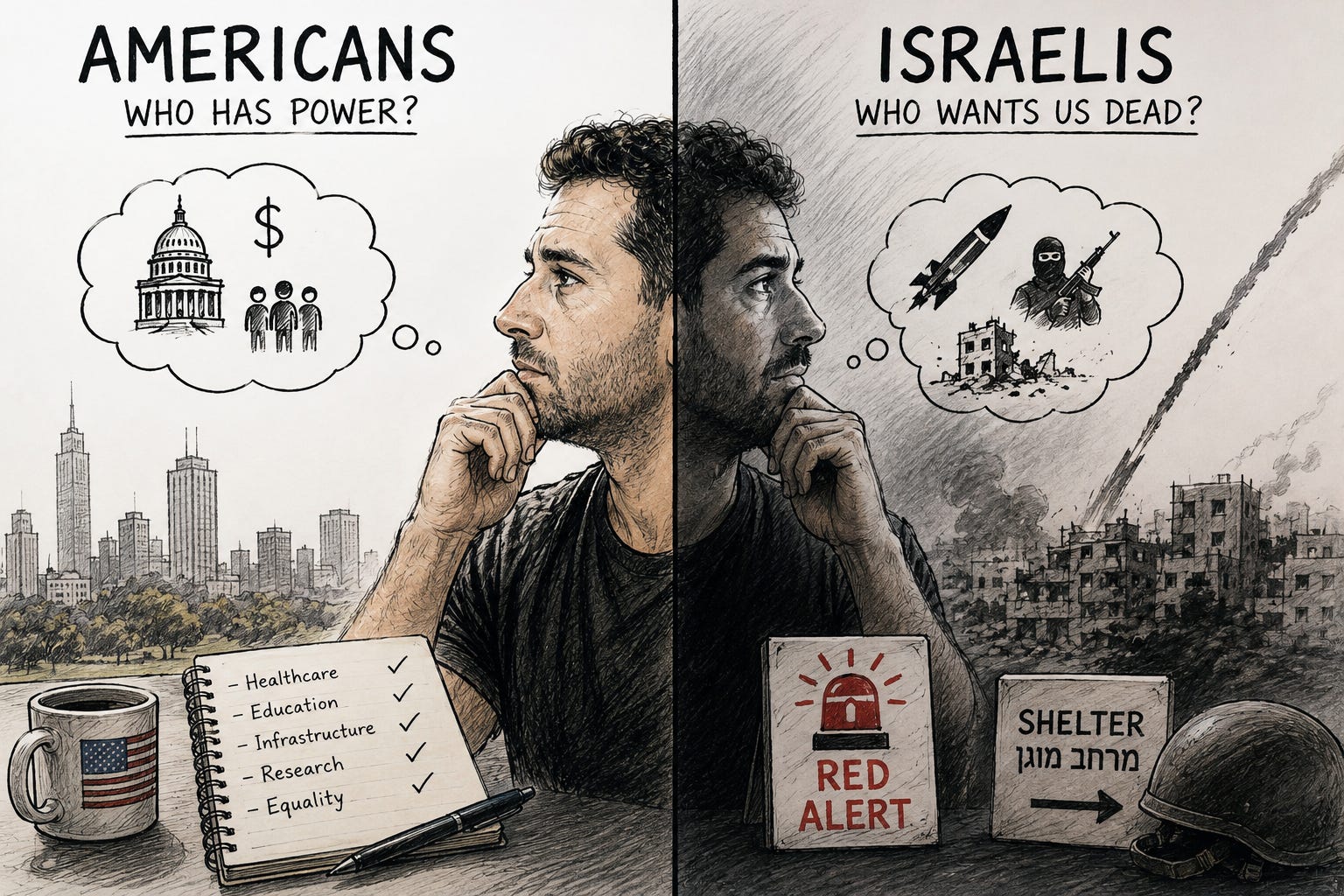
The deeper divide I’ve come to see is between how many Americans and many Israelis think about security.
Not because one side is better.
Because they grew up in different worlds.
Americans live behind two oceans, protected by the strongest military on earth. Most have never heard an air raid siren, sprinted to a bomb shelter, or thought of sending an eighteen year old into military service as simply part of growing up.
Israelis have.
So Americans often begin with one question:
Who has power?
Israelis often begin with another:
Who wants us dead?
I don’t think either question is wrong.
I do think the question you ask first shapes every answer that follows.
I see both perspectives because I grew up in both places.
I was born in Israel.
I came of age politically in America.
I worked on Democratic campaigns.
I knocked on doors for Bernie Sanders because I believed politics should expand opportunity, reduce inequality, and give more people a fair shot.
I still believe those things.
I still support universal healthcare. I still believe America should invest more in schools, infrastructure, scientific research, and the people who built this country. I’m still skeptical of concentrated corporate power, whether it comes from Wall Street, pharmaceutical companies, insurance companies, or lobbyists who write laws ordinary Americans never asked for.
I also don’t think the United States should write endless aid checks to anyone, including Israel. Israel is an economic powerhouse. Over time, I’d rather see our relationship evolve into one built on joint research, intelligence sharing, technological cooperation, and shared strategic interests than direct financial aid.
So my values didn’t change.
What changed was the order of operations.
October 7 did that.
Growing up in America, you absorb the idea that almost every political problem has a policy solution.
Growing up Israeli, you learn there are moments when the problem is much simpler.
Someone wants to kill you.
My generation remembers pulling gas masks out of cardboard boxes during the First Gulf War as Saddam Hussein launched Scud missiles toward Israeli cities. We remember sealing plastic over windows. We remember parents trying to stay calm for their children while wondering what would happen next.
Later came buses exploding during the Second Intifada.
Then rocket sirens from Gaza.
Now October 7.
Experiences like those don’t make Israelis less compassionate.
They make survival a lived experience instead of an abstract idea.
Once you’ve lived through that, one truth becomes very difficult to ignore.
Security makes everything else possible.
Freedom.
Equality.
Healthcare.
Education.
Climate.
Civil rights.
Every worthy political goal rests on one basic condition.
People have to stay alive long enough to enjoy them.
That realization also changed how I see American veterans.
For years, I respected their service.
Today I understand it differently.
Soldiers know something most civilians never have to learn.
Security isn’t simply another issue on the ballot.
It’s the condition that makes every other issue possible.
You can’t improve healthcare if your hospitals are under attack.
You can’t improve schools if children are running to bomb shelters.
You can’t expand civil rights if your country can’t defend itself.
Veterans understand this because many have lived it.
Israelis understand it because nearly everyone has lived some version of it.
That’s why I often find more common ground with an American veteran than with an activist whose understanding of war comes mostly through headlines and social media.
They understand that survival doesn’t compete with justice.
It makes justice possible.
Most Americans have had the good fortune to treat security as the default.
Israelis know it never is.
That’s why conversations about Israel often sound like two people speaking different languages.
Americans ask whether Israel used too much force.
Israelis ask what happens if Israel fails to stop people who openly promise to repeat October 7.
Americans often begin with principles.
Israelis often begin with consequences.
Both questions matter.
But if you don’t understand where each side begins, you’ll never fully understand where each side ends up.
Inside Israel, people argue fiercely about military strategy, proportionality, settlements, hostages, and the government. Few democracies criticize themselves more openly.
What they almost never argue about is whether survival comes first.
Until Americans recognize that many Israelis are reasoning from lived experience rather than abstract theory, they will continue to misunderstand not only Israel’s decisions, but Israel itself.
The same is true of many Americans who have worn the uniform of this country.
Whether they served in Sderot or Fallujah, Tel Aviv or Kandahar, they learned the same lesson.
Security isn’t the opposite of justice.
It’s what allows a nation to pursue justice in the first place.
No posts
Comments
Nothing yet. Say the first thing.
Sign in to join the conversation.