
Author’s Note
Most of what I’ve published this year has been an argument.
About genocide.
About language.
About the people trying to make Zionism radioactive.
This isn’t that.
It’s simply where I actually am.
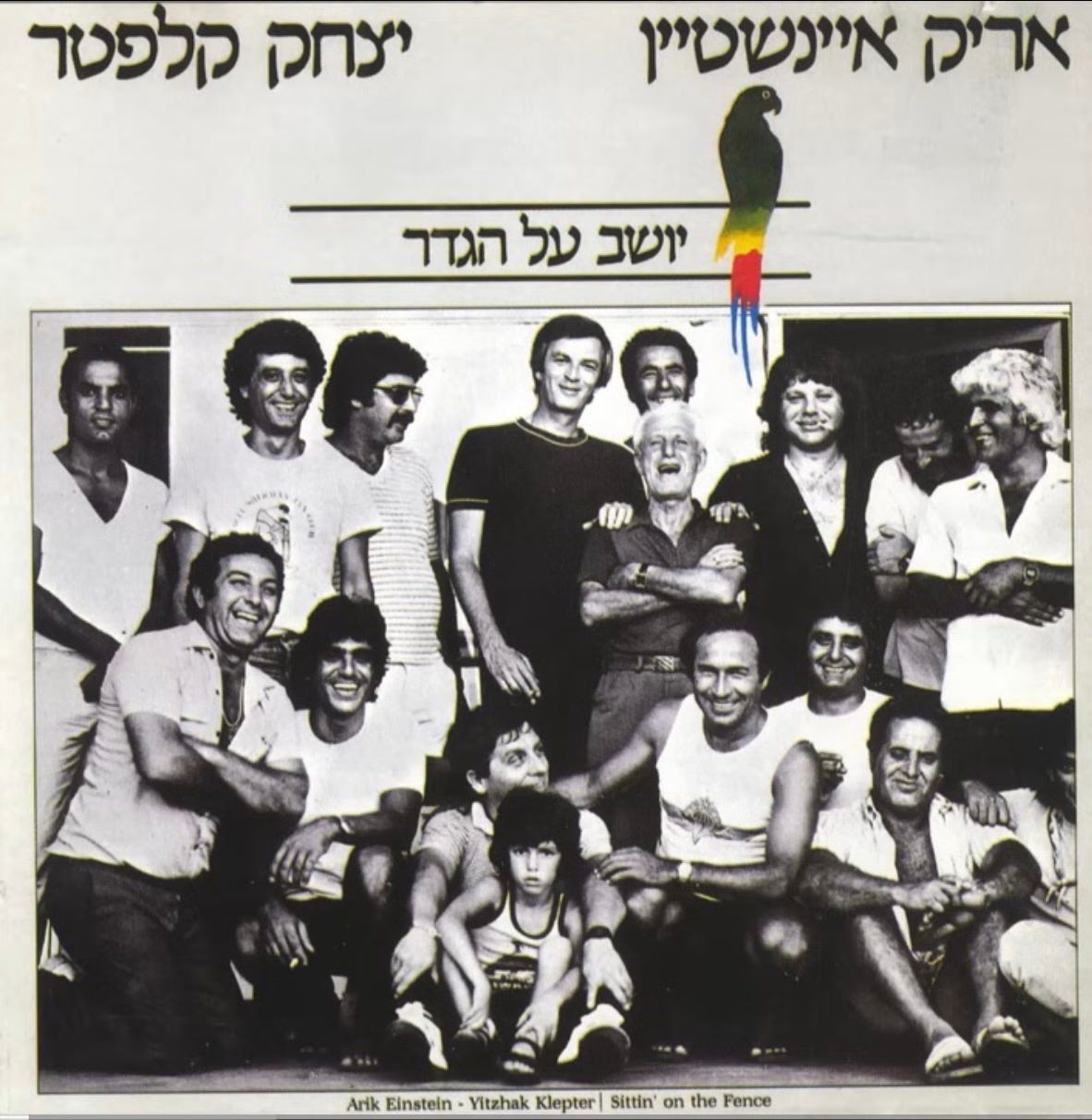
I’ve been listening to Arik Einstein’s Yoshev Al HaGader a lot lately.
The song was released in 1982.
I was just a kid. I don’t remember hearing it then, and I certainly didn’t understand it.
But over the last couple of years, I kept coming back to it.
One day I turned to Laura and said, “I think this is my theme song.”
I didn’t really know why.
Not because I’m politically on the fence.
Because I’ve spent most of my life between two countries.
I was born in Tel Aviv in 1975. A few years later, my parents moved to Los Angeles. Israel became my grandparents, my cousins, Hebrew, family vacations, and the place that still feels familiar the moment I land at Ben Gurion.
America became everything else.
School.
Little League.
Learning to drive.
College.
A fraternity.
Law school.
Business.
Marriage.
Fatherhood.
Eventually, a run for Congress.
For most of my life, that felt like enough.
I was Israeli.
I was American.
End of story.
It wasn’t.
I was born in south Tel Aviv into what we’d probably call a mixed Israeli family. Ashkenazi. Sephardi. Mizrahi.
Nobody talked about identity.
We were just family.
Growing up, the IDF wasn’t abstract.
My father served in Lahakat HaNahal, the legendary IDF entertainment troupe that launched the careers of some of Israel’s biggest stars, including Arik Einstein himself. My dad wasn’t some decorated commando. But the army shaped the rest of his life. His closest friends came from those years, and that experience eventually led him into the film business.
My mother was the exception.
She chose university before being drafted, and life just kept moving. She never served. In Israel, that was unusual, especially for her generation. Looking back, I think she spent much of her life building an identity outside one of Israel’s great shared experiences. She found her place in Tel Aviv’s bohemian film world, later studied cinema in London, and built a life that followed a different path.
I didn’t think much about that growing up.
Now I do.
When I turned eighteen, I did receive a draft notice. But because I was living in Los Angeles, I wasn’t required to serve.
Instead, I was deciding where to go to college.
Whether to join a fraternity.
What kind of American life I wanted to build.
I learned to drive in Los Angeles.
My mother never let me drive in Israel. She thought Israeli drivers were maniacs.
She wasn’t entirely wrong.
Back then, the roads were rougher, the cars were smaller, and traffic fatalities were much higher than they are today.
At the time, I thought she was just being overprotective.
Now I think she understood something I didn’t.
America was where I was growing up.
Israel was where I visited family and friends.
Israeli women baffled me too. I hardly ever dated one. They were direct in a way that felt foreign to me. I spoke Hebrew, but there were moments when I realized I wasn’t fully fluent in Israeli culture.
The friends I had in Israel mostly came from the year I lived there, family, family friends, and later my years at Warwick University in England.
My everyday life was here.
Every summer I’d go back to Israel, and because I had never served, there was always some interaction with the army bureaucracy.
Nothing dramatic.
Just another reminder that I was connected to Israel without having lived one of the experiences that defines so much of Israeli life.
The only time I voted in an Israeli election, I voted against Benjamin Netanyahu.
Looking back, I was seeing Israel through an American lens. I thought politics was left versus right. Good guys versus bad guys. Change the prime minister and maybe you change the country.
I didn’t understand Israel nearly as well as I thought I did.
Then came October 7.
Like so many Jews, I couldn’t stop reading.
History.
The Torah.
Ancient history.
Zionism.
The wars.
Israeli politics.
Coalition governments.
Military service.
I’ve probably spent more time trying to understand Israel since October 7 than I had during the previous forty years combined. I’ve read books I should have read years ago. I’ve listened to historians, journalists, soldiers, politicians, and friends from across the political spectrum.
I’ve probably asked AI ten thousand questions.
Maybe more.
I’ve changed my mind more than once.
During my congressional campaign, I met many Israeli Americans whose children had gone back to serve in the IDF. Some left college. Some postponed careers. Some fought in Gaza.
Those conversations stayed with me.
Not because they made me feel guilty.
Because they reminded me that military service is about more than defending a country.
It’s one of the shared experiences that binds Israeli society together.
It’s serving together in Tzahal.
It’s arguing over hummus on Dizengoff as if the future of the country depends on the conversation.
It’s voting for a party that disappoints you, then voting again because the government collapsed.
It’s reading Haaretz, Yedioth Ahronoth, Ynet, Maariv, and The Times of Israel. It’s buying every new book on Zionism, Jewish history, Israeli politics, security, or the Torah because none of it is abstract.
It’s your life.
Israelis, for the most part, are simply more engaged. They vote more often. They argue more. They’re probably more divided than American Jews, or even many Israeli Americans, can imagine. But they’re also living the consequences every single day.
One thing I’ve come to appreciate is that I spent most of my adult life trying to reduce the influence my Israeli parents had on who I became.
Not because I rejected them.
Because that’s what children of immigrants do.
You want your own identity.
Your own career.
Your own friends.
Your own country.
Your own life.
For me, becoming American almost meant creating some distance from being Israeli.
Not abandoning it.
Just putting it on a shelf.
I wanted to succeed on my own terms, not spend my life being “the Israeli kid.”
The surprise wasn’t that I became more interested in Israel after October 7.
The surprise was realizing that, at fifty-one years old, I was walking back toward the very part of myself I had spent decades trying to put in the background.
Not to become my parents.
Not to become more Israeli than I really am.
Just to understand them.
To understand where I came from.
People sometimes ask me whether I’ve become more conservative.
I don’t think that’s the right question.
I haven’t become pro-Bibi.
I haven’t found the perfect Israeli political party.
I’m not even sure one exists.
What changed is something deeper.
I’m more informed.
More humble about what I don’t know.
More willing to admit when what I’ve learned challenged what I thought I knew.
More aware that loving Israel and understanding Israel are not the same thing.
For years, I thought Yoshev Al HaGader was about indecision.
I don’t anymore.
I think it’s about belonging to two worlds and spending a lifetime learning that you never really have to choose between them.
Maybe that’s why I’ve been listening to it so much lately.
Or maybe, after fifty-one years, I was finally ready to hear what it had been trying to tell me all along.
Postscript
Arik Einstein has been the soundtrack to my life for as long as I can remember.
Somehow, Yoshev Al HaGader found me again at exactly the right time.
If you’ve never heard it, I’d love for you to listen before you leave.
It may explain this essay better than I ever could.
Listen here:
No posts
Comments
Nothing yet. Say the first thing.
Sign in to join the conversation.