

Light a candle for Melvin Edwards, who left us behind at the age of 88. While he did much more than the Lynch Fragments, those works, begun in 1963 (and which remained an open-ended series until, well, now), are the most lastingly powerful sculptures of the postwar era, and you might as well extend that through our own terrible age. Edwards’s ability to compress dynamism creates an impossible amount of tension within a volume roughly that of a good-size human skull. The Fragments are like tectonic epigrams; their concision is symbiotic with their violence. While they did evolve over the decades, particularly in response to Edwards’s travels to West Africa (he resided partially in Dakar), and their valence shifted from work to work, the Lynch Fragments’ essence is to capture a duel repression, of both the indignities endlessly inflicted on Black Americans and an indignation that has to be quelled to survive.
Edwards’s work is currently on view at the New Museum in their kickoff exhibition, and a recent three-year-plus presentation of his early ’70s barbed-wire sculptures at Dia Beacon just ended on February 22. The day before, Edwards appeared at the museum for a talk with art historian Michael Brenson. The conversation, available below, illuminates the degree to which Edwards was fascinated with intellectual, visual, and spatial oscillation. Per one example he cites, barbed wire is sold in thickly volumetric bales, but when unspooled, it defines a line: Sculpture becomes drawing. Then once arrayed in space, it becomes volume once again, even if via a trick of the eye. You can see Edwards working analogously in his Rocker works (1970s–2026), which change physically and in appearance depending on whether they’re at rest or in motion. Edwards talks about moving between mathematics and space, the abstract and the material. I’d add to that the formal and the semantic: the unique ability his great works have to switch between structural intensity and visceral reference.
If you happen to be heading to France, a touring survey of Edwards’s work is at the Palais de Tokyo this year, after stops at the Fridericianum and Kunsthalle Bern. Hopefully we won’t have to wait too long for a similar show in the US.
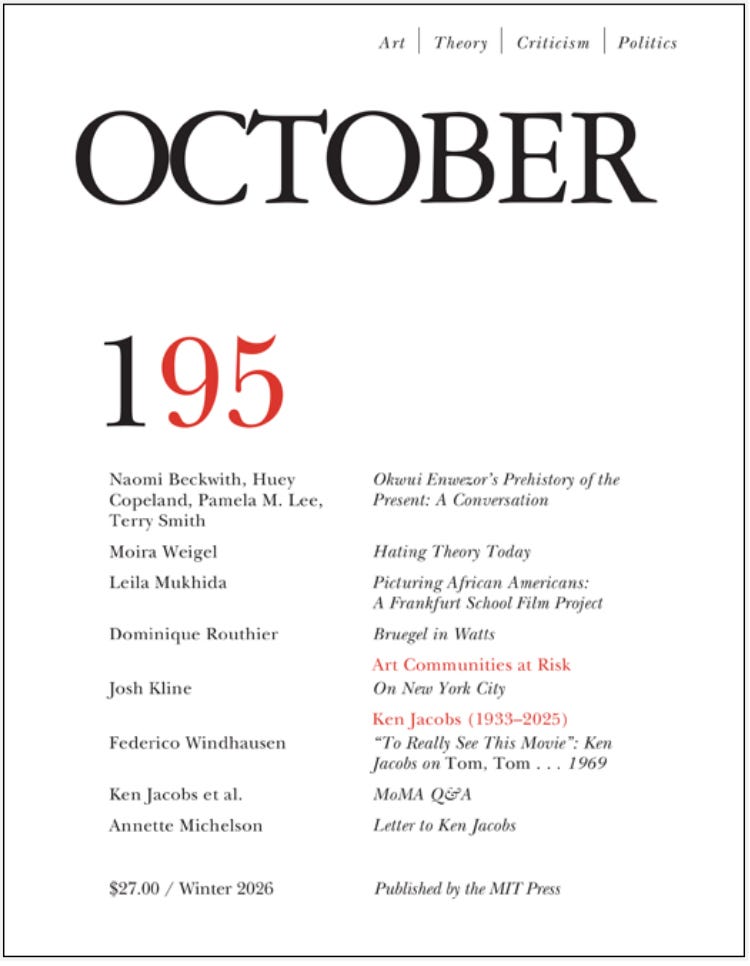
Congrats to my old pal Josh Kline for his recent appearance in the august journal October with a cogent essay on the whole “what’s killing art” question. His answer: New York real estate. If you thought it was bad for the presidency, wait til you see what it does to sculpture.
Here’s a sample passage offering a salient thesis on why contemporary art seems to lack “movements” that moves beyond by-now familiar explanations that focus on a sense of historical disjunction and the erosion of our individual and collective memories to something more structural:
The scarcity of artist-run spaces is likely one factor inhibiting the emergence of major new art movements in the United States over the past quarter century. Museums, galleries, and art schools don’t see nurturing artist communities and the art movements they give birth to as part of their job. In institutions that exhibit art, curators think carefully about how many times an artist appears in a group or solo exhibition in their space. With rare exceptions, appearing in a major group exhibition like the Whitney Biennial means you won’t be considered for the next iteration, regardless of how your work develops. If you have a solo exhibition at a nonprofit alternative space like White Columns or the Kitchen, you basically become ineligible for another solo show there or at any similar spaces in New York for at least a decade, if not longer. Curators are also unlikely to give solo shows to more than one artist from the same art scene or group of artists. While these rules don’t appear in a physical rule book, everyone in New York’s art industry is well aware of them. This institutional limitation means that for most young artists, regular solo shows in New York only happen within a commercial context at the gallery that represents them. Today, emerging artists who don’t make paintings have a harder time securing commercial representation. All this means that at the beginning of their careers, these artists have fewer solo shows in the city they live in than similar artists did even a decade ago.
There’s much more than that, including bars like “You can’t make sexy eyes or do your comedy routine at a gallery after-party in Tribeca if you’re in Seattle or Houston.” You can read the whole thing here.

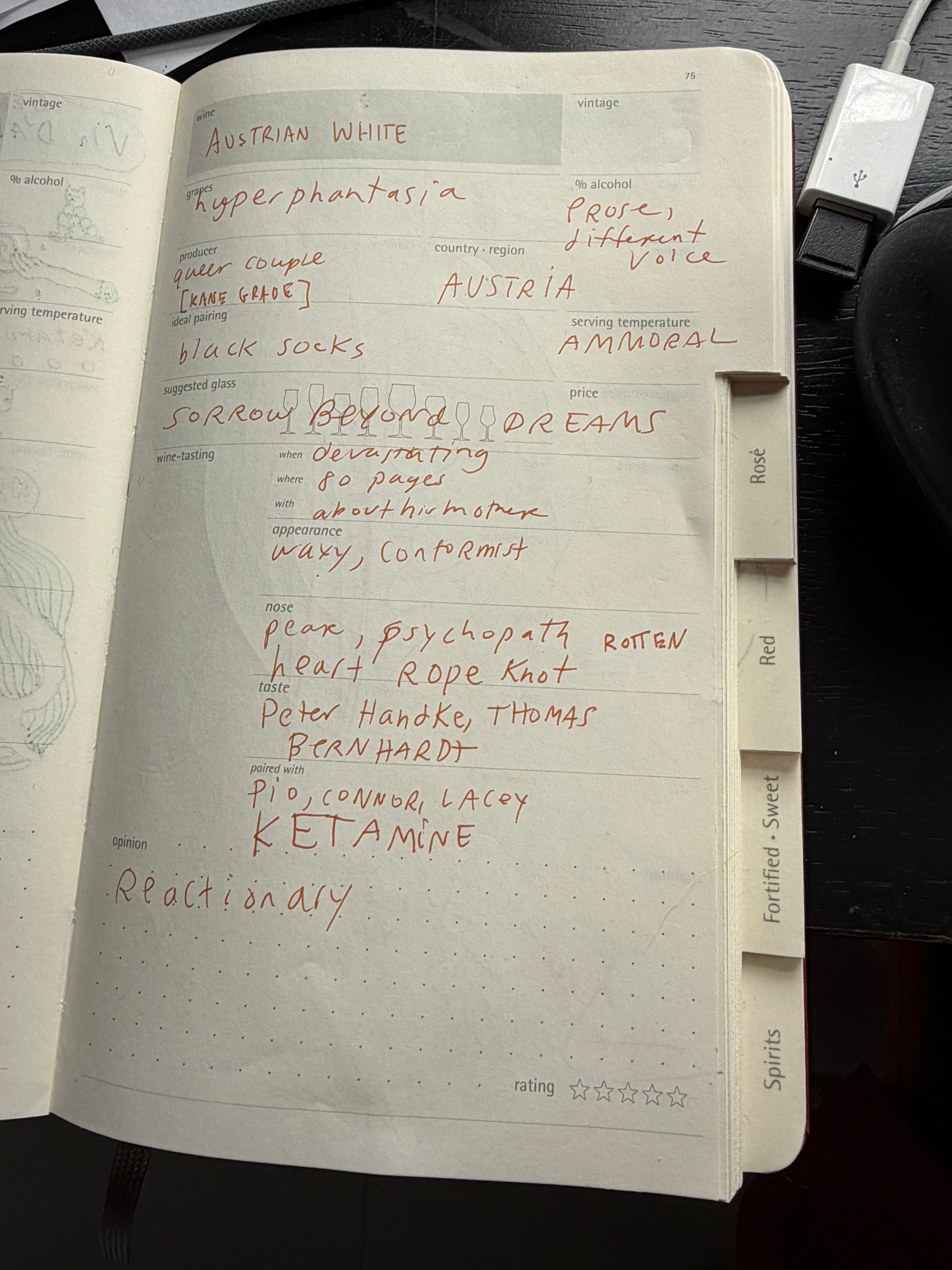
Von der Vogelwaide Kane Grade 2024. Some of my talented colleagues at the Fine Arts Work Center came over the other night to suck down a few bottles I had lying around, including a Vin d’Alsace that I found tart and rosy-cheeked but an anonymous member of our party dubbed “sadistic,” and Kane Grade, a remarkable light-skin-contact white wine from Austria. The name Kane Grade apparently means “Shit Grade” (German speakers, please fact-check) in a wry reference to the only arable plots that the couple who started the winery could afford when they decided to move back to their Heimat and press some biodynamic juice. They seem to have settled in dreamily, however, finding time to make a uniquely marbled label for each bottle and looking in their sexy/scruffy photos like a ’00s IDM duo.
Kane Grade is a wild bargain at only $30, and at Provincetown rates, no less. It’s easily as complex as many wines a price point or so up the ladder, a mélange of grapes mostly featuring Welschriesling, which is unrelated to Riesling and is known more for producing volume than quality. It must be savory, however, given the flavors fluttering and drifting within each sip, a little rusty and a little avian. The thirty percent of Kane Grade that’s Grüner presumably provides its flexible backbone and the touch of Pinot Blanc a little tackiness. All in all, it’s a constantly metamorphosing wine that would go well with fish or fowl, though we drank it Saturday-night style, ie: on an empty stomach with animal tranquilizers and mixed nuts.
As for the rest of the reflections my friends and I had on Kane Grade, I’ll leave you to glean it from our collective jottings, which are mingled amidst some reflections on modern Austrian literature.
I’m crazy about Smerz. I discovered the band not long ago through their album Big City Life, which came out last May to highly positive reviews. Props to PS1’s ever-prescient Warm Up series, which hosted them all the way back in 2017. They’re coming next month to New York, Los Angeles, Chicago, and parts in between.
The Norwegian duo of Henriette Motzfeldt and Catharina Stoltenberg has roots in Copenhagen’s Rhythmic Music Conservatory, which has minted a number of alt-euro-pop acts in the last decade. Big City Life only gets near the conservatorial in occasional keyboard passages that weave around dominant melodic riffs and the big galumphing beats of ’90s trip hop, which Smerz contrast with a keening edge of electronic soundscaping. That consistent abrasion, with the music chugging alongside light but sinewy vocals, meshes with the album’s theme: being a gal in the big city. The lyrics, alternately cocksure and anxious, perfectly convey a sense of freedom, exhilaration, and uncertainty. They can be self-mocking and prickly, as on the title track and “Feisty,” or yearning, as on “Imagine This,” about the erotics of friendship, and “Street Style,” whose vocals nod toward both Sade and Peggy Lee’s vertiginous “Is That All There Is?”
You may actually have heard Smerz via Big City Life’s crown jewel, “You’ve Got Time and I’ve Got Money,” which has notched nigh on 21 million spins on Spotify. As you the boorish title suggests, it’s a caustic parody, pairing a genuinely sexy groove and irresistible hook with lyrics in the voice of a boneheaded would-be boyfriend who thinks he’s a perfect romantic.
Every angle of the song is honed to a cutting edge. It opens with a command: “Put your arms around my body / Hold me close and show it to me.” Elsewhere, the beau declares: “When I’m with you, I wanna talk so much / About all the things I’m thinking of,” which might be cute if it didn’t sound exactly like the reflection of a man running off at the mouth on a bad date. Cymbals plash; strings à la “Bittersweet Symphony” and gliding horns swoop in from the wings; even the little ahs and ums sprinkled throughout take on a devastating irony. My personal favorite couplet is “Baby, can I see you naked? / Even though I love how you dress,” though there are plenty more idiocies to delect.
As with all great satire, I’m not sure everyone who likes the song gets the joke, but the video, with its gauzy filter, shots of fireworks, and pans across diamond rings and cheap chandeliers couldn’t make things any clearer. Stoltenberg performs the vocals as if she’s at a karaoke bar grinning through a takedown of an old sexist standard. It’s all as brutally funny as the song itself.
No posts
Comments
Nothing yet. Say the first thing.
Sign in to join the conversation.