
Magnifica Humanitas, Pope Leo’s encyclical letter “on safeguarding the human person in the time of artificial intelligence,” is probably the most insightful discussion of the ethics of AI that I have read anywhere. I recommend it to everyone regardless of religion, creed, or lack thereof.
The text has an undeniably universal appeal. You don’t have to be Catholic to see the wisdom in it. Indeed, Pope Leo deliberately addresses his “heartfelt appeal to all the Catholic faithful, to all Christians and to all men and women of goodwill” (16). He offers a reflection on general truths (or reliable norms if you prefer) that may be appreciated through either a Catholic lens or other philosophical perspectives. I suspect that its aspiration to universality helps to account for the wildly positive reception of the encyclical to date among many readers of varied backgrounds. In this time of technological upheaval, there is a palpable hunger for a human-centric understanding of AI, and Magnifica Humanitas breaks bread with us all.
To be sure, there is still a lot of theology in it. And it would be shocking if there was not. A papal encyclical, after all, offers authoritative teaching to Catholic leaders on matters of ecclesial importance. The text is solidly grounded in Christian principles and uses evangelical rhetoric to make its argument. For many readers, this will be a source of authority. For others, it will be a deterrent to understanding. For the former, there may be little need for additional commentary. For the latter, a secular mapping of ideas may be helpful.
In that spirit I will hazard a liberal interpretation of Magnifica Humanitas that connects some of its insights to themes in modern social science. I realize that this is a bit like brewing non-alcoholic beer, which is either a travesty or an improvement depending on your attitude toward alcohol. But here I will bracket, in the phenomenological sense,[1] questions of metaphysis or theology. My goal is simply to appreciate themes of the text as they appear to me. That is, you may read this effort as translation, distillation, dilution, interpretation, revelation or evangelism, as you prefer.
Magnifica Humanitas presents a closely reasoned argument over the course of an introduction, five chapters, and a conclusion. Recast in secular terms:
The introduction presents the overarching theme of valuing the flourishing of human community over the expansion of technocratic control.
The first chapter explains why this is a universal concern.
The second explains the principles of political economy that enable human flourishing.
The third explains why AI cannot substitute for human nature.
The fourth discusses the social challenges of the AI revolution.
The fifth turns to the dangers of militarized AI in the global system. (Note that these last three chapters map roughly to the levels of analysis familiar to scholars of international relations, introduced by Kenneth Waltz in Man, the State, and War, although in contrast to Waltz the last offers a sharp repudiation of realism.)
The conclusion calls for cultivating human relationships and social justice.
I will take each in turn. Or at least that was the plan. There is so much to chew on that I am already running way longer than expected on just the first two chapters. After all, the 42,300-word encyclical is the length of a short book and presents an entire cosmology.
So, in this post, I will just focus on the convergence between Catholic social doctrine and liberal political economy. A later post (hopefully) will discuss the three levels of analysis—human nature, society, and international relations. As always, the posts in this blog are unedited musings to figure out what I think, not finished scholarship. Comments are welcomed.
Magnifica Humanitas begins with a contrast between the Bible stories of the Tower of Babel and the rebuilding of Jerusalem. The first describes a technocratic project to impose a single language and goal on the world to ensure stability and control, “a uniformity that eliminated diversity and that chose homogenization over communion” (7). This hubristic venture fails miserably, and the people are scattered and confused. In the age of AI, the parable warns of “the idolatry of profit that sacrifices the weak, a uniformity that neutralizes differences, and the pretense that a single language — even a digital one — can translate everything, including the mystery of the person, into data and performance” (10).
The second describes a democratic project “which rebuilds relationships before rebuilding with stones,” building a safe and sustainable community “through the shared responsibility of all: men, women, priests, artisans, heads of households and young people all play a part” (8). In this parable AI is not a substitute for human beings but a complementary tool that people can choose to use to enhance the common good. Humanity thus faces a choice “between a power that claims to dominate the heavens and a people who work together…to rebuild the walls of fraternal coexistence” (9).
This contrast recalls Paul Edwards’ comparison of “the closed world” of cybernetics (the science of human and machine control that emerged from World War II and culminates in modern AI) with more open “green world” conceptions of technology. The idea that tech always develops within a broader system of human choices also recalls Langdon Winner’s classic discussion of autonomous technology (which fifty years later is still my favorite book about the social essence of AI).
The AI Tower of Babel is not just a material technology but a cultural “technics” that fetishizes artificiality, rationality, ubiquity, specialization, connectivity, and order in pursuit of power and efficiency at scale. This technocratic system runs on an endless treadmill that tries to achieve total control without ever getting there, while at the same time ratcheting up the potential for large-scale catastrophe. AI catastrophes top of mind include autonomous vehicle accidents, employment collapse, ecological shock, hacker exploitation, and military escalation, to say nothing of superintelligence explosion. (Robots of unusual size? I don’t think they exist). A more human-centered approach might help to mitigate them.
The Pope’s conception of technology is thus right at home in the interdisciplinary field of Science and Technology Studies (STS). Namely, “technology is never neutral, because it takes on the characteristics of those who devise, finance, regulate and use it” (9). The supposed neutrality of technology, widely assumed by technologists in public policy debates, is a lazy trope that obscures accountability for countless value-laden decisions that shape and reshape the human-built world. Technology is not external to society but an expression of it. So, what kind of society do we want to build?
The first chapter reviews encyclical teaching since the landmark Rerum Novarum, or “On Capital and Labor,” by Pope Leo XIII in 1891. Reflecting on the economic tumult of the industrial revolution, Leo XIII laid the foundations for what has come to be known as Catholic social doctrine. Pope Leo XIV explicitly honors this legacy by updating social doctrine for the automation revolution.
Chapter one thus connects Leo XIII’s early concern for labor rights to an evolving tradition of Catholic concern for social justice, military disarmament, and ecological sustainability. Leo XIV’s distinctive contribution to this tradition is to emphasize the sanctity of human relationships, the dignity of individual people, and the integrity of human community, which are all threatened by automation. Automation here is understood not as simple technological determinism but as a system of ideas, institutions, and infrastructures for automating data processing (or “intelligence,” which appears in quotation marks in the encyclical when referring to whatever it is that AI does in order to distinguish it from human intelligence).
This is accordingly the most doctrine-heavy chapter in the encyclical, but the upshot is demonstrating the Church’s abiding interest in worldly problems of universal concern, not just the eternal preoccupation with saving souls. The path from Rerum Novarum to Magnifica Humanitas is tale of progressively broadening engagement with the real political, economic, social, and environmental conditions under which people actually live, work, suffer, and die. These conditions are truly planetary in that they affect people of all backgrounds, nationalities, and faiths.
In other words, Magnifica Humanitas is meant to be not just Catholic but also small-c catholic. So, feel free to give it a liberal reading.
(I mean small-l liberal here, i.e., the ideas shared by both American Liberal and Conservative factions. Conservatives venerate the founding fathers, who were steeped in liberal thought, and have been known to champion free markets and democracy. Liberals are suspicious of concentrations of power and advocate for social justice. In the Jacobin formula of “Liberté, Égalité, Fraternité,” Conservatives tends to endorse liberty and fraternity, often exaggerated as nationalism, while Liberals overfit on equality and communists dispense with liberty altogether. The fact that they tend to split on their attitude toward Christianity, moreover, is at the very least suggestive of a historical link between liberal and Catholic values. That also means that Magnifica Humanitas can be read as a small-c catholic reflection on small-l liberal ideas.)
In the spirit of liberal universality, Pope Leo calls for interfaith and interdisciplinary dialogue: “The Church regards all who sincerely seek ‘truth, goodness and beauty’ as companions on the journey, and considers them as ‘precious allies’ in defending the dignity of every person and in caring for creation” (23). Rather than imposing a dogmatic interpretation, “When it comes to applying these standards to the complex situations of our time, the contributions of philosophy and of the human and social sciences is essential. These disciplines help us understand and analyze cultural, economic and political dynamics more deeply” (23). We’ve come a long way since the inquisition of Galileo.
If “the Church welcomes the contributions of the social sciences” (23), then perhaps the social sciences also have something to learn from the Church. There is interesting convergence between Catholic social doctrine applied to AI in Magnifica Humanitas and idea in the liberal tradition of political economy. I will not take a stand here on which perspective ultimately carries more authority or how each influenced the other historically. Suffice it to say that modern secular humanism and the Christian tradition share many fundamental values, such as speaking truth to power, giving voice to victims, and striving for social justice. The historical rupture between the liberal Enlightenment and the Catholic Church obscures their common anthropological origins and, perhaps, their common humanist destiny.
If chapter one is the literature review of the thesis, chapter two is its theory section. Here the encyclical lays out core principles of Catholic social doctrine: “the dignity of the person, the value of work, the universal destination of goods, solidarity and subsidiarity, care for creation and the centrality of peace and fraternity” (45). In reading this chapter, I was surprised (or rather impressed) to discover something like the essential norms of liberal political economy. The terminology is different and far more prescriptive, and the interconnections across concepts are not immediately obvious, but the familial resemblance is undeniable.
By liberal political economy I mean the tradition of thinking about the relationship between states and societies, or governments and markets, or institutions and individuals, or structure and agency, etc. This is a tradition that spans Adam Smith and John Locke (on the virtues of liberty), Karl Marx and John Keynes (on the dangers of unfettered capitalism), Douglass North and Elinor Ostrom (on the benefits of collective institutions), and many others.
There are many complicated debates and nuances in liberalism, but at a first order of approximation, an overarching theme in political economy is that human societies must make, and keep on making, tradeoffs across two different values or ends (the good of society and the good of individuals) and two very different types of institutions or means (governments and markets). Because I am a simple political scientist and a 2x2 figure is the simplest way to say that the world is complex, the tradeoff space can be summarized thus:
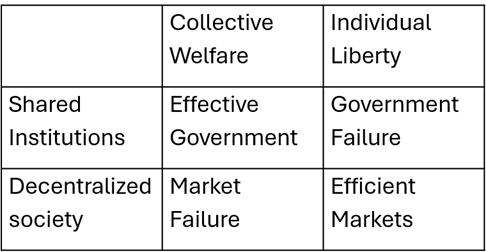
Considering the eight concepts above, there are six things that are generally nice to have (individual freedom, public goods, common infrastructure, healthy communities, and governments and markets that work for everybody), but there are two failure modes that we really want to avoid (ruthless domination and capitalist exploitation). Now, Pope Leo’s encyclical lists five principles of social doctrine, but it prefaces them with an overarching emphasis on “the equal dignity of all human beings” (51) and “the supreme value of human rights” (54), which I will take as a sixth principle or metaprinciple. It also sustains a critique of domination and exploitation throughout the text, so I’ll treat those as two important antiprinciples. Let’s see if we can map these two sets of six desiderata together.
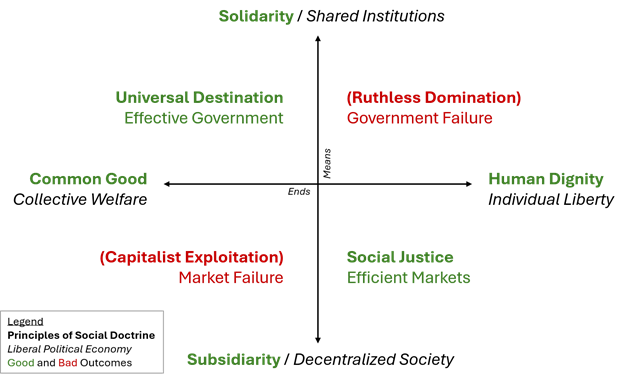
Here is the same 2x2 as a Cartesian graph. If it looks like a cross, that is purely a coincidence. Reason and religion come together, so to speak. Agential ends are on the x-axis (working together or doing your own thing). Structural means on the y-axis (having shared systems or using your own stuff). Concepts from Catholic social doctrine are in bold (including the five formal principles and the metaprinciple and antiprinciples). Concepts from liberal political economy are in italics. Good outcomes are in green, and bad outcomes are in red. Thus, the noble desiderata of social doctrine are in bold green while the diabolical outcomes are in bold red (see what I did there?). The political economy labels in black are meant to suggest, if not neutrality, then ambiguity: they become good or bad based on human choices in historical circumstances (i.e., combinations of ends and means).
I can hear my hair-splitting critics howling that I am conflating very different things. But hear me out! If you squint, I think you might see a familial resemblance, at least at the first order of approximation. Yes, nuance is missing. Also, I am an unreformed lumper, not a splitter. Let’s discuss!
Human Dignity refers to the inherent value of the human person and plays the same fundamental role in Catholic social doctrine as liberty plays in liberalism (as in “We hold these truths to be self-evident, that all men are created equal, that they are endowed by their Creator with certain unalienable Rights, that among these are Life, Liberty and the pursuit of Happiness”). Dignity has many dimensions: moral (wise choices), social (material conditions), existential (self-esteem), and ontological (intrinsic worth). Pope Leo contrasts it with the “insidious” ideology “that suggests that every person must earn or justify his or her own worth, to the point of attributing greater value to those who are more efficient or effective” (51). I read this contrast as the two faces of freedom. Liberty is the positive face of freedom, the flourishing of every individual person. The negative face of freedom is selfishness, treating people as instrumental to hedonic pursuits. The great thing about freedom is that you can express your authentic nature, but the bad thing is that other people are free to harm you. This ambiguity manifests in the “insidious” reduction of human value to efficiency and effectiveness and the virtues of “effective government” and “efficient markets.”
Common Good, “the social expression of the dignity recognized in every person” (59), maps easily onto collective welfare. Political economy recognizes different types of collective goods, e.g., public goods (national defense), club goods (subscription services), and common pool resources (fisheries). The common denominator, as the name implies, is that collective goods benefit everyone in the collectivity, however defined. Ensuring collective welfare likewise requires collective contributions “in which people learn to recognize that they themselves are interconnected and jointly responsible for the res publica” (62).
Solidarity describes the bonds of fraternity that unite a (or the) human community. While the word typically connotes a normative commitment to working together or a shared identity, Pope Leo uses it in the more full-blooded sense of “a social and political reality to be embodied in communal choices and endeavors” (73). The embodiment of ideas moves toward the substantiality of institutions and infrastructures. Indeed, “we are already experiencing a kind of ‘de facto solidarity,’ for our lives are intertwined; digital networks connect people and communities across the world in real time, and global economies and communications mean that events in one place have a far-reaching impact” (74). Institutions in political economy are “the rules of the game” or the human-built constraints on human interaction. Elsewhere I argue that sociotechnical institutions include “the tools of the game,” so the internet, for instance, is an institution. Institutions enable solidarity by lowering the costs of collective action, improving information, and socializing shared values.
Subsidiarity means that “the role of individuals, families, local communities and intermediary organizations should not be supplanted by higher-level authorities” (68). I take this to mean something like civil society. (I must admit this was a new word for me outside the context of corporate ownership.) Pope Leo states that “subsidiarity applies especially in the context of the digital revolution. Here, the highest level is not the State, but rather major economic and technological actors that exercise de facto power over the conditions of everyday life” (71). Market actors thus exemplify subsidiarity. And just as markets are complementary to governments, subsidiarity is the complement of solidarity: “When subsidiarity is not linked to solidarity, it ends up becoming merely the protection of particular interests; when solidarity is not supported by subsidiarity, it degenerates into a form of welfare that does not foster responsibility” (73). The complementarity of solidarity and subsidiarity maps well onto the liberal distinction between governing institutions and decentralized markets. Or in international relations, between institutions and anarchy. Atomized sovereignty is a boon for those who have it, until it isn’t.
Universal Destination refers to things that belong to all, most notably the natural environment: “every person has an inherent right to the use of such goods, both now and in the future” (65). Pope Leo expands the aperture to encompass not only material resources but also “new forms of property, such as patents, algorithms, digital platforms, technological infrastructure and data. In a context where the wealth of nations depends increasingly on knowledge and technology, when these goods remain concentrated in the hands of a few, without adequate forms of sharing and access, a new imbalance is created that contradicts the universal destination of goods” (67). Whereas the common good refers to the ends of social action, universal destination refers to public ownership, management, or husbanding of the means. The contrast here is with “private property, which has its own specific meaning and purpose, yet it is always subordinate to the universal destination of goods” (66). In the liberal mapping, I see this tracking with good governance, or institutional management to improve public welfare. Governments are important for setting standards, establishing and enforcing property writes, redistributing resources for public works, and providing for the common defense. Put differently, universal destination is solidarity for the common good. As we shall see, solidarity can also be selfishly subverted: governments can fail when they divert public resources to non-universal destinations.
Social Justice is “characterized by the capacity of a social, economic and political order to allow everyone — particularly the weakest — to live a truly dignified life, without leaving anyone behind” (77). Just as universal destination is the institutional enabling of the common good, social justice is the embodiment of human dignity. In the mapping here this corresponds to the virtues of the market, which might seem terribly strange since social justice movements often work to counter the injustices of capitalism. Fair enough, but that is only because markets fail in some terrible ways. In the liberal tradition, markets are the most efficient way of coordinating social interactions and honoring the principle of liberty. Consider that “injustices do not arise solely from the wrong choices of individuals, but also from structures, mechanisms and economic and cultural systems that produce inequality almost automatically” (79). Injustice is a structural product of institutions, so leaving them or reforming them is essential for social justice, which might be considered as deregulating domination. Social justice enables the flourishing of subsidiarity, or a diversity of voices, lifeways, and communities.
Exploitation, however, is subsidiarity run amok. This is my term for an antiprinciple, or something that social doctrine should avoid, mitigate, discourage, or heal. When selfish actors are free to harm and pillage as they please without regard for the common good, the result is the common bad. This is the basis for balancing freedom with governance: “States and transnational institutions are called to ensure fair rules and effective safeguards, so that local communities, intermediary organizations, schools, universities, religious institutions and associations have a voice and can contribute to the discernment of choices that affect people’s daily lives, such as employment, access to services, data management and digital environments” (72). This maps well onto the liberal idea of market failure. Markets may fail to provide collective goods under conditions of information asymmetry, negative externality or pollution, ill-defined property rights, or unfair competition. Capitalism run amok leads to the exploitation of people and the planet, as discussed extensively in later chapters.
Domination (my other inferred antiprinciple) is solidarity subverted. This is the capture of public institutions for private gain. Tyranny, conspiracy, corruption, regulatory capture, biased justice, fraud and waste, and all the varieties of government failure are forms of domination in this sense. Later chapters, especially on international relations, have a lot to say about the evils of domination.
Integral Human Development, finally, is the ongoing process of balancing all these desirable principles (and mitigating the antiprinciples). It refers to “the practical ways in which the noble principles — dignity, the common good, the universal destination of goods, subsidiarity, solidarity and social justice — are implemented in real life” and “encompasses all dimensions of existence and opens the future to subsequent generations as well” (82). In practical terms, this refers to the public policy process of balancing market and government solutions to shared problems. Markets enable innovation and prosperity, yet often at the price of exploiting people and the environment. Governments can reduce the harm of market failures, yet often at the price of institutional domination that imperils human dignity and liberty. Social actors exercise agency to continually reshape the structures that constrain them, so this political economic balancing act goes on forever. While there is no perfect solution to social problems, sometimes it is possible to cultivate shared values and productive dialogue to maintain a healthy balance.
“Seen in this light, integral human development is the framework through which we can interpret the changes of our time, including those brought about by the digital revolution. Technological innovations, including artificial intelligence, are not neutral, for they can either foster participation and justice or exacerbate inequality, control and exclusion. For this reason, they must be evaluated by asking a crucial question: Do they truly help individuals and peoples to become more humane and fraternal, while respecting our common home and future generations? It is here that the principles of Social Doctrine become concrete criteria for discernment regarding the issues which we will address in the following chapters” (85).
Part 2 (I hope) will explore the political economic tradeoff space at the various levels of human intelligence, economic organization, and international relations (i.e., a classical liberal take on AI, the Market, and War).
[updated to correct typos]
[1] Bracketing after the manner of Edmund Husserl means remaining agnostic about questions placed “in brackets” while attending to experiential phenomena as they appear. It is not a skeptical negation but an abeyance of judgment. Thus, I can describe the character of my experience of space and time without having to make any commitments about whether I am a brain in a vat or a child of God. Whether or not the universe is one or many, monist or dualist, material or conscious, or accidental or created may matter very much as a point of fact for explaining what causes my experience to appear as it does. But I can still describe the “dependent variable” of experience without necessarily committing to an “independent variable” of physical or metaphysical causation. In the same way, it may well be that a Christian anthropology or theodicy is essential for explaining the historical appeal or validity of liberal ideas (or not), but we can bracket such questions to simply describe how social phenomena show up.
No posts
Comments
Nothing yet. Say the first thing.
Sign in to join the conversation.