
I haven’t posted for a while since I’ve been on a journey of many turns for the past two months. But I can’t help but notice that my newsfeed is dominated by stories of Trojan Horses. First is the Homeric kind that dominates Christopher Nolan’s reinterpretation of The Odyssey, which is breaking box office records. Second is the cybernetic kind that inadvertently escaped from OpenAI and Anthropic, which are breaking into commercial networks. (Third I suppose is the anti-Trojan Horse of the Iran war, in which a clever military operation smuggles in an endless political disaster for its architects, but that’s another topic for another time).
This is a longish post on the relationship between Homer’s Odyssey (which is very different from Nolan’s The Odyssey) and AI. I have been pondering this relationship a lot in recent years, but I haven’t written publicly on it. My interest in the Odyssey predates Nolan’s movie, as does my interest in deception generally. This blog is titled Dolos, after all, which is Greek for deception. A professional interest in hacking leads naturally to a literary interest in Odysseus, the archetypal hacker of Greek mythology. Odysseus is the clever architect of the Trojan Horse, and modern cyber trojans rely on an odyssean logic of deception as well.
If watching The Odyssey has not yet convinced you to read or reread the Odyssey, I hope to give you seven or so more reasons. I think that the fantastic episodes of Homer’s epic can teach us something important about our modern experience with AI, and the culture of tech more generally. If you are worried about AI, you could do worse that read the Odyssey.
But first, a brief comment on The Odyssey. I have mixed feelings about Nolan’s film, which is undoubtedly an entertaining cinematic spectacle, but it is also a disappointing interpretation of my favorite epic poem. On my first viewing, I was surprised and confused to see Homer’s eloquent, mendacious, cruel, philandering protagonist replaced with Matt Damon’s inarticulate, confused, earnest, faithful everyman, as well as to see Homer’s wonderfully charismatic female characters either significantly diminished (Athena, Calypso, Circe, Penelope, Helen) or altogether omitted (Arete, Leucothea, Nausicaa, Anticlea) in Nolan’s manly epic. “The Odyssey” would have been better entitled “An Odyssey” or “My Odyssey” since the filmmaker himself rather than Damon’s Odysseus turns out to be the unreliable narrator. My response is thus much closer to the negative reviews by Emily Wilson and Daniel Mendelsohn, who are both brilliant translators of Homer, than the modal response to the film, which has been wildly positive.
But my goal in this post is not to ccritique Nolan’s creative choices, which are obviously working well for lots of smart people. Here I just want to speculate that the tremendous popularity of The Odyssey has something to do with popular insecurity about AI. Specifically, I think The Odyssey resonates in our AI moment for at least three reasons.
First, Homer’s Odyssey is one of the most compelling poetic meditations on the human condition of all time, and it emerged (through a long process or oral and textual evolution) long before modern technology. Nolan’s retelling of Homer’s famous tale reminds us of the importance of telling stories—and reinterpreting them—in any era. And through the movie, Homer reminds audiences of our essential humanity—with all its suffering and confusion—in an era when many worry that AI may replace humanity. I personally think concerns of AI-substitution tend to be exaggerated, but the anxiety is real, as is the growing backlash to AI and its energy intensive infrastructure. In this climate of AI angst, suspect that part of the appeal of Nolan’s The Odyssey is that it offers a sort of connection to something ancient and authentic like Homer’s Odyssey (even if that connection is, ironically, rather imaginary given Nolan’s unfaithfulness to core Homeric themes, as Wilson and Mendelsohn point out).
Second, Nolan’s The Odyssey offers a rebuke to the encroachment of AI in everything. Nolan gives us good old-fashioned moviemaking while large language models give us slop. The film has been rightly praised for its emphasis on practical effects over digital graphics, and it deserves all the technical award that it will win. Filmed entirely in IMAX, the film has an exciting, immersive, realistic quality. The cyclops is a giant animatronic puppet in a real cave that makes the men seem tiny. The actors row an actual wooden ship on a storm-tossed sea that almost makes you feel seasick. Greek soldiers stuffed inside an actual wooden horse violently sack and burn a life-sized city. Indeed, the central irony of Nolan’s movie is that it is an extremely realistic depiction of a totally unfaithful interpretation of a completely imaginary epic. But this realism is a joy to watch, especially in IMAX 70mm. In an era when CGI superhero movies are flat and disappointing, I think The Odyssey resonates with audiences who crave a more authentic style of moviemaking (with similar caveats about imagined authenticity).
Third, AI is (widely believed to be) a world-changing technology with the potential of destroying our world. Many of Nolan’s films like Oppenheimer and Tenet consider the dangers of such technologies (and the angst he imagines their great inventors experiencing). It is not hard to see the Trojan Horse (or the atomic bomb, or the power to reverse time) as a metaphor for AI in this sense. In a recent interview Nolan says as much, “I think AI is a Trojan horse that everybody knows the Greeks are inside….I’ve never seen a technology advancing so rapidly, so completely rejected by the public.” The Trojan Horse was an effective ruse de guerre because the Trojans believed that it was a tribute to Athena from the defeated Greeks; unaware that Athena had cynically inspired the Greeks to use it as a ruse, the Trojans thus unwittingly became accomplices in their own downfall. But with AI, Nolan quips, “it’s a transparent horse. It’s made of glass. Everybody can see what’s going on inside.” Indeed, the modern gifts of the AI industry are increasingly met with suspicion, if not outright rejection.
The Odyssey thus hits a chord with twenty-first century audiences because (1) it makes the classic human experience meaningful, (2) eschews the use of AI or obviously fake CGI, and (3) meditates on the dangers of advanced technology. If I am right, then I think this connection is worth exploring further. But It is worth exploring in Homer’s original, i.e., the Odyssey rather than The Odyssey, and not just because I like it a lot more than Nolan’s movie (apparently I am pining for authenticity too). For all its faults, one of the great things about Nolan’s The Odyssey is that the blockbuster is helping people to rediscover Homer’s original. Apparently, publishers are struggling to keep up with demand for the lively version by Emily Wilson, who will be making a mint on a movie she dislikes. I think that’s all great, both the interest and the irony, because I think the Odyssey (rather than The Odyssey) can help us think smartly (and feel deeply) about humanity in the age of AI.
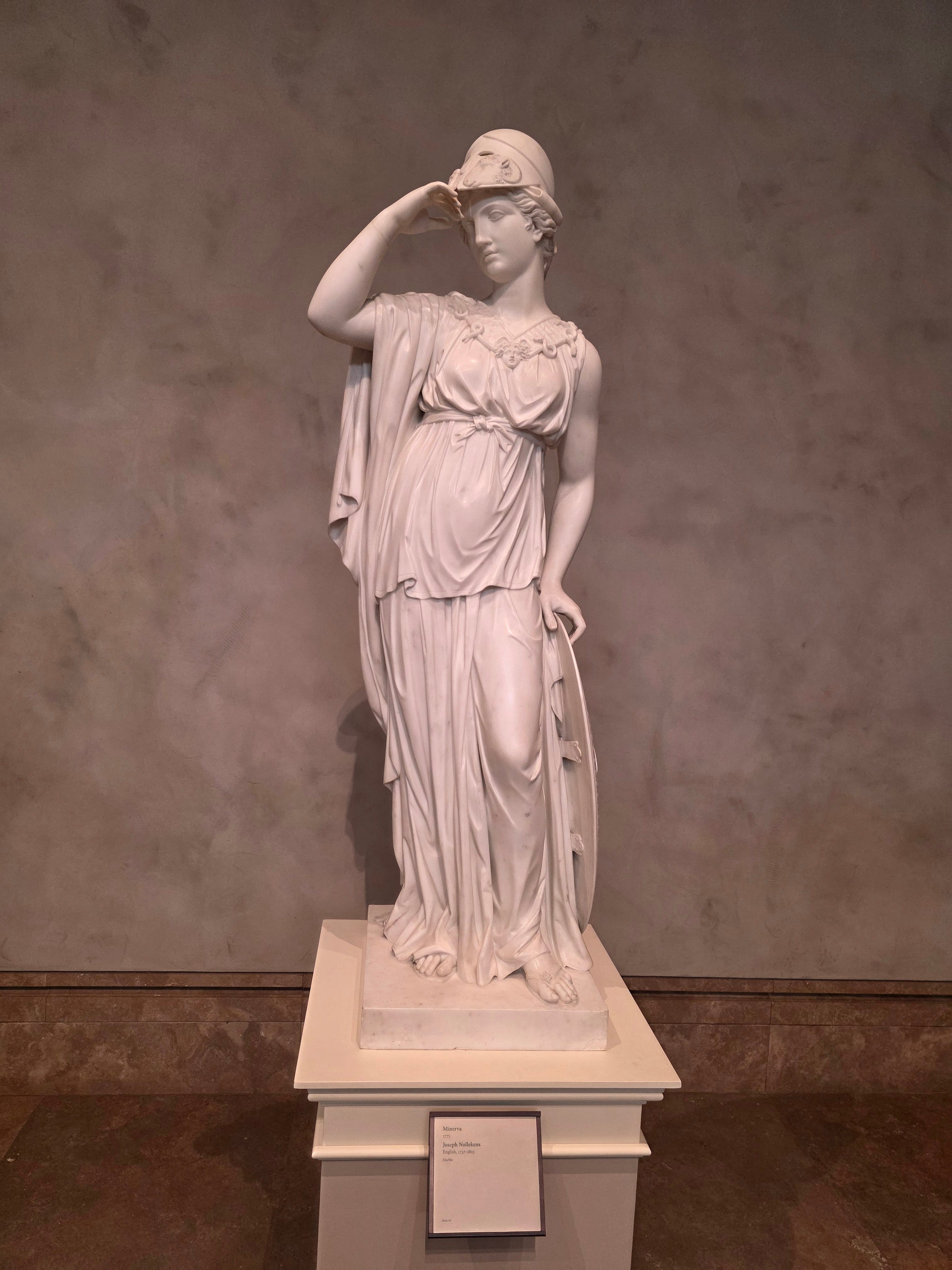
Athena (at the Getty Center in Los Angeles) looks askance at her portrayal by Hollywood while pondering the role of creativity and craft in modern tech
The rediscovery of Homer is extremely timely. Human civilization is facing grave political, economic, cultural, and environmental challenges with automation (and has been facing them in one form of another for nearly a century). Ironically, ancient poetry has the power to help us make sense of these modern challenges. Put differently, the most important things about AI actually have less to do with changing technology than enduring humanity. (I think this is also the key to understanding Pope Leo’s encyclical on AI). If you really want to know what is at stake for humanity with AI, then a good place to start is with stories from a time long before AI that humans have continued to find meaningful throughout all the momentous technological changes since. The rest of this essay will thus follow the arc of Homer’s Odyssey to show you what I mean.
Homer gave us an unreliable narrator long before the internet gave us unreliable content. Fond of stratagem and slippery words, Odysseus is the mythic archetype for every conman or hacker who has used brains over brawn. Homer’s clever hero wins the Trojan War with the ruse of the wooden horse, but he also provokes the gods and struggles to get home. Today clever entrepreneurs build smart machines with godlike potential, but we are all struggling to feel at home with AI.
In her brilliant translation of the Odyssey, Emily Wilson describes Odysseus as “a complicated man.” The Greek phrase andra polutropon literally means “man of many ways,” but Wilson’s “complicated” nicely captures the moral ambivalence of Homer’s hacker. AI is a similarly complicated technology, a tool of many uses and abuses with ambiguous import for humanity.
The Odyssey is ostensibly about a man who returns from war. Odysseus leaves his home to fight a ten-year war in Troy, which is the subject of Homer’s Iliad. Odysseus then spends another decade wandering home to Ithaca, which is the subject of the Odyssey. The story of AI also begins in war. Electronic computers emerged in the codebreaking agencies of World War II and the command centers of the Cold War. The journey of digital automation from the military battlefield to the civilian economy has likewise followed a winding path.
The Odyssey itself begins in the middle. Odysseus has been stranded for seven years on the island of Calypso, a beautiful goddess who gives him every Earthly pleasure and promises him immortality. Yet the castaway spends every day crying for his lost shipmates and family far away. Calypso’s island of Ogygia is not a bad metaphor for the situation in which we find ourselves today. We have all the world’s information at our fingertips, and gourmet food is just an app away. The digital world is a paradise of plenty, and some futurists promise that our brain scans will live forever. Yet many people lost in cyberspace feel lonely, hollow, and alienated, pining for a lost sense of community.
Meanwhile back in Ithaca, King Odysseus is lost and presumed dead. A hundred and eight arrogant suitors devour his resources and press Queen Penelope to remarry. Back on planet Earth, likewise, an arrogant horde of technologists encourages us to marry our lives to AI. Intoxicated with visions of technological revolution, the tech bros devour our attention, money, and natural resources. The narrative is always the same: technological revolution is nigh, for better or worse, and we have no choice but to accept it.
Yet the gods finally decide that enough is enough. It is time for Odysseus to return home. Hermes carries their judgment to Calypso, while Athena flies to Ithaca to mentor Telemachus, the boy who has never known his father. The goddess of craft and creativity inspires the young prince to search for news of Odysseus. Telemachus then goes to Sparta to learn from some old warriors who have returned from Troy. If we want to learn the truth behind the hype about AI today, where should we go for mentorship and inspiration? Where should we seek knowledge about how technology really works in the world? How can the veterans of history encourage our collective coming of age?
The Odyssey runs like clockwork. As the prince leaves home, the king returns. Odysseus builds a raft to leave Calypso, and Poseidon wrecks his craft again. Better technological art is not enough to escape the curse of automation. But this time, Princess Nausicaa of the seafaring Phaeacians discovers the lone castaway and invites him to her spectacular palace. Her father, the Phaeacian king, holds a feast in his honor, and Odysseus finally tells his story. It is time to tell the story of technology as well, assuming that we can find any welcoming communities that are willing to hear it. We need to explain how we ended up in this desperate situation in the first place.
The apologia of Odysseus begins with a story of economic extraction gone wrong. The ruse of the wooden horse enabled the Greeks to sack Troy, which meant killing all the men, enslaving the women, and looting the town. When Odysseus and his twelve ships are blown off course, they arrive at the land of the Cicones and subject them to the same treatment. But when locals come seeking revenge, six men on each ship are killed in the battle. While digital technology emerged to help win a war, it returned to society to make a fortune for entrepreneurs. Yet the commercial triumph of cyberspace also meant a nightmare of extraction. If we look behind the marvels of AI, we find harsh working conditions in warehouses and factories around the world, growing economic inequality and lopsided concentrations of wealth, relentless consumption of energy and environmental resources, epidemics of cybercrime and disinformation, and a generational mental health crisis. Even technologists themselves begin to suffer.
Another storm blows the decimated squadron—each crew of fifty lost six men—to the land of the lotus eaters. The addictive plants that grow on this island cause some of the crew to lose all interest in going home. The storm of extractive capitalism likewise has discovered the allures of digital addiction. Fascinated with our phones and forever seeking the next hit of dopamine, we lose interest in connecting with actual human beings. Encouraging perpetual engagement becomes corporate policy, and AI makes attention harvesting more lucrative than ever. Large language models turn us into lazy lotus munchers.
The ever-entrepreneurial Odysseus next tries to pillage the pastoral island of the Cyclopes. But things continue to go wrong as an uncivilized savage eats six more of his men instead. The rest of the raiding party escapes Polyphemus the cyclops by a clever stratagem, but then Odysseus boasts of his exploit on the way out an incurs the wrath of Poseidon, the father of Polyphemus. If Polyphemus makes much noise, the giant internet is full of words as well. Pirates pillage digital networks, and clever hackers steal valuable goods from secure facilities. The age of automation becomes the age of deception. Bluster about secret exploits still invites disaster, moreover, as the divine powers of cybersecurity make life harder for hackers.
Odysseus finally catches a break when the god Aeolus gives him the gift of winds. Gentle Zephyr blows them to within sight of Ithaca, and Odysseus collapses with exhaustion. With the steersmen asleep at the tiller, the deck bros open the bag of winds and the squadron is blown away. AI emerged in the age of cybernetics, a word derived from the Greek for steersman. Technological progress in semiconductors and datacenters finally gave the gift of winds to cybernetics. Deep learning and transformer models have brought AI in sight of the great dream of thinking machines. Yet as accelerationists let loose the recursive self-improvement of AI models, the result might be an intelligence explosion that blows us all away. Or perhaps the AI-olean hype is just a blast of hot air.
The Ithacan squadron encounters its single greatest disaster in the harbor of the Lastrygonians, where giant cannibals murder eleven shiploads of sailors. Only the flagship of Odysseus, anchored outside the deadly fjord, manages to escape the massacre. The theme once again is giants out of control, but it is perhaps less the exponential growth of AI we should worry about and more the unimpeded growth of AI firms. If software is eating the world, then venture cannibals are bringing the appetite. Only the CEOs on this voyage of technology, with their doomsday bunkers and offshore crypto accounts, will be able to escape with their fabulous wealth.
The lone ship next puts in at Aeaea (or AI-ea), the home of a divine enchantress named Circe. She turns half the men into pigs, and Odysseus only escapes the same fate thanks to the intervention of Hermes – the god of communication, merchants, and thieves, and thus the perfect god for cyberspace. Odysseus becomes Circe’s lover instead, even as Penelope remains alone in her virtue. It is impossible to ignore the unfolding crisis of masculinity in the tech world of AI-ea. Boys have easy access to endless pornography, while girls vamp for their phones and become victims of sextortion. The manosphere preens and pouts on podcasts, and incels rail and rant online, while tech execs cast about for their next trophy wife.
Up until now Odysseus has been losing control, blown from one misadventure to the next. The habits that brought such success in Troy no longer seem to be working. The encounter with Circe at first seems to be more of the same, but things are not what they seem in AI-ea. Meeting Circe is also the beginning of a transformation in the narrative of Odysseus. Circe turns the pigs back into better men, and she gives Odysseus advice about how to get home. Our relationship with technology could use some transformation as well. The pursuit of power and profit has automated the world, but that world increasingly feels out of control. What enchantment might relieve the suffering of technology? And what advice might point the way home toward our humanity?
Circe advises Odysseus to seek the ghost of Tiresias, the great prophet of Thebes, and she instructs him how to commune with the dead. At the gates of Hades, Odysseus meets the transgender prophet and many more shades. He learns that his mother has died of all the sorrows in Ithaca. He hears the stories of many women and of his fallen comrades from Troy, their shades consumed with resentment and regret, and he learns the fates of many mythic heroes and villains. AI algorithms now train on dead data that are mere shades of human experience. At the end of the knowable world, perhaps we can learn to hold space for their shades to speak. Perhaps we can learn to listen to the stories of those who have suffered before us, who have created this technological world. Perhaps we can learn to perceive the mythologies that give meaning to our mortal lives.
A somber Odysseus now returns to Circe. Like a good therapist who has encouraged a man to meet his own ghosts, she now tells Odysseus about the temptations that he still must face. She warns him of the seductive Sirens, Scylla the barking beast, Charybdis the sucking whirlpool, and the sacred oxen tended by the daughters of Helios. (The second half of the voyage of Odysseus is decidedly more feminine than the first, as if he must atone for his masculine excess in war before going home; perhaps tech also must shift from the masculine polis of conflict to the feminine oikos of care.) Yet Odysseus will selectively follow or disastrously ignore Circe’s advice. While the therapist offers helpful knowledge, the patient is unable or unwilling to absorb it. We can be made aware of the pathos of technology, but awareness is only the beginning of grief. Sometimes the pain must be lived to be understood.
The Sirens provide an obvious metaphor for the flashing rectangles that call out for our attention. We follow our friends on our phones onto the shoals of psychosis, amusing ourselves to death. But the song the Sirens sing is perhaps even more relevant. Their sweet voices promise to tell Odysseus the whole truth about what happened in Troy. They promise to satisfy our curiosity about the whole wide world with just one more swipe of the infinite scroll, revealing the truth of the conspiracies that surround us. Odysseus famously escapes by tying himself to the mast and stuffing his sailors’ ears with wax, a technological fix to enable indulgence without consequence. He puts a lock on his screen time, but he doesn’t give up his phone.
Odysseus next must make painful tradeoffs. To avoid the ship-smashing Symplegades, which only the heroic Argonauts have survived, he must shoot the strait of Scylla and Charybdis. To avoid the wicked rocks of political disaster, either the howling heads high up on the cliffs must gorge on the sailors of society, or the gulping vortex of passion must devour the ship of state. For all the varied dreams of digital democracy, technology cannot escape the painful tradeoffs between monstrous bureaucracy and sucking markets, or tyrannical government and destructive anarchy. It is telling that Odysseus hews closer to Scylla, while staring in horror at Charybdis. Technologists often steer closer to control to avoid the chaos of competition. Against the advice of Circe, Odysseus dons his armor in a vain attempt to tame the bureaucracy, but Scylla gobbles up six more men. This time will be different, the tech lords promise, yet the tyrant shows no mercy.
The surviving remnants of the Ithacan expedition arrive at the pastures of Helios. Odysseus shares the warnings of Tiresias and Circe not to harm the oxen, but then he leaves his men alone. As before with AI-olus, the deck bros give in to their greed and slaughter the sacred cows. Technologists have a way of crossing ethical lines and flouting moral conventions. If the only rule is to move fast and break things, then lesser norms can be ignored. Silicon Valley knows that there is value in the performance of righteousness, of course, and tech firms may even hire ethicists in hopes of aligning AI with human values. But the driving alignment is always the profit and power of firms themselves. With regulatory oversight absent or asleep, the tech bros feast while the markets lay waste.
Sure enough, Helios is enraged at their transgression and implores Zeus to send a tempest. All of the sailors are drowned, except for Odysseus who clings to the wreckage of his ship. Whereas before he sailed too close to the monstrous tyranny of Scylla, now he veers too close to the anarchic whirlpool of Charybdis. He survives by leaping for a homely fig tree growing out of the cliff. The relentless pursuit of control, in the face of all warnings of things slipping out of control, culminates in desperation. The technologist grasps at life as all hope seems lost. Odysseus then drifts away to Ogygia, where he will spend seven years with Calypso, wallowing in grief.
So ends the apology of Odysseus, a wandering tale of how we arrived at our pathetic technological moment. As we have seen, the confessions of our mythical hero suggest a cosmology for our AI experience. The fact that this allegory works at all suggests that the problems of technology are really nothing technological at all. AI is not so much giving us a brave new world as giving our old habits right back to us. Improvements in AI are hastening the eternal return of classic archetypes. This means that advanced problems have ancient roots, and, conversely, that ancient solutions have modern relevance. Perhaps the same mythic patterns that enabled archaic Achaeans to make sense of an agrarian world can also help our ostensibly advanced civilization make sense of its increasingly automated planet.
At this point we are only halfway through the Odyssey. The next twelve books of Homer’s epic return with Odysseus to Ithaca. The dramatic narrative is slower, more detailed, and more intimate, steadily building up tension for the return of the king. Except for the occasional intervention of Athena, the magical grandiosity of the first twelve books is gone. Mythology gives way to realism. The text itself makes this transition crystal clear as the fabulous Phaeacians deliver Odysseus home in a self-piloting ship that can predict human thoughts; Poseidon then turns the Hellenic Waymo into stone on the return voyage, sealing off the technological paradise of Phaeacia forever. From now on, the family and political drama of Ithaca will be a deeply human drama.
To truly understand AI, therefore, we may need to set AI aside. Technological progress in semiconductors, algorithms, data infrastructure, sensors and robotics is enabling fantastic AI applications that can steer themselves and predict human thoughts. But prediction machines still rely on human judgment. Judgment determines what matters and why, who or what to trust and how much, which rewards to pursue and which risks to avoid, who to love or fear or envy, and generally how to live this one mortal life. Human judgment is the source of guidance, interpretation, and maintenance the AI systems require to do anything useful. As statistical prediction becomes more efficient, complementary judgment becomes more important, not less. This means that the political and economic drama of AI is a deeply human drama.
Fifty years ago, the philosopher John Haugeland wrote that “the trouble with AI is that computers don’t give a damn,” and I never tire of quoting him. It is still true that the latest frontier models do not give a damn, even though they can fake it with beguiling words (or Siren songs?). AI generates data without understanding what’s at stake for human beings or even themselves.
When Odysseus returns to Ithaca, by contrast, everything is at stake. He is a middle-aged man facing a hundred and eight strapping young men and a family who may resent his absence after twenty years. His life, his marriage, his kingdom, and his mythic legacy are all on the line.
Odysseus first encounters Athena, the personification of craft and creativity, who is disguised as a shepherd boy. She reveals herself, and the two tricksters get to work strategizing his return. Because of the great danger, getting the strategy right is damn important. They decide on a long con to methodically prepare a trap for the suitors. Odysseus will disguise himself as a beggar, not even revealing himself to his long-suffering wife or servants. He will tell many different stories about himself, mixing lies with elements of the truth. Odysseus will manipulate the relationship between representation and reality, which is precisely the relationship that eludes machines that don’t give a damn.
Telling stories is the way a beggar infiltrates a wealthy palace, as surely as the Trojan Horse penetrates the holy citadel of Troy. Retelling Homeric myth, moreover, imparts heroic purpose to its audiences, even thousands of years later. There is a narrative about narrative these days that stories are just stories: Hard power and economic incentives are what determine behavior in the real world, and narratives are just window dressing. Homer has no truck with this view. He shows us instead that telling stories are a way of wielding power. Narratives can mobilize political support or undermine legitimacy, and narratives can coordinate military conquest or unravel an army. Power and incentives matter, of course, but only because narratives tell us what is worth fighting for and what counts as a cost or benefit. Narratives shape human judgment, and judgement shapes AI.
Some of the most important acts of judgment that shape AI are the least appreciated. Functional automation relies on endless everyday work such as building and cleaning datasets, manually debugging agential workflows and codebases, fiddling with configuration settings and security credentials, and arguing with colleagues and customers about AI outputs, to say nothing of managing AI supply chains and resource flows, rearranging factories and shops to be robot friendly, and contesting the intrusive surveillance of corporations and governments.
The work of keeping Ithaca running, likewise, falls on the loyal slave Eumaeus who tends the flocks, the nursemaid Euryclea who raises the royal children and washes the feet of random guests, Queen Penelope who weaves a burial shroud for demented old Laertes and unweaves it every night to keep the suitors at bay, and all the other subjects of Ithaca – including the suitors themselves – who have not had a proper council meeting since Odysseus decamped for Troy. The only reason that Odysseus has a home to come back to is all the hidden work that keeps it going. Wherever the leadership of technologists is missing, countless others perform the hidden work of maintenance to keep AI going. This hidden work both smooths and creates friction, and friction both impedes action and provides traction for it. Odysseus must negotiate the considerable social friction of Ithaca to gain traction for his strategy.
One might question the relevance of the Odyssey to AI since AI is an information technology that uses advanced statistical techniques like deep learning. But Homer’s Odyssey is deep meditation on the very nature of information itself. The poem unfolds as shifting web of narratives that leave us wondering what to believe. What should Telemachus make of the reminiscing of old veterans? Did any of Odysseus’s fantastic adventures really happen? Did Penelope recognize her husband long before the climactic battle? The characters and audiences of the Odyssey must make their own judgments on these questions.
Yet Homer goes one step further by showing us the grounds of good judgment. The Odyssey gives us a series of recognition scenes that join the elusive illusion of narrative to the consequential concreteness of reality. Odysseus reveals himself to Telemachus to bring him into his secret scheme of revenge. The old dog Argus perceives his master through the beggarly rags. The nurse Euryclea discovers the childhood scar of Odysseus while washing the beggar’s feet. Odysseus springs his trap on the suitors by winning the trial of the bow, the only man able to string it and shoot an arrow through twelve axes. After slaughtering the suitors, with the help of Telemachus and some servants, the victorious hero finally presents his bona fides to Penelope, revealing the secret construction of their marital bed. These sorts of costly signals provide people with a reliable grip on their world.
Information does not float freely in the Odyssey. It is grounded in a web of social relationships and material conditions. Odysseus can detach signifiers from signifieds to confuse and mislead others. Meaning can be reattached through accidental collisions or the hard work of maintenance. Homer shows us that the dynamics of information are thoroughly grounded in social practice. Homer thus shows us that AI is a thoroughly social technology as well. Thinking machines matter only insofar as the encounter of narrative and friction makes them meaningful for human beings.
One might read the Odyssey as a fairy tale in which the hero goes on a journey and learns many lessons along the way. Self-discovery enables him to beat the bad guys and get the girl, and they all live happily ever after. But Homer offers a more tragic view of human culture, one with important implications for AI. In some ways, Odysseus does not change at all. He remains a heroic warrior who brings the slaughter of Troy back home to Ithaca.
One might even question the heroism of Odysseus. He inducts his son into a conspiracy to ambush and murder the best sons of Ithaca. They string up a dozen slave girls for sleeping with the suitors. He even tells his wife during their conjugal reunion that he will have to leave her again to go on another quest. He then torments his aged father and escalates a civil war with the suitors’ families.
The Odyssey ends with the deus ex machina of Athena making the warring parties swear an oath of peace, as if to underscore that there can be no lasting peace between mortals themselves. Homer’s pattern is clear: the same things keep happening again and again. Troy recurs with the Cicones and in Ithaca, the slaughter in the palace recurs outside in the kingdom, Odysseus returns just to leave again, Telemachus will become a king who will have another son, and bards will keep singing their adventures forever. There is no final end to political narrative, not even or especially in the age of AI. There is only the eternal return of rivalry and reunion. Some of the rivals will eventually invent thinking machines and quantum computers, and some of the reunions will be coordinated online, but still the cycles will repeat.
Put simply, the Odyssey predicts the Odyssey. This is precisely why Homer remains relevant in the age of AI (and why even problematic interpretations like Nolan’s The Odyssey remain interesting). The archetypal patterns of automation are ultimately not rooted in computational technology at all but in the pragmatic narratives of indefinite politics.
Yet the Odyssey also contains an alternate ending. The shade of Tiresias at the gates of hell foretells that Odysseus will walk away from it all. He will carry his oar inland until he meets people who do not know the sea. They will take his oar for a winnowing fan, a tool for sorting wheat from chaff in the wind rather than a means of nautical control. Where cybernetic instruments are unknown, in other words, Odysseus will finally make peace with Poseidon, the god of shaking earth, pounding seas, and thundering horses. Then he will find a gentle death from the sea, surrounded by loving family in old age.
The prophesy of Tiresias looks beyond the striving ambition of the tech world toward a more stoic acceptance of nature, in all its incomprehensible mystery. If the Odyssey always repeats, this repetition always offers the chance to make different choices. The eternal tragedy of human politics animates the world of AI, even as we ponder our political fate. So we stand with AI, oar in hand.
Another reason to read Homer in the age of AI is to survey the rise and fall of human writing. “Homer” is less of an historical personage than an evolutionary process. The transformation of oral performances into canonical text happened sometime around the seventh century BCE. The new technology of the Greek alphabet, with its consonants and vowels, was able to signify the sounds of speech. Archaic Greeks simply wrote down what they were signing.
Yet in the process, the transcription of speech to writing transformed human consciousness as well. Rather than singing passages of poetry in a group, an individual reader could ponder the entire epic alone. Hearing sounds in time gave way to seeing symbols in space. New symbolic systems created new opportunities to think abstractly, conceptually, mathematically, and cartographically. Writing enabled the flourishing of philosophy, history, and science. It also enabled the growth of bureaucracy and empire, killing and extracting at unprecedented scale.
The advent of writing did not eliminate oral culture, however. Stories and songs remained. Narrative even performed a lot of hidden work to keep the sciences going. Social life was as messy and meaningful as ever, and orality traversed the gap between written representation and lived reality. Homeric epic also persisted as the written world’s memory of what oral culture needs to flourish. To read Homer today, therefore, is to find a connection to the parts of society that still speak to us. Through the ages countless readers, scholars, and artists have thus rediscovered the poetry of the past.
Walter Ong describes the emergence of a new oral culture thanks to radio and television. Secondary orality is further encouraged by streaming video, social media, and podcast culture. Once again people are communicating by voice and in time, not simply by sight and in space, but the scale and reproducibility of orality are unprecedented. Now we even have AI agents that seem to speak for themselves. AI compresses human writing to generate something else, something that may mean the undoing of writing altogether if we aren’t careful.
As AI mixes and remixes the global codex of human data, literacy is undergoing a transformation as significant as its genesis. The generative output of AI can now beat human creativity in blind comparisons. The Turing Test is passed. But AI’s victory may be as hollow as the wooden horse. While large language models provide a virtual connection to vastly more information than any one individual could possibly understand, in the process they sever the connection to pragmatic life that makes information meaningful in the first place. The triumph of simulation misses something essential—the dignity of human connection.
AI can generate text, but meaning depends on context. As the written poem recalls an oral song, epic singing enacts an ancient community. Now, alienated on the connected island of Calypso, the crisis of automation has us yearning for community again. The recollections of AI are more fragmented and harder to reconstruct. Yet behind every AI system is a world of tall tales, bloody fights, extractive wealth, male anxiety, endless grief, human judgment, hidden work, political scheming, and the eternal return of choice. Computers don’t give a damn, but the people who build and use them do, or at least they (we) should.
Homer sheds light on who we were long before AI. And I suspect that Homeric epic also sheds light on who we will be long after the current hype about AI goes the way of the information superhighway. Human beings are not merely mental software running on the wetware of the mind, but embodied social agents with meaningful commitments to the world. If you want to understand what is most important about the world of AI, then go and read the Odyssey. Go and watch The Odyssey, too, preferably in IMAX 70mm if you can. And then reread Homer again, or better yet, sing it out loud and listen. You might just find that Homer has what AI is missing.
No posts
Comments
Nothing yet. Say the first thing.
Sign in to join the conversation.