
Last week we talked about how markets don’t simply react to headlines—they weigh them against expectations.
This week provided another reminder.
Over the past month, the headlines surrounding Iran have almost felt like they’re repeating themselves.
Ceasefire.
Missiles.
Truce.
More fighting.
Another ceasefire.
Each development is significant. Lives are at stake, and the human cost of war should never be minimized.
Yet with each cycle, the market has reacted a little less dramatically than the one before.
Investors aren’t ignoring the conflict. They simply appear to be shifting their attention back toward the questions that ultimately drive stock prices: earnings, inflation, interest rates, and economic growth.
In other words...
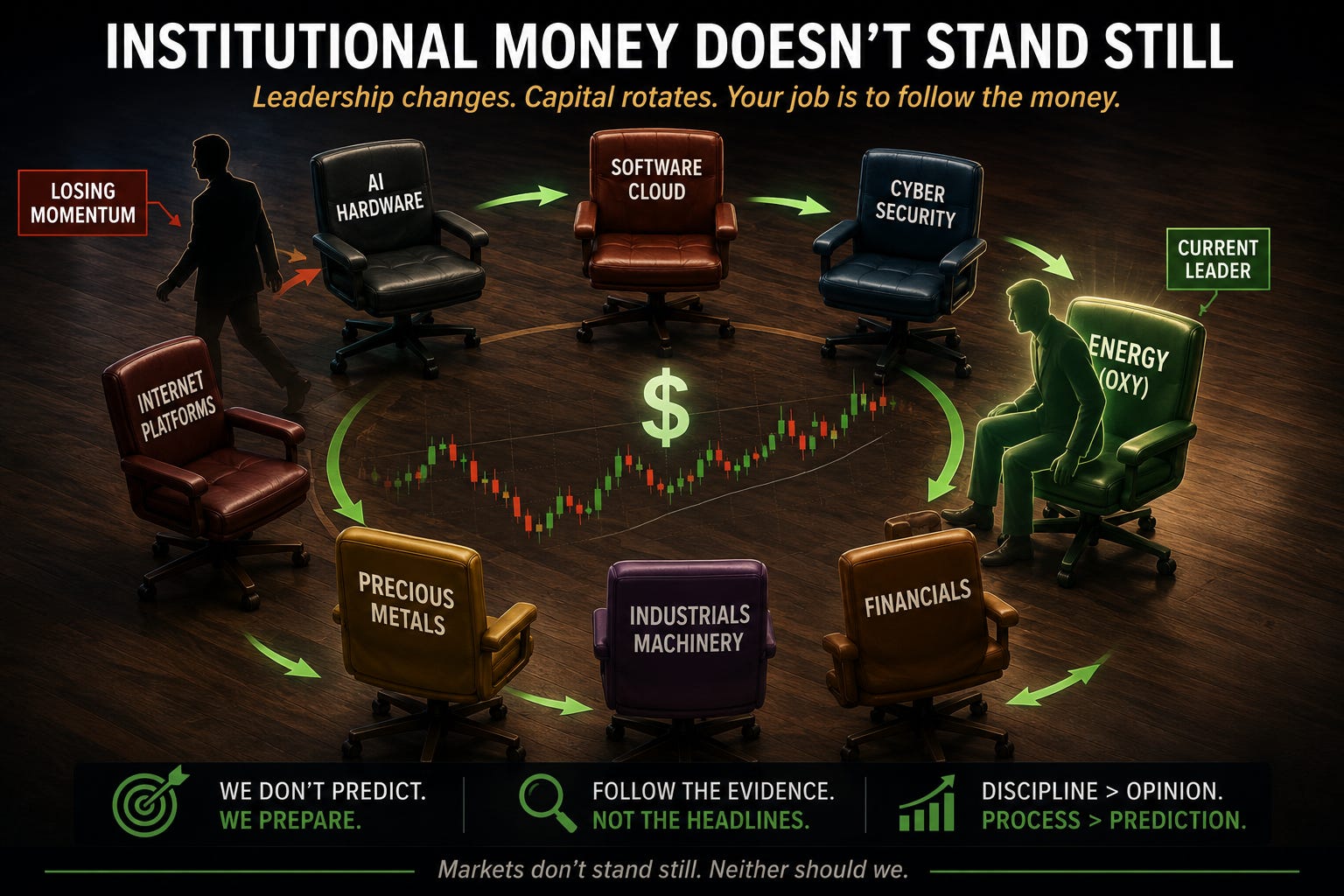
The market seems less interested in running for the exits and more interested in finding the next chair.
That’s exactly what we’ve been watching beneath the surface.
While the major indexes have spent several weeks consolidating near their highs, institutional money has been constantly rotating from one leadership group to another.
Artificial Intelligence hardware cooled after an incredible run.
Software lost momentum.
Internet platforms weakened.
Cybersecurity briefly looked ready to take the baton before stumbling as well.
Meanwhile, money quietly rotated into defense, industrial machinery, financials, energy, and even precious metals.
That’s what makes this market so challenging.
By the time a sector becomes the hottest story on financial television, institutions may already be looking somewhere else.
Capital rarely disappears.
It usually rotates.
Our job isn’t to predict where money should go.
Our job is to recognize where it is going.
That distinction matters.
Last week provided a perfect example.
Our biggest portfolio winner wasn’t NVIDIA.
It wasn’t Broadcom.
It wasn’t another AI stock.
It was ETSY.
I doubt many investors would have guessed that a month ago.
But our framework isn’t trying to predict tomorrow’s headlines. It’s simply looking for evidence that institutional money is beginning to accumulate shares.
When that evidence appears, we pay attention.
Today, our strongest portfolio leader is OXY.
At the same time, we’re watching precious metals closely. The group showed encouraging relative strength this past week, but one strong week doesn’t establish a trend. We’d like to see additional confirmation that institutions are continuing to commit capital before becoming more aggressive.
Patience is part of the process.
Successful investing isn’t about having an opinion on every sector.
It’s about having the discipline to wait until the evidence supports your opinion.
This week should provide plenty of new evidence.
Nearly one-third of the S&P 500 has already reported earnings, and results have generally been stronger than expected. This week several additional mega-cap companies will report, giving investors a much clearer picture of corporate America.
On Wednesday, the Federal Reserve concludes its second meeting under Chairman Kevin Warsh. While few expect an immediate change in interest rates, investors will be listening carefully for clues about the path ahead.
We’ll also receive updates on GDP and inflation before the week is over.
In other words...
The music may change again.
Fortunately, our job isn't to predict where the next chair will be. Our job is to recognize it when institutional money starts sitting down.
We simply need a disciplined framework that helps us recognize where institutional money is sitting down next.
If you’d like to see exactly how we’re identifying these rotations before they become headlines, I’d love to have you join us inside FMT Framework Stock & Option Picks.
You’ll receive our current portfolio, trade ideas, live market sessions, and the same relative strength tools and framework we use every day to follow institutional money.
Try it for just $37 for your first 30 days. If you don’t believe it’s worth it, simply let us know and we’ll refund your subscription—our 30-Day Money-Back Guarantee. After that, it’s $97 per month, and you can cancel anytime.
I hope to see you in the live sessions.
Dean
Comments
Nothing yet. Say the first thing.
Sign in to join the conversation.