

Last week wasn’t dramatic.
It was instructive.
The S&P 500 finally experienced a modest pullback after several months of strong gains. Technology continued to weaken, money rotated into completely different areas of the market, and earnings season officially began giving investors something more important than speculation.
Yet despite all of that...
Very little has actually changed.
Sometimes markets don’t reverse.
Sometimes they simply pause.
And that’s exactly what this looks like so far.
The first wave of reports has been encouraging.
The large banks generally delivered better-than-expected earnings while continuing to describe a consumer that remains surprisingly resilient.
Loan losses remain manageable.
Investment banking activity continues improving.
Credit quality has not shown the kind of deterioration many feared earlier this year.
Healthcare and industrial companies have also produced several solid reports, while semiconductor bellwether Taiwan Semiconductor reinforced that AI-related capital spending remains very strong.
Not every report has been rewarded.
Netflix, for example, beat expectations but disappointed investors with cautious guidance—another reminder that earnings season isn’t simply about beating estimates anymore.
Forward guidance matters just as much.
Heading into the season, FactSet projected S&P 500 earnings growth above 20% year-over-year—an unusually strong number—and analysts actually raised earnings estimates during the quarter instead of lowering them, something that rarely happens. Expectations were already high before companies began reporting.
So far...
Corporate America is largely delivering.
The earnings calendar now shifts into another gear.
This week we’ll hear from several companies capable of moving entire sectors:
Alphabet
Tesla
Intel
IBM
General Motors
3M
Honeywell
Lockheed Martin
Verizon
American Express
Over the following two weeks the pace only accelerates as many of the largest technology companies report.
By the end of this month we’ll have a much clearer picture of whether corporate earnings can continue supporting this bull market.
Sometimes investors mistake a pullback for a trend change.
The chart says otherwise.
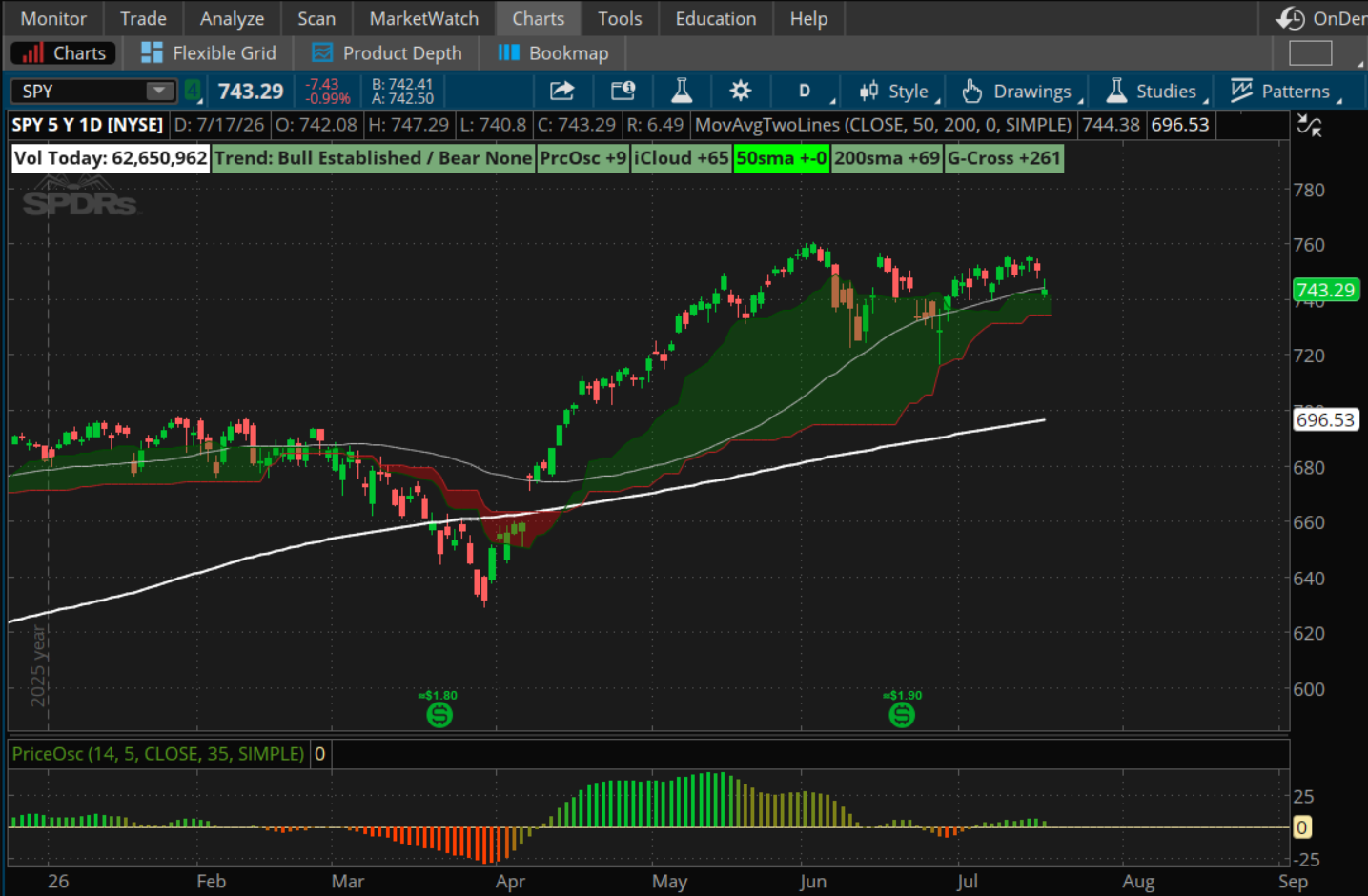
Price has retreated toward the rising 50-day moving average.
That’s exactly where we’d expect buyers to become interested during a healthy uptrend.
The 200-day moving average continues rising.
The Ichimoku Cloud remains supportive.
Momentum has cooled considerably from May’s surge, but it hasn’t rolled over into a bearish condition.
Could the market break below the 50-day?
Absolutely.
Anything is possible.
But today we’re responding to evidence—not possibilities.
Right now the evidence still favors the bulls.
It’s The Rotation
One of the most interesting developments this week wasn’t what the S&P did.
It was where money went.
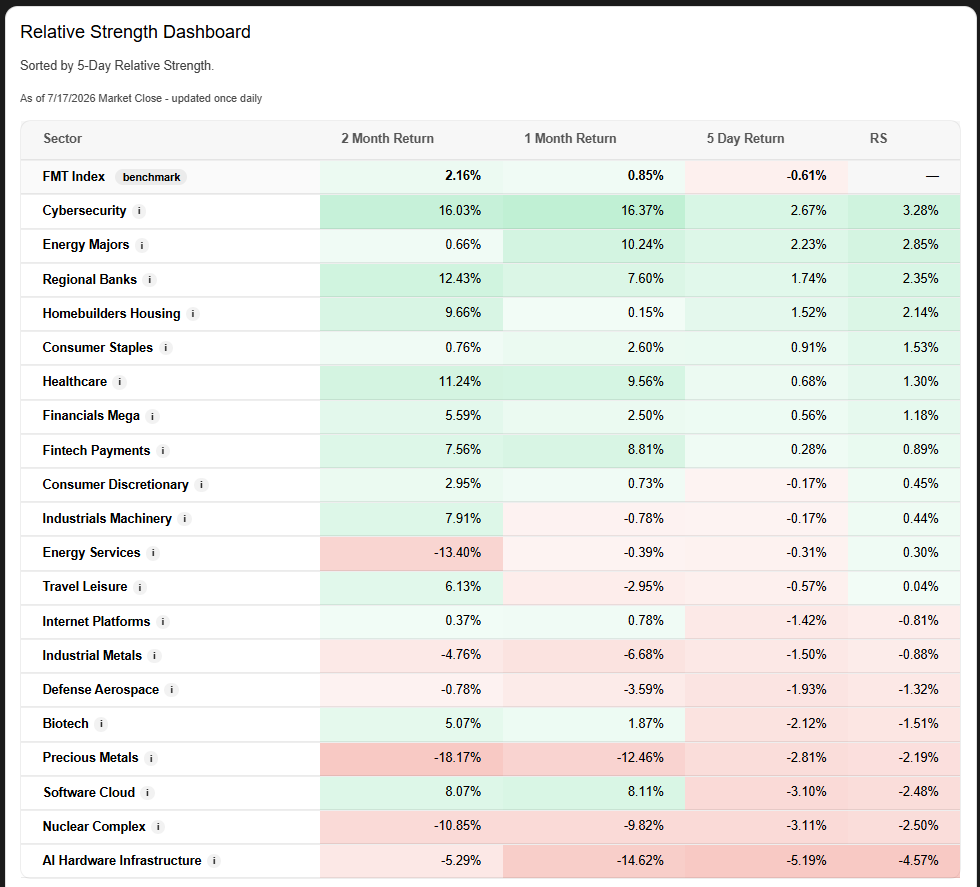
Only a few weeks ago AI infrastructure and semiconductors dominated our Relative Strength Dashboard.
Today they’re sitting at the bottom.
Meanwhile...
Cybersecurity has quietly climbed to the top.
Energy majors continue showing impressive strength.
Regional banks have moved into the leadership group.
Even homebuilders continue outperforming despite interest rates remaining elevated.
That’s healthy.
Bull markets rarely see every sector advance together.
Instead...
Leadership rotates.
Money leaves yesterday’s winners and begins searching for tomorrow’s opportunities.
One of the easiest mistakes investors make is assuming the strongest sector automatically becomes the next trade.
That’s not what Relative Strength tells us.
It tells us where institutional money is flowing.
Nothing more.
From there we ask the next questions.
Is the trend healthy?
Is price extended?
Is risk favorable?
Has the chart confirmed the move?
Relative Strength starts the conversation.
Price decides whether we participate.
That’s an important distinction.
Compared with recent weeks, the economic calendar is surprisingly light.
Wednesday brings crude oil inventories.
Thursday features weekly unemployment claims.
Friday we’ll receive Flash PMI readings for manufacturing and services along with new home sales.
None of these are likely to dominate market direction unless they produce a major surprise.
For now...
Corporate earnings remain the primary driver.
Three questions stand out this week.
Does the S&P hold the 50-day moving average?
Healthy pullbacks often stop there.
Failed rallies frequently don’t.
Does sector rotation continue?
If money continues flowing into financials, cybersecurity, and energy while technology consolidates, that’s evidence of a broadening bull market—not necessarily a weakening one.
Do companies continue rewarding investors with strong guidance?
Beating estimates isn’t enough anymore.
Markets want confidence about the second half of the year.
Guidance may prove more important than the headlines.
One thing I’ve learned over the years is that markets rarely send all the important signals through the major indexes.
Sometimes the real story is happening underneath the surface.
This week feels like one of those times.
The S&P is pulling back toward support.
Earnings have largely been constructive.
Money continues rotating rather than leaving the market altogether.
That doesn’t guarantee higher prices.
But it does suggest investors are reallocating—not retreating.
As always...
We’ll continue following the evidence.
Because the headlines tell us what happened.
The charts tell us what matters.
And the movement of money often tells us what’s coming next.
Comments
Nothing yet. Say the first thing.
Sign in to join the conversation.