
For more than a century, geopolitics revolved around controlling territory.
During the twentieth century, it shifted toward controlling energy.
Today, the competition has evolved once again.
The world’s major powers are increasingly competing to control connectivity—the ports, railways, pipelines, digital networks, shipping lanes, and supply chains that will determine how global commerce flows throughout the twenty-first century.
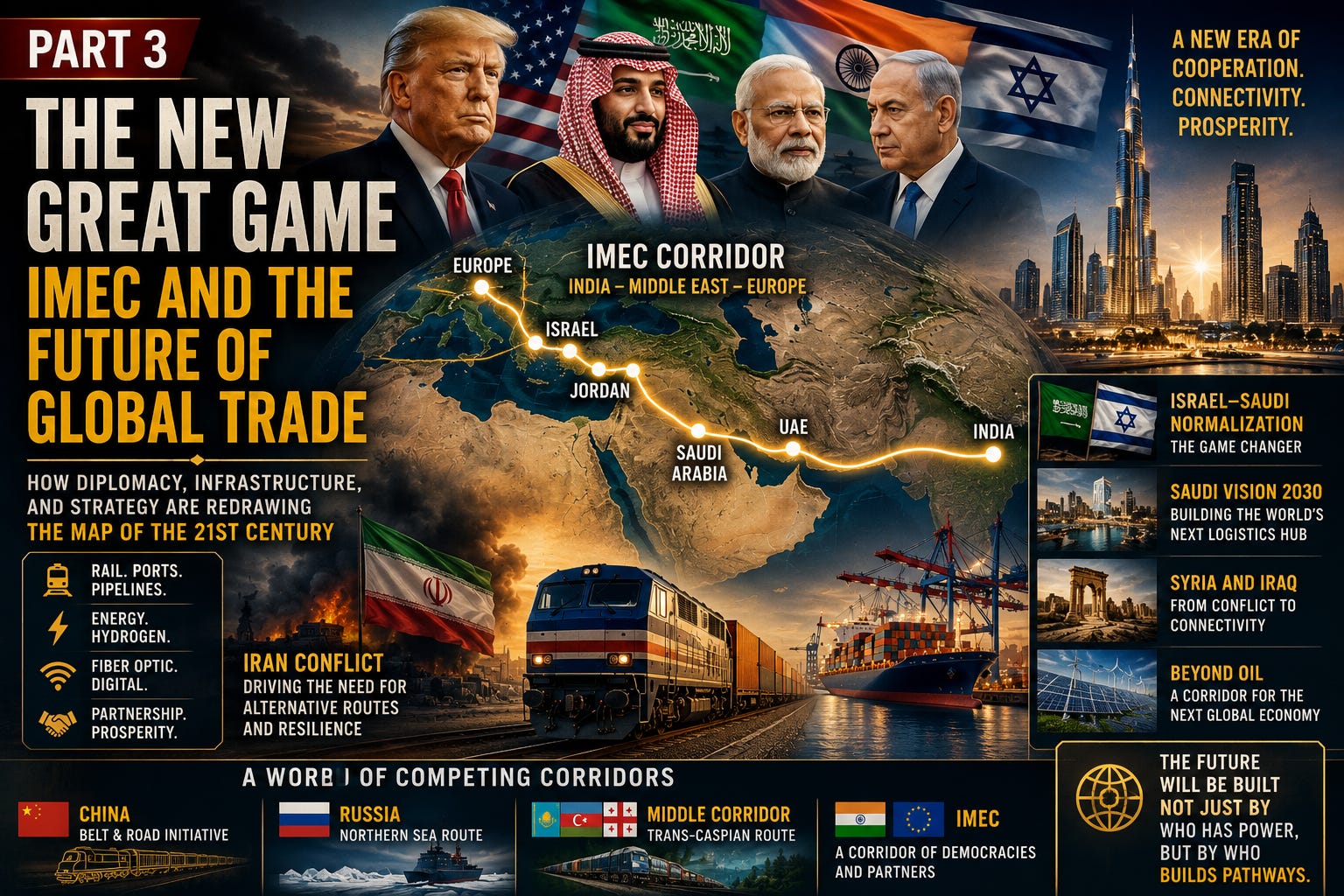
The IMEC corridor sits squarely at the center of that competition.
But it is not the only vision for Eurasia’s future.
Years before IMEC was announced, China had already begun implementing its own ambitious vision.
In 2013, President Xi Jinping unveiled the Belt and Road Initiative (BRI), a global infrastructure strategy stretching across Asia, Africa, Europe, and beyond.
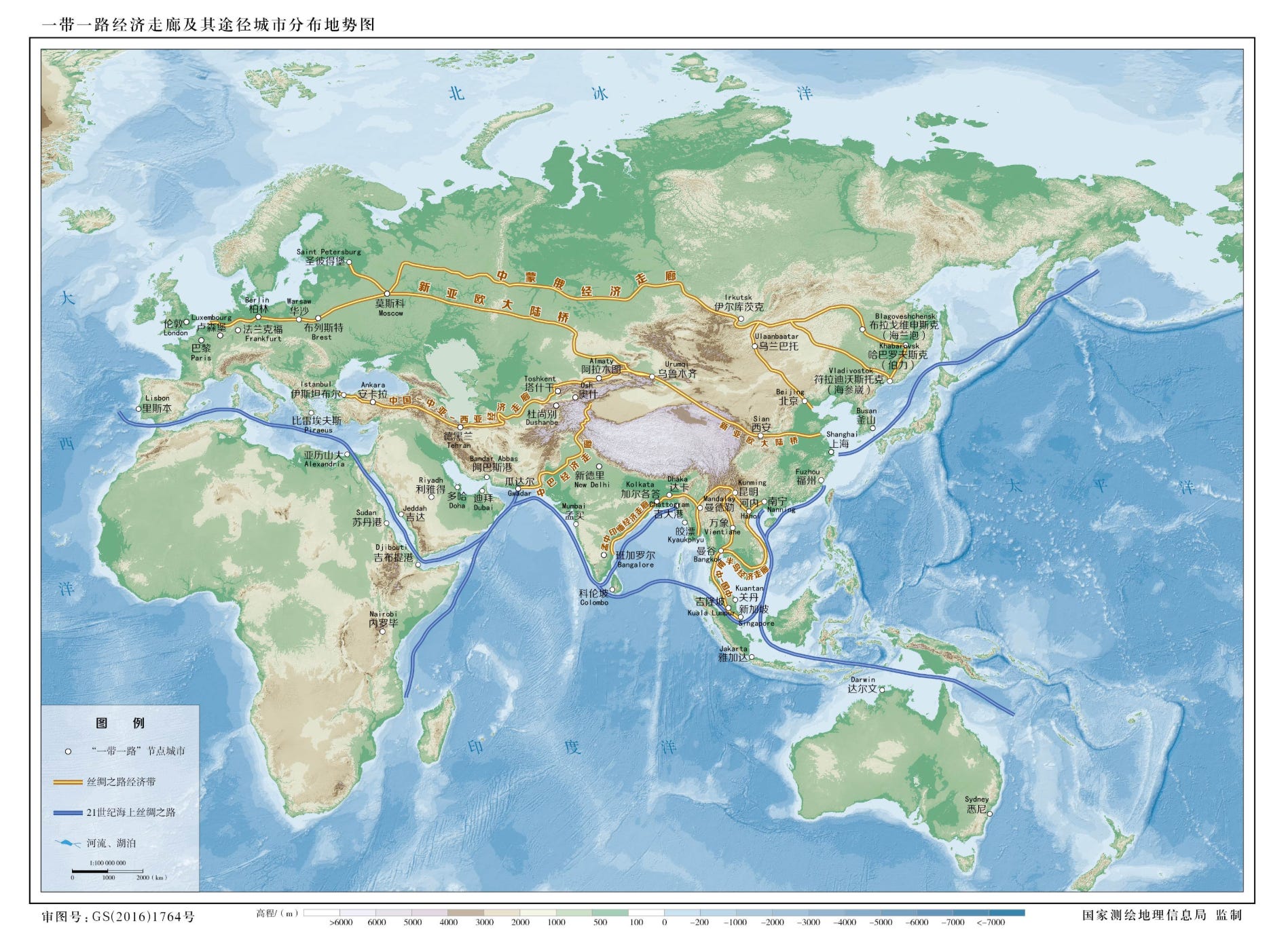
The initiative financed ports, railways, highways, industrial parks, pipelines, and digital infrastructure across dozens of countries.
For Beijing, the objective was never simply economic development.
It was geopolitical influence.
By financing critical infrastructure, China positioned itself as an indispensable economic partner throughout much of the developing world while reducing its own vulnerability to maritime chokepoints such as the Strait of Malacca.
The Belt and Road Initiative fundamentally altered the strategic landscape.
Washington and its allies now faced a new challenge.
How could they offer an alternative?
At the same time, Russia was pursuing its own trade corridor.
As Arctic sea ice gradually receded, Moscow invested heavily in developing the Northern Sea Route along Russia’s Arctic coastline.
The route promises significantly shorter shipping times between Europe and Asia compared with the traditional voyage through the Suez Canal.
Russia also expanded rail links connecting Europe with Asia while strengthening energy exports through pipelines stretching toward both Europe and China.
The war in Ukraine accelerated these changes.
Western sanctions pushed Moscow to deepen economic ties with China, India, and other non-Western markets, while encouraging new transportation routes that bypassed Europe altogether.
Instead of one dominant trade network, Eurasia was becoming home to several competing corridors.
A third alternative also began gaining momentum.
Known as the Middle Corridor, or the Trans-Caspian International Transport Route, it connects China to Europe through Kazakhstan, the Caspian Sea, Azerbaijan, Georgia, and Türkiye before reaching European markets.
Unlike Russia’s northern route, the Middle Corridor avoids Russian territory entirely.
That distinction became increasingly attractive after Russia’s full-scale invasion of Ukraine.
European governments began investing more heavily in transportation links that reduced dependence on Russian infrastructure while strengthening economic partnerships across Central Asia and the Caucasus.
The competition was no longer about choosing one route.
It was about creating resilience through multiple options.
For decades, one obstacle made an ambitious Middle Eastern trade corridor nearly impossible.
Politics.
Many of the region’s most important states simply did not recognize one another diplomatically.
That began to change in 2020 with the Abraham Accords.
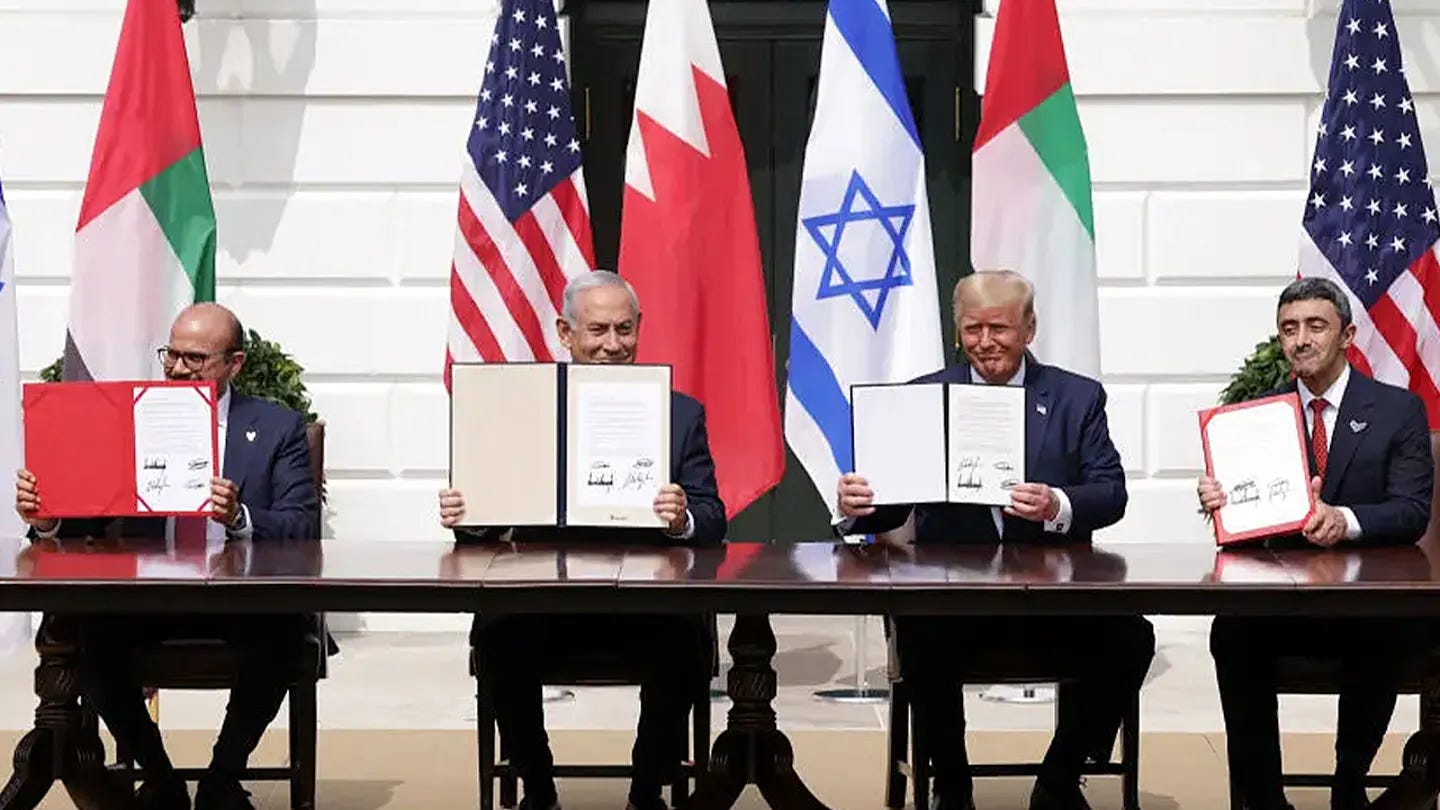
The normalization agreements between Israel and several Arab states fundamentally altered regional geopolitics.
For the first time, policymakers could realistically envision infrastructure linking Gulf ports with Israel’s Mediterranean coast.
Railways that had once existed only on maps suddenly appeared politically achievable.
Trade corridors that would have been dismissed as fantasy only a decade earlier became serious strategic proposals.
Without the Abraham Accords, IMEC would likely have remained an idea rather than a viable project.
Equally important has been Saudi Arabia’s own transformation.
For decades, the Kingdom’s economic model revolved almost entirely around oil exports.
Vision 2030 seeks to change that.
Under Crown Prince Mohammed bin Salman, Saudi Arabia has invested hundreds of billions of dollars in logistics, manufacturing, tourism, artificial intelligence, renewable energy, and transportation infrastructure.
Mega-projects such as NEOM are intended not only to diversify the Saudi economy but also to position the Kingdom as one of the world’s premier logistics hubs.
IMEC aligns naturally with those ambitions.
Instead of merely exporting oil, Saudi Arabia could become a central crossroads connecting Asia, Europe, and Africa.
The Kingdom’s geography, long viewed primarily through the lens of petroleum, is increasingly becoming one of its greatest strategic assets.
No discussion of IMEC is complete without Iran.
Geographically, Iran occupies one of the most advantageous positions in Eurasia.
Historically, many east-west trade routes passed through Persian territory.
In theory, Iran could serve as one of the world’s most efficient transit hubs.
In practice, decades of sanctions, regional tensions, and strategic rivalry have pushed many countries to develop alternative routes.
Rather than moving through Iran, IMEC bypasses it entirely.
That choice is not accidental.
It reflects the broader geopolitical reality that many governments seek greater supply-chain resilience while reducing exposure to political instability and sanctions risk.
Whether future diplomatic breakthroughs could eventually alter that equation remains uncertain.
For now, IMEC represents an effort to create connectivity without relying on Iran as the central transit state.
President Donald Trump’s return to office has added a new dimension to these regional developments.
His administration has emphasized expanding economic partnerships, strengthening ties with Gulf allies, and encouraging greater regional integration.
Trump’s meetings with the new leadership in Syria and Iraq signaled an interest in reshaping relationships that had been strained for years.
At the same time, renewed military pressure on Iran has reinforced the strategic importance of alternative trade and energy routes that avoid potential conflict zones.
Whether viewed through the lens of diplomacy or deterrence, infrastructure has become an increasingly important instrument of statecraft.
Trade corridors are no longer separate from foreign policy.
They are foreign policy.
Perhaps the single most consequential variable for IMEC remains the possibility of formal normalization between Israel and Saudi Arabia.
Such an agreement would represent far more than a diplomatic breakthrough.
It would transform the economics of regional transportation.
Rail links connecting Gulf ports to Israel’s Mediterranean coast could dramatically shorten shipping times between India and Europe.
Energy infrastructure—including electricity transmission, hydrogen exports, and future pipeline projects—could become commercially viable on an entirely new scale.
Although significant political obstacles remain, normalization would fundamentally strengthen IMEC’s strategic and economic rationale.
The corridor’s long-term success may ultimately depend as much on diplomacy as on engineering.
One of the biggest misconceptions about IMEC is that it is simply another energy project.
It is much broader than that.
The corridor envisions integrated transportation networks.
Digital infrastructure.
Fiber-optic communications.
Electricity interconnections.
Hydrogen exports.
Critical mineral supply chains.
Artificial intelligence infrastructure.
Secure data flows.
In many ways, IMEC represents an attempt to build the physical backbone of the next global economy.
Oil may have launched the geopolitical competition of the twentieth century.
Data, technology, and resilient supply chains are increasingly defining the twenty-first.
History rarely moves in straight lines.
The geopolitical theories of Mackinder.
The rise of petroleum.
The world wars.
The Cold War.
The collapse of the Soviet Union.
China’s Belt and Road Initiative.
Russia’s Arctic ambitions.
The Abraham Accords.
Saudi Arabia’s economic transformation.
The conflict with Iran.
Each represents a chapter in a much larger story.
IMEC is not the beginning of that story.
It is its latest evolution.
Whether the corridor ultimately fulfills its promise remains uncertain.
Infrastructure projects of this scale take years—sometimes decades—to complete.
Political shifts, regional conflicts, economic downturns, and technological change could all reshape its trajectory.
But one thing is already clear.
The struggle over the future of Eurasia is no longer defined solely by armies or oil fields.
It is increasingly defined by who builds the roads, ports, railways, pipelines, fiber-optic cables, and digital networks that connect the world’s fastest-growing economies.
Energy security remains national security.
But in the twenty-first century, connectivity has become strategy.
And the race to shape that future has only just begun.
—DC
Comments
Nothing yet. Say the first thing.
Sign in to join the conversation.