
Every year, enormous volumes of energy, goods, and commercial traffic move between the Mediterranean and the Atlantic through this narrow gateway. Any disruption would affect supply chains stretching from the Persian Gulf to Europe and beyond.
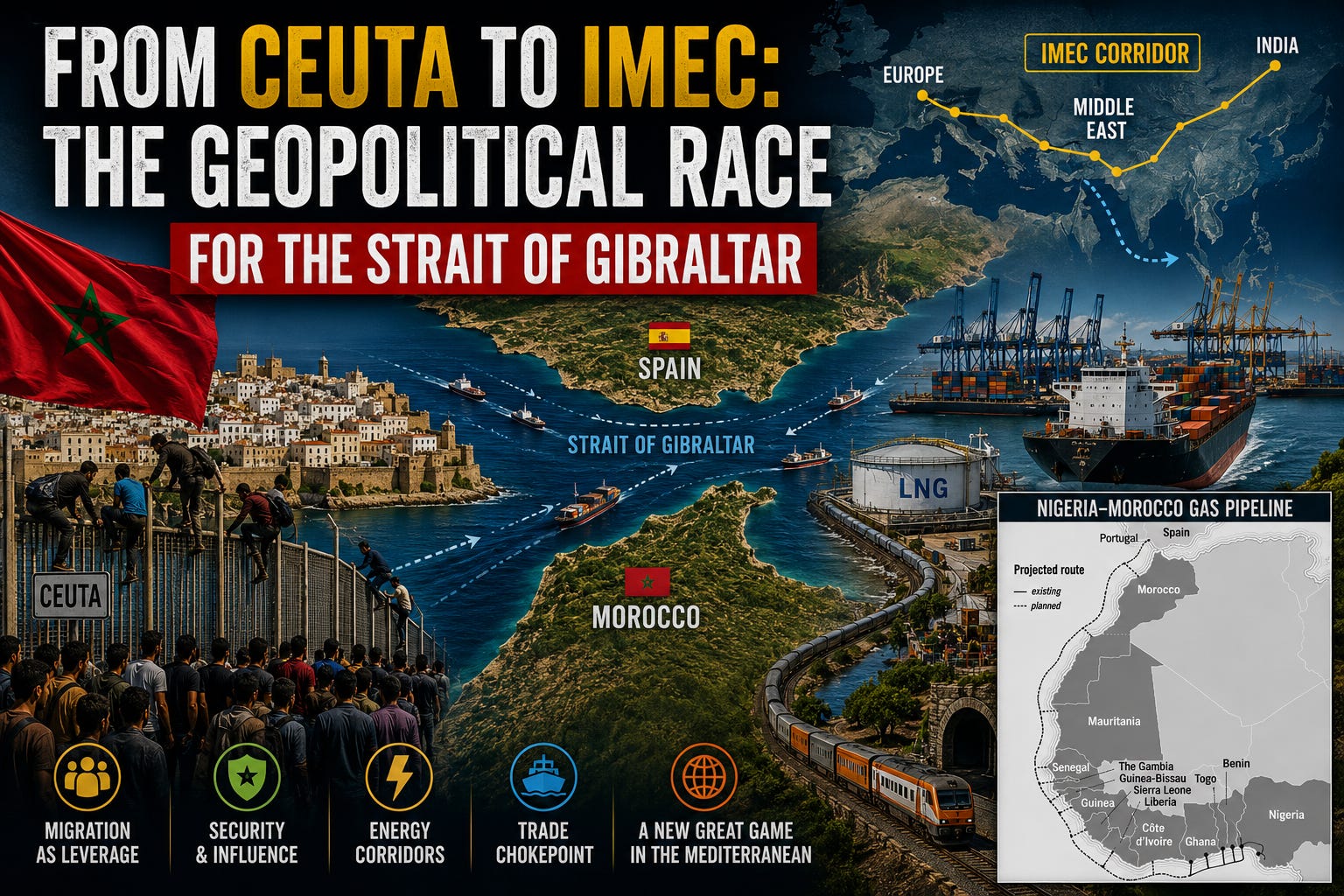
As Europe seeks new energy suppliers, as India–Middle East–Europe connectivity projects expand, and as Africa becomes increasingly integrated into global markets, the western Mediterranean is becoming one of the most strategically important regions in the world.
And at the center of that transformation is Morocco.
Yesterday’s invasion of the Spanish enclave in North Africa is not the first time Morocco used immigration as a weapon. When migrants entered Ceuta in 2021, international coverage largely focused on another migration emergency.
But Ceuta represents something larger.
It demonstrated how migration flows, border controls, and civilian movement can become tools of geopolitical pressure.
The June 2021 crisis unfolded shortly after Spain allowed Brahim Ghali, the leader of the Polisario Front, to receive medical treatment for COVID-19.
Madrid described the decision as humanitarian.
Rabat viewed it as a diplomatic insult.
Ghali, one of Morocco’s most prominent rivals over the Western Sahara dispute, was admitted to a hospital in Logroño, Spain, in April 2021 after becoming seriously ill.
Morocco responded by relaxing border controls, allowing thousands of migrants to cross into Ceuta. Approximately 8,000 people entered, including around 2,000 minors.
By November 1st, Algeria ended a 25-year transit agreement and shut its gas pipeline to Morocco entirely, cutting a supply line that had run since the 1990s. Initially, Algeria stopped sending gas north through Morocco, but Morocco began operating the pipeline in reverse — importing regasified LNG from Spain and re-injecting it into its network. Algeria’s Sonatrach announced a partnership with Russia’s Gazprom just three months later.
Whether the Cueta crisis was interpreted as coercive diplomacy, migration pressure, or a combination of factors, the episode revealed a new reality:
Migration had become leverage.
Morocco’s ability to influence European borders gave Rabat a powerful negotiating tool—not only with Spain, but with the European Union and NATO.
Morocco’s use of civilian mobilization to advance strategic objectives has historical precedent.
In 1975, approximately 350,000 Moroccan civilians crossed into Spanish-controlled Western Sahara during what became known as the Green March.
The timing was significant.
Spain was in the final days of Francisco Franco’s rule, and the massive civilian demonstration placed enormous political pressure on Madrid.
Soon afterward, Spain withdrew from the territory, and Morocco assumed control over much of Western Sahara.
The sovereignty dispute remains unresolved today, with Morocco controlling most of the territory while the Polisario Front continues to claim independence for the region.
Although the Green March and the Ceuta migration crisis occurred under very different circumstances, both demonstrate how demographic pressure and civilian mobilization can shape diplomatic outcomes without traditional military confrontation.
The Green March also intersected with the broader geopolitical competition of the Cold War. The Polisario Front was backed by Algeria, Cuba, and Libya (under Gaddafi), and supplied with Soviet arms.
The New York Times later examined the role of Vernon A. Walters, a United States Army officer, diplomat, and former Deputy Director of Central Intelligence.
“After leaving Government in 1976, Mr. Walters became a consultant and included among his clients an American company interested in the arms market in Morocco, where Mr. Walters has many friends from his World War II days.”
Walters had longstanding ties to Morocco’s monarchy when he met a young Prince Hassan after the Allied landings in Morocco.
Writing in 1978, Walters described the relationship:
“Thus began a friendship which was to endure until the present.”
Investigative journalist Bob Woodward later wrote about Walters’ relationship with the Moroccan monarchy, noting that their connection became so close that Walters was “almost considered the King’s case officer” during his time as deputy director of the CIA.
Walters later became involved in efforts connected to Morocco, including a controversial consulting role related to arms sales.
The episode illustrates how Morocco’s strategic importance extended far beyond North Africa—it was a country viewed by Washington as a key partner during the Cold War struggle for influence.
The Western Sahara dispute is no longer only a conflict between U.S. backed Morocco and the Polisario Front.
It has become part of a broader regional competition involving Algeria, Iran, and competing geopolitical networks.
Morocco has accused Iran and Hezbollah of supporting the Polisario Front.
In 2018, Rabat severed diplomatic relations with Tehran, alleging that Hezbollah had provided military assistance and training to Polisario through Iranian networks operating from Algeria.
Just two months after October 7th, Iran threatened to close the Strait of Gibraltar and the Mediterranean Sea if Israel didn’t cease its attack on Hamas.
A 2025 investigation by The Washington Post reported that Iran’s regional network in Syria included Polisario fighters who had trained alongside Tehran-backed militias during the Syrian conflict.
The reporting described these links as part of Iran’s broader effort to expand influence beyond the Middle East and into North Africa.
For Morocco, the Western Sahara issue is therefore not simply a territorial dispute.
It is increasingly viewed through the lens of regional power competition.
The geopolitical importance of Gibraltar becomes even clearer when examining Spain’s position.
Spain sits at the crossroads of competing interests.
It is a NATO member.
It maintains close economic ties with China.
It depends heavily on energy relationships with pro-Russia Algeria.
And it shares a complicated security relationship with Morocco.
Algeria remains one of Spain’s most important natural gas suppliers, including through underwater pipeline connections. It is also Russia’s largest arms customer.
At the same time, China has expanded its economic presence across Europe, while Beijing continues purchasing energy from U.S. sanctioned markets.
These competing relationships have complicated Madrid’s foreign policy decisions.
During recent tensions involving Iran, Spain restricted certain U.S. military activities connected to facilities at Rota and Morón, highlighting the challenges Washington faces when allied countries balance domestic politics, energy security, and international commitments.
Unlike the Strait of Hormuz, Gibraltar does not control the flow of oil production.
Instead, it controls the movement of trade.
Ships traveling from the Persian Gulf through the Suez Canal toward Europe must eventually pass through Gibraltar before reaching the Atlantic.
The same applies to many routes connecting Asia, Europe, and North America.
A disruption in Gibraltar would not necessarily stop energy production.
It would disrupt distribution.
That distinction makes the strait increasingly important in a world where supply chains have become instruments of geopolitical competition.
Just as the Strait of Hormuz and the Suez Canal shape global commerce, Gibraltar represents another critical gateway.
For decades, Morocco was primarily discussed through the lens of migration and Western Sahara.
That is changing.
Morocco is becoming:
A logistics hub.
An energy hub.
A manufacturing center.
A bridge between Europe and Africa.
The expansion of Tanger Med has transformed Morocco into one of the Mediterranean’s most important container ports.
The country has also invested heavily in renewable energy, electricity connections, green hydrogen projects, and future LNG infrastructure.
Morocco’s strategy is clear:
Use geography as an economic advantage.
Europe needs reliable partners.
Africa has growing energy potential.
And Morocco sits between them.
Geography gave Morocco importance.
Infrastructure is turning that importance into influence.
The most ambitious example of Morocco’s transformation may be the proposed Nigeria–Morocco Gas Pipeline.
Stretching approximately 6,000 kilometers along Africa’s Atlantic coastline, the project would connect Nigerian natural gas reserves with Morocco before linking into infrastructure serving Spain and the wider European market.
If completed, it would represent far more than an energy pipeline.
It would create an Atlantic economic corridor connecting West Africa with Europe.
It would also provide Europe with another potential energy source at a time when governments are seeking alternatives to dependence on vulnerable supply routes.
The project demonstrates a broader trend:
The future of energy security will not be based on a single supplier.
It will depend on networks.
At first glance, the India–Middle East–Europe Economic Corridor and the Nigeria–Morocco pipeline appear unrelated.
One begins in India.
The other begins in West Africa.
But strategically, they represent the same transformation.
The world is moving toward interconnected trade and energy networks designed to reduce dependence on vulnerable chokepoints.
IMEC is often discussed as an eastern corridor:
India → Middle East → Europe.
But its success ultimately depends on what happens farther west.
Goods entering Europe through Mediterranean ports must still connect to Atlantic trade routes.
Energy corridors must eventually reach global markets.
That makes Morocco a potential western anchor of a much larger connectivity network.
From India to the Arabian Peninsula.
From Israel to Europe.
From West Africa to the Atlantic.
The Strait of Gibraltar sits at the intersection.
The Ceuta crisis was not simply about migration.
The Green March was not simply about Western Sahara.
Morocco’s infrastructure investments are not simply about economic development.
Each reflects a larger geopolitical reality.
The competition of the twenty-first century is increasingly about controlling connectivity.
Who controls energy routes?
Who controls ports?
Who controls maritime chokepoints?
Who controls the infrastructure that connects continents?
The New Great Game is no longer confined to Eastern Europe, the Persian Gulf, or the South China Sea.
It now stretches from the ports of India to the Atlantic coast of Morocco.
And standing between Europe, Africa, and the global economy is a narrow passage of water only eight miles wide:
The Strait of Gibraltar.
It may become one of the defining geopolitical gateways of the century.
—D.C.
Comments
Nothing yet. Say the first thing.
Sign in to join the conversation.