
In Part 1, we explored how the rise of oil transformed Halford Mackinder’s Heartland Theory into something far more consequential. Geography alone no longer determined global power—energy did.
By the beginning of the twentieth century, policymakers understood that whoever controlled the world’s energy resources and the routes connecting them would possess enormous economic and military advantages.
The decades that followed only reinforced that lesson.
Two world wars, the Cold War, the collapse of the Soviet Union, and the emergence of globalization all revolved, in one way or another, around access to energy, transportation corridors, and strategic geography.
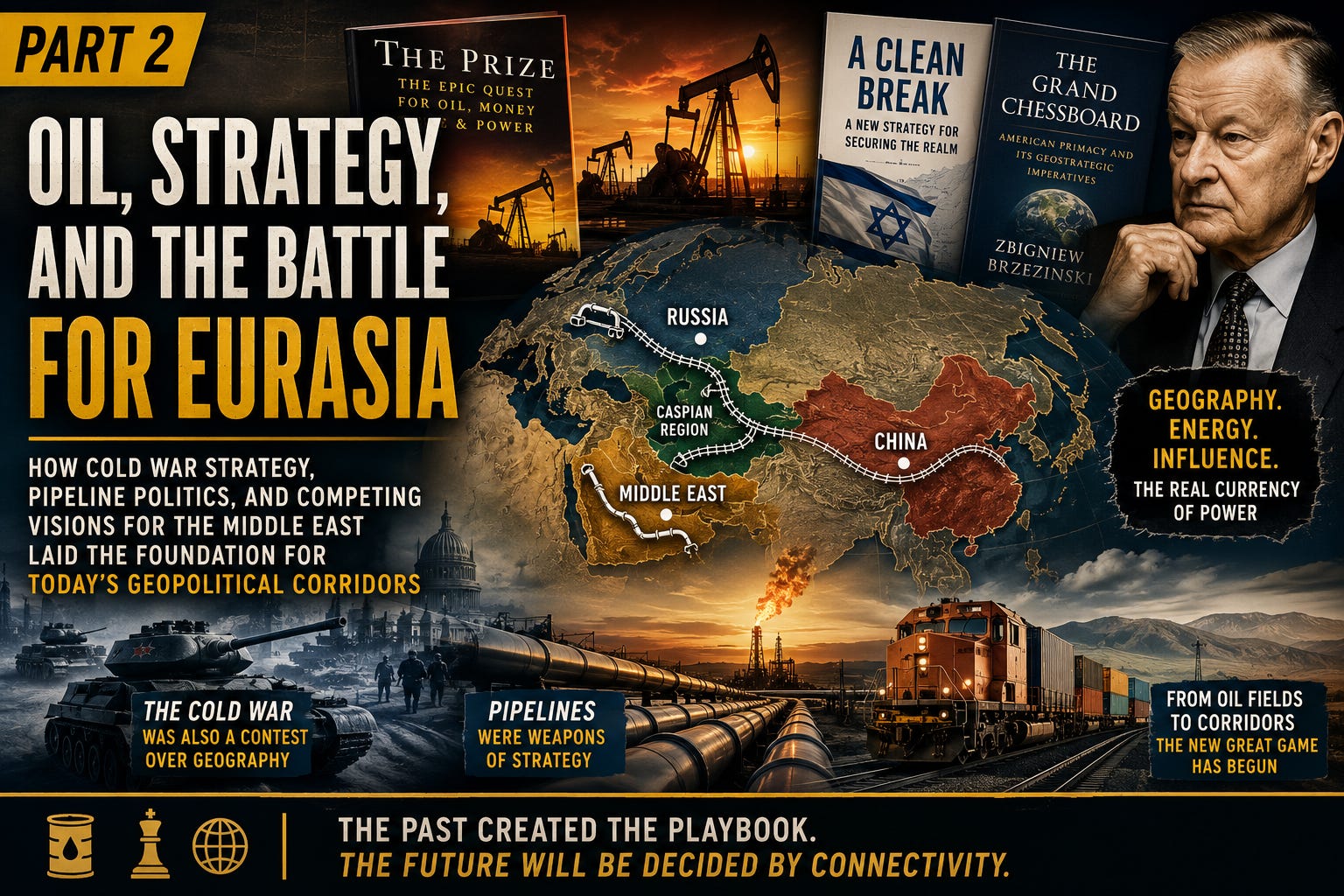
The IMEC corridor did not emerge from a vacuum.
It is the latest chapter in a geopolitical story that has been unfolding for more than a century.
The twentieth century proved what early strategists had only begun to suspect.
Oil wasn’t simply another commodity.
It became the foundation of industrial civilization.
Historian Daniel Yergin chronicles this transformation in The Prize: The Epic Quest for Oil, Money & Power, arguing that petroleum reshaped the global economy, altered military strategy, and permanently changed international politics. Oil replaced coal as the dominant source of energy, fueling automobiles, aircraft, navies, electricity generation, and modern industry. Nations that secured reliable access to oil gained decisive economic and military advantages.
Governments increasingly stopped viewing oil as a commercial product and began treating it as a strategic asset.
That shift fundamentally changed foreign policy.
Instead of simply competing over territory, great powers competed over oil fields, shipping lanes, pipelines, and the governments that controlled them.
Energy security had become national security.
As massive petroleum reserves were discovered across Iran, Iraq, Kuwait, and Saudi Arabia, the Middle East became the epicenter of global energy production. What had once been viewed largely through the lens of imperial competition was now recognized as indispensable to the industrialized world.
Following the Second World War, Western economies became increasingly dependent on Middle Eastern oil. The United States strengthened relationships with regional partners while European powers sought to preserve their own economic interests.
The creation of OPEC dramatically altered this balance.
For the first time, oil-producing nations possessed the collective ability to influence global markets and international politics.
The 1973 oil embargo demonstrated that energy itself could be weaponized.
Oil was no longer merely fueling economies.
It was shaping diplomacy, military planning, and the global balance of power.
Although the Cold War is often remembered as an ideological struggle between capitalism and communism, geography remained central to the competition.
The Soviet Union controlled much of Mackinder’s Heartland, stretching across Eastern Europe, Central Asia, and Siberia.
The United States responded by building alliances around Eurasia’s periphery—from NATO in Europe to security partnerships in the Middle East and Asia—to prevent any single rival from dominating the Eurasian landmass.
Energy resources made this competition even more significant.
Control over oil and natural gas production increasingly translated into geopolitical leverage.
As pipelines expanded across Eurasia, they became strategic assets every bit as important as military bases.
Following the collapse of the Soviet Union, former National Security Advisor Zbigniew Brzezinski offered one of the most influential frameworks for understanding America’s strategic position.
In The Grand Chessboard, Brzezinski argued that Eurasia remained the world’s geopolitical center of gravity.
It contained the majority of the global population, industrial capacity, economic activity, and natural resources. No rival power, he argued, should be allowed to dominate this vast region because doing so could threaten America’s global position.
On page 47, Brzezinski writes:
“An independent Azerbaijan, linked to Western markets by pipelines that do not pass through Russian-controlled territory, also becomes a major avenue of access from the advanced and energy-consuming economies to the energy-rich Central Asian republics.”
His analysis emphasized several enduring realities.
Central Asia and the Caspian Basin contained enormous oil and natural gas reserves.
Pipeline routes mattered almost as much as the resources themselves.
Ukraine occupied a uniquely important geopolitical position.
China’s economic rise would reshape the strategic landscape.
Russia, although weakened after the Soviet collapse, would remain a major geopolitical actor.
Looking back nearly three decades later, many of these observations appear remarkably prescient.
The war in Ukraine, competition over Central Asian energy, and the emergence of rival trade corridors all reflect themes Brzezinski identified long before they dominated today’s headlines.
During the 1990s, another debate emerged among policymakers focused on the future of the Middle East.
One of the most discussed documents was the 1996 policy paper A Clean Break: A New Strategy for Securing the Realm, prepared for Israeli Prime Minister Benjamin Netanyahu by a group of American and Israeli strategists led by Richard Perle.
The report argued that Israel should adopt a more assertive regional strategy while reducing the influence of hostile neighboring governments. It also questioned elements of the Oslo peace process and discussed alternatives to the existing regional order.
The document later became controversial because several of its authors joined the George W. Bush administration after the September 11 attacks.
Critics argued that aspects of its strategic thinking foreshadowed later efforts toward regime change in Iraq and broader regional transformation.
Supporters countered that it represented one contribution to an ongoing policy debate rather than a blueprint that directly dictated U.S. foreign policy.
Regardless of where one stands in that debate, A Clean Break illustrates an important point: long before IMEC, policymakers were already envisioning a fundamentally different Middle East—one shaped by new alliances, changing security relationships, and economic integration.
For most of the twentieth century, geopolitical competition centered on controlling oil production.
Today, the competition increasingly focuses on controlling how energy moves.
Pipelines.
Railroads.
Fiber-optic cables.
Deep-water ports.
Artificial intelligence infrastructure.
Critical mineral supply chains.
The twenty-first century rewards nations that can connect markets as efficiently as they can produce resources.
That evolution helps explain why projects such as China’s Belt and Road Initiative, Russia’s Northern Sea Route, the Trans-Caspian Middle Corridor, and IMEC have become strategic priorities rather than simple infrastructure projects.
These are not merely transportation networks.
They are competing visions of how global commerce will function for decades to come.
The original Great Game was fought over empires.
The Cold War was fought over ideology.
Today’s competition is increasingly fought over connectivity.
The question is no longer simply who controls the oil.
It is who controls the routes through which energy, technology, data, and trade flow.
That is why IMEC matters.
It is not simply another infrastructure project.
It is one of several competing efforts to redraw the economic map of Eurasia.
And it arrives at a moment when the Middle East itself is undergoing one of its most significant geopolitical realignments in decades.
We’ll examine how the Abraham Accords, Saudi Arabia’s Vision 2030, China’s Belt and Road Initiative, Russia’s Northern Route, the Trans-Caspian Middle Corridor, the conflict with Iran, and President Trump’s renewed regional diplomacy are converging to shape the future of global trade—and why IMEC may ultimately become one of the defining geopolitical projects of the twenty-first century.
—DC
Comments
Nothing yet. Say the first thing.
Sign in to join the conversation.