
The tournament ended Sunday when Spain beat Argentina 1-0 in New Jersey, and the confetti, the montage, and the record television number all went to the team that won the final.
Go back a couple of weeks, though. England beat Norway 2-1 in Miami, in extra time, and Erling Haaland finished his World Cup on the bench. Norway’s first World Cup in 28 years ended at the quarterfinal, and Haaland still won the tournament.
That is not a metaphor. Measure it. He arrived in June with 40 million Instagram followers and added more than 20 million during the tournament, the largest gain of any outfield player in the field. His public Snapchat passed five million subscribers, and the YouTube channel where he vlogged the entire run roughly doubled to over three million. Google built him a custom Easter egg. Nike put him in its tournament spot next to LeBron James and Kim Kardashian, with Channing Tatum serving as his comedic body double. He scored seven goals in five games, which tied a record for a World Cup debut that had stood since 1974, and the goals were still the second most interesting thing he did all month.
Let’s be upfront, because the Haaland takes are already a genre. Digiday has the CMO lessons. Fortune credits American influencers for making him viral. Inc. calls the ponytail a branding masterclass. Robb Report has the fashion angle, Outlook Business has the empire valuation, and every marketing newsletter on this platform has reached the same one-word conclusion: authenticity.
Call it authenticity and the story ends when the tournament does. And to be clear, everyone who paid got paid: FIFA cleared record revenue, Fox sold through its inventory, and the sponsors got the biggest audiences American television has delivered in years. But all of that was income from the moment, and when the moment ended, the meter stopped. Haaland is the only one still collecting. He walked out of the summer with a direct line to more than 60 million people, and none of the parties who staged the event keep a single one of them.
The existing coverage reads him as a personality story or a branding story, and both readings are true as far as they go. The problem is that personality stories aren’t repeatable, because you either have Haaland’s charm or you don’t, which makes “be authentic” the least useful advice in media. The branding stories, meanwhile, are written for the brands orbiting him, the sponsors and trendjackers renting his moment for as long as it lasts.
Here is what everyone is missing: the World Cup ended Sunday for everyone who paid for it. It did not end for Haaland. The 60 million people he picked up this summer follow him to Manchester, to every broadcast, to whatever he does next, for free, for the rest of his career. FIFA built the stage. He left with the crowd.
Last month, before the knockout rounds, we wrote that the game is 90 minutes and the cultural IP lasts. The broadcast rights to the moment sold for billions while the meaning around the moment sits barely owned, and creators were proving it from the outside through the food lens, the music house, and the street brand.
Haaland proved it from the inside. A player, the one asset class everyone assumed was fully priced, ran the same play from the middle of the pitch.
The rights to the 90 minutes were sold years ago. Haaland took the other 38 days without asking anyone, and he did it with a phone, a pair of boots, and a tee time.
The run is worth walking through city by city, because the geography is the strategy.
Boston is where Norway returned after 28 years away and beat Iraq, which was the sporting story. The cultural story began once the team left the group stage and Haaland started treating each host city as its own episode.
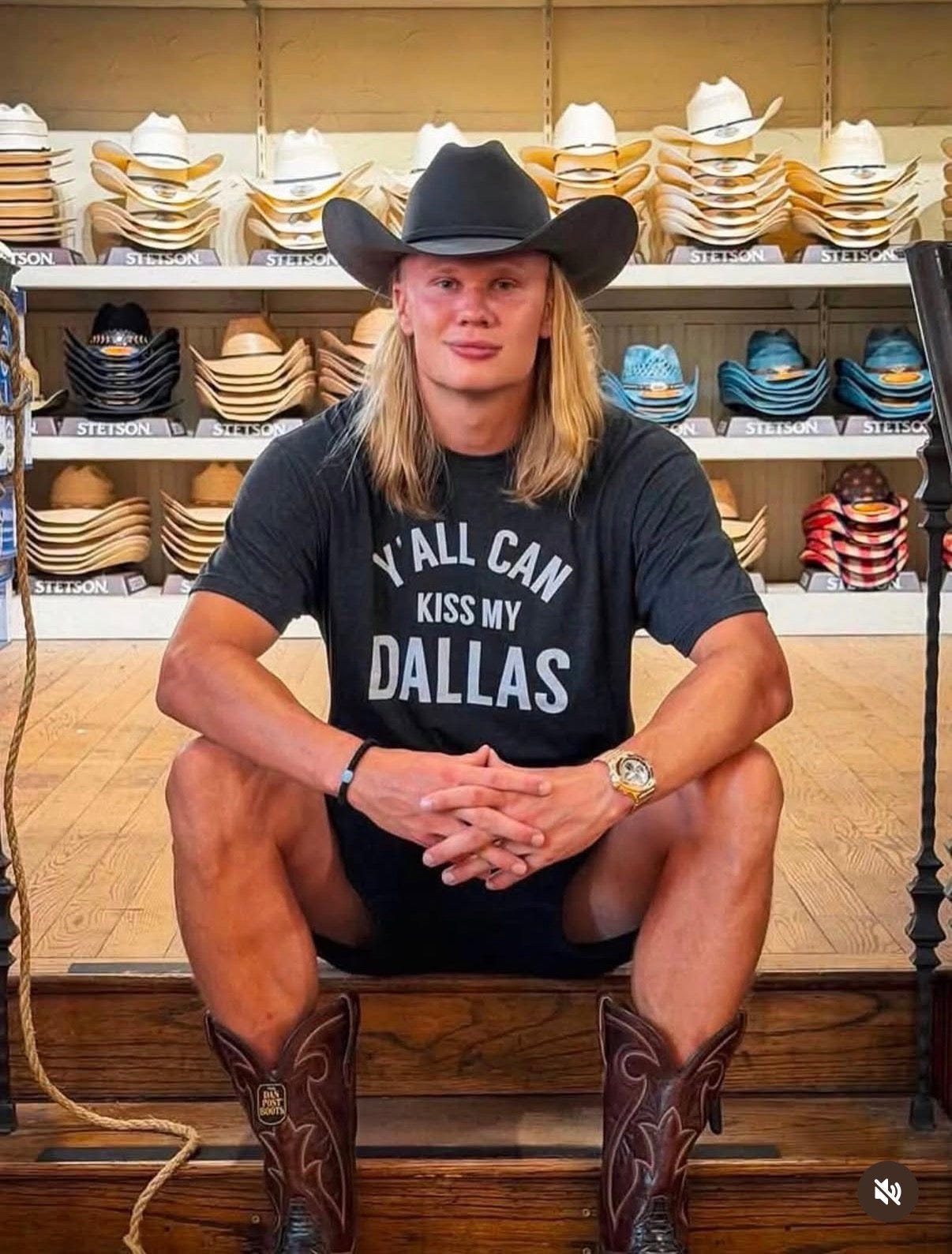
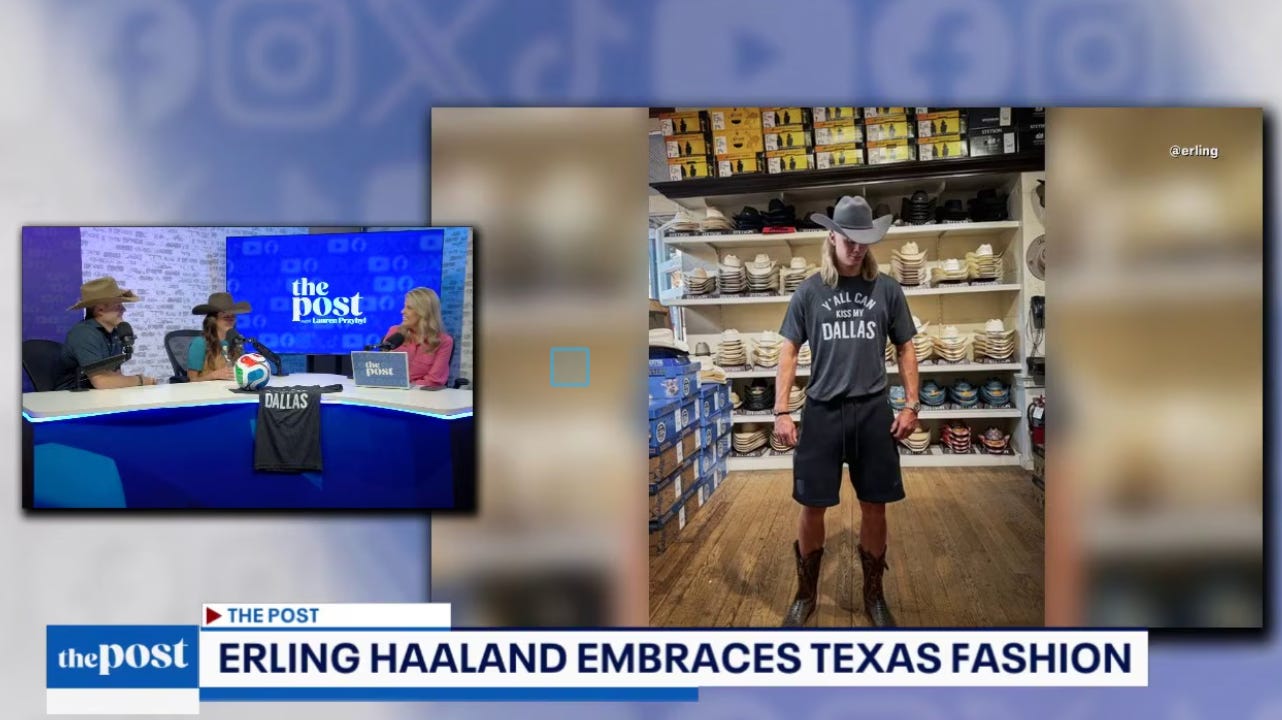
Dallas. Hours after scoring the 86th-minute winner against Ivory Coast, he walked into Wild Bill’s Western Store downtown and bought snakeskin boots, a longhorn belt buckle, and cowboy hats custom-stamped with his initials and number. He put on a “Y’all Can Kiss My Dallas” shirt and posted the whole visit to Snapchat, including his teammates roasting him at the register (”Look at this loser, drinking water.” / “They complain when I order water, but when I score goals they zip it up”). Fox News picked it up, local news picked it up, and the store nearly sold out of the shirt within days.
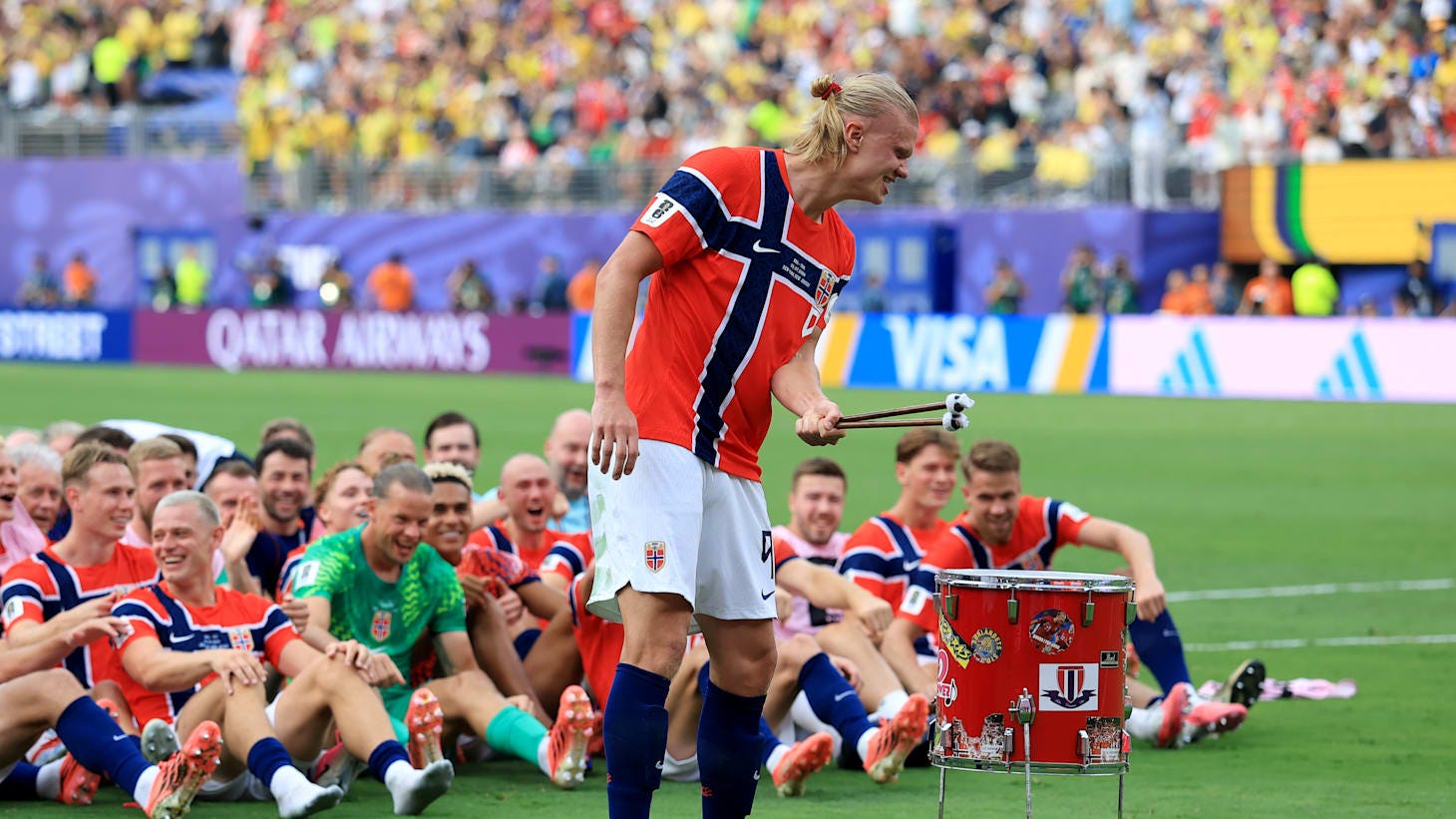
New York. He scored twice in the last eleven minutes to beat Brazil, then took the drumstick from Ødegaard and led the Viking row from the pitch. When Google turned the celebration into a search animation days later, his entire distribution strategy was a single post on X: “One thing to do today… search my name on Google.” He didn’t buy the placement. He was the placement.
Miami. On his off day before the England quarterfinal he played Turnberry Isle in Aventura and posted the round, at which point the internet learned that his father had wanted him to become a professional golfer. The storyline was sitting there waiting, and all he had to do was reveal it.
And everywhere in between. He sat in the stands at a Stanley Cup Final and told reporters the American anthem gave him goosebumps. He played shuffleboard and table tennis on Corden’s After Hours. A pre-match handshake with a kid mascot traveled further than most brand campaigns this year. His own summary of the operation: “I like Americans. They’re hilarious. I like the way they are.”
Dallas got cowboy, New York got the row, and Miami got golf. Each market saw itself through his lens, which stayed playful and curious without ever turning condescending, and each market adopted him for it. Most global brands run one campaign across the United States. Haaland ran four, and every one of them was local.
Watch the run again, though, and it was never really about the cities. The same five decisions repeat at every stop, and together they add up to something you can actually use.
Learn More About Disruptive Play
Disruptive Play Partners with Investors, Founders and C-suite Leaders Challenging Industry Norms at the Intersection of Sport, Media and the Creator Economy.

The lazy read is authenticity, and authenticity is not a strategy. Strip out the football and the charm and what remains is an operating manual: five decisions, each one repeatable, and each one the opposite of what a media-trained athlete or a media-trained brand is coached to do.
The default for anyone with 40 million followers is one global message, focus-grouped to offend no one and belong nowhere. Haaland inverted it, and every city got its own storyline built from that city’s own iconography, discovered in real time.
The operator test: when you show up in a new market, does the market see itself in your content, or does it see your content passing through?
He never posted about cowboy culture from a distance. He spent his own money on the boots, wore the shirt out of the store, and led the row himself. Participation reads as respect while commentary reads as tourism, and audiences can tell the difference in a single frame.
The operator test: in your last cultural play, did you buy anything, wear anything, or risk anything, or did you caption it?
The content that moved twenty million followers was Snapchat stories and vlogs shot without a crew, without a color grade, and posted the night everything happened. For everyone who paid for polished broadcast, the tournament’s most distributed clips were phone-shot, talent-owned, and off-schedule. The Nike spot amplified a phenomenon rather than creating one, which is creativity before capital running at the highest altitude in sport: the production caught up to the audience, never the other way around.
The operator test: if you halved your production budget, would the audience notice, or would you just move faster?
His teammates roasted him for ordering water, Ødegaard handed over the drumstick, his girlfriend beat him at shuffleboard on network television, and a nine-year-old mascot got a handshake that circled the world. Haaland ran his feed as a cast, which turned every episode into a network of teammates, partners, kids, and influencers who redistributed his content without a dollar of paid media. The whole Norway squad became supporting characters in a show only he was producing. Cast, not campaign.
The operator test: look at your last ten posts and count who else appears in them. If the answer is nobody, nobody else has a reason to spread them.
Asked about beating Brazil, he said "Uh… very slim." Asked after he beat them whether his outlook had changed, he said "Really low, still," and then told the press to "put every single pressure on the English lads." Every deflection lowered the stakes, so every win landed as found money and the exit landed soft. He managed expectations the way a good founder manages a raise, and it made him more likable per goal than anyone scoring at his rate has ever been. Compare that with IShowSpeed, who had a massive World Cup of his own but runs a model built on escalation, where every stream has to top the last one because the hype is the product. Haaland built the opposite machine. The bar never rises, so every win clears it.
The operator test: does your audience root for you, or keep score on you? Every promise you make moves people from the first group to the second.
None of this required a rights deal, a media company, or a dollar of paid distribution. It required a point of view and the nerve to post it the same night.
We made this argument in the 90-minutes piece a month ago. The tournament just finished making it for us.
FIFA sold the moment, Fox bought the broadcast, and sponsors bought the boards (and hydration breaks) all of it priced against the matches, and all of it earned back what it was supposed to earn. But the thing that keeps producing after the lights went off happened on a Snap account none of them control, run by a player whose team never reached the semifinal.
The followers don’t reset when the tournament ends. Everyone else rented the audience for a month, and Haaland keeps his. The broadcaster’s audience went home Sunday night, while Haaland’s audience goes with him to Manchester, to every Premier League broadcast, and to whatever he launches next. Early audience reads from TikTok, press profiles, and brand case studies suggest his new followers skew American, female, and new to football, arriving through lifestyle clips more than match highlights. He walked into the largest sports market on earth as a soccer player and walked out as an American celebrity, and the entire acquisition cost was a shopping trip and a green fee.
The audience already converts, too. Haaland bought a minority stake in Bon Dep, the Norwegian company behind the Kknekki hair ties he wears, back in 2024, and when the Haaland Edition launched in June it sold out. He holds equity in the product his content distributes, which tells you this was never merely a personality story. The wardrobe, the vlogs, and the hair are pieces of an ecosystem he owns, not a media kit for someone else’s campaign.
The takeaway for anyone holding rights: if your media contracts treat player-owned vertical content as an afterthought, you are giving away the way most new fans now discover your event, and the most durable audience asset your event creates is walking out the door in a player’s pocket.
Every player in that tournament had the same 38 days. One of them treated the host country as a format.
Spain gets the trophy and the record books, and deserves both. But the most valuable outcome of the American World Cup, a global superstar acquiring an American audience of twenty million in 30 days at zero media spend, belongs to a player who went home in the quarterfinals.
If you are an athlete, or you manage one, the tournament is the occasion. What lasts is the audience still following you when it ends, and this summer proved that audience gets built in western stores and golf carts, not in mixed zones.
If you are a rights holder or a sponsor, you paid for the moment and Haaland took the meaning. The next negotiation should account for the fact that the most distributed content of your event will be shot vertically, by the talent, for free.
And if you are building anything at all, remember that he out-imagined everyone at the biggest media event on earth with a phone, a sense of humor, and a genuine interest in the place he was visiting.
The playbook was accessibility. The distribution was joy. The budget was a pair of boots.
No posts
Comments
Nothing yet. Say the first thing.
Sign in to join the conversation.