
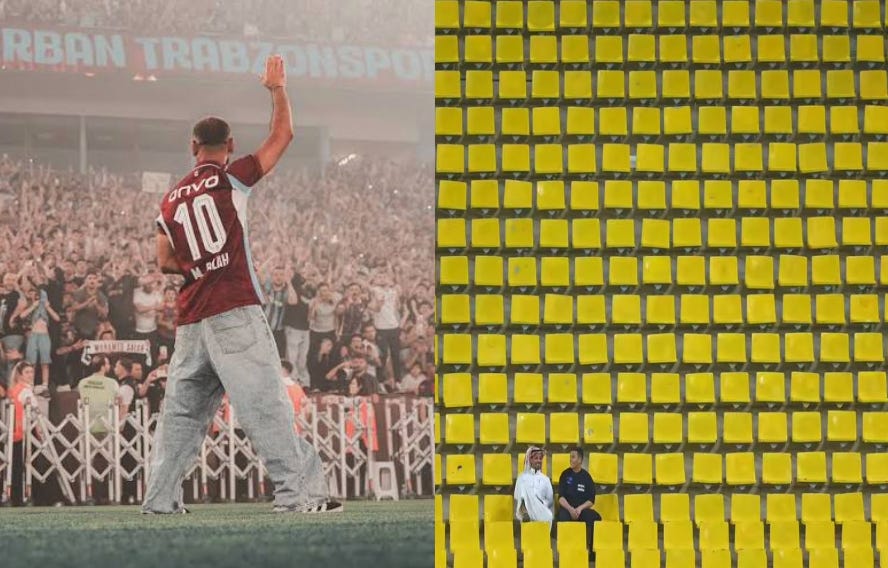
Last week Salah was introduced to more than 30,000 fans at Papara Park in Trabzon. One of the best players of his generation, having won almost everything, chose to close out his career at a club that sits behind Istanbul’s big three. However the story isn’t just that he pick the Black Sea Storm over Besiktas. What’s interesting is that the Saudi Pro Leagued tried harder, offered more and still couldn’t land him.
Al Ittihad had chased Salah since 2023, when Liverpool rejected a rumoured £150m bid. When he hit free agency this year, Al Ittihad, Al Hilal and Al Qadsiah all came back for him, spending months in talks with reports putting Saudi offers as high $25 million a year - a reported $5 million more than he will be making in Turkey. The logic was the same as it always was. Salah is a lethal forward can carry a team, speaks Arabic and is a devout Muslim. A generation of kids from Morocco to Iraq sees a star who speaks their language and shares their background. The shirt sales alone would have covered a chunk of the deal.
Salah took less money to keep playing meaningful football in Europe instead. He signed for Trabzonspor.
Compare that to the arrival of Ronaldo in December 2022 - who was soon followed by Benzema, Kante, Mahrez. The plan was to buy a seat at the top table inside of three years. What followed was a pullback, with league officials repositioning the priority as youth development rather than final pay checks for aging stars.
The repositioning was cover for a harder truth. The league had spent enormous money and generated almost no durable interest, at home or abroad. That is the same place the Chinese Super League landed between 2015 and 2017, when Ramires, Oscar, Tevez and Hulk disappeared into it and the audience never followed.
The money was never the constraint. The product was.
1. Stars don’t fix competition. Bring in the names and the fans will follow only works if the match is worth watching. Who was Ronaldo actually facing every week? A giant among Lilliputians makes for a highlight, not a fixture list. A team is only as good as the eleven on the pitch, and a league is only as good as the twenty teams in it.
2. It bought broadcast infrastructure for a product that wasn’t ready. The production and distribution deal with IMG was the sporting equivalent of no one gets fired for hiring IBM. Safe choice, wrong sequence. Rights buyers were already cutting budgets, and no amount of camera angles creates demand that doesn’t exist.
3. The match-day product never got the money. Officials kept telling us local fans were the priority. More than 60% of Saudi citizens are under 30, which is roughly 12 million young people looking for something to do on a Friday night. Then they were offered dilapidated or multi-purpose stadiums with no comforts and no concessions. Boulevard City in Riyadh has esports, food and shopping. That is who the SPL is actually competing with for the entertainment dollar, and it showed up empty-handed. We saw this firsthand when Disruptive Play visited a couple of years back.
4. It picked the fight on the incumbents’ turf. A live match costs a fan two hours. Once you ask an international viewer to treat you as a second league, you are competing with the Premier League and La Liga for the same slot, and their loyalties are decades deep. There is only so much time and brainspace to go around. Better production doesn’t win that trade.
Learn More About Disruptive Play
Disruptive Play Partners with Investors, Founders and C-suite Leaders Challenging Industry Norms at the Intersection of Sport, Media and the Creator Economy.

The SPL has eight years until it hosts a World Cup, and enormous investment is coming regardless. That money can go into the same playbook that already failed, or it can build something the region actually uses. The route exists. The Kings League has run it, and Baller League is moving toward it. It is just less glamorous than a Ronaldo unveiling.
1. Distribute social first. The SPL is not going to make meaningful money selling live rights to broadcasters or streamers. The audience it needs is on social platforms, and those platforms keep adding live tools and monetization. Put the VOD there. Put the live product there. Be the first major league to treat social as the primary window instead of the trailer.
2. Own Arabic. The algorithm still serves local language to local viewers, so stop confusing it with a mixed-language strategy. UNFPA puts the Arab region’s 15 to 29 cohort at roughly 110 million people. The SPL should be the dominant Arabic-language football offering on every platform, with no ambiguity about who it is talking to.
3. Break the unwritten football IP rules. Everyone remembers the Saudi national team half-time speech against Argentina in Qatar. Since then, nothing. Silence from the changing room, nothing from the training pitch, almost no access to players away from the ground. A challenger league cannot play by the incumbents’ access rules. Highlights of an unfamiliar league sold to fans who don’t know the team names will never move.
4. Give creators equity in clubs. MENA has some of the most inventive creators anywhere. Flying them in for a match visit buys a post. Giving them a stake buys a decade. The Kings League proved the mechanic with streamer-owned clubs from day one. Imagine AboFlah livestreaming commentary on a match where he owns part of the club.
5. Run social like a network, not a marketing channel. SPL clubs are not competing with each other. They are all competing for attention against everything else on the phone. The league should centralize resources, share data, set the standard and force cross-promotion between clubs.
6. Build a match day that social fandom wants to attend. World Cup investment should fix the facilities, with one warning. Qatar built eight stadiums above 40,000 seats for 2022, which is a lot of empty red plastic on a normal league night. Scale the capacity back afterwards. Then run promotional nights where creators actually show up, build vlogging positions in the style of AFTV, and give creators the same player access the press gets. Make it about more than 90 minutes of football.
There is a scene in Moneyball where Peter Brand tells Billy Beane that losing Damon off the payroll opens up all kinds of interesting possibilities. The SPL was ready to pay Mo Salah $25 million a year and lost him anyway. That money is still sitting there.
The first phase bought famous players and rented an audience that never converted. Salah just confirmed the ceiling on that approach. A league that can outbid Europe and still lose to it has a product problem, not a payroll problem. The second phase can buy the audience directly. One of those is a transfer fee. The other is a business.
No posts
Comments
Nothing yet. Say the first thing.
Sign in to join the conversation.