
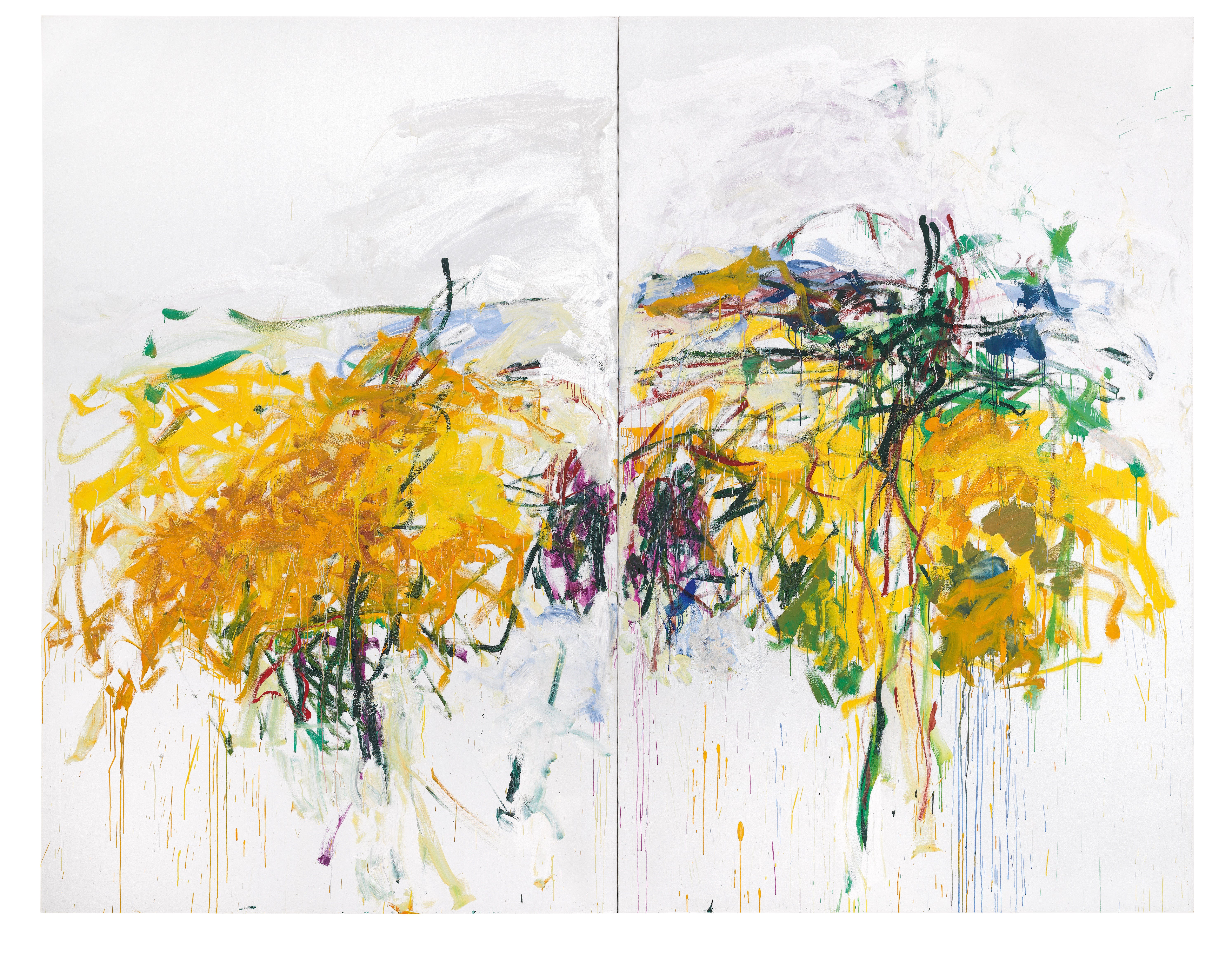
Joan Mitchell, Untitled, 1992; Shah Garg Collection; © Estate of Joan Mitchell; Courtesy of Cheim & Read; Photo by Brian Buckley
JANET SOBEL’S UNTITLED 1946 PAINTING, the oldest piece in “Making Their Mark: Works from the Shah Garg Collection,” fits neatly into the history of 20th-century American abstraction. It looks rather European, which shouldn’t surprise, since Sobel lived the first 15 years of her life in Ukraine. If the vibrant all-over canvas seems to presage abstract expressionism, Sobel’s work was acknowledged by Jackson Pollock as an influence on his style.
Whatever its historical significance, the picture is not characteristic of this National Museum of Women in the Arts exhibition. But then neither is any other of the entries. This ambitiously unruly show is unified by just two things: All 80 items were made since 1945, and all 68 artists are women. The variety reflects the eclectic taste of Komal Shah and her husband, Gaurav Garg, California art collectors and tech-industry veterans.
Curated by Cecilia Alemani, “Making Their Mark” has been labeled a show of abstract art. That’s not entirely true. The exhibition does open with a late example of abstract expressionism, suggestive of a sun-drenched garden, made by Joan Mitchell just before her 1992 death. The diptych is one of the largest works (and probably one of the most valuable) in the selection, as well as a reminder that Mitchell was among the most successful of Pollock’s female peers. But Sobel and Mitchell’s paintings are the only examples of mid-century abstraction.
The show is divided into seven sections that highlight thematic, stylistic, or material links. These categories encompass video, craft-based, text-driven art, as well as more conventional genres.
While there’s no realist work, more than a few pieces are representational: Emma Amos’s 1982 fabric collage places a silhouetted female figure in a cosmic setting. Maria Lassnig’s 2000 painting depicts a “green paintress,” also in silhouette. Another fabric collage, made by Tschabalala Self in 2021, renders a pair of “Sisters.” Firelei Báez’s 2018 paintings are speculative and symbolic portraits of a pair of 19th-century Haitian princesses, placed in opulent frames. Both Simone Fattal and Rose B. Simpson offer sculptures of streamlined human bodies, rendered in bronze and mixed-media, respectively.
Elizabeth Murray’s 1990-91 “Joanne in the Canyon,” a painting on a shaped canvas, doesn’t literally portray her friend, experimental theater director JoAnne Akalaitis. But it does hint at the Southwestern landscapes through which Akalaitis liked to hike.
Shah and Garg collect art from many areas, but California is well represented. There’s just one piece from L.A.’s 1960s “finish fetish” scene, a sleekly machine-like sculptural abstraction fabricated by Judy Chicago in 1960. But there are later works in the same tradition, notably Helen Pashgian’s translucent orange plastic tube, made in 2009, and Aria Dean’s seemingly punched-in column of high-density foam, 3D-modeled in 2022 and painted the exact color as a Hollywood green screen.
More traditional in technique, if not form, are eight glazed-stoneware forms made between 1960 and 1998 by ceramicist Toshiko Takaezu. The Hawaii-born Japanese-American is one of the show’s several “craft” artists who make things that are defiantly unfunctional.
“V. Speculum,” Jo Baer’s stark yet playful 1970 painting of two gray triangles at the edges of an off-white field, may be the only artwork that qualifies as minimalist. (Baer began her artistic career in L.A., although she lived elsewhere for most of her life.) But several works could be termed post-minimalist, including Samia Halaby’s trio of “kinetic paintings,” programmed on an Amiga computer in 1987; and Howardene Pindell’s gridded 2022 collage, constructed from thousands of paper chads produced by a hole punch.
There are as many conceptual paths through this array as there are repeated forms in another striking example of post-minimalism, Françoise Grossen’s “Contact III,” which consists of 17 red-rope lattices hung in a row. Still, since the show opens with Mitchell’s 1950s-style picture, it’s tempting to follow a route that leads through the evolution of painting.
This itinerary leads to two works, poured and peeled by Lynda Benglis in 1969 and Suzanne Jackson in 2020, that are all dried pigment, skin-like with no canvas or paper below. Along the same trail is Rosemarie Castoro’s stark 1972 paint-less “brushstroke,” applied to board with gesso, marble dust, and other materials; and Mary Weatherford’s 2015 “The Tempest,” a vibrant, mostly blue blot that’s bisected by a vertical white-neon tube.
The glowing tube evokes Dan Flavin’s light sculptures, much as the bicycle wheel attached to Laura Owens’s 2016 collage-painting recalls Marcel Duchamp’s readymades. Such references, however, don’t limit the scope or inventiveness of “Making Their Mark.” These 80 artworks derive from many sources, and point in even more directions.
Making Their Mark: Works from the Shah Garg Collection
Through July 26 at National Museum of Women in the Arts, 1250 New York Ave. NW. nmwa.org. 202-783-5000.
Comments
Nothing yet. Say the first thing.
Sign in to join the conversation.