
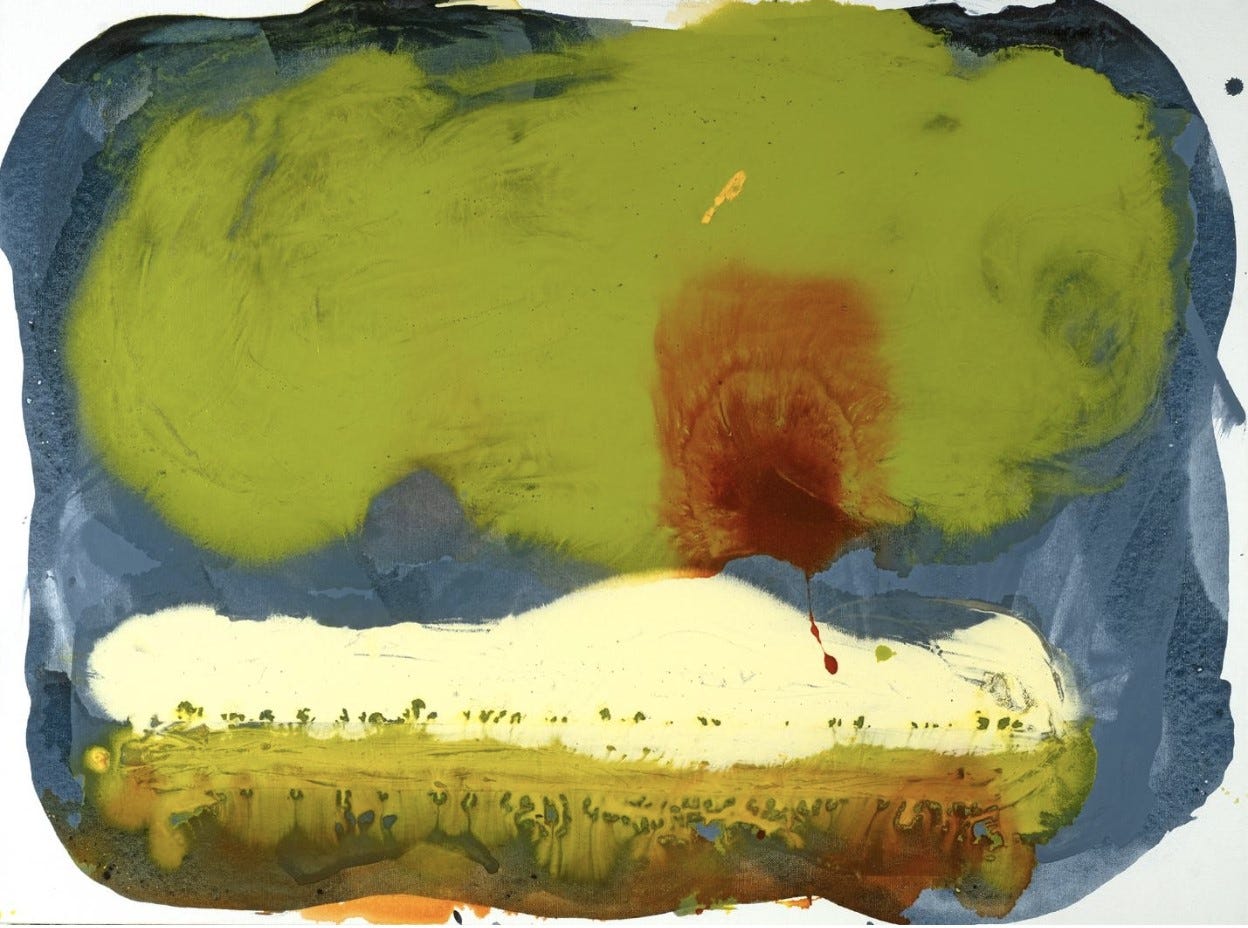
Kathryn Camicia, untitled (Studio Gallery)
THERE’S A STRONG SENSE OF PLACE to Kathryn Camicia’s paintings, even though they’re entirely abstract. The local artist is sufficiently attuned to words to have taken the title of her Studio Gallery show, “All That Is Wanted Is Time,” from a John Asbery poem. Yet she left untitled all but one of the pictures, which were curated by Adah Rose Bitterbaum. The exception offers a clue: “Calanais” is named for a Neolithic-era edifice of standing megaliths in Scotland’s Outer Hebrides.
The upright gestures in that painting do have a stony quality, seemingly the result of being scraped out of black blobs of paint. But Camicia’s style is mostly soft and fluid, and sometimes features drips, although its watery textures may be offset by areas of glossy latex paint. Most of the pictures have hit red-orange backdrops and often included feathered gestures that evoke plants more than rocks.
Yet the horizontal paintings often suggest landscapes, albeit ones whose textures defy nature. A trio of black forms stand defiantly, yet are nearly diaphanous, more like clouds than stones. Another picture is dominated by a cloud-like shape, but one rendered in olive-green -- punctuated by a blood-red block -- that suggests earth or hill. For Camicia, the limited certainties of the physical world are overpowered by the endless possibilities of paint.
THE WORLD IS A SERIES OF ELEGANT FOUND PATTERNS in the pictures made by Scott Robinson. A veteran photojournalist, the local artist has traveled the world, capturing such striking images as “Sunset in the Sahara,” in which a lone figure walks in the tracks left by multiple tires in an expanse of red sand. A solitary person and areas of vivid red are among the defining features of “A Collection of Photographs by Scott Robinson,” another Studio Gallery show.
Some of the repeated motifs in these pictures are funky: a series of battered red and orange corrugated metal sheets linked into a barrier, a wall of multi-layered political graffiti behind a solo saxophonist. Others are sleek and uniform: the curved checkerboard facing of a tunnel, the alternating green and black panels of a modernist behemoth. There are also designs drawn merely with light, such as the vast and seemingly unbroken swoops produced by automobile lights on a highway or the dagger of sunlight that harshly illuminates part of a seated person. Like most of the people in Robinson’s photos, the seated figure appears incidental to environments that enthrall and overwhelm.
ELEGANT FLOWER ARRANGEMENTS FIXED IN CIRCLES, the six photographs in Leslie Kiefer’s turn a few twigs, leaves, or petals into miniature universes. The artist’s “Bowl/ing,” also at Studio and curated by Iza Thomas and Robert Cwiok, observes plant matter in various degrees of spring-like vitality or autumnal decay. Each grouping is arrayed in a bowl whose circular form gives the picture a sense of infinity. The depths of such serene composition as “Orchid Party” even suggest an eye -- gazing out as the viewer peers in.
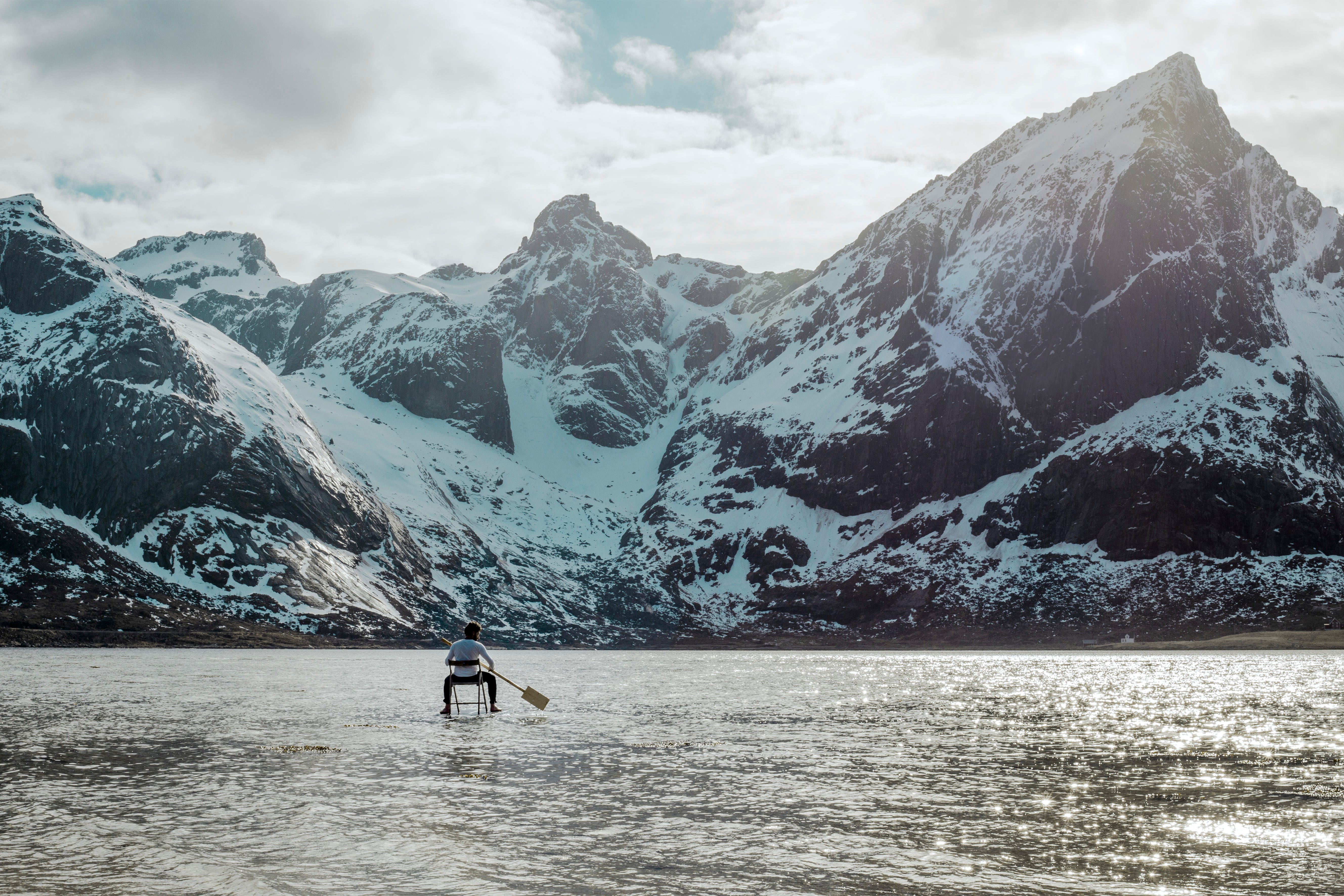
Felipe Castelblanco, “Driftless” (VisArts)
TO MARK THE 10TH ANNIVERSARY OF ITS “FRAME AND FREQUENCY” video-art surveys, VisArts has mounted two exhibitions. The five-artist “Frame and Frequency X” is smaller and themeless, while the six-contributor “Liquid Territories” is larger and, however loosely, themed. Both showcase mostly video, but sometimes in association with other art forms.
Thus Dawn Whitmore’s “There and back again,” part of the smaller show, nestles two videos among paintings, one of them a large canvas whose representational images are montaged in a cinematic manner. Nearby, Jessye McDowell uses futuristic game-generation software to offer a parody of marketing for a futuristic AI companion; the video makes such products seem as banal as they ominous. The other entries include Liz Trosper’s animated eco-disaster tour, which depicts a burning tree and an ocean full of trash; and João Krefer’s intentionally disorienting short video of metropolitan Tokyo, composed of literal tracking shots -- shot from a train -- that are split horizontally with the lower set of images presented upside down.
“Liquid Territories” is more sweeping, as exemplified by its centerpiece, Felipe Castelblanco’s “Driftless.” Made over six years, the three-screen video observes a single person who navigates a primitive raft -- also on display -- through such diverse locations as an inlet overlooked by snowy peaks and a tight Venetian canal. If the bulk of the video appears mythic and timeless, the final sequence is specific and gently comic: It consists of TV footage of a scramble to arrest the artist as he paddles through a medium-sized American city.
Kissel Hiram Bravo Hernández’s mixed-format “Fire Warning” is a vision of an atrophying world, with forests on fire and buildings rotting like overripe vegetables, all depicted with a viewpoint in constant flux. Dwayne LeBlanc’s “You Don’t Exist” ponders migration and mixed identities with voiceover narration atop soft black-and-white imagery of clouds and an airplane in flight. Leigh Davis nestles a video of everyday female-coded activities -- vacuuming, applying makeup -- inside an installation that arrays green benches and a red telephone, evoking some sort of waiting room.
Local artist Jonathan Monaghan places two video screens within digital prints of elaborate frames for another of his elegant mashups of myth and reality, history and contemporary consumer culture. The looped short videos were inspired by the fable of Prometheus, the god who brought fire to humans and was punished by having his liver perpetually eaten by an eagle. In Monaghan’s twofold retelling, one figure is chained to a computer server rack and Prometheus’s vulnerability is expressed by a lineup of Naked juices. Myth, like history, repeats itself -- the first time as tragedy, the second time as a marketing opportunity.
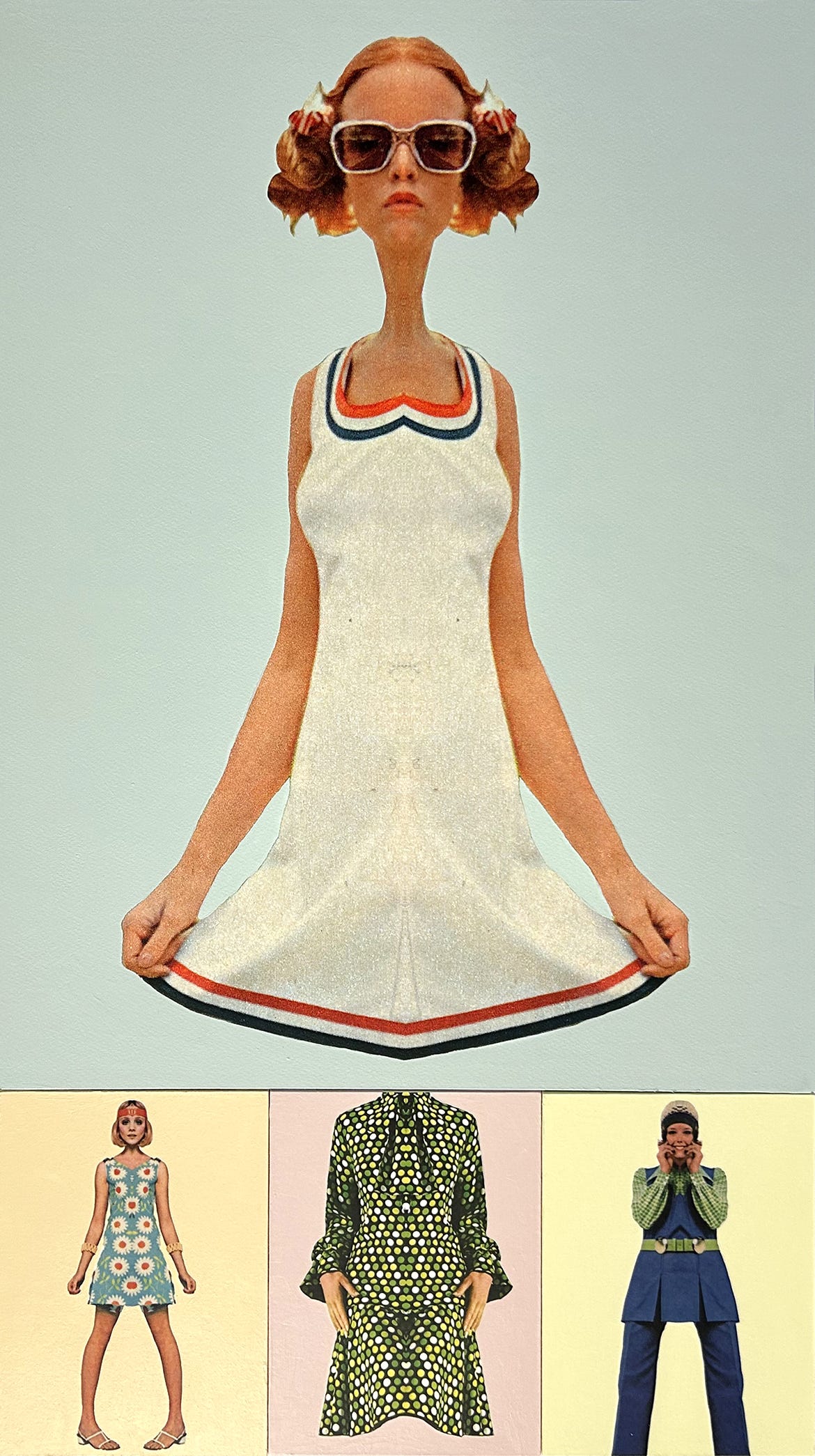
Susan R. Johnson, “Small Combine No. 6 (Cool Cat)” (Gallery Neptune & Brown)
FOR HER RECENT COLLAGE-PAINTINGS, Susan R. Johnson has abandoned her former strategy of combining idealized women’s bodies with sleek mid-20th-century machines. That idea hasn’t been entirely forgotten, however. The southern-Maryland artist’s Gallery Neptune & Brown show is titled “Blueprint for Happiness,” an advertising slogan for Silex coffee makers. Silex merged into Proctor Silex in 1960, which gives a sense of the era Johnson means to evoke: the United States during her childhood and its triumphant post-WWII economic boom, before the discontents of the late 1960s.
One of those discontents, of course, was second-wave feminism, which challenged the definition of women as primarily consumers and custodians of clothing, makeup, and the domestic realm. Johnson offers a similar challenge, but in a sly, ironic manner. (One composition places a halved avocado, in the ‘60s known more as a color than a vegetable, on an avocado-green field.) Her subjects, derived mostly from French fashion magazines and clothing-pattern catalogues, are nearly, well, perfect. But their bodies are sometimes distorted, notably with elongated necks. The tension of fitting into the dominant paradigm has twisted these women and girls in uncomfortable ways.
In this set of artworks, which layer wax and acrylic paint over digital prints, Johnson sometimes brackets women with Barbie-like dolls. Whether flesh-and-blood or plastic, the figures usually appear in lineups, as if on a symbolic catwalk, often with a larger one atop three or four smaller ones below. The arrangements are very tidy, although the clothing -- flowery, billowing, vividly hued, and influenced by Asian and Middle Eastern motifs -- hints at the imminent Age of Aquarius. Johnson’s art couldn’t be more meticulous, but the epoch she revisits is about to get messy.
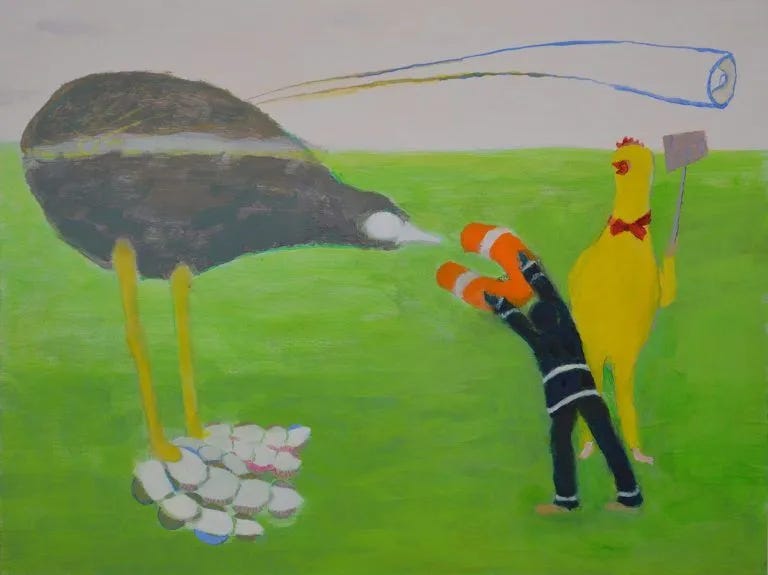
Sabine Carlson, “Dream a Better World” (McLean Project for the Arts)
STRAIGHTFORWARD IMAGERY IS HEIGHTENED by complex textures or color schemes in the work of the three local artists featured in the McLean Project for the Arts’s “Spring Solo Exhibitions.” Sabine Carlson paints vignettes in which cartoony birds interact with more realistically rendered humans. Zsudayka Nzinga makes fabric-and-paper collages that draw on folklore of the American South. Also a collagist who engages the past, Darlene R. Taylor depicts silhouetted Black women garbed in actual heirloom textiles.
The work of Nzinga and Taylor, who share a gallery, is quite compatible. One difference is that the style of Taylor’s “Heirlooms: Garden Beauty” is more orderly, with compositions that focus on a single woman. Taylor’s colors are also more muted than those of Nzinga, whose “Ancestral Iconography” highlights bright reds and yellows in multi-figure scenes set in what appear to be deep-shadowed forests. The settings seem apt, since Nzinga’s human subjects are overlooked and possibly exploited laborers. Both Taylor and Nzinga summon people from the recesses of history, conjuring them in part with materials that literally embody the past.
The import of Carlson’s “Dream a Better World” appears ecological, although perhaps these small paintings are simply appeals for empathy. The people and birds “appear to be engaged in various kinds of rescue efforts,” says the show’s catalogue. The artist’s blobby birds eye or nudge life-preserver-like objects, which may be symbols of hope. But perhaps the most significant thing about the U-shaped objects is that they’re orange, a color that jauntily contrasts the pictures’s mostly blue and green fields.
Kathryn Camicia: All That Is Wanted Is Time
A Collection of Photographs by Scott Robinson
Leslie Kiefer: Bowl/ing
Through June 13 at Studio Gallery, 2108 R St. NW. studiogallerydc.com. 202-232-8734
Frame & Frequency X
Through June 14 at Concourse Gallery.
Frame & Frequency: Liquid Territories
Through July 12 at Kaplan Gallery. Both at VisArts, 155 Gibbs St., Rockville. www.visartscenter.org. 301-315-8200.
Susan R. Johnson: Blueprint for Happiness
Through June 20 at Gallery Neptune & Brown, 1530 14th St. NW. galleryneptunebrown.com. 202-986-1200.
MPA Spring Solo Exhibitions: Sabine Carlson, Zsudayka Nzinga, Darlne R. Taylor
Through June 13 at McLean Project for the Arts, 1234 Ingleside Ave., McLean. mpaart.org. 703-790-1953.
Comments
Nothing yet. Say the first thing.
Sign in to join the conversation.