
I spoke to an agency owner last month who has been running a small SEO shop for dental practices for 25 years. As niche as it gets. He makes over $400k a year and works one day a week. A buyer came along last year with a serious offer. He said he’d probably shut the doors rather than sell.
A founder obsessed with scaling might look at that and see wasted potential or a lack of ambition. Twenty-five years of work, a business that almost runs itself, and an exit offer met with indifference.
I keep turning it over. I’m not sure that’s the right way to see it.
Over the last fifteen years, the creative industry absorbed startup culture’s definition of success. Bigger teams. Bigger clients. An exit at the end, with some number on a spreadsheet turning years of work into a liquidity event.
Most design studios were never built for that. Someone was good at making things and wanted to build a living around it. The goal was to create something sustainable and worth being proud of. That’s a different business, with a different idea of winning.
But startup culture got loud, and LinkedIn got louder. Studio owners with profitable, self-directed businesses started feeling like they had to explain why they didn’t want more. The ambition that built the business stopped looking like ambition.
“Scale became the only acceptable goal. Everyone running a smaller, calmer, more profitable business started to feel like they were doing something wrong. Most of them weren’t.”
Most studio owners skip this calculation when they start feeling the pressure to scale. Not because it’s hard to do. Because nobody told them to do it. Here’s a version of it.
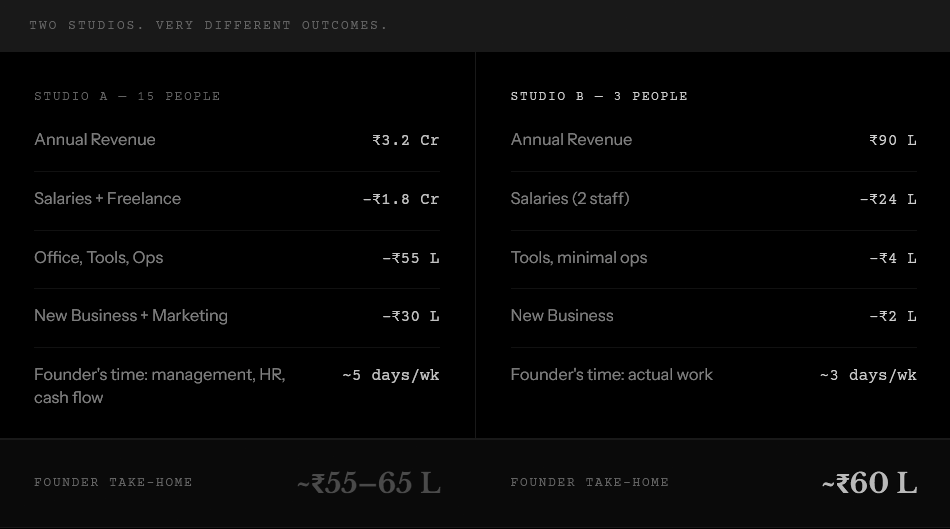
The numbers are illustrative, not universal. But the underlying math holds. Growth costs money before it makes money. Overhead often rises faster than revenue in the early stages of expansion. A founder who doubles their team usually doubles the management burden before doubling margins, if those margins ever arrive.
Most studios expand before asking whether being bigger actually makes the business better than being the right size. The right size is not a failure condition. For many design businesses, it is the most profitable one available.
This is the part I want to be precise about, because the argument is easy to misread as permission for avoidance.
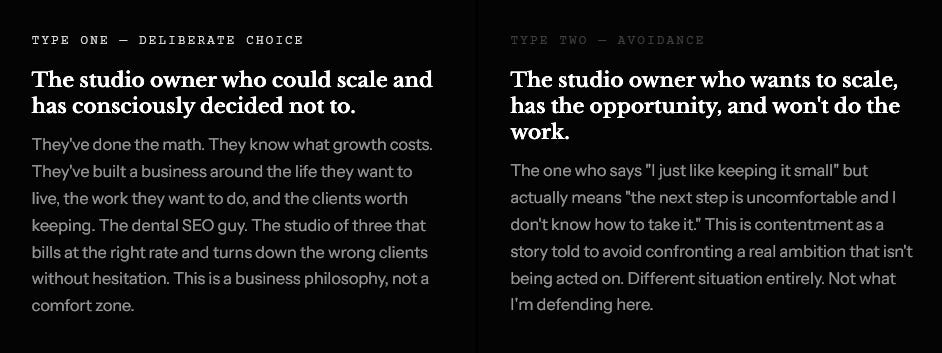
Knowing which one you are is the most honest question a studio owner can sit with. And most people, if they're being straight with themselves, already know the answer.
In startup culture, “lifestyle business” often means not serious, not scalable, and not interesting to investors. It suggests the founder chose comfort over ambition and deliberately kept the business small because they couldn’t turn it into something bigger.
In practice, it describes a business designed around the life of the person running it, rather than investor expectations or the logic of compounding growth. For many design studio owners, that isn’t a consolation prize. It’s the goal. They have simply spent enough time around startup culture’s vocabulary to feel embarrassed admitting it.
What “Lifestyle Business” Actually Means
A studio where the founder does the work they’re good at, with clients they respect, at a pace they can sustain without becoming someone else. That’s a legitimate business to create. It doesn’t need to be defended against a different kind of ambition. It needs to be named clearly so the person running it can stop measuring themselves against a metric that was never designed for them.
The creative industry is full of this story, but it rarely gets told because it’s uncomfortable to admit.
A studio starts small. It does good work. Gets noticed. Wins bigger clients. Hires more people. Brings in a studio manager. Moves into an office with a kitchen and a branded espresso machine. Wins an award. Pitches for a retainer. Hires to service it. The retainer ends. Redundancies follow. The founder spends most of the week on management, HR conversations, cash flow projections, and new business calls, barely touching the work that started the whole thing.
The studio became something else. Not necessarily worse, but different from what it was built to be. The transition happened gradually, rewarded at every step by the usual signals of success, until the founder realized three years in that they no longer enjoyed running it and couldn’t easily reverse course.
Growth is expensive to undo. Downsizing a team, losing clients who came for the larger operation, and rebuilding a reputation around a smaller, more focused offer can take years. People talk about growth as the default path. They rarely talk about what it takes to come back.
Almost any studio can grow if it’s willing to take on the added overhead and complexity. Growth is usually available as an option. That doesn’t make it worth choosing.
The more useful question is one most studio owners skip because it can feel too soft for a business conversation: what does this studio need to be for it to be worth running?
The person who gets to answer that is the one who built it. Not the LinkedIn post about 10x thinking. Not the founder who scaled their agency and now thinks everyone should do the same. Not the investor looking at a creative business and wondering what it could become with capital behind it. The person who built it knows what it cost to get here and what they were actually trying to make.
Before you hire the next person, sign the bigger office, or take on the client that requires you to staff up, ask what the studio needs to be for it to be worth running.
Not worth growing. Worth running. Those are different answers for almost everyone who has built one of these businesses honestly.
Until next time
Stay curious. Stay intentional. Stay Groundbreakin.
— Dipaq
No posts
Comments
Nothing yet. Say the first thing.
Sign in to join the conversation.