
I have a habit whenever I come across a new Indian startup brand.
Before I judge the craft, I try to spot the reference point behind it. Not the logo or colour palette. The assumption underneath all of it: what does this team believe good design looks like? Where did that idea come from?
Usually, the answer is obvious.
The reference point is somewhere in San Francisco and Copenhagen. The ambition is to look familiar to a Western audience. Success is measured by whether someone from Pentagram, Stripe, or even a devoted Linear fan would approve.
That standard has settled so deeply into our thinking that it rarely feels like a decision anymore. It simply feels like taste or ‘the standard.’
That’s the part that deserves attention. The work itself is often excellent. But the assumption beneath it deserves far more scrutiny.
1947 solved the political problem. The flag changed, borders were redrawn, and colonial administration was dismantled over the decades that followed. The deeper hierarchy remained.
Nobody really had a playbook for dismantling the belief that “standards coming out of the West were the standards,” while everything else belonged somewhere lower on the ladder: regional, kitsch, or waiting for approval.
Design reflects that belief in subtle ways.
You see it in the studios that Indian design schools place on reading lists. You see it in what the awards agencies chase. You hear it in briefs that ask for something to ‘feel global,’ even though everyone in the room already knows what it means.
“Make it feel global” is not a design direction. It’s an anxiety dressed up as an ambition. And most Indian founders say it without hearing what they’re actually saying.”
There’s an easy version of this argument, and it isn’t very useful.
India is producing exceptional work today. Packaging, digital products, type, and spatial design. Some of the strongest visual thinking I’ve seen this year came from studios in Ahmedabad, Bengaluru, and Mumbai. The question is whether we’re building on it or treating it like an exception.
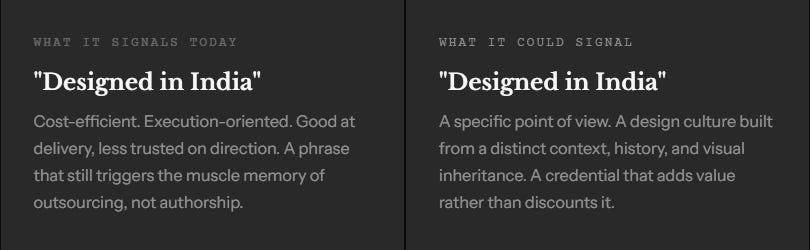
There’s a reason every Apple product says “Designed in California” on the back instead of on the invoice.
It’s a proud declaration of authorship. The thinking came from California.
Part of this story belongs to Indian companies themselves.
For years, we competed on price because that was the opportunity available. Technology services, creative services, and consulting. The pitch was simple: we can do the same work for less. It built businesses. It also trained clients across the world to associate Indian work with savings rather than authorship.
That strategy built the industry.
It also made it a ceiling.
The catch is simple. If price is the first thing a client remembers about you, it’s difficult to convince them later that your thinking deserves a premium.
Indian studios charge less than the quality of their thinking deserves. Anyone who’s worked across different markets can see it.
Raising prices isn’t enough. The way the industry presents itself has to change first.
Some studios have already begun to break through it. Their pitches now focus more on how they approach problems, make decisions, and develop a point of view than on how quickly they can produce the work.
There’s a pattern that keeps appearing in brands targeting premium or international markets.
The visual language shifts toward a kind of placeless modernism. Enough local signals are removed that almost nothing remains to suggest where the company comes from. The identity becomes increasingly detached from its place of origin.
Founders usually have sensible reasons for making those choices. If your customers live in Europe or North America, you’re thinking about recognition and recall. That’s practical. Nobody should dismiss it.
Still, one question remains.
When was the last time you saw a Scandinavian company erase every trace of Scandinavia before entering another market? Or would a Japanese brand flatten its identity because someone in the West might find it unfamiliar?
The design cultures people admire don’t arrive asking permission. They arrive carrying their context with them.
What’s being left behind?
Indian visual culture offers one of the richest collections of ideas anywhere: colour, geometry, typography, spatial thinking, and ways of organising information that have developed over centuries. None of that requires decorative motifs or obvious cultural references. What matters is the way of seeing that emerges from this environment. That’s an advantage. Too many companies still treat it like baggage.
I use this phrase often, so it’s worth explaining what I mean.
A brief arrives asking for “something like Linear,” “the Stripe look,” or “that clean European studio aesthetic.”
The brief usually starts with the design, but what gets copied is the visible result, separated from the decisions that shaped it.
Linear looks the way it does because it’s the result of countless deliberate choices made within a specific company for a specific audience under a specific set of constraints.
Once those decisions disappear and only the visual language remains, what you’re left with may look familiar at first glance, but it rarely feels convincing.
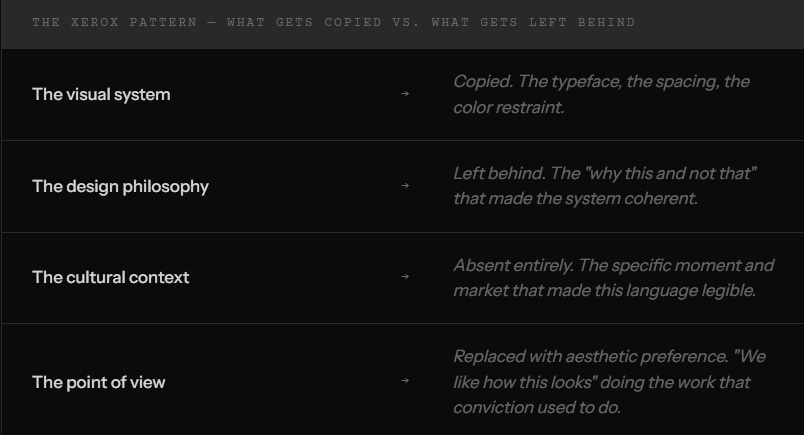
The result is a copy of a copy.
Every year, hundreds of Indian startups launch with brands that borrow a Western visual language almost entirely while adding very little of their own.
The execution is often polished. What feels absent is an original perspective.
Founders aren’t wrong for admiring companies like Linear. They’re wrong if admiration becomes a substitute for having a brand positioning of their own.
I’m not arguing for nostalgia. I’m not asking designers to reject ideas that began elsewhere or to wrap every project in visible Indian references. That argument collapses as quickly as the imitation it criticises.
The point is much simpler.
Know where your perspective comes from.
Stop treating the place that shaped your thinking as something that needs explaining away.
Stop pricing your work as though the distance between Mumbai and San Francisco automatically lowers its worth.
Stop letting someone else’s coordinates define what “global” means.
The studios producing original work already share this instinct, even if they don’t describe it that way.
They build from a clear way of seeing the world, with little concern for whether that perspective fits a Western gaze. People remember work like that because it carries a distinct point of view and feels like it belongs to someone.
Eighty years is a long time to wait for the second part of independence. Waiting isn’t the problem anymore. Choosing to wait is.The next time someone asks you to “make it feel global,” try answering with a question instead of a lecture. Global according to whom? Whose standards are we using? Did we choose them, or did we inherit them?
Until next time.
Stay curious. Stay intentional. Stay Groundbreaking.
—Dipaq
No posts
Comments
Nothing yet. Say the first thing.
Sign in to join the conversation.