
Disclosure: I run a design agency too, so take this with a pinch of salt. I’m writing it because most clients evaluate design agencies in a way that surfaces the least useful information before they spend significant money.
Ask any agency to walk you through a project that went sideways. Not the case study, the one where the timeline slipped, the client hated round one, or the strategy fell apart halfway through. Listen to how they talk about it.
Every agency has those projects. The honest ones can describe what happened without shifting the blame to the client by the third sentence. The others tend to reach for familiar explanations: “the brief kept changing,” “they weren’t ready for what we were proposing,” or a smooth redirect to a project that went well. Watch for the redirect. That’s useful information.
It’s more revealing than almost anything in the deck they sent you. Which is unfortunate, because the deck is probably what you looked at first.
Every case study you’ve looked at was made under assumptions you can’t see from the outside. A budget you don’t know. A timeline that may have been unusually generous or brutally tight. A client who was exceptionally clear or a team that had already done three rounds of strategy before the agency arrived. A lead designer who has since left. A brief that was rewritten four times before the work began.
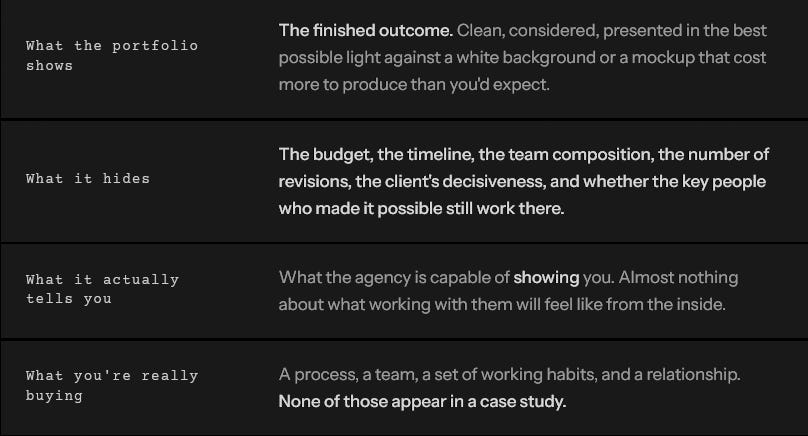
The portfolio is a highlights reel edited by the agency for the purpose of winning work. It is not a neutral document. Treating it as the primary evaluation tool is a bit like hiring a chef based on the photos they chose for their Instagram.
This is one of the most common sources of client disappointment in the design industry, yet it rarely gets discussed because it’s awkward for everyone involved.
The senior creative director presents the vision while the co-founder talks you through the strategy. Someone else handles the process questions, usually the person most comfortable explaining how the team works. The pitch feels polished because they’ve done it many times and genuinely believe in the work they’re selling.
Then the contract is signed and the project moves to the actual team: a capable mid-level designer, a junior still learning, and a project manager coordinating across three other accounts. The senior creative reviews the work on Fridays, assuming the week hasn’t gone sideways.
“The people in the room for the pitch are frequently not the people on your project. Nobody lies about this. It just doesn’t come up unless you ask directly.”
Ask directly. Who is actually on my project? What percentage of their week? Will the person presenting today be reviewing the work, and at what intervals? If the answer is vague, or if it requires a follow-up to pin down, and you have just located it before you signed anything.
Ask to see a mid-project artifact from something recent. Not the final presentation or the case study. Ask for the messy Figma file with the explorations that didn’t make it, the strategy document with comments still in it, the brief that has been revised and annotated, or the internal Slack thread where the team disagreed on a direction.
Most agencies won’t have an immediate answer. The ones with a genuine process will know exactly where to look. The ones improvising will offer a polished deck instead and explain that they can’t share client work without checking. That’s reasonable, except real work can usually be anonymized quickly if it actually exists in a shareable state.
What to look for in the working files:
Dead ends: Directions the team explored and eventually abandoned.
Reasoning: Notes explaining why certain directions were dropped.
Disagreements: Evidence of different opinions that were worked through and resolved.
Multiple voices: Comments and input from people beyond the lead designer.
The mess: A working file that is too clean has probably been cleaned for your benefit. That tells you something about what the agency thinks you want to see and suggests they’re still in pitch mode when you’ve asked to see something real.
Ask these. Listen carefully to how they answer, not just what they say.
“What have you talked a client out of?”
An agency that only takes orders will happily sell you the rebrand you don’t need, the campaign that’s more exciting than strategic, or the full identity overhaul when what you actually need is a clearer proposition. A genuine answer here, specific and slightly uncomfortable to recount, is one of the clearest signals of strategic value you’ll get in a pitch. An agency that can’t remember talking a client out of anything probably hasn’t tried.
“How do you handle it when we disagree on a direction?”
You’re listening for a mechanism, not a temperament. “We’d talk it through” isn’t a process. We’d listen and try to understand the concern, but it isn’t one either. You want to hear something more concrete: how decisions are documented, what happens when a creative direction is challenged without a clear rationale, and how the team separates personal preference from strategic misalignment. If the answer focuses on tone rather than structure, disagreements will ultimately be settled by whoever is most persistent in the room.
“What happens after the handoff?”
Brand systems decay when they meet real marketing teams, social managers, and developers who never attended the brand presentation. An agency with no answer here built you an artifact, not a system. The case study photo looks great. Six months later, the guidelines are being ignored, and nobody knows who to call. An honest answer should feel slightly uncomfortable, because it involves acknowledging all the things that can go wrong after the agency hands the work over, many of which it can only partially control.
An agency that agrees with everything on the first call.
You came into that call with a problem, a budget, a rough idea of what you need, and a set of references to explain your taste. An agency that responds with enthusiasm and agreement at every point has decided to win the work before it has understood the work.
What You’re Actually Paying For
You’re paying for an outside perspective. An opinion that arrives already aligned with yours adds little value because you already had that opinion before the call. The agency that pushes back in the pitch, asks the question you weren’t expecting, or says, “We don’t usually recommend that approach, and here’s why,” is demonstrating the thing you came to buy. The one agreeing with everything is selling comfort. Comfort is cheap, and it doesn’t ship.
The pushback doesn’t need to be confrontational. Often, it’s just a question you hadn’t asked yourself: “What does success look like twelve months after we hand this over?” Or, “Have you tested whether your current customers actually experience the problem the way you’ve described it?”
Small redirections. The kind that happens when someone is thinking about your problem rather than their proposal.
If clients are evaluating agencies on the wrong signals, some of the responsibility sits with the agencies for letting them.
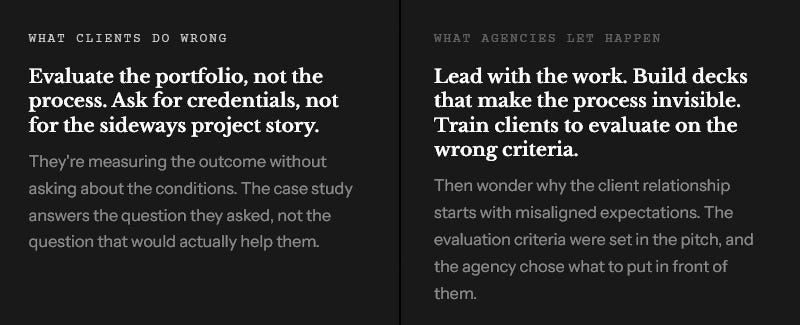
The agency that leads with the sideways project story shows the working file before the final or asks, “What would make this a failure for you?” before discussing the timeline the client isn’t expecting. It’s changing what gets evaluated before the client has even realized the frame has shifted.
Most agencies don’t do it because it feels risky. The safer move is to lead with beautiful work and let the client project their hopes onto it. That same approach is why many client relationships start well and then deteriorate, while the same conversations about expectation gaps keep repeating across the industry.
Ask them about the project that went sideways. Watch whether they can tell the story without turning it into a story about the client. That answer will tell you more about what working with them will actually be like than everything else they showed you combined.
Until next time
Stay curious. Stay intentional. Stay Groundbreaking.
— Dipaq
No posts
Comments
Nothing yet. Say the first thing.
Sign in to join the conversation.