
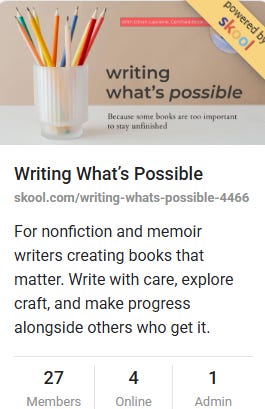
Over the past few months I haven’t written here as often as usual. I didn’t run out of things to say. Instead, I’ve been spending my creative energy building something new: a small online space for nonfiction and memoir writers called Writing What’s Possible.
My hope for the community is simple. Writing can be a solitary activity, especially for people working on long projects. Many writers are doing this work inside full lives — managing jobs, families, responsibilities, and the everyday demands that push writing to the “margins” of the day. I wanted to create a place where writers could show up regularly, talk honestly about the craft of writing, and sit down together for a few hours to move their work forward.
So far, it’s been a pleasure to see the first group of writers settling in. There are 26 of us already…cool, huh?
One of the unexpected things I’ve noticed as the community begins to take shape is that my own writing feels different too. When I sit down to write something now, I’m not picturing a vague future reader somewhere out there on the internet. I’m thinking about the specific people who are already in the room — the projects they’re working on, the questions they’ve raised in discussion threads, the places where they’re feeling energized or stuck.
The writing becomes a response.
This is something I often talk about with my coaching clients. When nonfiction writers struggle to make progress on a book, they sometimes assume the problem is discipline or time management. In many cases, the real difficulty is that the reader is still abstract. When you don’t know who you’re speaking to, every sentence carries the burden of explaining everything to everyone.
Once a writer begins to understand their reader more clearly, they relax into the writing. Decisions become easier. Examples come more naturally. The writing starts to feel less like performing and more like talking with someone who has come to the page with curiosity and goodwill.
That’s how I’m feeling too.
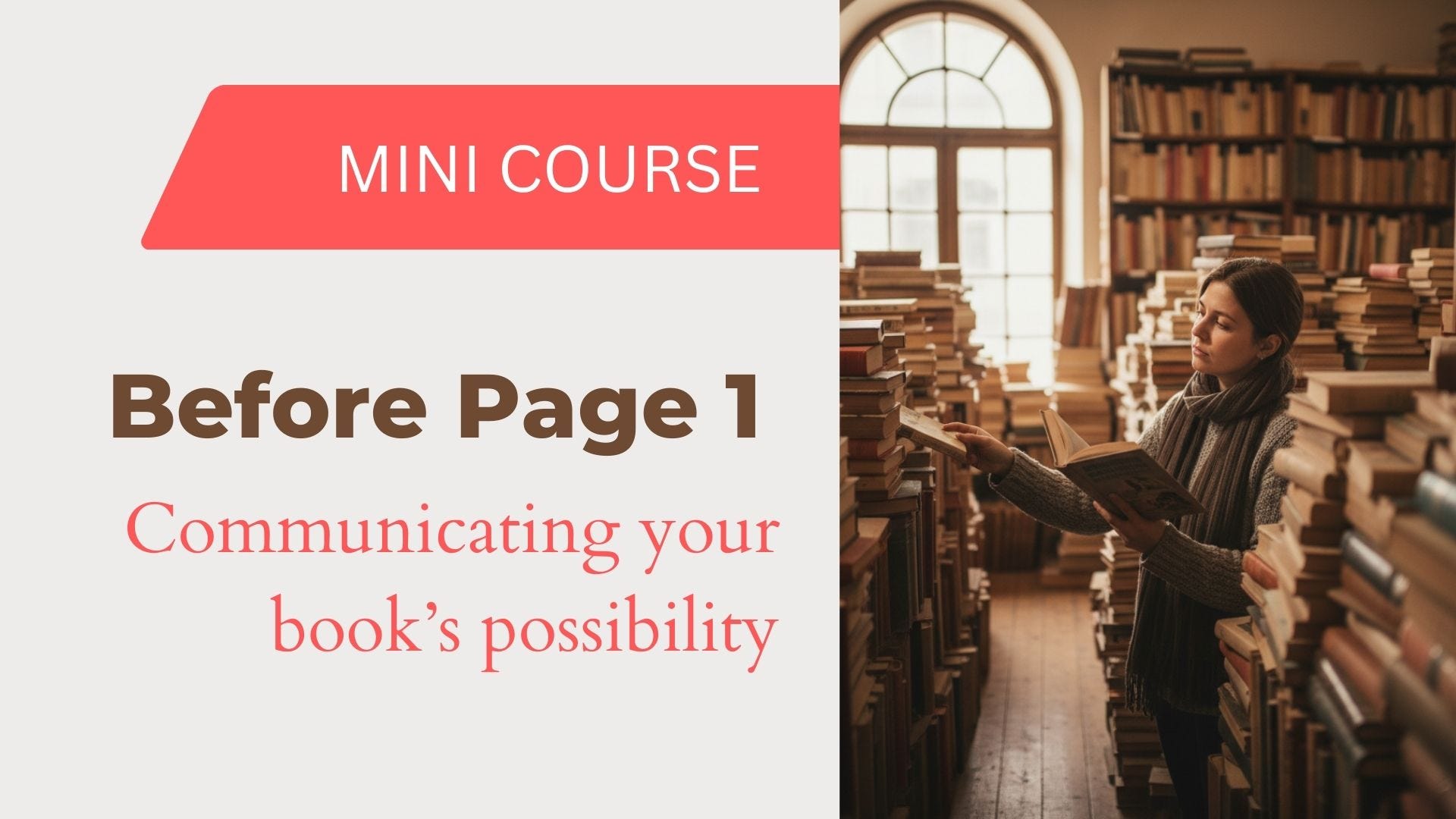
If you’re curious about the idea of writing to, I’ve added a free mini course to the classroom in Writing What’s Possible called Before Page 1: Communicating your book’s possibility, and it includes three short videos and three worksheets.
If you’re writing nonfiction, including memoir, you're invited to join me in Writing What’s Possible, where writers are working on nonfiction projects of many kinds. it’s a place talk about the craft of writing, share reflections about the process, and meet regularly for coworking sessions (usually on Mondays) to reset our intentions for the week ahead. It’s still a young space, and you’re welcome to join us and help build it. Community, after all, is co-creation. Like any good community, Writing What’s Possible will ultimately be shaped by the people who participate in it.
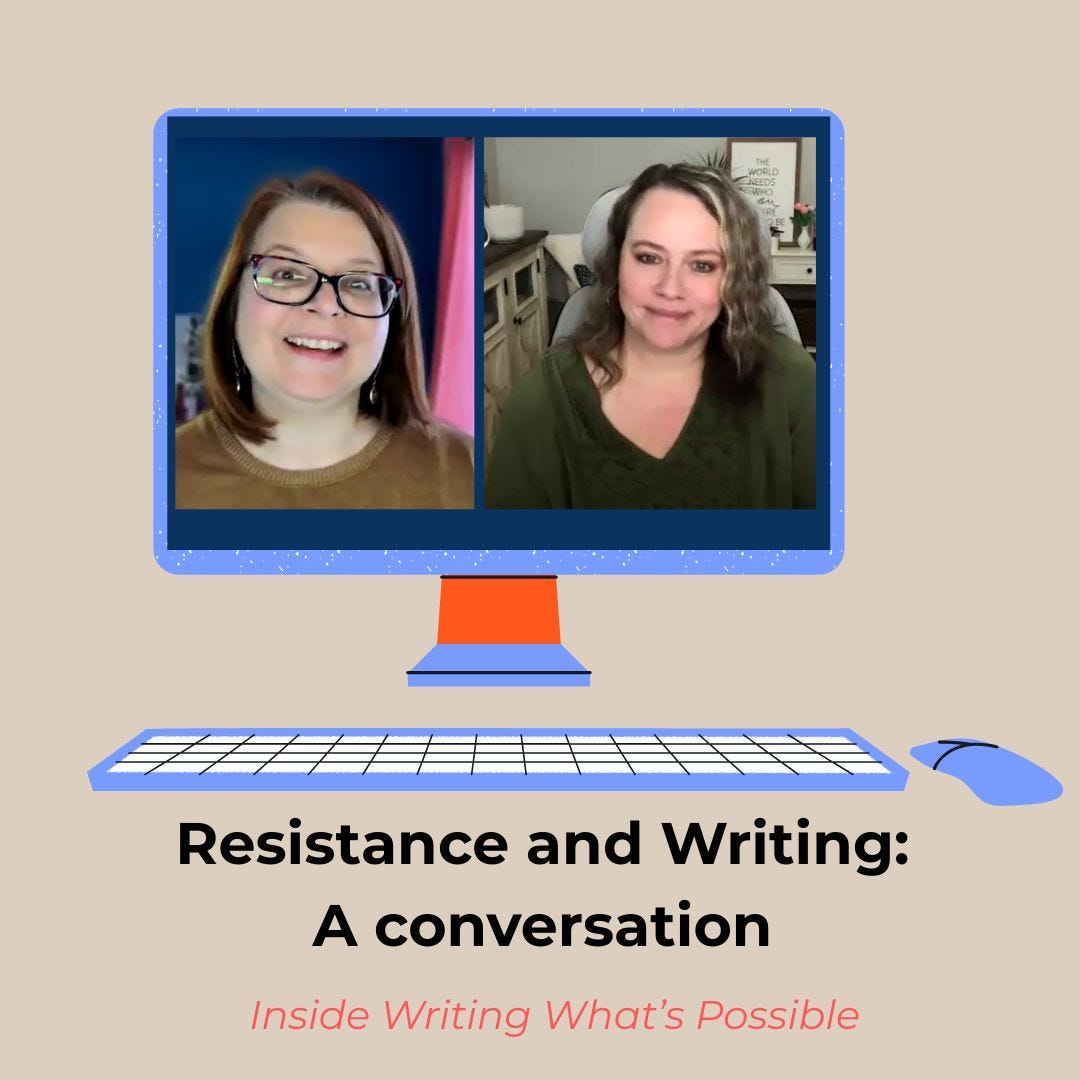
Last week I recorded our first Writing What’s Possible member spotlight conversation inside the community with writer and coach Kim Job.
Kim is currently working through the final stages of editing her book, which explores the process of moving from self-protection toward self-leadership. Her work helps people identify the internal stories that shape their decisions and leadership style, and then untangle those stories so they can move forward with more clarity.
As often happens near the end of a book project, Kim is experiencing resistance. She’s completing final edits and her fears and worries are coming to the surface. I’ve seen resistance show up in many of my clients’ projects, and it shows up in different parts of book development. I’ve written about it before:
In Kim’s case, part of that resistance comes from the personal stories included in the manuscript. Some of the events she writes about are things her family members don’t yet know. As she prepares to publish, she’s thinking about how those people will experience the stories once the book is out in the world. Especially her mom.
Many nonfiction and memoir writers recognize that moment of resistance. It doesn’t feel good. But Kim, being a coach herself, recognized it for what it is: fear. And that means working through it.
By the time a manuscript reaches the final stages, the craft work may be largely complete, but the emotional work of letting the book exist outside of you is only beginning. At one point Kim described the feeling this way:
Writing a book can feel like cracking your heart open and saying, here world, just read it.
If you’re interested in hearing more of that conversation — and how Kim creatively addressed her resistance in her manuscript — you’ll find the recording inside the community.
A number of writers reach out to me each year at the moment when their manuscript exists but the next step feels unclear. They’ve done the hard work of drafting the book, but they’re close enough to the material that it’s difficult to see what is working and what might need attention.
My Outside Eyes Manuscript Review is designed for that stage.
In this service, I read the manuscript as a whole and provide an editorial assessment focused on the book’s structure, clarity, and effectiveness for its intended reader. Writers receive a detailed written evaluation along with a one-hour coaching conversation where we can talk through the recommendations and discuss strategies for revision.
Manuscript evaluations typically range from $695 to $2,500, depending on the length of the manuscript. I currently have two openings available this month for writers who would find this kind of feedback useful.
If that sounds helpful, you’re welcome to book a call and we can discuss whether the review would be a good fit for your project.
A quick note about a couple of upcoming writing retreats as well.
The Rekindle Creativity Spring Retreat, which I co-facilitate with Liisa Kovala, will take place May 21–24 in a beautiful bed and breakfast in the woods north of Stouffville, Ontario, not far from Newmarket. At the moment we have one room remaining for the retreat.
It’s a gorgeous room, too, with jacuzzi and fireplace. Bonus: There are two beds, so you can bring a writing friend and still have plenty of room. My family of four was very comfortable when we visited last year.
If you’ve been thinking about joining us for a weekend of focused writing time, conversation, and creative renewal, you can find the retreat details here. Think about how good it will feel to know you’ve reserved a weekend for writing.
♦
I’ll also be facilitating a writing weekend with Rustic Mama Retreats from July 3–5, 2026. The programming for that retreat is currently being refined, and I’ll share more details about it in next week’s newsletter. But think cabins, the outdoors, and time to write.
I’ll also be participating in a couple of events this spring that may be of interest to writers.
► First, I’ll be speaking at the Built to Be Seen Summit, taking place March 30–April 1. This event brings together women who are building communities and businesses on the Skool platform. My session, “Your Book as Growth Tool” will explore how a book can function within a larger ecosystem of work — how the ideas in a book can invite readers into deeper learning experiences and conversations beyond the page.
► Later in the spring I’ll also be presenting at Book Coaches Canada’s first virtual summit, Write On 2026, on May 30–31. My session is called How to Begin the Book You Always Meant to Write. We’ll look at some of the common reasons meaningful book projects get postponed and explore practical ways to create protected time and momentum for long-form writing. I’m super impressed with the offering from the other coaches — I’ll be tuning in to a lot of the sessions myself!
More details about both events will be shared as the speaker lineups are announced.
Before I close, I’ll leave you with a question:
When writing feels easiest for you, who are you imagining on the other side of the page?
Back soon, probably next week, with more to share!

www.dinahlaprairie.com
Comments
Nothing yet. Say the first thing.
Sign in to join the conversation.